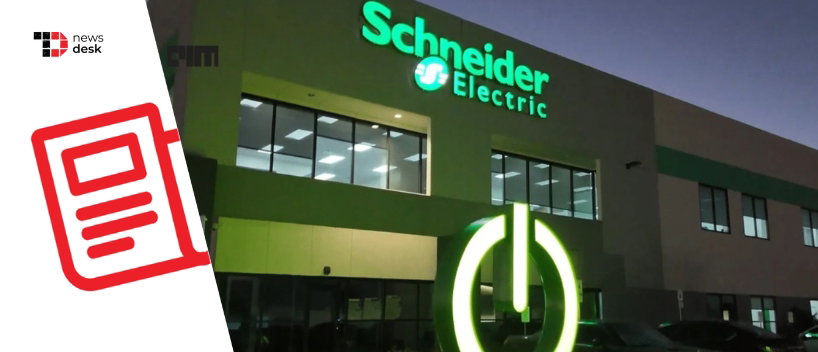
Schneider Electric expects its India data center business to grow faster than its broader local operations over the next four to five years, as AI workloads, cloud demand, and grid modernization push companies to invest in power, cooling, and energy management infrastructure.
TL;DR
- Schneider Electric’s India data center business now contributes 15% to 20% of its local business.
- The segment is growing at a double-digit pace and is expected to become a much larger share over time.
- India’s data center capacity could rise from 1.5 GW to 6 GW to 7 GW by 2030.
- AI-ready infrastructure, hyperscalers, colocation firms, and enterprises are driving demand.
Schneider Electric is leaning deeper into India’s data center opportunity, expecting the segment to outpace its overall business growth in the country over the next four to five years.
The growth is being driven by demand for AI-ready infrastructure, as companies need more reliable power, cooling, monitoring, and energy management systems to support high-compute workloads. Schneider Electric’s data center business currently makes up about 15% to 20% of its India business and is already growing at a double-digit pace.
Sumati Sahgal, Vice-President for Secure Power and Data Centres, Greater India Zone at Schneider Electric, told Reuters that data centers and grid modernization are among the company’s strongest growth drivers in India. The company expects the data center segment to account for a much larger share of its local business as demand expands across cloud, AI, enterprise IT, and colocation infrastructure.
India’s data center market is projected to reach $31.36 billion by 2035, growing at a compounded annual growth rate of 13.37%, according to Astute Analytica figures cited in the Reuters report. The country’s installed data center capacity is also expected to increase sharply from about 1.5 gigawatts today to 6 gigawatts to 7 gigawatts by 2030.
The momentum is not limited to traditional hubs such as Mumbai and Chennai. Reuters reported that investment is also moving into states including Gujarat and Rajasthan, signaling a broader geographic spread as companies look for power availability, land, connectivity, and lower operating constraints.
Topics For More Insights
For Schneider Electric, this plays directly into its portfolio. The company supplies critical data center infrastructure including UPS systems, switchgear, power distribution units, precision cooling, and energy management software. Much of this equipment is locally manufactured, making India not just a consumption market but also a manufacturing base for data center infrastructure.
The company’s official India data center solutions page also highlights cooling, power, software, pod and rack systems, lifecycle services, maintenance, and optimization as part of its AI data center portfolio, designed to support high-performance AI workloads.
The update comes as Schneider Electric continues to benefit globally from the AI data center wave. In April 2026, the company topped first-quarter revenue expectations, with Reuters reporting 11.2% organic growth and quarterly revenue of €9.77 billion, helped by demand for data center power equipment, racks, and advanced cooling systems.
Schneider Electric’s India push also aligns with broader AI infrastructure investment in the country. Microsoft, for instance, expects its largest India data center to go live in Hyderabad by mid-2026, as part of a major investment plan focused on AI and cloud demand.
The bigger signal is clear: India’s AI boom is moving beyond software and model development into physical infrastructure. For companies such as Schneider Electric, that means the opportunity now sits in the less visible but essential layer of AI growth, power stability, cooling efficiency, infrastructure management, and grid readiness.
