
OpenAI has introduced Prism, a new AI-powered workspace designed specifically for scientists and research teams, signaling the company’s push beyond general-purpose chatbots into domain-specific, high-stakes scientific workflows.
The product aims to unify data analysis, modeling, collaboration, and AI reasoning into a single environment.
Here's everything you need to know about Prism.
TL;DR
- OpenAI launched Prism, an AI workspace built for scientific research and collaboration.
- Prism combines large language models with data analysis, simulation support, and shared research contexts.
- The tool targets academic labs, biotech firms, and industrial R&D teams.
- OpenAI positions Prism as an augmentation layer rather than a replacement for scientists.
What Is Prism, And Why Did OpenAI Built It?
Prism represents a strategic shift for OpenAI, moving from horizontal AI tools like ChatGPT toward vertical products tailored for specific professional domains. Prism functions as a persistent research environment where scientists can upload datasets, run analyses, document hypotheses, and collaborate with colleagues while leveraging OpenAI’s latest reasoning models.
Unlike conventional AI assistants that operate in isolated chat sessions, Prism maintains long-term project memory. This allows research teams to track experimental assumptions, iterate on models, and revisit prior results without losing context.
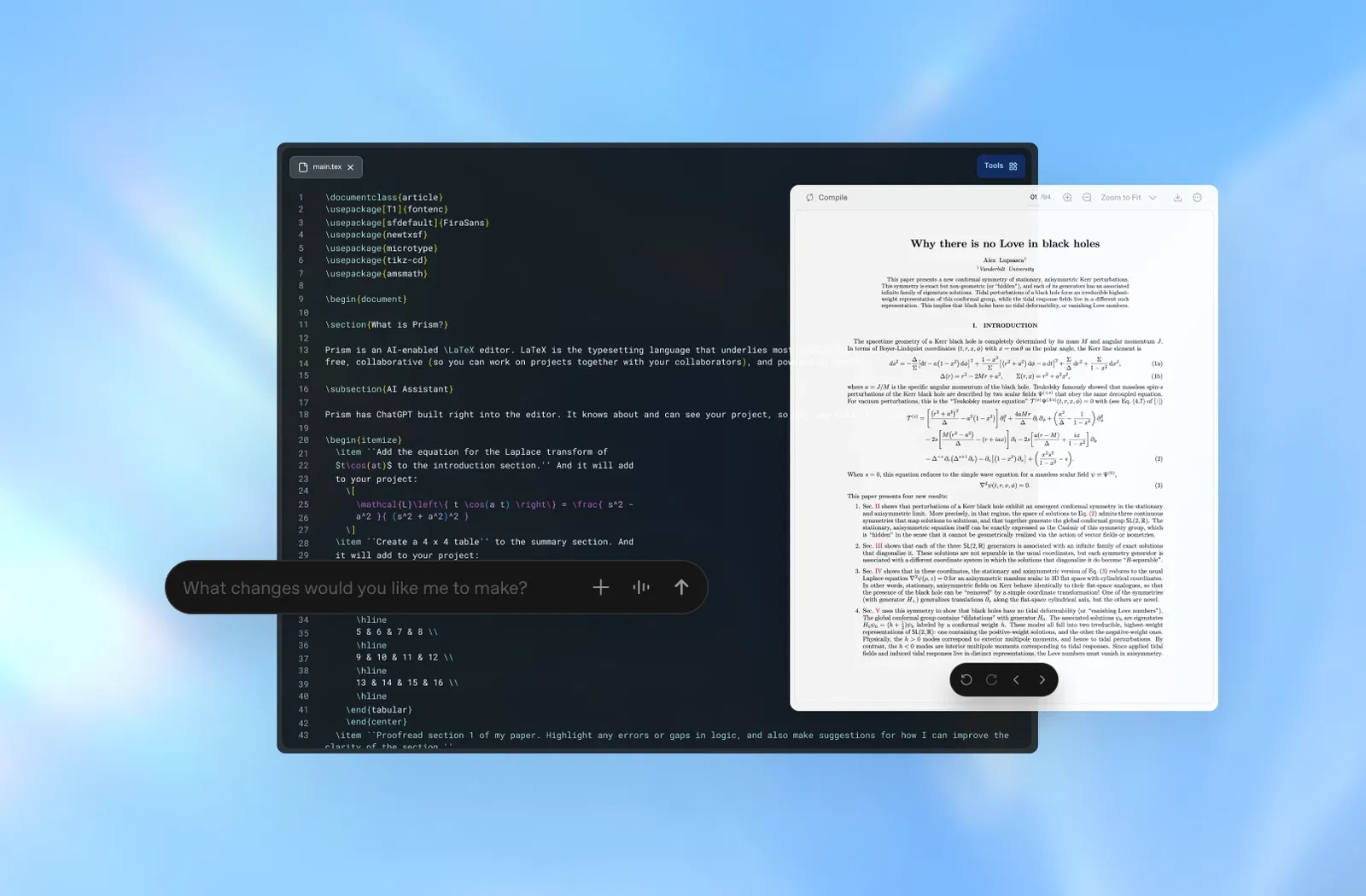
OpenAI says this structure is essential for scientific rigor, where reproducibility and traceability matter as much as speed.
“Scientific work is cumulative and collaborative by nature. Prism is built to reflect how real research happens, not as one-off prompts, but as ongoing investigations that evolve over time,” an OpenAI spokesperson said.
Core Capabilities And Research Workflows
From a capability standpoint, Prism integrates code execution, document analysis, and multimodal inputs. Researchers can work with structured data, lab notes, PDFs, and experimental images in a shared workspace.
OpenAI says Prism can assist with literature reviews, hypothesis generation, debugging simulation code, and summarizing experimental outcomes.
The emphasis is not on replacing domain expertise but on reducing overhead that slows scientific progress. By keeping data, discussion, and reasoning in one place, Prism aims to reduce context switching between notebooks, chat tools, version control systems, and documentation platforms.
Topics For More Insights
How Prism Fits Into The AI-For-Science Landscape
Industry observers see Prism as a response to growing competition in AI-for-science platforms. Companies such as Google DeepMind, Microsoft Research, and several startups have been developing AI systems for drug discovery, materials science, and climate modeling.
OpenAI’s approach relies on general-purpose reasoning models paired with a collaboration-first design rather than narrowly optimized scientific models.
“Researchers don’t just need smarter models; they need systems that fit into how labs actually operate. If Prism reduces friction between thinking, coding, and documenting, that’s a meaningful productivity gain,” said a computational biologist at a U.S. research university.
Human Oversight And Commercial Strategy
OpenAI stressed that Prism is designed as an augmentation tool, not a fully autonomous research system. The company says human oversight remains critical, particularly in validating results and interpreting findings.
Prism's commercial presence strengthens OpenAI’s enterprise and institutional footprint. While pricing has not been disclosed, Prism will be offered to research institutions and companies through dedicated plans, signaling a revenue-focused expansion beyond consumer AI tools.
Whether Prism becomes a standard fixture in scientific laboratories will depend on trust, accuracy, and its integration with existing workflows. Still, its launch highlights how AI vendors are increasingly building profession-specific tools rather than relying solely on general-purpose assistants.
