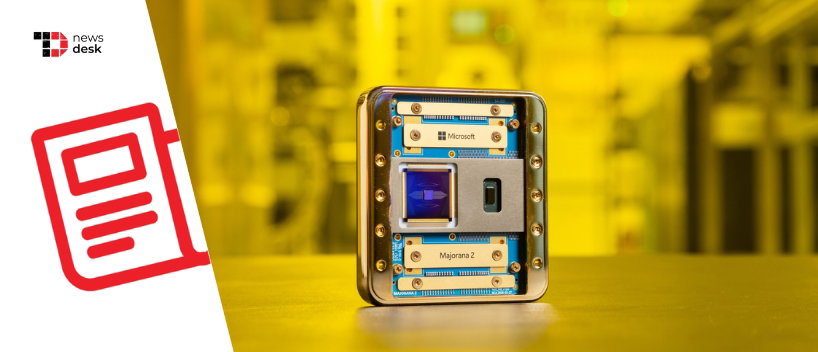
Microsoft has unveiled Majorana 2, its next-generation topological quantum chip, claiming a 1,000x improvement in qubit reliability and a faster roadmap to commercially useful quantum computing by 2029, with Microsoft Discovery’s agentic AI playing a major role in the breakthrough.
TL;DR
- Microsoft says Majorana 2 delivers a mean qubit lifetime of 20 seconds, with some instances lasting up to one minute.
- The chip replaces Majorana 1’s aluminum-based stack with lead-based materials.
- Microsoft Discovery helped optimize workflows, fabrication, measurements, and materials research.
- Microsoft now expects a scalable quantum computer by 2029, but outside experts still want stronger public validation.
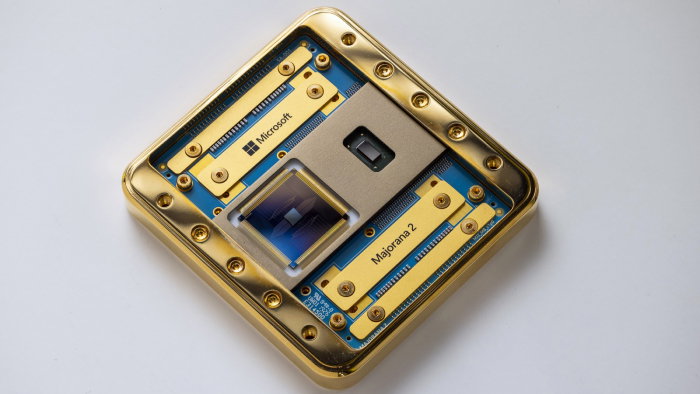
Microsoft has announced Majorana 2, a new topological quantum chip that it says brings the company closer to a practical, commercially useful quantum computer.
The chip follows last year’s Majorana 1 and improves one of quantum computing’s biggest challenges, reliability. According to Microsoft, Majorana 2’s new materials stack enables qubits that are 1,000 times more reliable than the previous generation, with a mean qubit lifetime of 20 seconds and some instances lasting as long as one minute.
Source
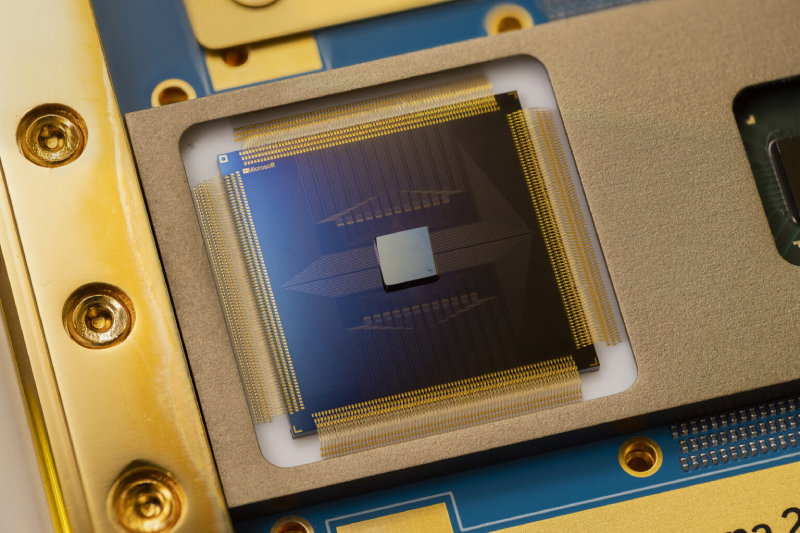
That is a major leap from the millisecond-scale lifetimes seen in Majorana 1. The Verge reported that Majorana 2 replaces aluminum with lead as the superconductor and updates the semiconductor active region to a combination of indium arsenide and indium arsenide antimonide.
The new chip also brings one-microsecond operations and qubits measuring around 1/100th of a millimeter, according to Microsoft. With this progress, the company now says it is targeting a scalable, commercially valuable quantum computer by 2029, cutting its original timeline in half.
“We’re 1,000 times better,” said Chetan Nayak, Microsoft Technical Fellow, while describing the progress from last year’s chip.
Where Microsoft Discovery Fits In
A major part of the story is Microsoft Discovery, the company’s agentic AI platform for frontier research and development. Microsoft says its quantum team used agentic AI to manage workflows, automate measurements, optimize fabrication, identify unnoticed flaws, and propose new solutions across the development process.
The platform is now generally available and allows researchers to deploy AI agent teams guided by human expertise. Microsoft says these agents can reason across large volumes of knowledge, generate hypotheses, validate theories, and learn through continuous loops, while staying within governance and security controls.
Microsoft also introduced an early preview of the Microsoft Discovery app, which offers local access to some core capabilities for individuals using a GitHub Copilot account. This makes the same approach used in the Majorana program more accessible to researchers and developers.
Source
Zulfi Alam, Corporate Vice President for Quantum at Microsoft, said the system keeps a “scientist in the loop,” emphasizing that AI provides guidance but does not make final research decisions.
Topics For More Insights
The Breakthrough Still Faces Scientific Scrutiny
However, the breakthrough is not without scrutiny. Reuters reported that physicists have criticized Microsoft for not releasing enough public data to verify some of its claims, while Microsoft says certain details remain confidential due to trade secrets and that it has shared data with DARPA.
Science News also noted that Microsoft’s new paper on the 20-second parity lifetime is a preprint and has not yet been peer reviewed. Some scientists praised the progress, while others argued that the data still does not fully prove the existence of a functioning topological qubit.
Still, if Microsoft’s claims hold up under further scientific scrutiny, Majorana 2 could mark a major step in quantum computing. More importantly, it shows how agentic AI may accelerate real-world scientific research, not just by writing code or summarizing documents, but by helping researchers discover, test, and refine new materials for next-generation computing.
