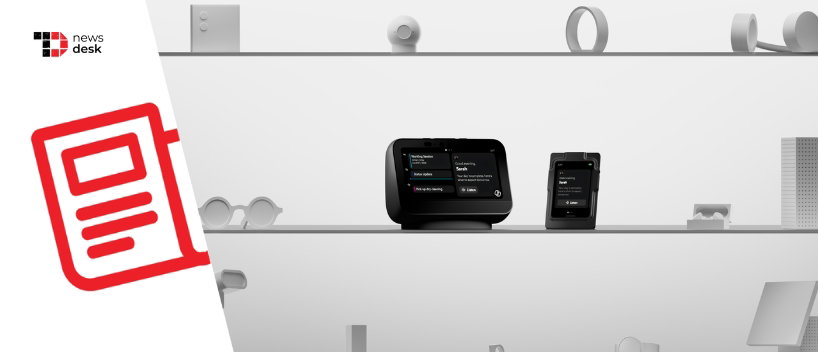
Microsoft has introduced Project Solara, a new chip-to-cloud platform designed to bring AI agents into enterprise-focused devices, moving beyond traditional apps, PCs, phones, and browsers toward purpose-built badge and desk concept hardware.
TL;DR
- Microsoft unveiled Project Solara at Build 2026.
- It is designed for agent-first devices rather than traditional apps.
- Qualcomm and MediaTek are the first silicon partners.
- Microsoft previewed badge and desk concept reference devices.
- AccuWeather, Best Buy, CVS Health, Levi’s, Target, and others are expected to join pilots.
Microsoft is looking to rewrite the rules of personal and workplace computing again.
At Build 2026, the company revealed Project Solara, a new platform designed for agent-first devices that place AI agents at the center of how users interact with computers. Instead of opening apps, switching windows, or navigating multiple tools, users would invoke agents that can understand intent, context, and workflow across devices.
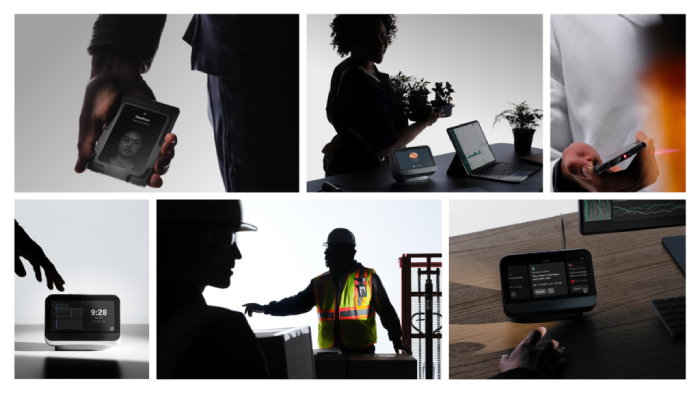
The platform is being positioned as a chip-to-cloud system, where the device acts as a lightweight access point while cloud services, including Azure and Microsoft 365 Copilot, help maintain state and intelligence across workflows. Microsoft says the goal is to bring AI into the places where work happens, not just into PCs, phones, or browsers.
“When the cost of specialization drops, innovation accelerates,” said Steven Bathiche, CVP and Technical Fellow, Applied Sciences Group, Microsoft.
What Is Project Solara?
Project Solara is designed around three pillars: enterprise readiness, an agent-driven interaction model with just-in-time UI, and extensibility for organizations to bring their own agents.
For enterprise use, Microsoft is building in manageability, security, privacy, identity, and user control. Device-side attributes include Microsoft Device Ecosystem Platform, Agent Shell, Microsoft Intune, Entra ID, Hello for Business biometric authentication, physical privacy controls, recording indicators, and approved chipsets with reference designs.
The platform also introduces just-in-time UI, where agent experiences can adapt across screen sizes, voice, touch, vision, and multimodal interfaces without developers having to rebuild everything for each new form factor. Microsoft says the current approach sits between traditional responsive interfaces and a future of more dynamic generative UI.
Topics For More Insights
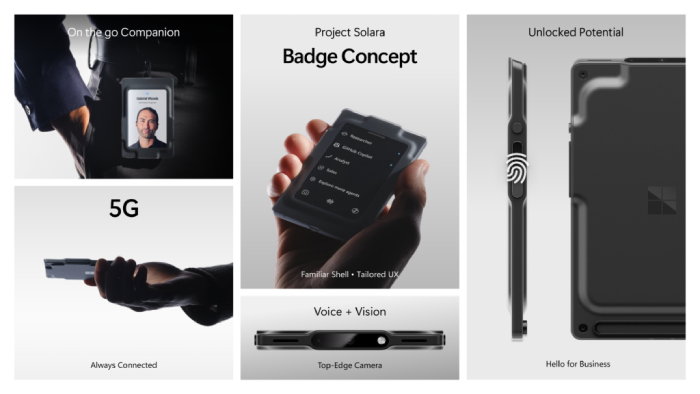
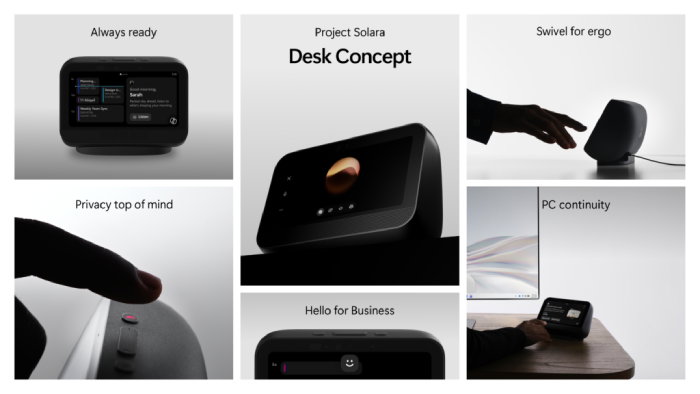
Microsoft previewed two broad concept categories: a portable badge device and an in-place desk device.
The badge concept reimagines an enterprise access badge as an always-connected AI companion. It includes a touchscreen, Hello for Business fingerprint sensor, privacy switch, volume controls, microphone array, speaker, side-facing camera, WiFi, Bluetooth, GNSS, 5G, and Qualcomm wearable silicon.
The desk concept is designed as a workplace companion with a touchscreen, face authentication, privacy lock buttons, microphone mute, volume controls, far-field microphones, speaker, UWB presence sensor, USB-C ports, WiFi, Bluetooth, and MediaTek IoT silicon. It can work as a standalone device, pair with a Windows PC, or become a Windows 365 client when connected to an external display.
The Verge reported that Microsoft does not plan to ship these two devices itself, as they are reference designs intended for hardware makers and partners to build into real products.
Who Is Microsoft Working With?
Qualcomm and MediaTek are the first silicon partners working with Microsoft on Project Solara.
“Microsoft’s Project Solara is an important step,” said Dino Bekis, Qualcomm Senior Vice President for Personal and Wearable AI.
Vince Hu, MediaTek Senior Vice President and General Manager, Data Center and Computing, said the platform will significantly accelerate agent-first experiences and devices.
Microsoft also said hundreds of employees are already using the concept devices internally, while AccuWeather, Best Buy, CVS Health, Levi’s, Target, and others are expected to join private pilots in the coming months.
Reuters described Project Solara as part of Microsoft’s broader Build 2026 push to move beyond apps and remake computing around autonomous AI agents. During the keynote, Microsoft CEO Satya Nadella said the goal is to let developers and enterprises imagine new form factors and make agents ubiquitous.
For Microsoft, Project Solara signals that the next phase of AI hardware may not be one universal device, but a network of specialized, enterprise-ready access points for agents across desks, hospitals, stores, factories, field work, and beyond.
.png?ext=.png)