Microsoft has made Microsoft Discovery generally available, turning its agentic AI platform for research and development into a production-ready offering. The company also introduced the Microsoft Discovery app in preview for researchers, students, academic labs, and scientific teams.
TL;DR
- Microsoft Discovery is now generally available for organizations.
- The platform helps teams build and govern agentic AI workflows for R&D.
- A new desktop app preview lowers the entry barrier for researchers and labs.
At Microsoft Build 2026, Microsoft announced the general availability of Microsoft Discovery, a platform designed to support scientific and engineering research workflows with agentic AI, governance, and transparency.
Source
The company said Discovery is built for R&D environments where teams need more than a prompt interface or a single model response. Instead, Microsoft is positioning it as a platform that connects institutional knowledge, domain expertise, modeling tools, simulation systems, experimental evidence, and review processes.
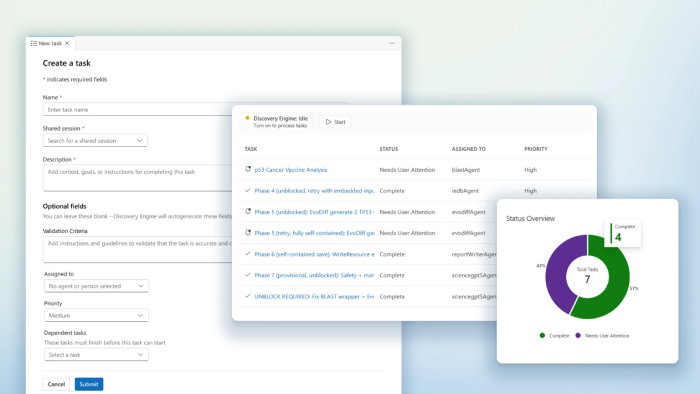
At the center of the platform is the Microsoft Discovery Engine. It supports the scientific workflow by helping teams move from evidence to hypotheses, then to execution, analysis, and further iteration.
This means researchers can use Discovery to compare tradeoffs, question assumptions, narrow large search spaces, and preserve reasoning paths in a way that can be reviewed and repeated.
Microsoft says the platform is designed to work inside existing research environments rather than replace them. This keeps human judgment central to scientific and engineering decisions, while helping organizations coordinate specialized AI agents across complex workflows.
Source
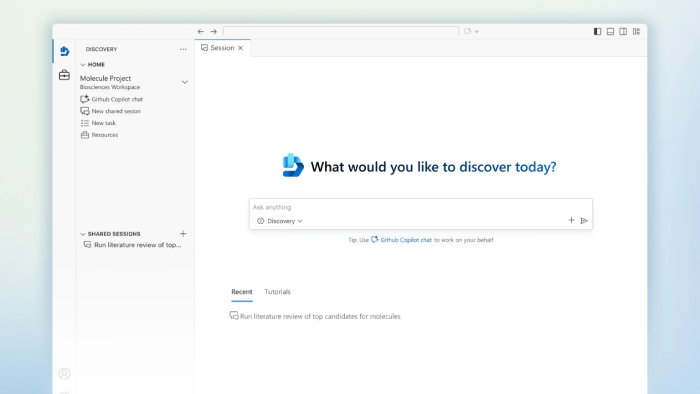
The newly announced Microsoft Discovery app, currently in preview, expands access beyond full enterprise deployments. It offers a local desktop experience for researchers, students, academic labs, and smaller scientific teams.
The app is available through Microsoft Discovery GitHub, and users can begin using it with a GitHub Copilot account. Microsoft says the preview is meant to support literature exploration, hypothesis generation, scientific reasoning, and iterative experimentation.
As projects become more complex, work developed locally in the app can be brought into the broader Microsoft Discovery platform for more advanced R&D programs.
Microsoft also highlighted several early use cases and partners. A collaboration involving Yale Engineering and Microsoft researchers used Discovery Engine to advance agentic small molecule design for grid-scale aqueous organic redox flow batteries.
Topics For More Insights
“This work introduces a powerful new framework for advancing battery science with AI,” said David Kwabi, Associate Professor at Yale. He added that combining human-led experimentation with AI’s ability to explore vast chemical design spaces is only the beginning of what such systems can do.
Source
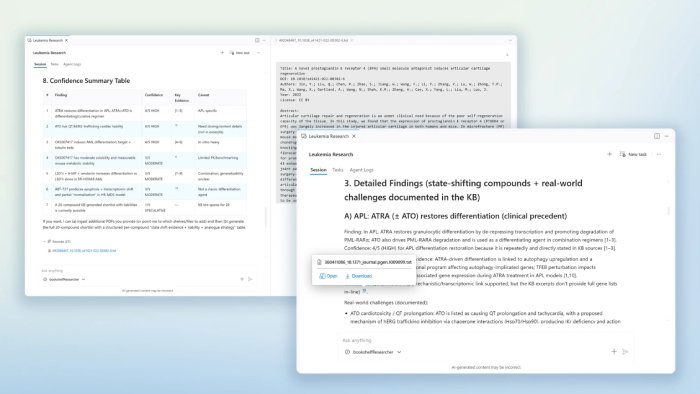
In life sciences, Ginkgo Bioworks and Microsoft are collaborating to bring agentic AI into biological discovery. Specialized agents can analyze datasets, generate hypotheses, and design experiments for autonomous labs.
“Together, agentic AI and autonomous labs will change every part of the scientific process,” said Jason Kelly, CEO of Ginkgo Bioworks, Inc. He said the approach could make iteration cycles faster, reduce manual lab time, and make computational analysis more systematic.
Wiley is also bringing its Wiley Research Agent: Life Sciences to the Microsoft Discovery platform. The agent provides access to a continuously updated index of more than one million authoritative life sciences articles with hybrid search capabilities.
Josh Jarrett, Senior Vice President and General Manager of Applied Research Intelligence at Wiley, said connecting trusted evidence with AI systems can help pharmaceutical and life sciences teams accelerate hypothesis generation, experimentation, and results interpretation.
The launch also comes as Microsoft uses Build 2026 to reinforce its wider AI-agent strategy across software, devices, cloud, and enterprise workflows. For Discovery, the core pitch is clear: agentic AI should not just help scientists search faster, but help them run more systematic, transparent, and repeatable R&D cycles.
