Artificial Intelligence
Microsoft Azure CTO Mark Russinovich Showcases Next-Generation AI Innovations Across Cloud, On-Premises, And Edge!
Updated on Thu, Jun 4, 2026
Share
TL;DR
- Microsoft launched new Azure infrastructure for AI workloads.
- Azure Boost delivers faster storage and networking performance.
- New Azure technologies also support massive AI GPU clusters.
During a recent Azure session on day 2 of Microsoft Build 2026, Microsoft Azure CTO, Mark Russinovich provided an overview of Microsoft's latest infrastructure innovations aimed at supporting the next generation of AI applications. He noted that some of the technologies discussed are still under development and may evolve before becoming generally available.
A major focus of the session was the company's approach to AI-driven infrastructure design. Russinovich highlighted Microsoft's Fairwater data centers in Atlanta and Wisconsin, emphasizing their scale and ongoing expansion. These facilities are equipped with extensive liquid-cooling systems and high-density cabling infrastructure designed to handle the demands of modern AI computing.
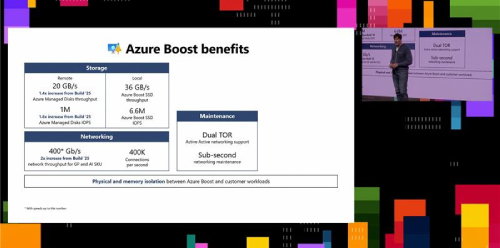
Microsoft also showcased Azure Boost, a specialized offload card that moves storage and networking data processing away from the main CPU. The technology combines DPUs, ARM cores, and FPGA-based acceleration to improve efficiency and free server processors for application workloads. According to Microsoft, the latest Azure Boost generation delivers up to 20 GB/s remote storage throughput, 1 million IOPS, and 400 Gbps networking performance.
The company has also introduced bare metal Azure instances, particularly for OpenAI workloads. These instances provide direct access to physical servers, eliminating virtualization overhead and enabling greater performance for demanding AI applications.
Topics For More Insights:
To support increasingly large GPU deployments, Microsoft has developed a new networking protocol called Multipath Reliable Connection (MRC). The protocol is designed to improve both resilience and performance across large-scale AI training environments where thousands of GPUs must communicate efficiently.
The announcements show Microsoft's ongoing efforts to strengthen Azure's foundation as AI workloads continue to grow in size, complexity, and infrastructure requirements.
First published on Thu, Jun 4, 2026

Enjoyed what you read? Great news – there’s a lot more to explore!
Dive into our content repository of the latest tech news, a diverse range of articles spanning introductory guides, product reviews, trends and more, along with engaging interviews, up-to-date AI blogs and hilarious tech memes!
Also explore our collection of branded insights via informative white papers, enlightening case studies, in-depth reports, educational videos and exciting events and webinars from leading global brands.
Head to the TechDogs homepage to Know Your World of technology today!
Disclaimer - Reference to any specific product, software or entity does not constitute an endorsement or recommendation by TechDogs nor should any data or content published be relied upon. The views expressed by TechDogs' members and guests are their own and their appearance on our site does not imply an endorsement of them or any entity they represent. Views and opinions expressed by TechDogs' Authors are those of the Authors and do not necessarily reflect the view of TechDogs or any of its officials. While we aim to provide valuable and helpful information, some content on TechDogs' site may not have been thoroughly reviewed for every detail or aspect. We encourage users to verify any information independently where necessary.
Loading comments...