Google I/O 2026 was dominated by artificial intelligence, with Gemini moving deeper into Search, Android, shopping, productivity, smart glasses, media creation, and communication tools. Rather than positioning AI as a separate feature, Google used the event to show how Gemini is becoming the connective layer across its entire product ecosystem.
This year’s announcements were not limited to new models. Google revealed faster Gemini models, multimodal AI tools, a redesigned Gemini app, AI-powered Search upgrades, Universal Cart for shopping, Gmail Live, Android XR glasses, Project Aura smart glasses, Google Beam, and expanded AI transparency tools.
TL;DR
- Google I/O 2026 brought major AI-focused announcements across Gemini, Search, shopping, productivity, XR hardware, communication, and content creation.
- The biggest reveals included Gemini 3.5 Flash, Gemini Omni, Gemini Spark, the redesigned Gemini app, AI-powered Search agents, Universal Cart, Gmail Live, Android XR glasses, Project Aura, Google Beam, and expanded SynthID and C2PA tools.
Gemini 3.5 Flash Becomes Google’s New AI Workhorse
One of the biggest announcements at Google I/O 2026 was Gemini 3.5 Flash, which Google positioned as a faster, more capable model for everyday AI use.
The model is designed to support a wide range of tasks, including coding, reasoning, agentic workflows, multimodal responses, and daily productivity. Google also made Gemini 3.5 Flash the default model inside the Gemini app, signaling that it wants users to interact with the newer model across consumer-facing products.
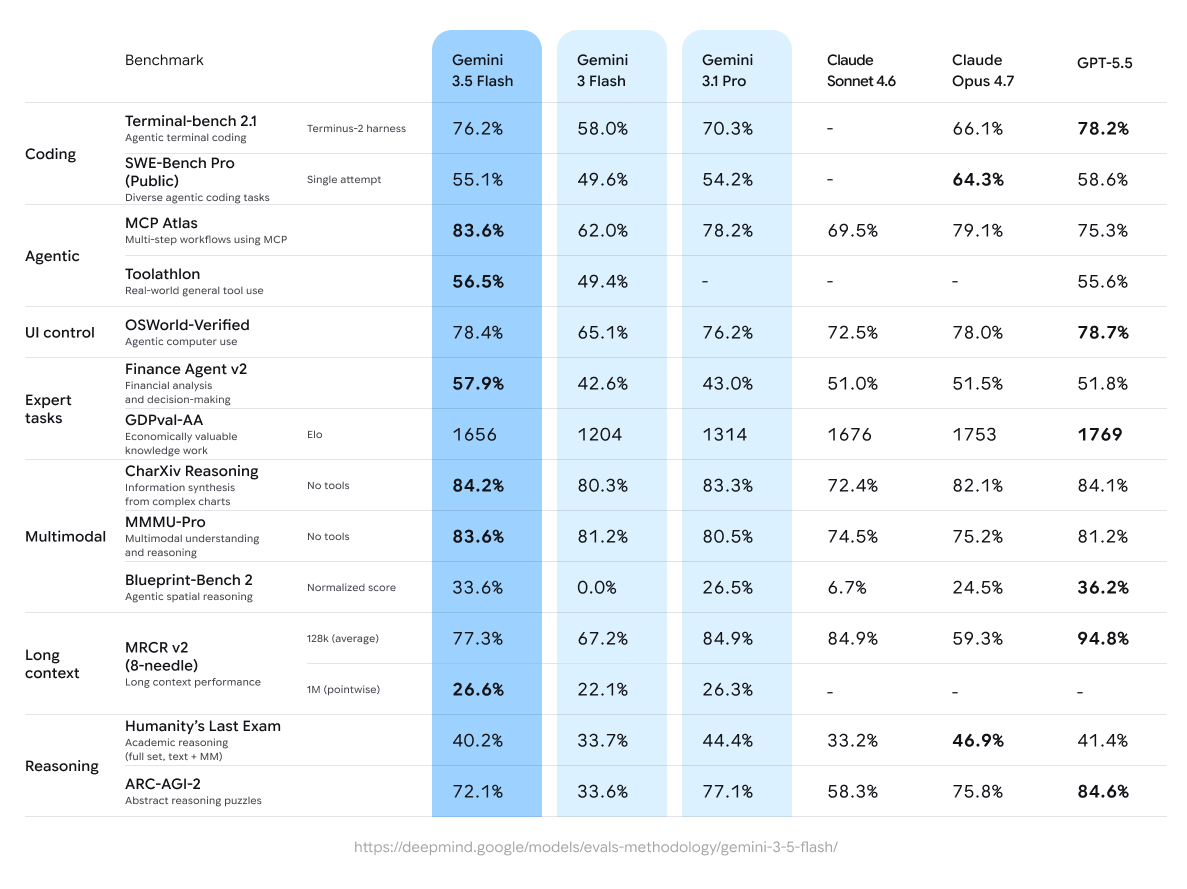
The launch matters because Google is not treating Gemini 3.5 Flash as just another model upgrade. It is being used as the foundation for several new AI experiences across Search, Gemini, developer tools, and cloud-backed products.
Gemini Omni Pushes Google Further Into Multimodal AI
Google also introduced Gemini Omni, beginning with Omni Flash, as part of its broader push into multimodal AI creation.
The model is designed to work across different types of inputs and outputs, starting with video. Google described this as a step toward letting users create and manipulate content using a mix of text, images, video, and other media formats.
This puts Google deeper into competition with companies building AI video and media generation tools. More importantly, it signals that Google wants Gemini to become useful not only for answering questions but also for creating content across multiple formats.
Gemini Spark Brings Personal AI Agents Into The Picture
Another major reveal was Gemini Spark, a personal AI agent designed to work across Google Workspace and third-party apps.

The idea is to make Gemini more proactive. Instead of simply responding to user prompts, Gemini Spark is meant to help organize information, understand user context, and complete tasks across connected apps.
This is important because it shows how Google is thinking about the next phase of AI assistants. The company is moving from chatbot-style interactions toward agents that can understand context, coordinate information, and help users act on it.
For everyday users, this could mean more automated planning, smarter task handling, better organization, and fewer manual steps across apps.
The Gemini App Gets A Major Redesign
Google also gave the Gemini app a major redesign at I/O 2026.
The updated app includes a new design language called Neural Expressive, with brighter visuals, improved animations, updated typography, haptic feedback, and a more prominent “Ask Gemini” bar. Google also added richer responses that can include images, timelines, videos, and more visual formats.
Gemini Live also gets more attention in the redesigned experience, making real-time, conversational interaction a larger part of the app.
The redesign matters because Google is trying to make Gemini feel less like a basic chatbot and more like a complete AI interface. As Gemini expands across Android, Search, Workspace, shopping, and XR devices, the standalone Gemini app becomes an important control point for users.
Google Search Gets More Agentic AI Features
Search was another major focus at Google I/O 2026.
Google showed how it is making Search more AI-driven, with improvements to AI Overviews and AI Mode. The company wants users to move more naturally between traditional search results, AI summaries, and conversational Search experiences.
More importantly, Google is turning Search into something more agentic. This means Search is being designed to help users complete tasks, not just find links.
For example, future Search experiences could help users compare products, build plans, generate interfaces, simulate ideas, and take action based on context. This marks a major shift from search as an information retrieval tool to search as an AI-powered action layer.
The change is significant because Search remains Google’s most important product. Any major AI upgrade to Search has a direct impact on users, publishers, advertisers, and businesses that depend on search visibility.
Universal Cart Brings AI-Powered Shopping Across Google
Google also introduced Universal Cart, one of the most consumer-friendly announcements from I/O 2026.
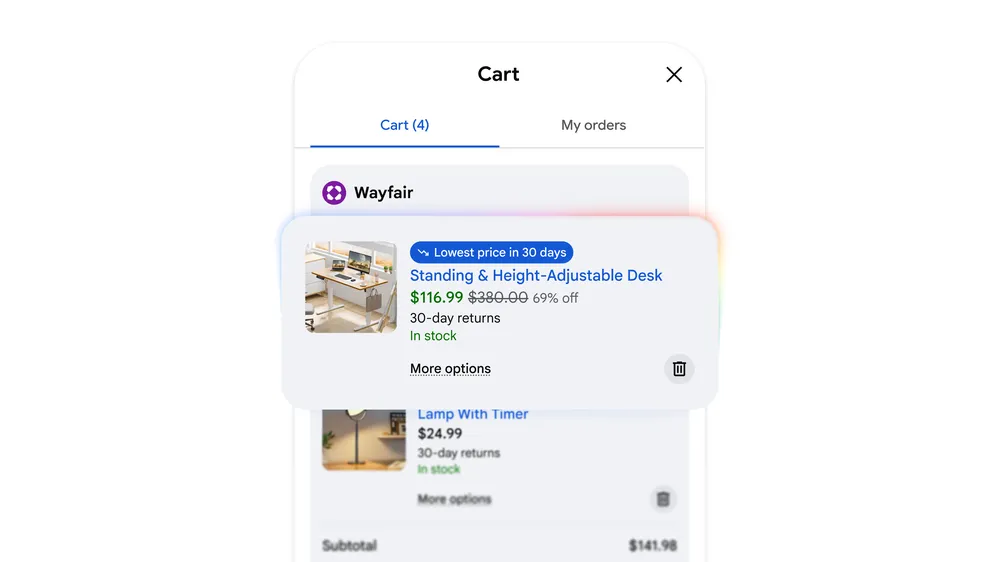
The feature allows users to add products from different retailers and Google surfaces, including Search and Gemini, into one shopping cart. Google can then help track prices, suggest discounts, check availability, show stock alerts, and flag possible purchase issues before checkout.
This is a major move for Google’s commerce strategy. Instead of limiting shopping experiences to search results or product listings, Google wants AI to guide users through the entire buying journey.
Universal Cart also fits neatly with Gemini’s broader role. If Gemini can help users research products, compare choices, monitor prices, and complete purchases, Google can turn AI-powered shopping into a more connected experience across Search, Gemini, and retail partners.
Gmail Live Brings Voice-Based AI To Email
Gmail also received a notable AI upgrade through Gmail Live.
The feature adds voice-based interaction to email, allowing users to search, understand, and act on messages through spoken commands. This is part of Google’s broader effort to bring Gemini deeper into Workspace and productivity apps.

The announcement matters because email remains one of the most common productivity pain points for users. People often spend large amounts of time searching through inboxes, summarizing threads, drafting replies, and organizing tasks.
With Gmail Live, Google is trying to make email more conversational and less manual. Instead of typing queries or scanning threads, users may be able to ask Gmail questions, get summaries, find context, and draft responses through voice.
Android XR Glasses Put Gemini On Users’ Faces
Google also used I/O 2026 to push its extended reality ambitions forward.
The company discussed Android XR glasses and showed how Gemini could become a key interface for wearable devices. These glasses are expected to support hands-free AI assistance, directions, messages, photo capture, contextual information, and real-time interactions.
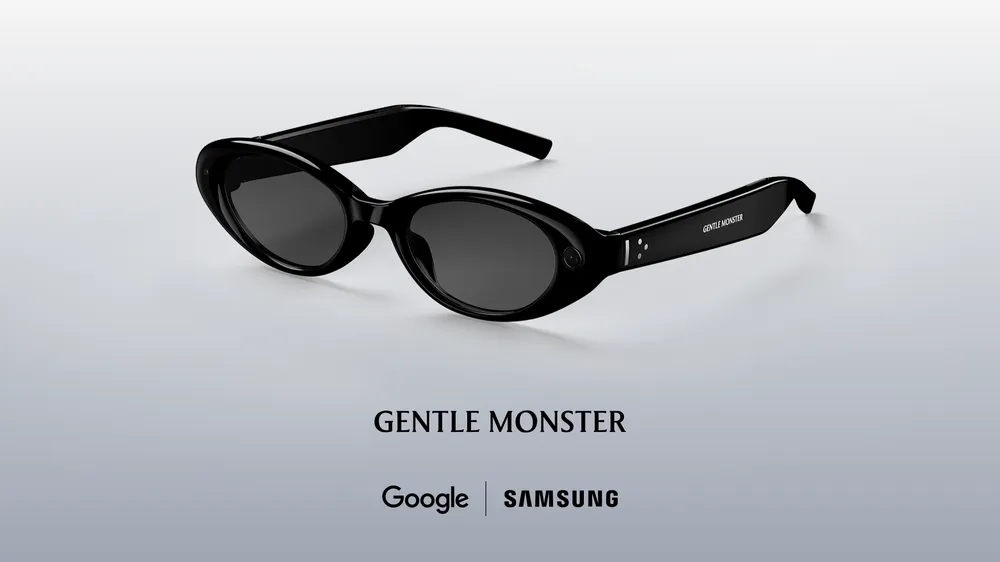
This announcement is important because it connects Gemini to the next generation of computing interfaces. Google is not only putting AI inside phones and apps but also positioning it for glasses and wearable displays.
Android XR also gives Google a platform-level role in the emerging smart glasses market. With partners such as Samsung and eyewear companies involved, Google appears to be building an ecosystem approach rather than relying on one device alone.
Project Aura Smart Glasses Expand Google’s Wearable AI Push
Project Aura smart glasses were another hardware-related highlight from Google I/O 2026.
Developed with Xreal, Project Aura is part of Google’s renewed interest in AI-powered eyewear. The glasses are expected to focus on lightweight, everyday AI use cases rather than heavy mixed reality experiences.
This could include hands-free answers, translations, navigation, notifications, image capture, and contextual support powered by Gemini.
The timing is important. Meta has been aggressively expanding its AI glasses lineup with Ray-Ban and Oakley, while other companies are also experimenting with wearable AI devices. Google’s Project Aura announcement shows it does not want to be left behind as AI wearables become a more serious product category.
Google Beam And AI Transparency Tools Round Out The Event
Google Beam also returned to the spotlight at I/O 2026 as part of the company’s AI-powered communication push.

The technology focuses on more lifelike remote communication, using AI to improve video presence and interaction. It reflects Google’s larger interest in making virtual communication feel more natural, especially as AI becomes more integrated into workplace and personal interactions.
Google also expanded its AI transparency work through SynthID and C2PA-related tools. These tools are designed to help identify AI-generated or AI-edited content, giving users more information about how digital media was created.
This is becoming increasingly important as AI-generated images, videos, and synthetic media become more realistic. For platforms, publishers, creators, and businesses, provenance and verification tools will be essential for maintaining trust.
Takeaway From Google I/O 2026
The biggest takeaway from Google I/O 2026 is that Gemini is no longer being treated as a standalone AI assistant.
Google is turning Gemini into a system-wide intelligence layer across Search, Android, Workspace, shopping, smart glasses, communication, and content creation. The company wants AI to help users search, shop, write, create, communicate, organize, and act across its ecosystem.
The event also showed that Google is thinking beyond chatbot competition. With Gemini 3.5 Flash, Gemini Omni, Gemini Spark, Universal Cart, Android XR, Project Aura, and Google Beam, the company is trying to make AI more ambient, proactive, and action-oriented.
For users, this could mean more personalized and useful AI experiences across Google products. For developers, businesses, and publishers, it also means adapting to a Google ecosystem where AI increasingly mediates discovery, productivity, commerce, and content.
