Data Management
Why Everyone Is Talking About Data Centers In Space
Share
TL;DR
-
Space data centers put servers, storage, and networking gear inside satellites or orbital modules.
-
AI demand is growing fast, and Earth-based data centers are becoming harder to power and cool at scale.
-
Some orbits offer long solar exposure, and space cooling can rely on radiating heat instead of water-heavy systems on Earth.
-
Launch costs, radiation, limited repairs, bandwidth limits, debris, and orbit governance are major blockers.
-
Near-term progress is likely to be targeted in-space processing, not hyperscale cloud infrastructure in orbit.
Introduction
“Space: the final frontier.” If you grew up on Star Trek, you know that line was never really about tourism. It was about infrastructure, the systems that make big leaps possible.
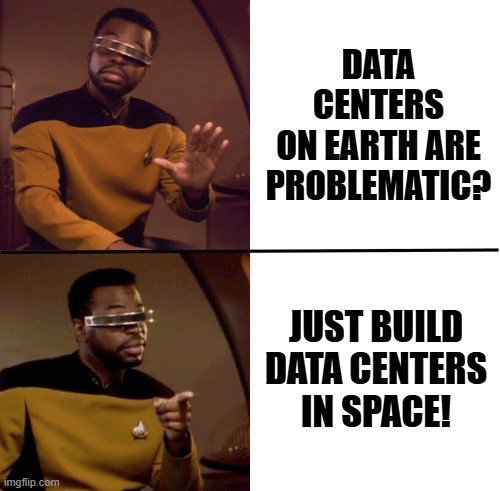
Artificial Intelligence has created a very Earth-bound infrastructure problem: data centers are hitting hard limits around power availability, cooling, land, permitting timelines, and community tolerance. The more AI workloads scale, the more these facilities behave like industrial projects.
That is why people are suddenly talking about putting data centers in space. It is not because someone wants to move the entire internet into orbit next year, but because some workloads make more sense closer to where data is generated, especially space-generated data like Earth observation and satellite feeds. Process it in orbit, send down the insights, and reduce the downlink burden.
So what exactly counts as a space data center, who’s testing it, and what are the real blockers that keep this from being more than a headline? Let’s break it down.
Why Earth-Based Data Centers Are Becoming A Problem
AI has changed the scale and intensity of what data centers have to support. Facilities are getting bigger, denser, and harder to expand, and the constraints aren’t theoretical anymore. The bottlenecks show up in power availability, cooling capacity, land, permitting timelines, and community resistance, all at once.
Compute Growth
Modern AI workloads push heavy, always-on demand into GPU clusters, along with the networking and storage needed to keep them fed. That means more heat per square foot, more power draw per rack, and less room for good infrastructure planning.
Power
Electricity is now the critical path. In many markets, grid connection lead times and substation capacity are slowing projects. This makes energy access a competitive advantage.
Cooling And Water Usage
Cooling is where the resource conversation gets political. Large facilities can consume significant water for cooling, and even when operators use different methods, public perception often stays the same: data centers are competing users for local needs.
Land And Permits
Land is not the issue by itself, but land with the right power, connectivity, and approval is scarce. Add zoning constraints, environmental reviews, and neighborhood resistance, and even well-funded projects can stall.
When the constraints stack up like this, it’s not surprising that the industry starts looking for outs. That’s where the data centers in space conversation come in. Before we judge whether it’s genius or hype, we need to define what a space data center actually is.
What Exactly Is A Space Data Center?
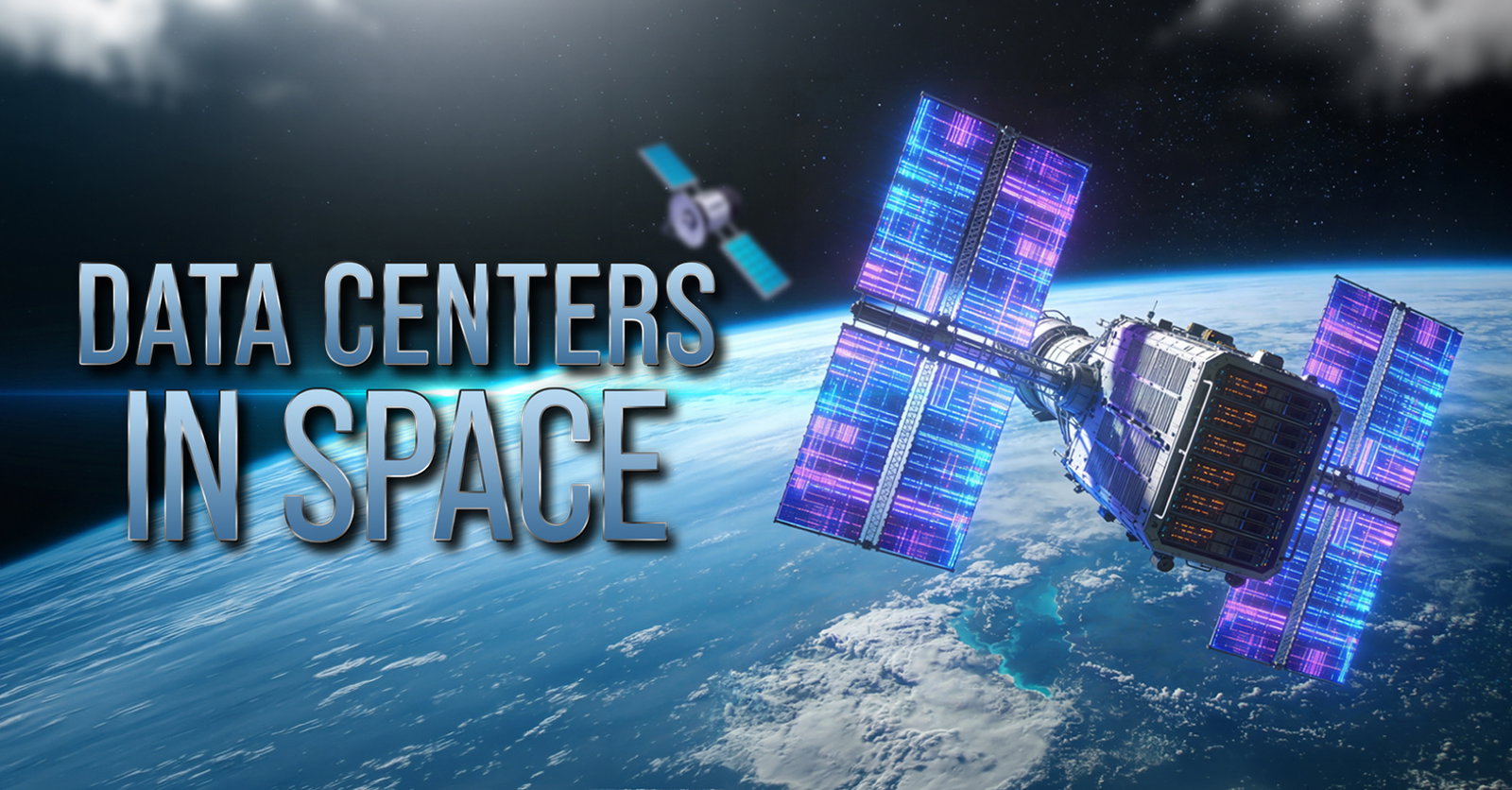
A space data center is servers, storage, and networking gear deployed in space, usually inside a satellite or an orbital module, to run computing workloads off planet. The core idea is to process data closer to where it’s created, then send only the useful output back to Earth instead of downlinking everything.
Most near-term concepts focus on low Earth orbit (LEO) because it’s cheaper to reach and can maintain faster links back to Earth than higher orbits. LEO also supports practical early use cases like processing Earth observation imagery, satellite sensor data, and other space-generated feeds in orbit.
In terms of form factor, these projects usually look like one of three things: compute satellites designed to run specific workloads, modular platforms that scale by adding more units, or in-orbit processing systems built mainly to filter and analyze space data before it’s sent back down.
So why would anyone take on the cost and complexity of orbit in the first place? Because on Earth, power, water, land, and approvals are getting tighter, and space offers a few advantages that look tempting on paper.

Why Space Suddenly Looks Attractive
If putting servers in orbit sounds like an overreaction, the reasons are simple. Earth-based constraints are tightening, while AI demand keeps climbing. Space looks like an escape hatch from the land, water, and local grid fights.
-
Long Solar Exposure
Power is one of the biggest reasons this idea keeps resurfacing. Certain orbital paths can provide long periods of sunlight, where nights, clouds, and grid limits complicate supply. It’s not unlimited energy, but it can be predictable enough to plan around.
-
Cooling
On Earth, cooling often means heavy HVAC systems and, in many cases, significant water usage. In space, you can’t use airflow-based cooling the same way, but you can dump heat by radiating it away through large radiators.
-
Land, Permits, And Local Politics
Space-based compute does not require buying contested land near cities or waiting for local approvals. In theory, moving some compute off-planet reduces the pressure on Earth-side power and cooling infrastructure.
-
Processing Space Data
Before anyone talks about cloud in orbit, the most practical use case is processing data that’s already generated in space. If you can filter, compress, or analyze that data in orbit, you downlink less, make faster decisions, and reduce bandwidth bottlenecks.
Space can sidestep some Earth constraints, but it replaces them with a different set of hard problems. Launch costs, repairs, radiation, bandwidth, and debris risk are the realities that decide whether this stays a concept or becomes infrastructure.
The Biggest Challenges Of Putting Data Centers In Space
Space solves a few Earth-side headaches, but it creates a new set of constraints. On Earth, you can truck in replacement parts. In orbit, every kilogram costs money to launch.
-
Launch Costs
Data centers are heavy by nature. Compute hardware, power systems, shielding, radiators, and communications equipment quickly turn into serious launch mass, and launch mass drives cost.
-
Repairs
In a terrestrial data center, hardware failures are routine and fixable. In orbit, servicing is rare and complicated, so systems need more redundancy and may be designed for shorter lifetimes.
-
Radiation And Durability Risks
Space radiation can degrade electronics and corrupt data over time. Protecting against it often means shielding, error correction, redundancy, and conservative design choices, all of which increase mass and cost.
-
Bandwidth And Data Movement
Hyperscale AI depends on moving massive volumes of data. Orbital compute can be powerful, but without high-throughput, reliable links to Earth and between satellites, it risks everything.
-
Space Debris And Governance
Orbits are already crowded. More platforms increase collision risk, which increases debris. Beyond safety, there are governance constraints: traffic management, frequency coordination, and rules for what happens when systems fail or deorbit.
With that many blockers, it’s fair to ask if this is all just a headline. However, there is enough movement, prototypes, and filings to make it real. Here’s who’s actually working on space data centers right now, and what stage their efforts are in.
Who’s Actually Working On Space Data Centers Right Now?
Right now, there are prototypes, regulatory filings, and long-horizon plans. Some efforts are real hardware tests in orbit. Others are concepts being positioned for regulators and investors.
SpaceX
SpaceX hasn’t deployed a space data center yet, but it sits at the center of the conversation because it controls launch economics and operates Starlink satellite infrastructure. The company has also filed with the U.S. FCC seeking authority tied to an NGSO system described as an “Orbital Data Center” concept.
Google’s Project Suncatcher
Google’s Project Suncatcher is framed as a prototype-oriented approach: a LEO system that explores how a network of solar-powered satellites could run machine learning workloads in orbit.
Starcloud
Starcloud-1 launched in November 2025, carrying an NVIDIA H100, positioned as an orbital test of advanced AI compute. This in-orbit GPU demo is the clearest example of an active LEO data center we have at the moment. The company has also shared aggressive cost and timeline targets.
Kepler Communications And Sophia Space
Kepler has positioned itself around in-orbit compute and connectivity, describing a compute cluster in orbit linked via optical communications. Sophia Space appears in this ecosystem as a customer planning on Kepler’s network before launching its own hardware later.
Orbital And NVIDIA
Orbital is framing its approach around space-based AI infrastructure designed for inference first, with a test mission planned in the 2027 timeframe. NVIDIA has also signaled explicit intent to support space computing as a category.
A lot of this activity proves the concept is technically possible in pieces. The bigger question is whether it can ever make economic sense at scale. So, could space data centers actually be profitable, or is this destined to remain a niche?
Could Space Data Centers Actually Be Profitable?
They can be profitable, but only under a narrow set of conditions, and most of those conditions are not guaranteed yet. The economics are brutal because everything that makes a data center work on Earth become heavier and more expensive in orbit.
Even if you save on land, permits, and some Earth-side cooling water, you replace those costs with new ones: large radiators to dump heat, orbital power systems, redundancy for failures you can’t fix easily. That combination can crush ROI unless the workload is valuable enough to justify the premium.
That’s why the most realistic near-term business case is not hyperscale AI training in orbit. It’s smaller, targeted use: processing data that is generated in space, filtering it in orbit, and downlinking only the insights.
If that reduces bandwidth costs, speeds decisions, or enables services that are hard to deliver from Earth, the model can work.
Topics For More Insights
Conclusion
Everyone is talking about data centers in space because AI’s insatiable thirst for land, water, and land is driving environmental concerns up, and apparently, the sky is the limit. Moving its compute requirements off planet seems like a way to sidestep those fights, especially in orbits with long solar exposure.
While space removes some of these problems, it also introduces new ones. Cooling is not like what it appears; radiation is relentless, bandwidth is not infinite, servicing is hard, and crowded orbits add risk that no single company can manage alone.
If we can solve these constraints, space-based AI data centers might be a genuine reality. However, in the best case, it remains a longer bet that depends on significant economic and operational advancements.
So, if you’re wondering why data centers are moving to space, now you know!
Frequently Asked Questions
Are Space Data Centers Real Today Or Just An Idea?
They’re early-stage, but real in the sense that projects are testing hardware and communications in orbit. What’s not proven yet is operating data center-scale platforms with sustained power, cooling, and bandwidth at anything close to terrestrial hyperscale economics. Near-term progress is more likely to look like small, modular platforms proving specific use cases. We’re most likely to see meaningful deployments in the mid-2030s.
Would Putting Data Centers In Space Solve Cooling And Water Use On Earth?
It could reduce Earth-side water demand, but it does not make cooling “easy.” In space, you cannot use convection the way you do on Earth, so large systems must dump heat through radiation, which becomes a major engineering constraint at scale.
Why Does Low Earth Orbit Come Up So Often?
Most proposals focus on LEO because it is cheaper to reach than higher orbits and can provide faster communications with Earth. Some LEO options, like sun-synchronous orbits, are also discussed because they can offer long solar exposure for power generation.
Thu, Apr 30, 2026

Liked what you read? That’s only the tip of the tech iceberg!
Explore our vast collection of tech articles including introductory guides, product reviews, trends and more, stay up to date with the latest news, relish thought-provoking interviews and the hottest AI blogs, and tickle your funny bone with hilarious tech memes!
Plus, get access to branded insights from industry-leading global brands through informative white papers, engaging case studies, in-depth reports, enlightening videos and exciting events and webinars.
Dive into TechDogs' treasure trove today and Know Your World of technology like never before!
Disclaimer - Reference to any specific product, software or entity does not constitute an endorsement or recommendation by TechDogs nor should any data or content published be relied upon. The views expressed by TechDogs' members and guests are their own and their appearance on our site does not imply an endorsement of them or any entity they represent. Views and opinions expressed by TechDogs' Authors are those of the Authors and do not necessarily reflect the view of TechDogs or any of its officials. While we aim to provide valuable and helpful information, some content on TechDogs' site may not have been thoroughly reviewed for every detail or aspect. We encourage users to verify any information independently where necessary.
Loading comments...