Manufacturing Technology
Waymo Vs. Tesla: Comparing The Best Autonomous Vehicle Technology
Share
Introduction
Have you ever considered becoming one?
From old coins to rare editions, coin collectors love exhibiting their collection in frames or albums. Yet these coins don't match the rare phenomenon of a double-sided coin, i.e., both sides feature the same side.
In fact, the common belief is that such minting errors are almost nonexistent, and such coins are 99.9% likely to be used by magicians or novelty items.
In the end, the point is that coins almost always have 2 sides: heads and tails. This also gives rise to the idiom "two sides of the same coin," which describes "two seemingly different, contrasting, or opposite aspects that are actually closely related components of the same, single situation or idea."
A perfect example of this idiom is Waymo vs. Tesla, where the consideration is the autonomous technologies used by both.
See, both automakers produce self-driving vehicles (vehicles that don't need human drivers), but they employ different technologies to enable this capability. Furthermore, both offer robotaxi services, with vastly different service areas.
The billion-dollar question: which has the best autonomous vehicle technology?
TL;DR
-
Waymo uses cameras, lidar, radar, and audio sensors for 360-degree perception.
-
Tesla relies primarily on cameras supported by ultrasonic sensors.
-
Waymo operates at Level 4 autonomy in mapped areas.
-
Tesla currently operates at Level 2 with driver supervision.
-
Waymo emphasizes sensor redundancy and controlled deployment.
-
Tesla focuses on data scale and rapid AI iteration.
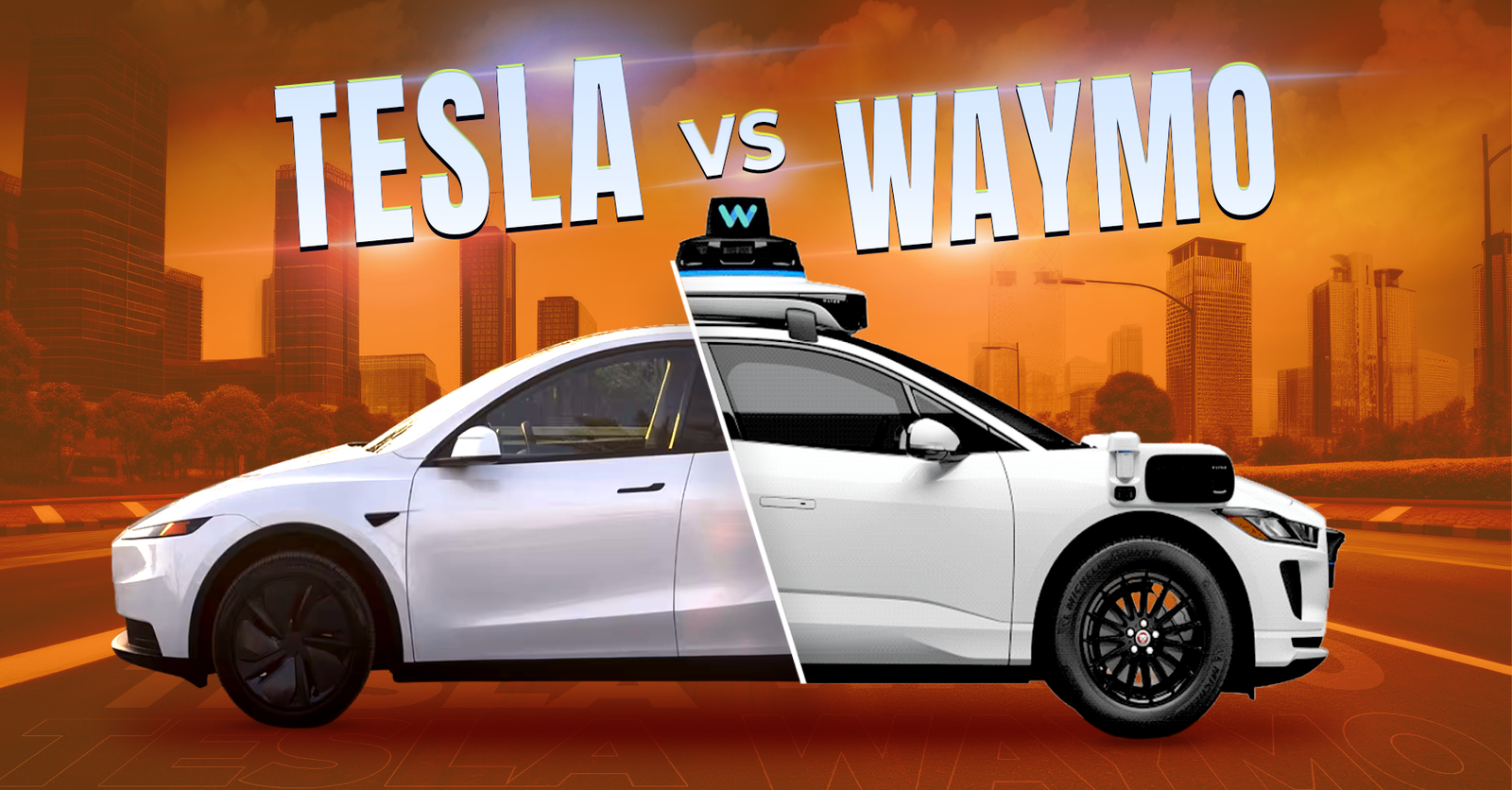
Waymo Vs. Tesla: Who Has The Best Autonomous Vehicle Technology?
Let's break this down in simple terms:
Google parent Alphabet-owned Waymo uses a combination of cameras, lidar (Light Detection and Ranging), and radar (Radio Detection and Ranging).
Tesla relies solely on cameras to power the Tesla FSD (Full Self-Driving) platform. These are supported by ultrasonic sensors.
This is as far as hardware is concerned. Both companies use artificial intelligence (AI), machine learning (ML), and neural network algorithms to enable autonomous driving on the road. However, these algorithms vary because their hardware setups differ.
So, the question now is: who has the best sensor setup, and who's got the upper hand in algorithms?
Sensor Set Up
Waymo's 5th-generation autonomous Jaguar I-PACE vehicles feature 29 cameras, 6 radars, and 5 lidars distributed around the vehicle, all working together to provide 360-degree perception.
The newer 6th-generation setup reduced this to 13 cameras, 6 radars, and 4 lidar units. The setup is built on seven years of safety-proven service across nearly 200 million miles.
When it comes to cameras, Waymo uses high-resolution, long-range, color, telephoto-lens cameras to detect objects far ahead on the road; wide-angle cameras to detect close objects, such as people, intersections, road signs, and cyclists; and near-infrared cameras for night vision or low-light perception. Its cameras can identify important details, such as pedestrians and stop signs, at distances of more than 500 meters.
Waymo says its vision system "goes far beyond the capabilities of human sight or standard automotive cameras," as it "operates with a level of awareness no person can match."
Waymo uses proprietary lidar sensors called "Laser Bear Honeycomb." Two are placed on the side, one in the front, and one at the back of the vehicle. These are short-range, solid-state lidars that are good for blind spots, which is why it's also mounted a mechanical lidar sensor on the roof, which can see up to 300 meters ahead.
If you're wondering what lidar is used for, it paints a 3D picture of the surroundings around the vehicle and far ahead by using laser beams. Fun fact, it's also known as a point cloud image.
Adding to this is Waymo's radar, which creates dense, temporal maps that instantly track the distance, velocity, and size of objects in all lighting and weather conditions. It helps the vehicle ride safely in tough weather conditions, including rain, fog, and snow.
Waymo vehicles also use numerous external audio receivers (EARs) to detect important sounds on the road and respond appropriately. These sounds include approaching emergency vehicles, railroad crossings, and more.
Tesla opts for a clean-shaven look and relies solely on cameras.
It has no excess protrusions to enable its self-driving capabilities.
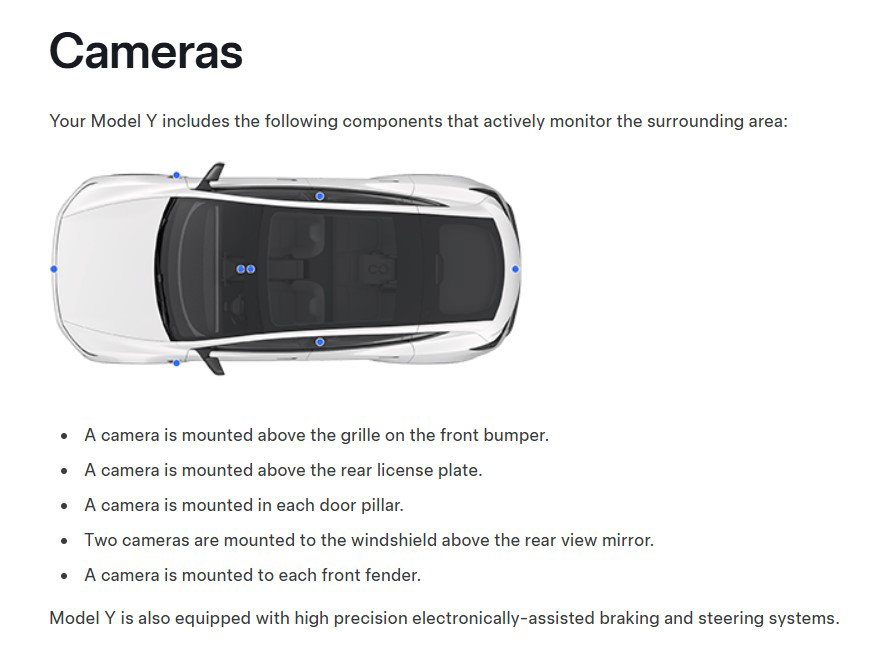
It comes with 8 cameras located around the vehicle. As per Tesla, one camera is mounted above the rear license plate; one is mounted in each door pillar; two are mounted on the windshield above the rear-view mirror; one is mounted on each front fender; and one is mounted above the grille on the front bumper.
The camera locations vary depending on the model.
The company plans to use the same design for the Tesla robotaxi. It offers autonomous rides for Tesla fans in Austin, Texas, without a human safety driver.
Tesla also uses 12 ultrasonic sensors to assist the vehicle with close-range movement and parking.
It's long been Tesla CEO Elon Musk's belief that lidar and radar reduce safety when they produce conflicting results.
"Lidar and radar reduce safety due to sensor contention," said Musk through a post on X. "If lidars/radars disagree with cameras, which one wins? This sensor ambiguity causes increased, not decreased, risk. That's why Waymos can't drive on highways. We turned off the radars in Teslas to increase safety. Cameras ftw [for the win]."
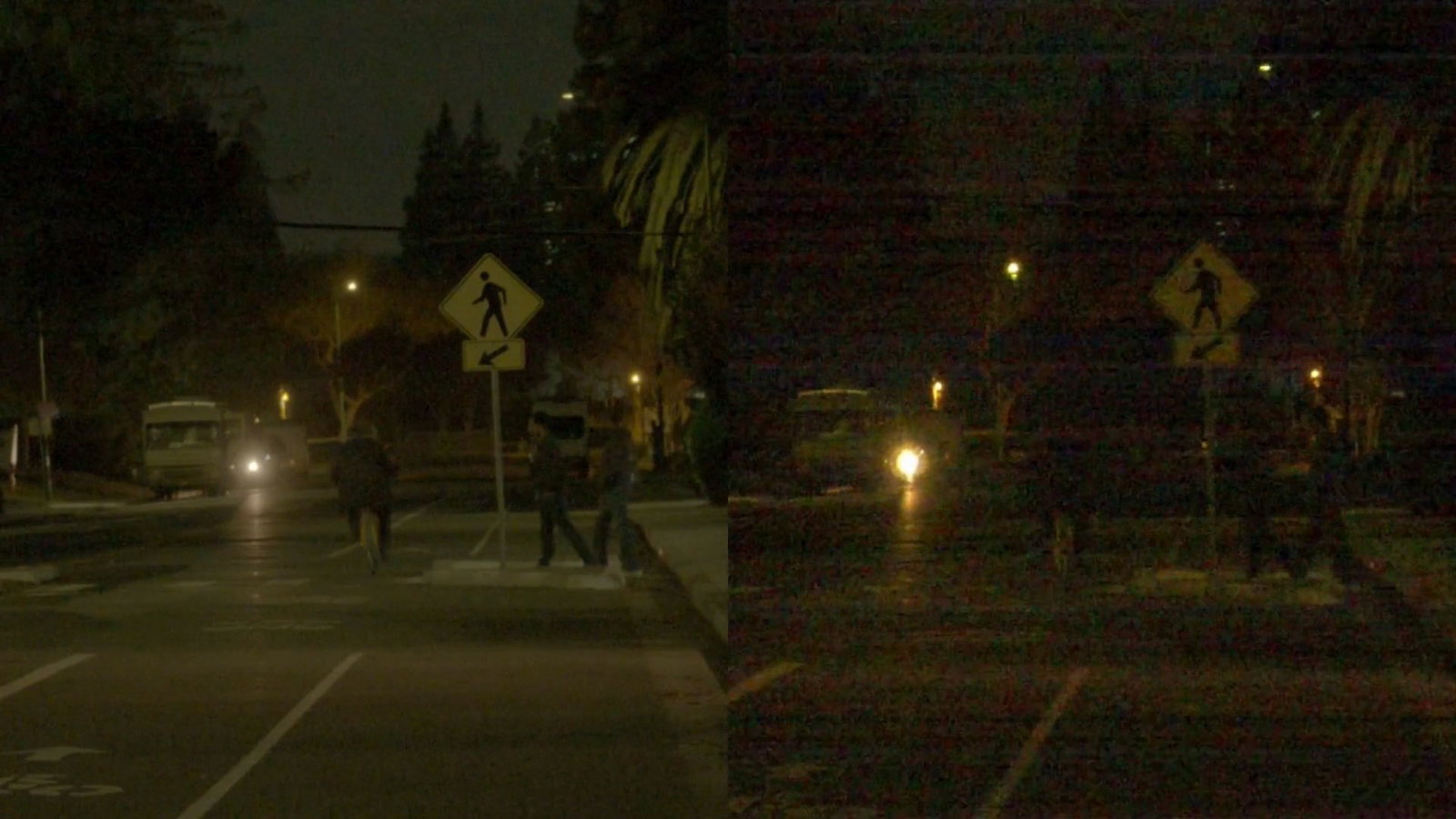
There is, however, a counterargument that cameras face limitations in bad weather, especially rain, snow, or fog. It also can't perform in storms or when it's sleet. This is where the lidar-radar partnership benefits self-driving vehicles. In case the lidar misses something, the radar will pick it up.
For example, a YouTuber pitted a Tesla against a lidar-equipped car on a road with a wall that resembled a street.
Spoiler alert: the Tesla drove right through the wall with no remorse for the driver, car, or anything else, but the lidar-equipped car stopped.
Algorithm
Waymo's approach to algorithms is built around a 3D-first philosophy.
Since its vehicles rely heavily on lidar, radar, and cameras together, its software is designed to process detailed 3D point clouds and combine inputs from multiple sensors.
Over the years, the company has worked to detect objects directly from 3D lidar data. In recent years, Waymo has moved towards learning-based planning systems, gradually incorporating end-to-end components into its stack.
Waymo relies on advanced neural networks and controlled reliability, operating in defined areas, validates extensively, and updates its system with a clear safety case tied to specific cities and conditions, prioritizing consistent real-world performance.
Meanwhile, Tesla's algorithm strategy is centered on data scale and rapid iteration.
With millions of vehicles on the road, Tesla collects vast amounts of real-world driving data that directly feed into the training and improvement of its neural networks. Its system evolved from multitask perception networks that handle lanes, objects, and signals simultaneously to richer 3D scene understanding using occupancy-based models.
Tesla is also pushing more of its stack toward end-to-end learning, allowing its neural networks to handle perception and planning together and enabling smoother, more human-like driving behavior. Its biggest strength lies in its feedback loop, which captures, analyzes, and uses edge cases from real drivers to retrain the system continuously.
However, in the end, it still relies on cameras that can face challenges in poor visibility.
Topics For More Insights
What's The Verdict?
Essentially, both come with positives and negatives. The excess equipment on a Waymo is costly to manufacture and maintain. Plus, it's bulky and protrudes prominently. However, it offers clear benefits in terms of enhanced safety, even in tough weather conditions.
Meanwhile, Tesla exhibits the importance of a clean look and affordable self-driving technology.
However, it's important to note that Tesla currently operates at Level 2 autonomy and is advancing towards Level 4. At the same time, Waymo has already achieved Level 4 autonomy that functions without human intervention in carefully pre-mapped zones.
In the end, it's all about what you're looking for from a self-driving car. Do you want it to be good-looking and cost-effective, or highly accurate and safe? Also, you'll have to look at which roads you travel on most. If it's somewhere you go a lot, lidar will map it; but if it's exploratory, in good weather, you're better off with camera-based autonomous driving.
Conclusion
Comparing Waymo and Tesla is less about choosing a winner and more about understanding two fundamentally different philosophies.
One believes in layering sensors to build a rich, redundant 3D view of the world. The other believes vision, powered by large-scale neural networks and real-world data, is enough to solve autonomy at scale.
Both approaches reflect contrasting priorities: controlled precision versus scalable deployment, hardware redundancy versus software iteration. As autonomous driving continues to evolve, the real question may not be who is right today, but which philosophy proves more resilient, adaptable, and commercially viable over time.
Like two sides of the same coin, both are shaping the future of self-driving mobility, just in very different ways.
Frequently Asked Questions
What Is The Main Difference Between Waymo And Tesla's Self-Driving Technology?
The core difference lies in their sensor philosophy. Waymo uses a multi-sensor approach that combines cameras, lidar, radar, and audio receivers to build a detailed 3D understanding of the environment. This allows the vehicle to operate redundantly, meaning that if one sensor struggles in certain conditions, others can compensate. Tesla, on the other hand, follows a vision-only strategy powered primarily by cameras and supported by ultrasonic sensors. It believes that cameras, combined with advanced neural networks, can replicate human vision and scale more efficiently. In simple terms, Waymo prioritizes sensor diversity and redundancy, while Tesla prioritizes simplicity, scalability, and cost efficiency.
Is Waymo Safer Than Tesla In Poor Weather Conditions?
Waymo's sensor fusion model generally performs better in challenging weather such as fog, rain, or snow because radar and lidar are less affected by low visibility than cameras. These sensors can measure distance, speed, and object shape even when visual clarity drops. Tesla's camera-based system may face limitations in such conditions, as cameras rely on clear visual input. However, Tesla continuously improves performance through massive real-world driving data collected from millions of vehicles. Safety outcomes depend not only on hardware but also on software validation, deployment zones, and operational limits. Waymo currently operates fully driverless services in mapped areas, while Tesla still requires active driver supervision.
What Level Of Autonomy Do Waymo And Tesla Currently Operate At?
Waymo operates at Level 4 autonomy in specific geofenced areas, meaning its vehicles can drive without human intervention under defined conditions. Tesla's system is classified as Level 2 autonomy, which requires the driver to remain attentive and ready to take control at any time. While Tesla is working toward higher levels of autonomy, its current deployment still depends on driver oversight. Waymo's approach focuses on controlled, city-specific rollouts with extensive validation before expansion. Tesla focuses on continuous over-the-air improvements across a wide user base. The difference reflects two strategies: localized full autonomy versus broad, supervised autonomy at scale.
Mon, Mar 2, 2026

Enjoyed what you read? Great news – there’s a lot more to explore!
Dive into our content repository of the latest tech news, a diverse range of articles spanning introductory guides, product reviews, trends and more, along with engaging interviews, up-to-date AI blogs and hilarious tech memes!
Also explore our collection of branded insights via informative white papers, enlightening case studies, in-depth reports, educational videos and exciting events and webinars from leading global brands.
Head to the TechDogs homepage to Know Your World of technology today!
Disclaimer - Reference to any specific product, software or entity does not constitute an endorsement or recommendation by TechDogs nor should any data or content published be relied upon. The views expressed by TechDogs' members and guests are their own and their appearance on our site does not imply an endorsement of them or any entity they represent. Views and opinions expressed by TechDogs' Authors are those of the Authors and do not necessarily reflect the view of TechDogs or any of its officials. While we aim to provide valuable and helpful information, some content on TechDogs' site may not have been thoroughly reviewed for every detail or aspect. We encourage users to verify any information independently where necessary.
Loading comments...