Manufacturing Technology
The Hype And Reality Of Sodium-Ion Batteries
Share
TL;DR
-
Sodium-ion batteries use abundant and cheaper raw materials than lithium-ion batteries, making them attractive for cost-sensitive applications.
-
They perform better in extreme cold weather and reduce dependence on lithium supply chains.
-
Major players such as CATL, BYD, Reliance Industries (via Faradion), and HiNa Battery Technology are pushing commercialization forward.
-
Recent breakthroughs are improving charging speed, energy density, and battery lifespan.
-
They still lag behind lithium-ion batteries in energy density and supply chain maturity.
-
Sodium-ion batteries are unlikely to replace lithium-ion batteries entirely but could dominate specific use cases like affordable EVs and grid storage.
Introduction
Do you have an EV?
Then you already know the real stress point is not driving, it is charging. Not just how long it takes, but whether the station works, how crowded it is, and what your actual range will look like once you’re back on the road.
That gap is why the battery breakthrough storyline keeps returning, not just in labs, but in pop culture too.
In movies like I, Robot, Minority Report, and Blade Runner 2049, we would see sleek electric vehicles, but there won’t be anyone circling in a parking lot, hunting for a functional plug because real life is messier. There is always #ChargingAnxiety.
So the industry is looking beyond lithium-ion. Sodium-ion batteries are back in the conversation because sodium is abundant and cost-effective, potentially easing supply chain pressure and bringing costs down.
The hype says this could reshape electric vehicles and storage. The reality depends on what sodium-ion can outperform, and where it can’t. That’s what we’re here to dissect: the hype and reality of sodium-ion batteries.
What Are Sodium-Ion Batteries?
Sodium-ion batteries are rechargeable batteries that store and release energy by moving sodium ions between two electrodes during charging and discharging, similar to how lithium-ion batteries shuttle lithium ions. In plain terms, the battery charges by parking ions on one side, and discharges by sending them back, releasing energy in the process.
The big reason sodium-ion is getting attention is the material behind it. Sodium is widely available and typically cheaper to source than lithium, which makes sodium-ion attractive for cost-sensitive applications and for diversifying supply chains. However, it is not a replacement because performance depends heavily on the exact chemistry and design.
In practice, sodium-ion batteries are being positioned for places where cost, safety profile, and cold-weather performance matter more than maximum energy density, such as affordable EV segments and stationary energy storage. The hype is about replacing lithium. The reality is about finding the use cases where sodium-ion wins.
Now that we know what sodium-ion batteries are and why they matter, the next question is how they’re built, and why manufacturers see them as easier to scale than many other new battery ideas.
How Are Sodium-Ion Batteries Made?
Sodium-ion batteries are made in a way that’s broadly similar to lithium-ion batteries, which is part of why companies are taking them seriously. The basic structure is familiar: two electrodes, a separator between them, and a liquid-like material that lets ions move during charging and discharging.
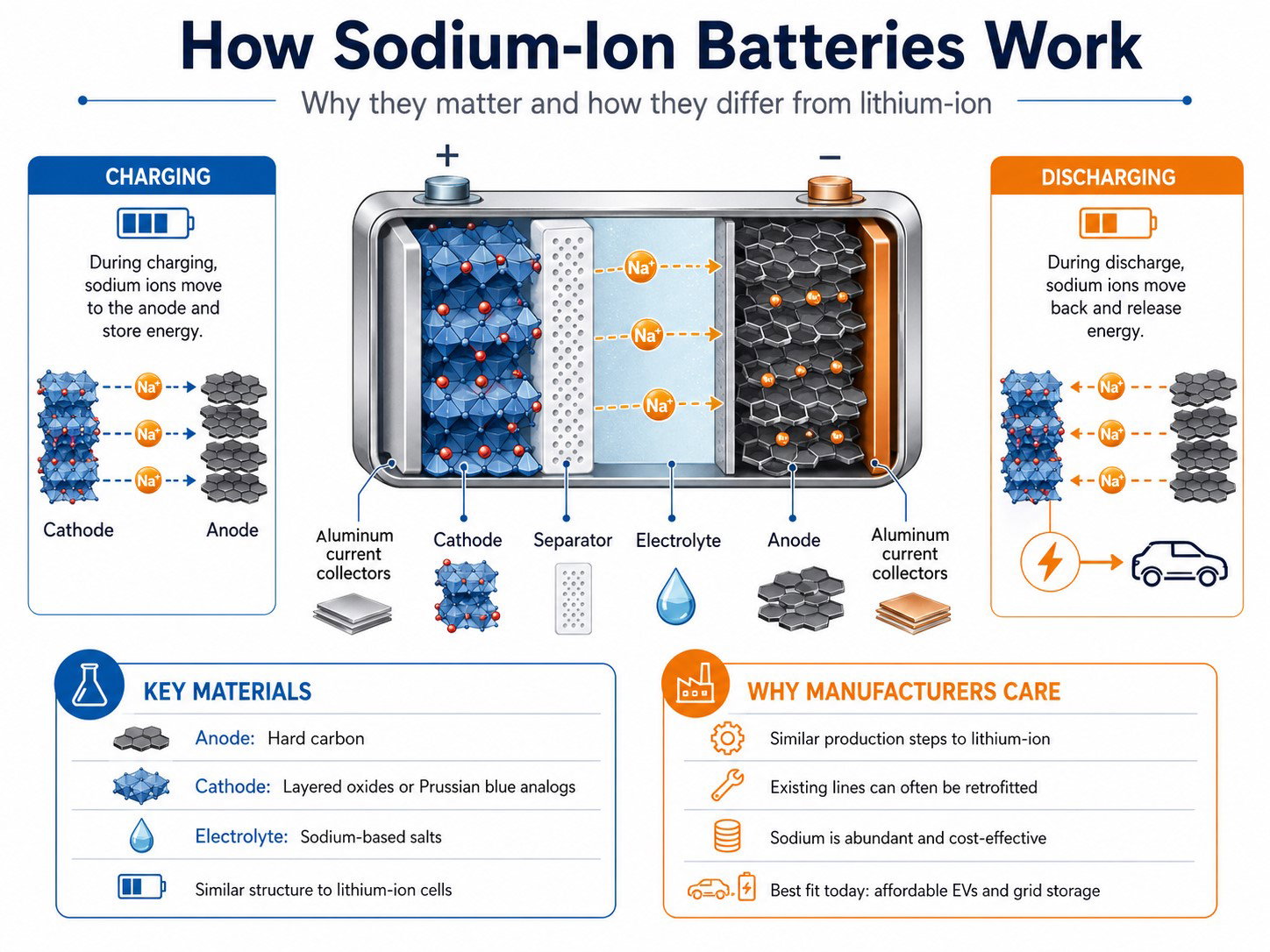
The practical benefit is manufacturing: because the production steps are similar, many existing lithium-ion factories could potentially adapt their lines rather than build entirely new ones from scratch. That lowers the barrier to scaling, although final costs still depend on production volume, supply chain maturity, and how well the chemistry performs in real-world packs.
If sodium-ion has been around as a concept for decades, the real question is why momentum is accelerating now, and what has changed in the technology and market to bring it back into focus.
Why Are Sodium-Ion Batteries Growing So Fast?
Sodium-ion battery technology is not new. Researchers explored it decades ago, but it stayed in the shadow of lithium-ion because lithium batteries advanced faster and became the default for electronics and EVs. What’s changed is that sodium-ion chemistry has improved over the years to make it commercialize.
The market timing helps, too. Battery demand is rising fast, and lithium supply chains are under pressure from scale, cost swings, and geopolitical concentration. Sodium is widely available and typically cheaper to source, which makes sodium-ion attractive for cost-sensitive vehicles and large storage systems where affordability and supply resilience matter.
Cold-weather performance is another driver. EV range drop in freezing temperatures is a common complaint, and sodium-ion is being positioned as a stronger option for cold-climate use cases. If you add the growing investment and early deployments to this, the momentum starts looking like something has happened overnight, even though the groundwork has been building for years.
Now let’s look at what’s actually new, the launches, technical gains, and who’s pushing sodium-ion from pilot projects into real products.
What Are The Latest Innovations In Sodium-Ion Batteries?
Sodium-ion batteries have moved past the lab phase. The biggest change in the last 12–18 months is that major players are now shipping real products, signing large-scale supply deals, and backing the tech with manufacturing capacity.
-
The First Launch
CATL’s Naxtra program has been the loudest signal that sodium-ion is entering mainstream deployment. In February 2026, CATL and CHANGAN announced what they called the first mass-produced passenger vehicle equipped with a sodium-ion battery pack, built around CATL’s Naxtra chemistry.
CATL claims the pack reaches up to 175 Wh/kg (a benchmark for mass-produced sodium-ion), supports a pure-electric range exceeding 400 km, and retains over 90% capacity at -40°C, positioning cold-weather performance as a key differentiator. -
Energy Storage
In April 2026, Reuters reported that CATL signed its first major sodium-ion deal for energy storage: a 60 GWh supply agreement over three years with Beijing HyperStrong.
-
Other Players
Other big names are preparing for a multi-chemistry future. BYD has also been linked to a 30 GWh sodium-ion battery facility in China, which suggests sodium-ion is being positioned as a volume play for cost-sensitive segments.
-
Research
On the R&D side, the focus is predictable: charge speed, cycle life, and energy density. For example, Tokyo University of Science published a work in late 2025 looking at why sodium-ion could potentially charge faster in certain conditions, by analyzing ion movement behavior at hard carbon electrodes.
Put all that together, and the hype will make sense: sodium-ion is getting cheaper to build at scale, improving in cold conditions, and crossing into real-world deployment. Now let’s get specific about where it actually wins, and where it still falls short.
Sodium-Ion Battery Advantages
So what’s actually fueling the excitement? Sodium-ion batteries have a few advantages that are especially attractive for cost-sensitive EVs and grid storage, where affordability and reliability often matter more than squeezing out maximum range.
-
Cheaper
Sodium is widely available and typically less price-volatile than lithium, which makes sodium-ion appealing for manufacturers trying to reduce cost pressure and supply-chain risk.
-
Strong Cold-weather Behavior
Cold-weather performance is one of sodium-ion’s most talked-about strengths. Several deployments and product announcements position sodium-ion as more dependable in low temperatures than many lithium-ion options, which matters because winter range drop is still one of the biggest EV complaints.
-
Manufacturing Familiarity
From a factory standpoint, sodium-ion is attractive because it can follow many of the same production steps as lithium-ion. That means existing battery makers may be able to adapt current lines rather than start from scratch, lowering the barrier to commercialization.
-
Easier Scale-up
Even when sodium-ion loses on energy density, it can still win on economics in stationary systems, where weight and size matter less. That’s one reason the earliest large deals and deployments are clustering around energy storage.
These are real strengths, but they come with trade-offs. To understand the reality part of the hype, we need to look at where sodium-ion still lags, especially for long-range EV performance and supply-chain maturity.
Sodium-Ion Battery Disadvantages
The hype around sodium-ion is real, but so are the constraints. These batteries are improving fast, yet they still carry trade-offs that make them a complement to lithium-ion today, not a clean replacement.
-
Lower Energy Density
This is the biggest limitation for EVs. Even with recent products landing around the mid-100s Wh/kg, sodium-ion generally stores less energy per kilogram than lithium-ion chemistries used in most passenger EVs. That typically means shorter range for the same pack size, or a heavier pack to match the range.
-
Limited Use Case
Because energy density still lags, sodium-ion is currently better positioned for use cases where affordability and durability matter more than squeezing out maximum range, like entry-level EVs, two/three-wheelers, commercial fleets, and stationary storage.
-
Immature Supply Chain
Sodium is abundant, but that does not mean sodium-ion manufacturing is mature. Lithium-ion has decades of refinement, huge global capacity, and deeply optimized supply chains. Sodium-ion is still ramping suppliers, standardization, and production scale, which affects cost, quality, and availability.
-
Critical Minerals
A common marketing line is that sodium-ion avoids critical minerals entirely. In reality, some sodium-ion chemistries still rely on materials like nickel or manganese, and those supply chains have their own concentration and processing risks.
-
The Cost
Cheaper raw material does not mean cheaper pack today. At certain lithium price points, some lithium-ion packs can still be highly competitive, and sodium-ion’s cost edge depends on scale, yields, and where the pack is being produced and deployed.
Once you stack the advantages and disadvantages side by side, the real answer becomes clearer. The question is not which one wins forever; it is where each chemistry makes the most sense, and whether sodium-ion can take a meaningful share without dethroning lithium-ion.
Will Sodium-Ion Batteries Replace Lithium-Ion Batteries?
Probably not. Lithium-ion has decades of manufacturing scale, deeply optimized supply chains, and a massive installed base across EVs and consumer electronics. Sodium-ion is growing quickly, but it’s still early in commercial rollout and does not yet match lithium-ion on energy density.
What’s more likely is a split-market future. Lithium-ion stays dominant where energy density and weight matter most, such as long-range passenger EVs and performance vehicles.
Sodium-ion grows where its strengths show up clearly: affordable EV segments, two- and three-wheelers, cold-climate use cases, commercial fleets, and stationary energy storage, where cost, supply resilience, and operating temperature can outweigh pack size penalties.
Even major manufacturers are signaling this both-and direction rather than a winner-takes-all fight. The reality is that different chemistries solve different problems, and the battery industry is big enough to support multiple winners.
Here’s a quick comparison side-by-side.
Sodium-Ion Batteries Vs Lithium-Ion Batteries: Quick Comparison
If you strip away the marketing, this decision comes down to a few practical questions: how much energy you can pack into a given space, how the battery behaves in cold weather, how mature the supply chain is, and what the economics look like at scale. Here’s the clean side-by-side.
| Factor | Sodium-Ion Batteries | Lithium-Ion Batteries |
| Raw Material Availability | Sodium is abundant and generally cheaper to source | Lithium is more constrained and price-sensitive |
| Energy Density | Around 160–175 Wh/kg | Around 200–300+ Wh/kg |
| Cold-Weather Performance | Stronger low-temperature performance | Range drops significantly in extreme cold |
| Safety Behavior | Low thermal runaway risk | an overheating risk |
| Supply Chain Maturity | Still developing | Highly mature, global scale |
| Best-Fit Use Cases | Affordable EVs, two/three-wheelers, cold regions, grid storage | Long-range EVs, electronics, and premium vehicles |
Topics For More Insights
Conclusion
Sodium-ion batteries are not a magic replacement for lithium-ion, and they don’t need to be. The hype is the idea that one chemistry will suddenly take over every EV and device. The reality is more practical: sodium-ion is becoming commercially relevant because it can win in a few high-value areas, especially where cost, cold-weather performance, and supply chain resilience matter more than maximum energy density.
That’s why we’re seeing early momentum in affordable EV segments and stationary energy storage. Lithium-ion will likely remain the default for long-range and premium vehicles for the foreseeable future, while sodium-ion grows alongside it, taking share where its trade-offs make sense.
In other words, sodium-ion is not here to end lithium-ion. It’s here to expand the battery playbook. And that shift, from one dominant chemistry to a multi-chemistry market, is the real story behind the sodium-ion buzz.
Frequently Asked Questions
Will Sodium-Ion Batteries Replace Lithium-Ion Batteries?
Not entirely, and not anytime soon. Lithium-ion is still ahead in energy density and has a far more mature global supply chain, which is why it remains the default for long-range and premium EVs. Sodium-ion is more likely to grow alongside lithium-ion, winning in specific use cases like affordable EVs, two/three-wheelers, cold-climate applications, and grid storage.
What Are The Main Advantages And Disadvantages Of Sodium-Ion Batteries?
Sodium-ion batteries are appealing because sodium is abundant and typically cheaper to source, which can reduce cost pressure and supply-chain risk as the technology scales. They’re also often positioned as stronger in extreme cold. The trade-offs are just as real: sodium-ion still generally lags lithium-ion on energy density, the supply chain is newer and less mature, and the cost advantage is not guaranteed in every market or application.
When Will Sodium-Ion Batteries Be Widely Available In Electric Vehicles?
Sodium-ion batteries are already entering the market through early commercial deployments, but broad adoption will take time. In the near term, you’ll see them first in budget-friendly EV segments and regions where cold-weather performance is a strong selling point, while stationary storage scales faster because weight and size matter less. Wider EV availability depends on continued improvements in energy density, production scale, and supply chain maturity.
Thu, Apr 30, 2026

Liked what you read? That’s only the tip of the tech iceberg!
Explore our vast collection of tech articles including introductory guides, product reviews, trends and more, stay up to date with the latest news, relish thought-provoking interviews and the hottest AI blogs, and tickle your funny bone with hilarious tech memes!
Plus, get access to branded insights from industry-leading global brands through informative white papers, engaging case studies, in-depth reports, enlightening videos and exciting events and webinars.
Dive into TechDogs' treasure trove today and Know Your World of technology like never before!
Disclaimer - Reference to any specific product, software or entity does not constitute an endorsement or recommendation by TechDogs nor should any data or content published be relied upon. The views expressed by TechDogs' members and guests are their own and their appearance on our site does not imply an endorsement of them or any entity they represent. Views and opinions expressed by TechDogs' Authors are those of the Authors and do not necessarily reflect the view of TechDogs or any of its officials. While we aim to provide valuable and helpful information, some content on TechDogs' site may not have been thoroughly reviewed for every detail or aspect. We encourage users to verify any information independently where necessary.
Loading comments...