Artificial Intelligence
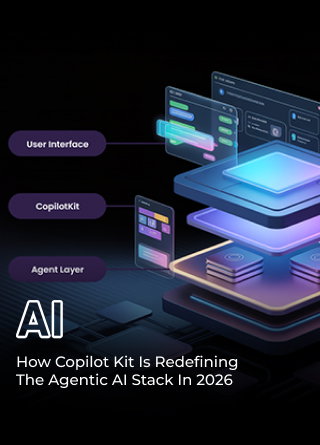
How CopilotKit Is Redefining The Agentic AI Stack In 2026
Share
TL;DR
-
CopilotKit raised $27M in May 2026 to build the enterprise agentic frontend stack, backed by Glilot Capital, NFX, and SignalFire.
-
Its AG-UI protocol completes the three-layer agentic stack: MCP for tools, A2A for agent coordination, and AG-UI for user interaction.
-
AIMock mocks the full agentic call chain, LLMs, MCP, A2A, and vector databases, in one zero-dependency server.
-
Pathfinder is a self-hosted MCP knowledge server turning docs, Slack, and Notion into agent-ready hybrid search.
- DocuSign, Cisco, and Deutsche Telekom are among the Fortune 500 companies running CopilotKit in production today.
-(1)-178.jpg.aspx "TechDogs-\"How CopilotKit Is Redefining The Agentic AI Stack In 2026\"")
Introduction
It is 2026, and AI has become as common as a web browser.
Teachers use it to create lesson plans. Parents use it to settle arguments at the dinner table. Engineers use it to write code. Writers use it to brainstorm ideas. Heck, even school kids are building applications and launching side projects with AI tools.
Meanwhile, the AI ecosystem refuses to slow down. Every week seems to bring a new model, a new API, a new connector, or a new framework promising to push the boundaries of what AI can do.
Yet for all this progress, most AI assistants still suffer from the same limitations they had when the generative AI boom began.
They can talk about your work, but they cannot truly see it.
A user types a request, receives a response, and then manually performs every recommended action. The AI may know how to solve the problem, but it remains disconnected from the application where the problem actually exists.
That is precisely the challenge CopilotKit has spent the last two years trying to solve.
In May 2026, the company announced a $27 million Series A funding round and unveiled its enterprise agentic frontend stack, an infrastructure layer designed to embed AI agents directly inside applications. Instead of responding with static blocks of text, these agents can understand real-time application context and interact through dynamic user interfaces built into the software itself.
With the platform already powering tens of millions of agent-user interactions every week, the funding announcement is certainly noteworthy. However, the bigger story may be what it signals for the future of AI applications.
What Is The Agentic AI Stack?
Before CopilotKit’s argument fully makes sense, the stack it is trying to complete needs to make sense first. So, let’s build that picture layer by layer.
For most of 2024 and 2025, the agentic AI conversation focused heavily on two big questions: how agents access external data and how agents communicate with other agents. The industry began solving both. Yet one layer remained strangely underdeveloped: how agents actually interact with humans inside real applications.
That is where the agentic AI stack starts to take shape.
-
Model Context Protocol (MCP): Developed by Anthropic and now supported across the broader AI ecosystem, MCP standardizes how agents connect to tools, APIs, databases, and external systems.
-
Agent-to-Agent (A2A) Protocol: Introduced by Google, A2A focuses on how agents discover each other, delegate tasks, exchange results, and coordinate across different frameworks. If MCP helps agents access tools, A2A helps agents work with other agents.
-
AG-UI (Agent-User Interaction): This is CopilotKit’s open protocol and the newest layer in the stack. AG-UI focuses on the part that users actually experience. Real-time, interactive collaboration between humans and AI agents inside software applications.
CopilotKit co-founders Atai Barkai and Uli Barkai compare these protocols to the agentic web’s TCP, HTTP, and HTML. Each one solves a different communication problem. MCP gives agents access to tools and data. A2A helps agents coordinate with each other. AG-UI gives the stack its human-facing interface.
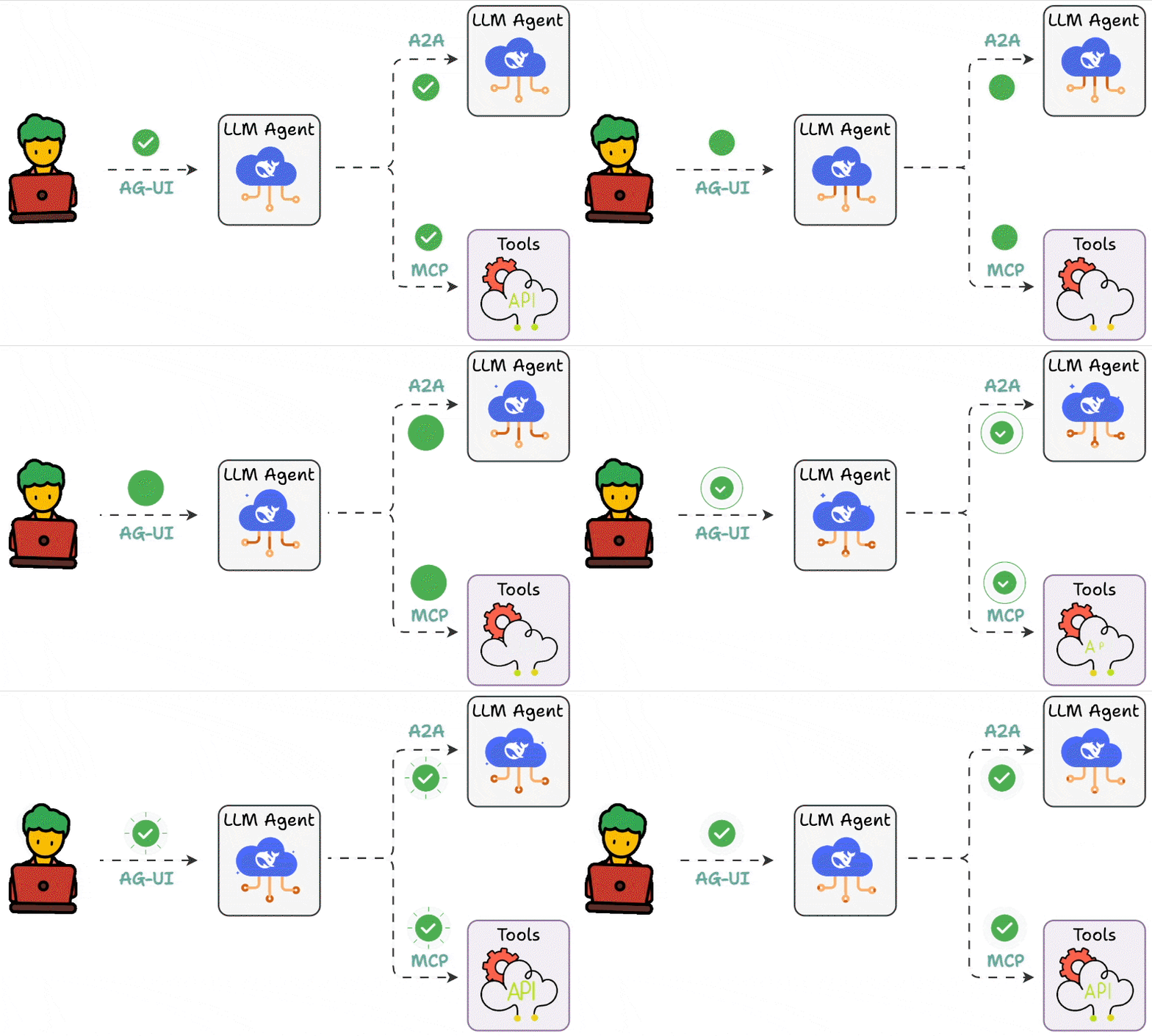
In that sense, AG-UI is the missing display layer. It is what allows AI agents to stop living only inside chat boxes and start showing up inside the applications where work actually happens.
What AG-UI Concretely Enables Inside Applications
Understanding AG-UI is easier when you look at what changes for the end user.
Traditional AI assistants mostly operate like chatbots. You ask a question, receive a response, and then manually perform the recommended actions yourself. AG-UI changes that dynamic by allowing agents to interact directly with the application's interface while keeping users involved in the process.
This unlocks several capabilities:
-
Real-time Streaming Responses: Instead of waiting for a completed answer, users see responses generated token by token, creating a faster and more interactive experience.
-
Dynamic Generative Interfaces: Agents can render actual UI components such as forms, buttons, tables, charts, and approval screens rather than simply describing them in text.
-
Bidirectional State Synchronization: The agent and the application remain continuously aware of each other's state, allowing workflows to adapt instantly as users interact with the interface.
-
Human-in-the-loop Decision Making: When a workflow reaches a sensitive action, such as approving a payment, modifying customer data, or triggering a deployment, the agent can pause and wait for human confirmation before proceeding.
The result is a shift from AI acting as a detached advisor to AI functioning as an active participant inside the software itself. Instead of telling users what to do next, the agent can help them do it within the application they are already using.
Now, let's look at what CopilotKit actually shipped in 2026 to build on top of it.
What Did CopilotKit Actually Ship In 2026?
CopilotKit’s 2026 release cycle focused on three blockers that often stop promising agent prototypes from becoming production-ready applications: testing, knowledge retrieval, and runtime persistence. Each release addresses one of those gaps directly.
AIMock: Testing AI Agents Without Losing Your Mind
Testing an agentic application in 2026 is not like testing a standard API. A single user request can travel through an LLM, tool servers, vector databases, rerankers, web search APIs, moderation layers, and even other agents before returning an answer. That makes the call chain long, messy, and often non-deterministic.
Most engineering teams mock one or two services. The rest stay live, which quietly makes test suites unreliable.
Released in April 2026, AIMock was built for exactly this problem. It lets teams mock the full agentic call chain from one configuration file, covering LLMs, MCP tool servers, A2A sub-agents, vector databases, rerankers, web search APIs, and moderation layers. It supports 11 LLM providers, including OpenAI, Claude, Gemini, Bedrock, Azure, Vertex AI, Ollama, Cohere, and more.

What makes AIMock especially useful is that it is built with zero dependencies using Node.js built-ins, so teams only need to install the package. Its record-and-replay workflow captures provider responses and reuses saved fixtures during tests, making results far more stable. It also runs daily CI checks against real provider endpoints to detect drift and update fixtures when response formats change.
There is also chaos injection, which lets teams simulate failures before users encounter them in production. Interestingly, CopilotKit uses AIMock to test AG-UI itself across LLM providers, which is a pretty strong signal of confidence in the tool.
Now that the testing problem has an answer, the next question is what happens when the agent simply does not know enough to be useful.
Pathfinder: The Knowledge Server For AI Agents
Also released in April 2026, Pathfinder targets the knowledge retrieval gap.
Every useful enterprise agent eventually runs into the same problem: it needs access to company-specific knowledge.
Pathfinder is CopilotKit’s self-hosted MCP knowledge server for that world. It indexes documentation, source code, Notion pages, Slack discussions, and Discord forums into a PostgreSQL vector database, giving agents a searchable knowledge layer inside the organization’s own infrastructure.
Its hybrid vector-keyword search combines semantic retrieval with keyword matching, helping agents find relevant information more accurately than relying on embeddings alone. It also does not require an external API key because pluggable embeddings can run entirely inside the user’s infrastructure.
The setup is deliberately lightweight. Teams can start the knowledge layer with a single command:
npx @copilotkit/pathfinder serve
A Docker image is also available for containerized deployments. CopilotKit also maintains a live Pathfinder instance at mcp.pathfinder.copilotkit.dev, which indexes its own documentation and can be accessed from MCP clients such as Claude Code or Cursor.
That solves knowledge access. The final blocker is probably the one enterprise teams feel most painfully: memory.
CopilotKit Enterprise Intelligence Platform
Announced in May 2026, the CopilotKit Enterprise Intelligence Platform focuses on runtime persistence, or in simpler terms, the agent’s ability to remember what happened across sessions, devices, users, and workflows.
That may sound basic, but it is one of the hardest pieces to build properly. Many agent prototypes work well in a single chat session but fall apart when users return later, switch devices, reopen an application, or expect the agent to continue from where it left off.

CopilotKit addresses this with the Thread primitive, a first-class persistent session object that stores more than chat history. It also captures generative UI outputs, tool call records, shared state, and user preferences. That means the agent can preserve context across sessions instead of starting from scratch every time.
The platform also supports cross-session and cross-device continuity, allowing users to resume work regardless of where they return from. For enterprises, the architecture is self-hosted on Kubernetes, letting teams bring their own database and retain full control over their data. A managed cloud option is also in development.
On the business-readiness side, CopilotKit includes SOC 2 Type II compliance, SSO integration, role-based access control, and support for air-gapped offline applications through license key validation.
So, three products, three production blockers: AIMock for testing, Pathfinder for knowledge retrieval, and the Enterprise Intelligence Platform for persistent runtime memory.
Knowing what CopilotKit shipped is only half the story. The bigger question is where this places the company in the wider agentic AI market.
CopilotKit Vs Vercel AI SDK Vs OpenAI Apps SDK
CopilotKit operates in a space that includes Vercel's AI SDK and OpenAI's Apps SDK, but the positioning is meaningfully different across all three.
| Key Features | CopilotKit | Vercel AI SDK | OpenAI Apps SDK |
| Agent-UI protocol | AG-UI (open standard, framework-agnostic) | Custom streaming adapters | Proprietary to the OpenAI ecosystem |
| Framework support | LangGraph, CrewAI, Mastra, Agno, PydanticAI + community SDKs | Primarily works with major LLM APIs | Works within ChatGPT only |
| Vendor lock-in | MIT licensed, self-hostable | Low | High, switching LLM backends starts over |
| Enterprise persistence | Yes, Thread-based, Kubernetes, SOC 2 Type II | No native persistence layer | No native persistence layer |
| Testing infrastructure | AIMock, full agentic call chain | No dedicated mock layer | No dedicated mock layer |
| Knowledge retrieval | Pathfinder, self-hosted MCP knowledge server | No native knowledge layer | No native knowledge layer |
| Open source | Yes — 31,700+ GitHub stars | Yes | No |
Now, let us look at who specifically is already running this in the real world.
Who Is Already Using CopilotKit In Production?
The fastest way to separate developer hype from real platform momentum is to look at who is running it in production and where it shows up in the ecosystem.
-
Enterprise Customers
CopilotKit states that it is already used by enterprise teams and references customers such as DocuSign, Cisco, and Deutsche Telekom in its Series A announcement. TechCrunch’s funding coverage also frames the company around app-native AI agents and the push to productionize in-app agent experiences.
-
Cloud And Infrastructure Adoption
Amazon Bedrock AgentCore Runtime added support for deploying AG-UI servers, positioning AG-UI as a supported pattern for building interactive agent experiences with authentication, session isolation, and scaling handled by the runtime.
AWS also published a full-stack starter template (FAST) for AgentCore, designed to speed up production deployments by bundling common infrastructure patterns for agentic apps. This matters because it signals that interactive agent experiences are being treated as a first-class, repeatable deployment pattern, not a one-off demo integration. -
Ecosystem Maturity
A practical maturity indicator is when a protocol becomes teachable as a repeatable build pattern. DeepLearning.AI launched a course taught by Atai Barkai (CopilotKit co-founder) focused on building interactive agents with generative UI, explicitly tied to AG-UI and CopilotKit’s approach.
Should You Adopt This Stack In 2026?
If you are building agentic products in 2026, then here is how you make a decision.
-
AG-UI: Adopt an agent-to-UI protocol when the agent needs to render UI components users can interact with, keep frontend and agent state synchronized in real time, or pause at decision points and require user confirmation for risky actions.
-
AIMock: If your test suite is flaky because agent chains touch multiple nondeterministic systems, AIMock is designed to mock the full agentic call chain (LLMs, tools, retrieval, sub-agents, and event streams) through a single mock server approach.
-
Pathfinder: If your agent’s usefulness depends on internal docs, source code, Notion, and Slack, Pathfinder is positioned as a self-hosted knowledge server that indexes those sources and exposes them via MCP-style access for agents, reducing the “it doesn’t know our context” failure mode.
Conclusion
For the last two years, most agentic AI progress has focused on how agents call tools (MCP) and how agents coordinate across systems (A2A). The layer that determines whether users trust an agent, complete a workflow, and ship it into production has been the interaction layer inside the application. That is the gap AG-UI is trying to standardize.
What makes CopilotKit’s positioning interesting is that it does not stop at protocol talk. AIMock tackles the reliability problem that breaks real deployments, Pathfinder tackles the knowledge gap that makes agents feel generic, and the Enterprise Intelligence Platform frames persistence as infrastructure rather than a chat feature. Together, the stack outlines a practical path to an agent that can operate inside product UI with state, confirmations, continuity, and enterprise constraints.
If the next generation of software is built around agents, the winners will not just have better models or better prompts. They will have better interaction primitives, better testing realism, and better persistence. In that context, the agent-to-UI layer is not a nice-to-have. It is where agentic systems either become usable products or stay impressive prototypes.
Frequently Asked Questions
What Is CopilotKit And Why Is It Relevant In 2026?
CopilotKit is a developer platform focused on building app-native AI agents that can work inside real product interfaces instead of only responding in chat. Its 2026 positioning matters because it targets the biggest production gap in agentic AI: reliable human-agent collaboration through the UI layer, not just better prompts or tool calls.
What Is The AG-UI Protocol?
AG-UI (Agent-User Interaction) is an open protocol designed to standardize how agents communicate with user interfaces in real applications. The goal is to make interactive agent experiences portable across stacks by formalizing patterns like streaming interactions, UI-state synchronization, and human approval checkpoints.
How Does AG-UI Fit With MCP And A2A In The Agentic AI Stack?
A practical way to understand the stack is: MCP covers how agents access tools and data, A2A covers how agents coordinate with other agents, and AG-UI covers how agents collaborate with humans inside the application experience. CopilotKit’s core argument is that production-grade agents require all three layers, and the UI layer is the one that most teams were rebuilding from scratch.
What Is AIMock, And What Is It Used For In Agentic Applications?
AIMock is positioned as a testing layer for agentic systems where requests can trigger long, nondeterministic call chains across models, tools, retrieval, and sub-agents. It is meant to reduce flaky tests by allowing teams to mock and replay the full chain in a controlled way, which is often the difference between a convincing demo and a reliable production workflow.
When Should An Enterprise Team Consider CopilotKit And This Stack?
Enterprise teams should consider CopilotKit when the agent must operate through the product UI with state, approvals, and continuity across sessions, and when testing reliability and data control are non-negotiable. If the use case is mostly backend tool execution with minimal UI interaction, MCP plus orchestration may be enough without adopting a dedicated agent-to-UI protocol layer.
Wed, Jun 3, 2026

Liked what you read? That’s only the tip of the tech iceberg!
Explore our vast collection of tech articles including introductory guides, product reviews, trends and more, stay up to date with the latest news, relish thought-provoking interviews and the hottest AI blogs, and tickle your funny bone with hilarious tech memes!
Plus, get access to branded insights from industry-leading global brands through informative white papers, engaging case studies, in-depth reports, enlightening videos and exciting events and webinars.
Dive into TechDogs' treasure trove today and Know Your World of technology like never before!
Disclaimer - Reference to any specific product, software or entity does not constitute an endorsement or recommendation by TechDogs nor should any data or content published be relied upon. The views expressed by TechDogs' members and guests are their own and their appearance on our site does not imply an endorsement of them or any entity they represent. Views and opinions expressed by TechDogs' Authors are those of the Authors and do not necessarily reflect the view of TechDogs or any of its officials. While we aim to provide valuable and helpful information, some content on TechDogs' site may not have been thoroughly reviewed for every detail or aspect. We encourage users to verify any information independently where necessary.
Loading comments...