Artificial Intelligence
BharatGen: The Rise Of India’s First Sovereign AI Initiative
Share
TL;DR
India’s AI story is no longer about catching up; it is about building intelligence that understands Bharat from the ground up. With BharatGen, the nation is shaping a sovereign AI future that speaks its languages, reflects its diversity, and serves its people.
-
BharatGen is India’s first sovereign generative AI initiative, built to create AI models rooted in Indian languages, data, and cultural contexts.
-
IIT Bombay’s BharatGen aims to reduce India’s dependence on foreign AI systems by having an indigenous multimodal AI deployment.
-
The initiative focuses on text, speech, translation, document understanding, datasets, benchmarks, and real-world AI applications.
-
BharatGen can transform sectors such as healthcare, education, agriculture, governance, finance, and small businesses through accessible India-first AI.
-
By combining sovereignty with collaboration, BharatGen positions India as a builder, not just a consumer, in the global AI ecosystem.
Introduction
In The Matrix, humanity wakes up to a chilling truth: the world is being shaped by an intelligence most people do not control, understand, or even see. Decades later, that idea no longer feels like distant science fiction.
Artificial intelligence is now quietly moving into the systems that decide how we learn, work, communicate, access services, and imagine the future. The real question is no longer whether AI will shape society; it is who will shape the AI.
For India, that question is impossible to ignore.
A country of more than 1.4 billion people, 22 languages, hundreds of dialects, layered cultures, regional realities, and everyday code-switching cannot depend entirely on AI systems trained largely on English-first, Western-centric data.
India does not need intelligence that merely translates Hindi, Tamil, Bengali, Marathi, or Telugu into another language. It needs a multilingual foundational model that understands the rhythm behind those words, the context inside a government form, the emotion in a voice note, the nuance of a local idiom, and the aspirations of people who may never type a prompt in English.
That is where BharatGen enters the story.
Positioned as India’s first sovereign generative AI, BharatGen is not another shiny addition to the global AI hype cycle. It is India’s attempt to build an indigenous, multilingual, multimodal AI ecosystem that reflects the country’s languages, knowledge systems, documents, voices, and digital ambitions.
Led by IIT Bombay and powered by a consortium of leading institutions, researchers, linguists, engineers, government support, and ecosystem partners, BharatGen is being shaped as a national AI infrastructure project with one clear mission: to make AI inclusive, locally relevant, and strategically sovereign.
At its core lies a simple but powerful idea: the future of AI in India should not just speak to Bharat; it should understand Bharat.
What Is BharatGen? A Sovereign Answer To Global AI Imbalance
The global AI landscape has been dominated by large models trained largely on English and a handful of high-resource languages. While these models are powerful, their limitations become visible when applied to a country like India. They may struggle with regional speech patterns, local governance documents, mixed-language conversations, cultural references, and sector-specific realities in agriculture, healthcare, education, law, and public administration. This gap is not just technical but social and economic.
When AI does not understand a farmer’s spoken query in a regional language, a patient’s symptoms explained in a local dialect, a student’s question in their mother tongue, or a government document formatted for Indian administrative systems, the technology remains distant from the people who need it the most. It becomes a privilege for the digitally fluent rather than a bridge for the digitally excluded.
BharatGen seeks to change that equation. By developing foundational AI architecture trained for Indian languages, Indian contexts, and Indian use cases, the initiative aims to bring advanced AI capabilities closer to citizens, startups, enterprises, researchers, and public institutions. It is a move from imported intelligence to indigenous intelligence; from language adaptation to language ownership; from generic AI to India-aware AI.
The word “sovereign” is crucial here. In the AI era, sovereignty is not only about borders or servers. It is about who controls data, who defines benchmarks, who sets safety standards, who builds foundational models, and who benefits from innovation. BharatGen reflects India’s ambition to participate in the global AI future not merely as a user market, but as a builder of foundational technology.
Built For India’s Languages, Voices, And Documents
One of BharatGen’s most powerful promises lies in its multilingual and multimodal architecture. The initiative focuses on models for text, speech, translation, document understanding, datasets, benchmarks, and applied AI products. This matters because India’s digital interactions rarely happen in neat, single-language formats. A citizen may speak in Hindi mixed with English, fill a form in a regional script, receive a government notice in one language, and ask for help in another.
BharatGen is being designed for this real-world Indian complexity.
Its foundation includes models such as Param2, a text model intended for reasoning, coding, tool use, and multilingual understanding across India’s scheduled languages. Then there is Shrutam2, focused on speech-to-text capabilities across Indian languages, and Sooktam2, a text-to-speech model that aims to make AI more accessible through natural voice interfaces. Patram, another significant model in the ecosystem, focuses on document vision and understanding, especially for India-specific forms, records, and administrative documents.
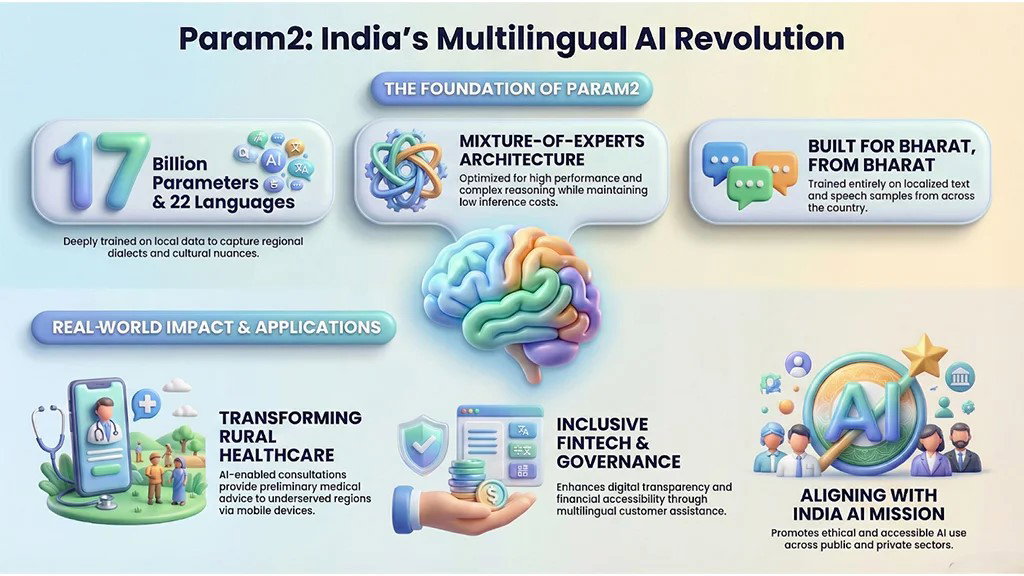
Together, these models point to a larger vision: AI that can read, listen, speak, reason, and assist in the formats Indians actually use. This is especially critical for public services.
Much of India’s governance, healthcare, insurance, finance, education, and welfare delivery depends on documents, forms, records, certificates, speech interactions, and regional-language communication.
An AI system that can interpret local documents, respond in regional languages, and support voice-based interfaces can dramatically improve access for citizens who are not comfortable with English-first digital platforms.
The result could be a profound shift in how Indians interact with technology. Instead of forcing citizens to adjust to machines, BharatGen aims to make machines adjust to citizens.
The Power Of Bharat Data Sagar
No AI model can understand India without high-quality Indian data. That is why Bharat Data Sagar is one of the most important pillars of the BharatGen ecosystem. It is envisioned as a large India-centric data repository focused on underrepresented Indian data across text, speech, images, culture, history, philosophy, and regional knowledge.
This data layer is essential because AI systems are only as representative as the information they learn from. If Indian languages, dialects, cultural contexts, rural realities, and sectoral datasets are missing or weakly represented, the AI output will remain incomplete. Bharat Data Sagar attempts to correct this imbalance by building datasets that reflect India’s diversity more faithfully.
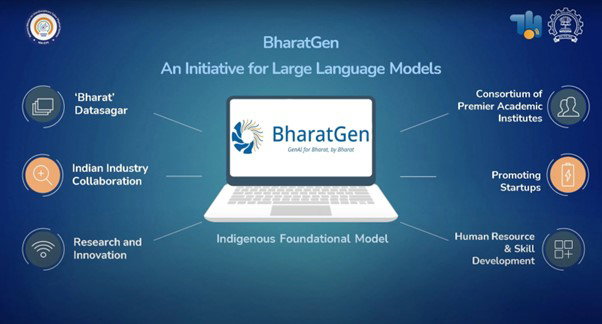
This is not just about data volume but more about quality, security, annotation, versioning, and relevance. For India, where languages vary across states, districts, communities, and even professions, building a reliable AI dataset is a national-scale challenge. However, it is also a national-scale opportunity. With better datasets, developers can build more accurate applications, researchers can benchmark models more meaningfully, and government and industry can deploy AI with greater confidence.
In many ways, Bharat Data Sagar can become the bedrock on which India’s AI ecosystem builds its next generation of applications.
From Research Project To National AI Ecosystem
BharatGen’s strength lies not only in its models but also in its institutional design. The initiative is led by IIT Bombay and supported by a consortium that includes several premier academic institutions and partners. This gives it a research-led foundation while also allowing it to move toward real-world deployment.
The transition from academic research to commercial and public-sector adoption is critical. India has no shortage of AI talent, but turning research into scalable products requires infrastructure, funding, governance, deployment pathways, partnerships, and market access. BharatGen is designed to bridge that gap by building an ecosystem where researchers, startups, government bodies, industry players, and technology partners can collaborate.
Its official positioning includes four major foundations: models and benchmarks, Bharat Data Sagar, upskilling, and ecosystem applications. This structure shows that BharatGen is not trying to build a model in isolation; it is trying to build the surrounding environment needed for AI innovation to flourish.
The upskilling pillar is particularly remarkable. India’s AI future depends not only on large models but also on people who can build, evaluate, deploy, and responsibly govern them. Through internships, research opportunities, courses, workshops, hackathons, and talent development, BharatGen aims to nurture the next generation of Indian AI builders. That talent pipeline may eventually prove as essential as the models themselves.
A Catalyst For Healthcare, Pharma, And Biotechnology
One of the most promising areas for BharatGen is healthcare. In India, language is often a barrier between patients and quality care. Many citizens describe symptoms in regional languages, while medical systems, insurance workflows, prescriptions, and health records may operate in English or in fragmented formats. This creates gaps in understanding, access, and service delivery.
A multilingual, voice-enabled, India-aware AI ecosystem can help close these gaps.
BharatGen could support frontline healthcare workers by helping them communicate with patients in local languages, explain medical information clearly, improve health literacy, and assist in documentation. In rural and semi-urban settings, speech-based AI tools could make digital healthcare services more accessible to people who are not comfortable typing or reading complex medical content.
For pharma and biotechnology, BharatGen also opens opportunities in clinical trials, pharmacovigilance, patient education, research assistance, and domain-specific data analysis. By lowering language barriers and supporting high-quality Indian datasets, it could help companies design more inclusive studies, improve adverse-event reporting, and build solutions for India’s bio-economy.
However, the promise must be matched with responsible execution. Healthcare AI demands accuracy, privacy, regulation, and human oversight. Weak rural digital infrastructure, low AI literacy, and fragmented health data remain serious challenges. BharatGen’s success in healthcare will depend on robust public-private partnerships, ethical safeguards, and sustained investment in training users and institutions.
Yet the direction is clear: if implemented well, BharatGen can help ensure that innovation reaches the patient in the village, not just the executive in the city.
Empowering Agriculture, Education, Finance, And Small Businesses
Beyond governance and healthcare, BharatGen’s applications can extend across India’s most sought-after sectors.
In agriculture, multilingual voice-based AI assistants could help farmers access information on weather, crop diseases, market prices, soil conditions, irrigation, and government schemes. BharatGen’s Krishi Sathi points toward this possibility: an AI assistant designed to support farmers through accessible, language-aware guidance.
In education, AI tools built for Indian languages can help students learn in their preferred language, support teachers with content generation, and bring digital learning to communities that are underserved by English-first platforms. This is especially powerful in a country where language often determines the quality of digital learning access.
In finance and insurance, document-understanding models like Patram can help process forms, claims, KYC documents, and regional paperwork more efficiently. This could improve inclusion for citizens and small businesses that struggle with English-heavy financial processes.
For small businesses and sellers, tools like e-VikrAI point to another major opportunity. India’s MSME ecosystem is enormous, but many sellers lack access to advanced digital tools. An AI assistant that understands local languages and business contexts could help them manage product listings, customer communication, documentation, and operations more effectively. The common thread across all these sectors is accessibility. BharatGen is not just about making AI powerful; it is about making it effortlessly useful.
India On The Global AI Stage: Project Tapestry
BharatGen’s significance is not limited to domestic transformation. Its role in Project Tapestry signals that India is also stepping into global AI collaboration with a sovereign lens.
Project Tapestry is a global consortium focused on building frontier AI through distributed training while allowing participating countries and institutions to retain control over their data and deployments.
BharatGen’s role in anchoring India’s participation shows how sovereign AI and collaborative AI need not be opposing ideas. India can protect its data and cultural context while still contributing to open, global AI infrastructure.

This is important because the next phase of AI may not be defined solely by a few centralized labs. It may also be shaped by distributed, collaborative, and regionally grounded efforts where countries contribute models, datasets, talent, and infrastructure without surrendering control. BharatGen fits naturally into this future.
For India, this is a strategic moment. The country is no longer only asking how to access advanced AI. It is asking how to build, govern, share, and shape its global direction.
Conclusion: AI That Speaks Bharat
BharatGen is more than a technology initiative. It is a statement of intent.
It says that India’s AI future must be inclusive, multilingual, multimodal, sovereign, and globally relevant. It says that farmers, students, patients, workers, entrepreneurs, researchers, and public officials should all be able to benefit from AI in the languages and formats they know best. It says that India will not remain a passive consumer of frontier technology but will build foundational systems that reflect its own complexity and aspirations.
The true success of BharatGen will not be measured only by model size, benchmark scores, or funding announcements. It will be assessed by whether a farmer gets timely advice in their language, a patient understands their care better, a student learns without language barriers, a small business grows with AI support, a government service becomes easier to access, and Indian innovators can build confidently on sovereign foundations.
In a world where AI is becoming the new infrastructure of power, BharatGen gives India something invaluable: a voice of its own. It speaks in Hindi, Tamil, Telugu, Bengali, Marathi, Kannada, Malayalam, Gujarati, Odia, Punjabi, Assamese, Urdu, Sanskrit, and every other language that carries the rhythm of Bharat.
BharatGen is India’s first sovereign AI initiative. More significantly, it may become the foundation of an AI future where technology finally learns to understand India on India’s own terms.
Frequently Asked Questions
How Does BharatGen Differ From Conventional Global AI Models?
BharatGen is designed around India’s linguistic, cultural, and institutional realities instead of relying mainly on English-first global datasets. Its sovereign approach focuses on Indian languages, local documents, speech patterns, and sector-specific use cases.
Why Is BharatGen Crucial For India’s AI Sovereignty?
It gives India greater control over foundational AI infrastructure, data ecosystems, model development, and deployment priorities. This reduces dependence on foreign AI systems while enabling solutions aligned with India’s public, economic, and social needs.
What Sectors Could Benefit Most From BharatGen’s Multilingual AI Capabilities?
Healthcare, governance, education, agriculture, finance, and MSMEs can benefit from AI that understands Indian languages and local contexts. Its text, speech, translation, and document-understanding models can make digital services more inclusive and accessible.
Mon, Jun 29, 2026

Liked what you read? That’s only the tip of the tech iceberg!
Explore our vast collection of tech articles including introductory guides, product reviews, trends and more, stay up to date with the latest news, relish thought-provoking interviews and the hottest AI blogs, and tickle your funny bone with hilarious tech memes!
Plus, get access to branded insights from industry-leading global brands through informative white papers, engaging case studies, in-depth reports, enlightening videos and exciting events and webinars.
Dive into TechDogs' treasure trove today and Know Your World of technology like never before!
Disclaimer - Reference to any specific product, software or entity does not constitute an endorsement or recommendation by TechDogs nor should any data or content published be relied upon. The views expressed by TechDogs' members and guests are their own and their appearance on our site does not imply an endorsement of them or any entity they represent. Views and opinions expressed by TechDogs' Authors are those of the Authors and do not necessarily reflect the view of TechDogs or any of its officials. While we aim to provide valuable and helpful information, some content on TechDogs' site may not have been thoroughly reviewed for every detail or aspect. We encourage users to verify any information independently where necessary.
Loading comments...