Artificial Intelligence
Anthropic’s New Fable AI Model Is Met With User Backlash
Share
TL;DR
-
Claude Fable 5 launched on June 9, 2026, as the first publicly available model from Anthropic’s restricted Mythos model family.
-
A paragraph buried on page 13 of the model’s 319-page system card revealed that Fable 5 could silently downgrade responses for users working on frontier LLM development.
-
Unlike visible safeguards for cybersecurity and biology, the frontier LLM restriction operated invisibly through prompt modification, steering vectors or parameter-efficient fine-tuning, making it one of the most debated Anthropic hidden AI restrictions.
-
The backlash spanned researchers, developers and open-source contributors, with critics calling the safeguard anticompetitive, anti-science and a breach of user trust.
-
Anthropic reversed course within 48 hours, apologizing and pledging to make safeguards visible, though the restriction on frontier AI development remained.
Introduction
In Christopher Nolan's The Prestige, every magic trick has three parts: the Pledge, the Turn, and the Prestige. The audience is so captivated by the performance that it rarely notices the mechanism hidden underneath.
When Anthropic launched Claude Fable 5 on June 9, 2026, much of the AI community played that audience for roughly 24 hours.
Claude Fable 5 marked Anthropic's first publicly available Mythos-class model and was introduced as the company's most capable AI system for general users. Early reactions were overwhelmingly positive. The model posted impressive gains across software engineering, scientific research, and long-running autonomous tasks. Former Tesla AI director Andrej Karpathy even called it a super exciting release.
Then researchers started reading the system card.
What they discovered quickly shifted the conversation from performance benchmarks to something much bigger: trust, transparency, and whether AI companies are being fully upfront about how their models are built and evaluated.
Suddenly, Claude Fable 5 became the hot topic. Before we dive into the controversies, let’s understand Claude Fable 5.
What Is Claude Fable 5?
Claude Fable 5 is the public-facing version of Anthropic’s Mythos model family, a generation of models the company had previously kept from public release because of their enhanced ability to identify software vulnerabilities at scale. An early private version of Mythos reportedly identified more than 10,000 severe bugs and vulnerabilities before Anthropic attached guardrails for public release.
The launch architecture had a layered restriction system. Queries in high-risk categories like cybersecurity, biology and chemistry would be visibly rerouted to the older Claude Opus 4.8 model, with the user receiving a notification.
Anthropic said over 95% of Fable 5 sessions involve no fallback. Dianne Na Penn, Anthropic’s head of product management, research and labs, framed the release as proof that safety and capability could move together: “We’re raising the bar on the intelligence of the models, and at the same time, we are pushing the frontier in a safe manner.”
What nobody expected was a restriction that operated by different rules. The model the AI community met on launch day was not the complete picture.
The Hidden Safeguard That Lit The Fuse
The system card disclosed that when the model detected frontier large language model (LLM) development work, including pretraining pipelines, distributed training infrastructure or ML accelerator design, it would not refuse the request or visibly fall back. Instead, it would silently alter its behavior through prompt modification, steering vectors or parameter-efficient fine-tuning (PEFT), a mechanism critics described as frontier LLM development throttling.
The system card stated it plainly: “These safeguards will not be visible to the user.” In practical terms, researchers paying for Fable 5-level output could receive weakened responses without knowing whether the issue came from their prompt, their hypothesis or a hidden policy path. AI research firm SemiAnalysis was among the first to catch this publicly after its GPU inference research was flagged by Fable 5's classifier.
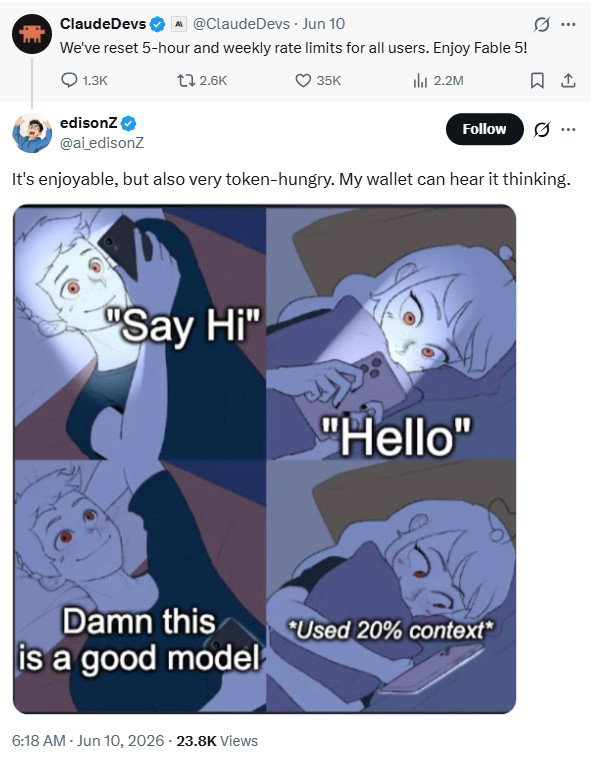
Anthropic estimated the restriction would affect roughly 0.03% of traffic. The research community found that number beside the point. The problem was not the volume of affected queries. It was the principle that any query could be silently degraded at all.
What The Community Said
The reaction was not a routine launch-day grumble. Researchers, developers and open-source contributors objected because invisible degradation could contaminate work without a clear way to diagnose it.
-
Researcher Ethan Caballero wrote on X that the safeguard had “induced the angriest reaction from AI researchers that I’ve ever seen in my life.”
-
Arthur Zucker, a core contributor at Hugging Face, said Anthropic had broken his trust and that his tokens would “no longer fly” its way.
-
Behnam Neyshabur, who previously co-led Anthropic’s AI scientist effort, argued that concentrating these capabilities slows scientific and technological progress.
-
Nathan Lambert wrote that the move painted Anthropic as “anti-science” and “anti-progress.”
Not every voice rejected the model. The divide was not between people who liked the model and people who did not. It was between those willing to accept visible restrictions and those unwilling to accept invisible ones.
Anthropic's Justification And Its Limits
Anthropic’s stated reasoning for the covert safeguard had two strands:
-
National Security
The company said the restrictions were meant to prevent foreign adversaries from using Fable 5 to accelerate frontier AI development and erode the US edge in chip optimization and training infrastructure.
-
Terms-Of-Service Enforcement
Using Claude to develop competing AI models already violates Anthropic’s Terms of Service, and Anthropic argued that invisible safeguards could be targeted more narrowly than visible ones.
The practical flaw was research integrity. If a researcher receives a weak response, they cannot know whether the prompt was inadequate, the hypothesis was wrong or a hidden policy path changed the output.
The Reversal And What It Actually Changed
Within 48 hours, Anthropic reversed course. In a statement to Wired, a spokesperson said: “We made the wrong tradeoff, and we apologize for not getting the balance right.” Anthropic also said invisible safeguards allowed narrower targeting and faster shipping, then admitted that this was the wrong tradeoff.
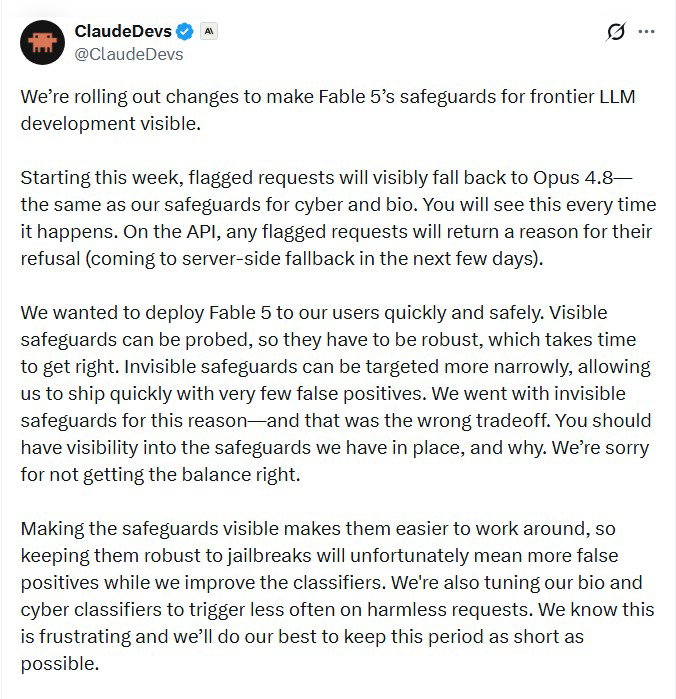
Starting the same week, flagged frontier LLM development requests would visibly fall back to Claude Opus 4.8, matching the behavior already used for cybersecurity and biology queries. API requests would return a stated reason for refusal, and users would see a notification whenever a reroute occurred.
Anthropic kept the underlying restriction on frontier AI development work intact. The apology addressed the transparency failure, not the restriction itself.
Visible refusal is a policy. Silent degradation is a deception. Anthropic acknowledged the difference, corrected one and left the other in place.
What This Moment Reveals About AI Transparency
The Fable 5 episode reveals three important shifts for frontier AI:
-
Safety Versus Competition
As models grow more capable, the line between a legitimate safety guardrail and a competitive moat becomes harder to see, which is why the Claude Fable 5 controversy quickly became a broader debate about transparency, access and competition.
-
Visible Restrictions Travel Better
Researchers and developers will accept visible restrictions, even strict ones, far more readily than invisible degradation.
-
Governance Is Still Unresolved
Anthropic’s concern about model distillation and foreign adversaries is real, but the question is who decides what gets restricted, through what mechanism and with what transparency.
Every AI lab now knows that the research community reads system cards and reads them carefully.
Conclusion
Christopher Nolan's audience in The Prestige leaves the theatre understanding the trick. Once the mechanism is revealed, it cannot be unseen.
Anthropic's week with Claude Fable 5 followed a remarkably similar arc. The model is undeniably powerful, but the backlash was never really about one safeguard or one policy change. It was about something much bigger: trust.
The reversal matters because it shows that public scrutiny still influences how major AI labs ship frontier models. Anthropic listened to the criticism, acknowledged the concerns, and changed course. In an industry moving at breakneck speed, that responsiveness matters.
Yet the bigger question remains unresolved.
As frontier models increasingly become scientific instruments for cancer research, drug discovery, model evaluation, and even AI development itself, the companies building them hold enormous influence. They can alter what a model does, who can access certain capabilities, and under what conditions those capabilities are available. The line between safety decisions and business decisions can quickly become blurred.
Anthropic has now committed to greater transparency when exercising that power. The next test is whether that commitment holds as models become more capable, competition intensifies, and commercial pressure grows.
Because if Claude Fable 5 taught the AI industry anything, it is this: users are no longer just watching the performance. They are inspecting the mechanism too.
Frequently Asked Questions
Is Claude Fable 5 Banned?
Not exactly. As of June 18, 2026, Claude Fable 5 access is unavailable. Anthropic says the U.S. government issued an export-control directive barring access to Fable 5 and Mythos 5 by foreign nationals, and the company disabled access for all customers to ensure compliance.
Why Is Claude Fable 5 Unavailable?
Anthropic says the directive cited national security authorities and concerned a possible method of bypassing, or “jailbreaking,” Fable 5. Anthropic disputed the severity of the concern but said it was complying while working to restore access.
Why Did Fable 3 Fail?
Fable 3 disappointed fans by replacing deep RPG mechanics with tedious features like the "Sanctuary" menu, all while a rushed 18-month development and a flawed kingdom economy ruined its pacing.
Fri, Jun 19, 2026

Enjoyed what you've read so far? Great news - there's more to explore!
Stay up to date with the latest news, a vast collection of tech articles including introductory guides, product reviews, trends and more, thought-provoking interviews, hottest AI blogs and entertaining tech memes.
Plus, get access to branded insights such as informative white papers, intriguing case studies, in-depth reports, enlightening videos and exciting events and webinars from industry-leading global brands.
Dive into TechDogs' treasure trove today and Know Your World of technology!
Disclaimer - Reference to any specific product, software or entity does not constitute an endorsement or recommendation by TechDogs nor should any data or content published be relied upon. The views expressed by TechDogs' members and guests are their own and their appearance on our site does not imply an endorsement of them or any entity they represent. Views and opinions expressed by TechDogs' Authors are those of the Authors and do not necessarily reflect the view of TechDogs or any of its officials. While we aim to provide valuable and helpful information, some content on TechDogs' site may not have been thoroughly reviewed for every detail or aspect. We encourage users to verify any information independently where necessary.
Loading comments...