Manufacturing Technology
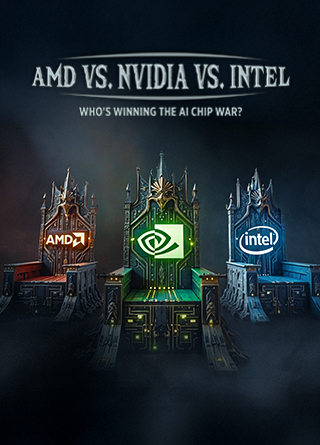
AMD Vs. NVIDIA Vs. Intel: Who's Winning The AI Chip War?
Share
Overview
Well, picture that amount of intelligence in a manufacturing setting. Machines can do the job, figure out when anything can go wrong, change processes on the fly, and talk to each other, without waiting for an engineer's input.
This is the world of smart manufacturing powered by Cyber-Physical Systems (CPS), and at its core lies advanced processing chips.
From robotic arms that inspect products in milliseconds to systems that optimize entire supply chains in real-time, the demand for quick, reliable, and efficient AI chips is exploding.
As factories become smarter, the question arises: which chipmaker is truly driving this transformation: NVIDIA, AMD, or Intel?
Keep reading this article to find out!
-(1)-206.jpg.aspx "TechDogs-\"AMD Vs. NVIDIA Vs. Intel: Who's Winning The AI Chip War?\"")
We often talk about automation, AI, and smart factories, but we rarely think about what’s powering all of it under the hood. Like watching a Formula 1 race where we can see the cars speeding by, but what wins the race is what's under the hood: the engine.
In the world of industrial AI, that “engine” is the chip, and the three major tech giants, NVIDIA, AMD, and Intel, are neck to neck.
Each brand has its unique strategy to dominate the future of manufacturing. One brings raw power, another offers a value-friendly balance, and the third leans on reliability and integration.
So, who's really ahead in this high-stakes chip war?
Let’s break it down in this article.
Why Are AI Chips Important?
As smart factories grow more advanced and machines take on more complex tasks, there’s a rising need for powerful processing chips, playing a key role in modern manufacturing setups built on Cyber-Physical Systems (CPS). They power automation, help robots make decisions on the spot, predict equipment issues before they happen, and keep robotic systems running smoothly.
Powerful chips are now handling huge amounts of data on the factory floor, right as things happen. This real-time processing helps factories work smarter, respond faster, and run more efficiently on their own. Whether it’s spotting defects as products move down the line or making quick decisions across the supply chain, these chips are doing more than just speeding things up.
So, which one the three great names in chip technology is actually leading the way when it comes to defining the future of manufacturing?
Let's take a closer look.
NVIDIA
-
Strengths In AI Workloads And GPUs
NVIDIA’s powerful GPUs have been the top choice for handling tasks like machine learning and deep learning for years. What really sets NVIDIA apart, though, is its CUDA software, an ecosystem that makes it easier for developers to get things done faster and efficiently. Over time, it’s become the standard that many in the industry rely on.
NVIDIA’s chips are especially useful for training complex large language models (LLM) and vision systems, which makes them a great fit for smart manufacturing, whether it’s inspecting products on the line, powering robotics, or fine-tuning operations.
NVIDIA is also known for its involvement in making digital twins in CPS-based manufacturing. Digital twins are like virtual replicas of industrial systems that enable teams test ideas, find problems early, and improve performance in real time. -
Industrial Partnerships And CPS Use Cases
NVIDIA’s growing influence in the industrial world isn’t just about its tech, it’s also about who they’re teaming up with. Big names like Siemens, BMW, and Foxconn are already weaving NVIDIA’s solutions into their manufacturing processes.
For on-the-ground factory use, NVIDIA’s Jetson series offers small, energy-efficient modules that bring powerful computing right to the production floor. This enables smarter systems, from autonomous robots to predictive systems in real time. -
Limitations
NVIDIA's technology is great, but it doesn't come cheap. Its processors need a lot of power and can be expensive, something that manufacturers need to keep a watch on. Also, NVIDIA's strengths are in GPU-based systems, so they might not be the ideal choice for every arrangement, especially if general-purpose processing or very low power utilization are more important.

AMD
-
Innovation In GPUs And AI Acceleration
AMD is making a powerful comeback in the world of chips. The company is becoming a major competitor in both AI training and routine processing operations with its new MI300 series. One of its big advantages is the open-source Radeon Open Compute (ROCm) software stack, designed to give developers more freedom and a more affordable alternative to NVIDIA’s CUDA platform.
In modern manufacturing setups, AMD chips are starting to gain traction for tasks like machine vision, factory data analysis, and AI-driven control systems, especially in scenarios where strong performance is needed, but keeping costs in check is just as important.
-
Adoption In Industrial CPS And Manufacturing Workflows
AMD’s chips are catching on in mid-sized manufacturing setups that need solid performance without sky-high costs. With a lower total cost of ownership and strong CPU-GPU integration, AMD offers a flexible option for industrial teams looking to get more without overspending.
AMD is also gaining ground in enterprise-level CPS systems by partnering with big names like TSMC, Lenovo, and Dell, bringing its chips to advanced manufacturing environments. -
Limitations
That said, AMD still has some catching up to do. NVIDIA’s ecosystem is more mature, and with so many developers already comfortable using CUDA, it’s tough for AMD to break into spaces where that’s the norm. Plus, while AMD is growing in the AI chip space, its GPU market share is still in the early stages, especially when it comes to AI-focused workloads.

Intel
-
Strength In General Purpose AI And CPUs For Edge
While NVIDIA and AMD focus mostly on GPUs, Intel is sticking to what it knows best: CPUs, but with a smart twist. Its Gaudi AI accelerators and Xeon Scalable processors come with built-in AI features, making them a strong choice for handling inferencing tasks right at the edge of the factory floor.
Intel’s OpenVINO toolkit takes things a step further by helping developers fine-tune and run AI models across different types of hardware, whether it’s CPUs, GPUs, FPGAs, or even VPUs, making edge performance more flexible and efficient.
For CPS setups, Intel’s strategy makes it possible to run AI models on existing systems—no need for high-end GPUs. That’s a big win for applications like smart PLCs, combining data from multiple sensors, and checking product quality in real time. -
Real-World CPS Applications And Industry Collaborations
Intel has been a trusted name in manufacturing for years. Its chips already run countless industrial controllers, automation tools, and embedded devices on the factory floor. By adding AI features to this well-established setup, Intel helps factories to adopt new tech without rebuilding everything they already have.
Add to that Intel’s emphasis on power efficiency and industrial-grade reliability, and you’ve got a solution that fits seamlessly into CPS environments, without the need for major system upgrades or complicated integrations. -
Where Intel Lags
Intel still has some problems to deal with. Its GPUs aren't quite as good as NVIDIA's or AMD's when it comes to training big AI models, making them less useful for high-end tasks. Intel's software tools have come a long way, but they, too, aren't as popular or easy to use for developers as CUDA or ROCm.
So, that brings us to the key question...

Who’s Winning The AI Chip War: Verdict By Use Case
So, who’s truly ahead in the AI chip war when it comes to manufacturing and Cyber-Physical Systems (CPS)?
The answer isn’t one-size-fits-all; it depends on the specific application and environment. Let’s find out.
-
Best For AI Training: NVIDIA
When it comes to training complicated AI models, NVIDIA is the best. Developers consider it because it has high-performance GPUs and the well-known CUDA program. NVIDIA's technology has the processing power and scalability needed for large-scale CPS applications, whether they are driving robotic vision, running digital twins, or providing predictive maintenance.
-
Best For Balanced Performance And Cost: AMD
AMD secures its position as the value-driven contender. For manufacturers looking to balance strong AI performance with budget constraints, AMD offers a compelling alternative. With a lower total cost of ownership compared to NVIDIA, AMD appeals to those seeking efficiency without compromise.
-
Best For Edge Deployment In Industrial CPS: Intel
Intel stands out when it comes to AI at the industrial edge. Its AI-enabled CPUs, such as the Xeon Scalable processors, are well-suited for real-time inferencing and lightweight AI tasks directly on the factory floor. Combined with the OpenVINO toolkit, Intel enables efficient deployment of AI models across a variety of devices without the need for dedicated GPUs. With a longstanding presence in industrial automation and embedded systems, Intel offers a familiar and reliable path for manufacturers integrating AI into their existing CPS infrastructure.

This is where we are right now, the the race is far from over!
Final Thoughts
The competition between AMD, NVIDIA, and Intel is more than just a battle of specifications; it's affecting how things are manufactured and how businesses come up with new ideas. The need for custom AI chip solutions will only grow as factories get smarter, more connected, and more independent.
These three leading chipmakers are changing the way manufacturing works by developing powerful AI models adnd chips, applying real-time inferencing at the edge, and building smarter CPS systems.
For plant managers, engineers, and tech leaders, the question isn't "Who's winning?"
It's "Who's the right fit for us?"
Frequently Asked Questions
What Is The Role Of AI Chips In Smart Manufacturing?
AI chips power real-time decision-making, automation, and predictive maintenance in smart factories, enabling machines to process large volumes of data and operate independently.
Who Are The Major Competitors In The AI Chip Market?
Nvidia, AMD, and Intel are the top contenders in the AI chip space, each offering unique strengths across AI training, edge computing, and industrial applications.
Which AI Chipmaker Is Best For CPS Applications?
It depends on the use case: Nvidia for training, AMD for balanced cost-performance, and Intel for edge deployment in Cyber-Physical Systems.
Tue, Aug 5, 2025

Liked what you read? That’s only the tip of the tech iceberg!
Explore our vast collection of tech articles including introductory guides, product reviews, trends and more, stay up to date with the latest news, relish thought-provoking interviews and the hottest AI blogs, and tickle your funny bone with hilarious tech memes!
Plus, get access to branded insights from industry-leading global brands through informative white papers, engaging case studies, in-depth reports, enlightening videos and exciting events and webinars.
Dive into TechDogs' treasure trove today and Know Your World of technology like never before!
Disclaimer - Reference to any specific product, software or entity does not constitute an endorsement or recommendation by TechDogs nor should any data or content published be relied upon. The views expressed by TechDogs' members and guests are their own and their appearance on our site does not imply an endorsement of them or any entity they represent. Views and opinions expressed by TechDogs' Authors are those of the Authors and do not necessarily reflect the view of TechDogs or any of its officials. While we aim to provide valuable and helpful information, some content on TechDogs' site may not have been thoroughly reviewed for every detail or aspect. We encourage users to verify any information independently where necessary.
Loading comments...