Social Media
Social Media Marketing Trends Brands Must Know In 2026
Share
TL;DR
-
Email Marketing and Automation: Automated email flows drive 37% of all email revenue despite being just 2% of total sends.
-
AI Personalization at Scale: 73% of business leaders believe AI will fundamentally change personalization strategies (Involve.me). 91% of consumers say they enjoy shopping with brands that give relevant recommendations. AI-driven personalization boosts email revenue by 41% and CTR by 13.44%.
-
Short-Form Video: 91% of businesses use video as a marketing tool in 2026 (Wyzowl). Short-form video delivers the highest ROI of all content formats (HubSpot State of Marketing 2026). 82% of people say watching a video has influenced their purchasing decisions.
-
Community-Centric Marketing: 64% of consumers stay loyal to a brand because they share the same values (Cropink). 92.3% of brands see a positive impact from their communities (Aspire). Community-first platforms are overtaking passive follower growth as the primary engine of brand loyalty.
-
Social Commerce: 53% of global users now make purchases directly through social media platforms.
Introduction
In Ratatouille, Remy the rat operates invisibly from beneath, guiding Linguini's cooking with precise pulls and adjustments, translating instinct into extraordinary results while the audience only sees the effortless dish. In 2026, social media marketing works the same way. AI is Remy: invisible, essential, working beneath every campaign to guide timing, personalization, tone, and targeting. The best social media strategies of 2026 are the ones where the audience can't see the intelligence behind them; they just feel the connection.
Social media is where trends bloom overnight and fade just as fast. Creators are experimenting with stories in exciting ways, platforms are changing how we connect, and audiences are constantly seeking something fresh. In 2026, the hidden layer is smarter than ever, and the brands that understand it will move with precision that their competitors can't match.
Here are the top five social media marketing trends to follow in 2026.
Trend 1: Email Marketing And Automation Will Make Every Inbox Personal And Engaging
Until 2025, email marketing was already holding its ground. Brands were using newsletters, promotions, and automated follow-ups to keep in touch with their audience. Automation saved time, and segmentation helped target the right people. However, most emails still felt somewhat generic and lacked a personal touch.
In 2026, email marketing is getting a serious upgrade. Hyper-personalization is now the norm, as AI helps craft personalized messages. Interactive emails are transforming inboxes into mini-experiences through polls, quizzes, and shoppable content. With privacy and data ethics shaping strategy, personalization now comes with trust built in. Emails are also integrated with social media, different apps, and other marketing channels, making campaigns smarter and more seamless.
How Is The Industry Responding?
Email remains the channel that quietly outperforms everything else. Automated email flows now drive 37% of all email revenue despite being just 2% of total sends, and email marketing generates $36–$40 for every $1 spent, a 3,600%–4,000% ROI (Omnisend/Statista). With 4.5 billion people using email in 2025, expected to grow to 4.8 billion by 2027, the inbox is the most reliable real estate in digital marketing.
According to Omnisend, automated email campaigns generate nearly 40% of email revenue, even though they represent only about 3% of total sends. Emails with images see a 30% open rate compared to 22% for text-only, proving that visuals grab attention.
Jacob Hanson from Twilio SendGrid highlighted: "Marketing automation is more than just automating portions of your marketing process because it provides valuable data points that allow marketers to determine who to target within their list of leads with varying outreach methods."
The shift is clear: In 2026, email is not the old-school channel brands depict it as; it is the highest-ROI channel in the stack. The difference between brands succeeding with email and those struggling is automation depth, personalization precision, and integration with the broader marketing ecosystem.
Challenges To Watch
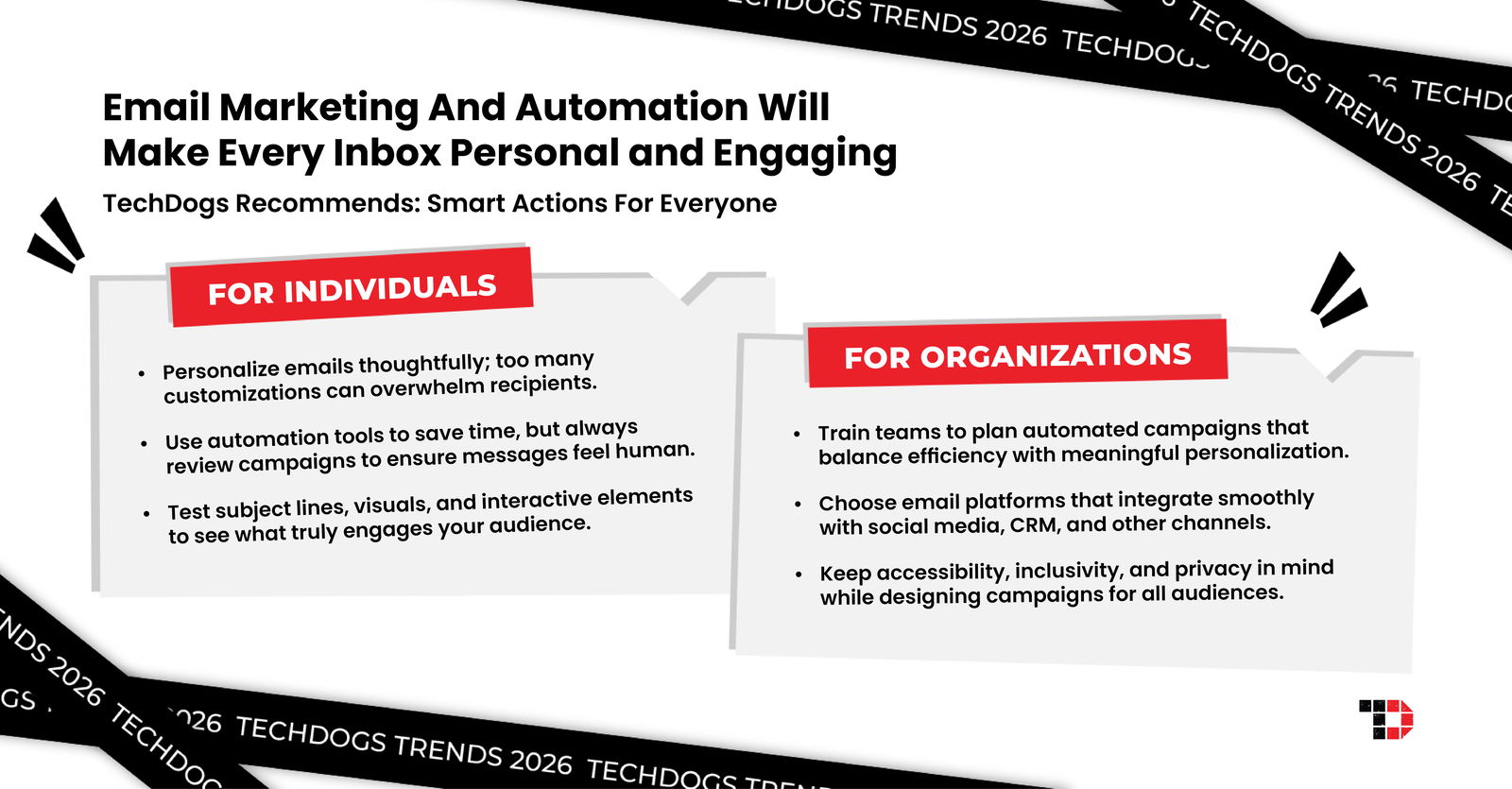
Even with the upgrades, email marketing comes with hurdles. Too much personalization can feel overwhelming. Making fresh content takes constant effort, and getting emails past crowded inboxes is not always easy. Privacy rules demand careful handling of data, and connecting emails seamlessly with social media and other channels can be tricky.
TechDogs Recommends: Smart Actions For Everyone
Trend 2: Personalized Marketing With AI Will Deliver Personal Experiences At Scale
This is the Remy layer. AI analyzes SEO signals, browsing habits, social activity, and even customer service interactions to deliver content that feels designed for each person individually, while the marketer focuses on strategy and storytelling. What Remy does for the kitchen, AI does for the campaign: producing extraordinary results from precisely the right ingredients at exactly the right moment.
Tools like ChatGPT, Canva, and Midjourney are helping marketers create content faster and more creatively. Personalization has evolved from adding a first name to delivering experiences that adapt to each person's journey in real time.
How Is The Industry Responding?
According to Involve.me, 73% of business leaders believe AI will fundamentally change personalization strategies. 91% of consumers also say they enjoy shopping with brands that give relevant offers and recommendations, proving that smarter, personalized experiences directly drive loyalty and revenue.
Meta's CEO Mark Zuckerberg has emphasized AI's role in marketing, noting that integrating AI into marketing efforts is essential for delivering personalized experiences that drive results. AI-driven personalization has been shown to boost email revenue by 41% and improve click-through rates by 13.44%.
What this means in practice: in 2026, AI is not a creativity replacement; it is a creativity amplifier. The marketers gaining the most from AI are those who use it to scale what they're already doing well: sharper targeting, faster iteration, and more relevant content across every channel. The intelligence stays invisible. The results don't.
Challenges To Watch
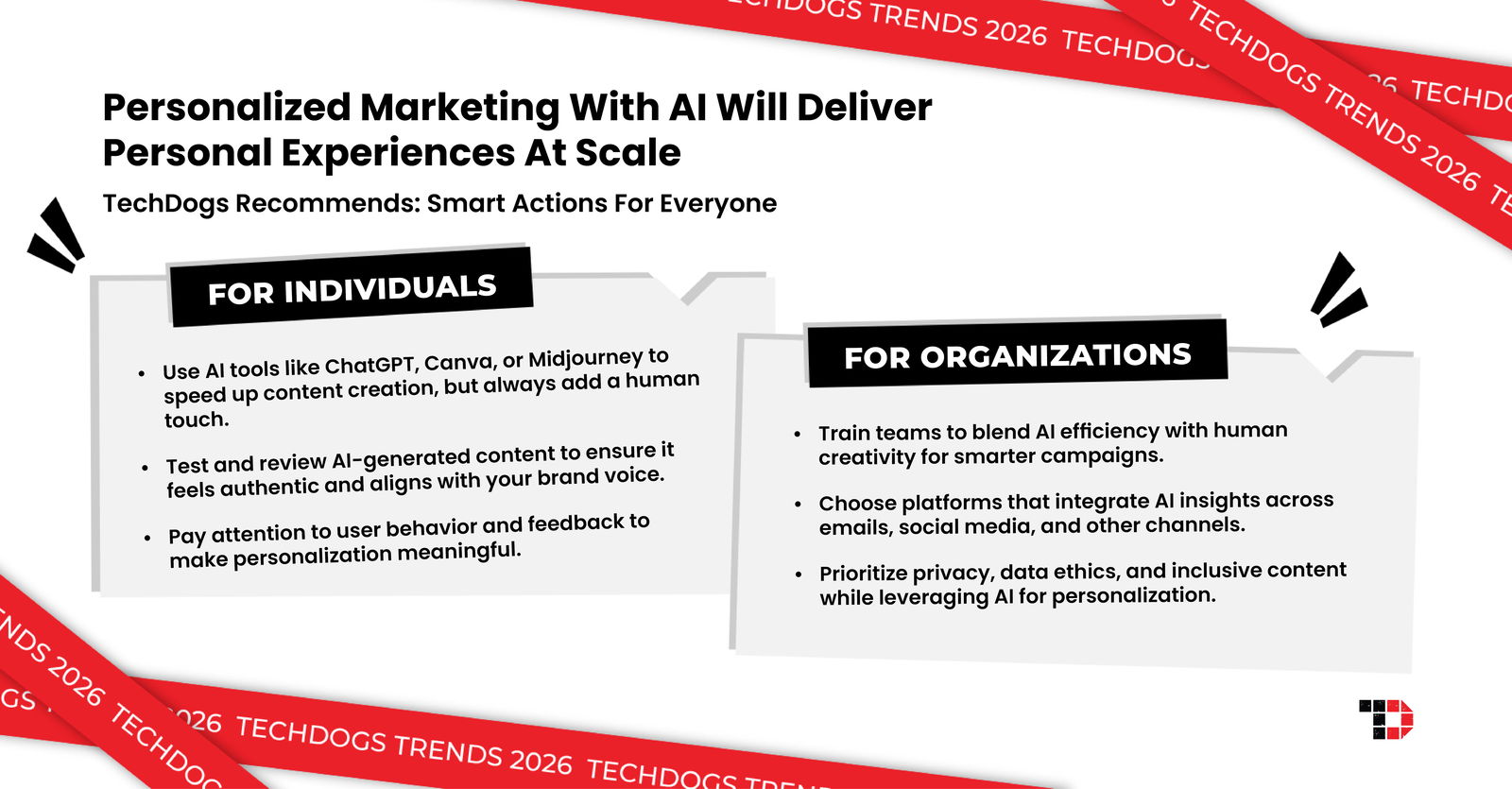
AI-powered content creation and personalization come with challenges. Too heavy a reliance on AI can make content feel robotic. Privacy and data ethics are critical to making AI insights work responsibly across emails, social media, and other channels. Balancing speed, creativity, and trust is the core challenge for marketers in 2026.
TechDogs Recommends: Smart Actions For Everyone
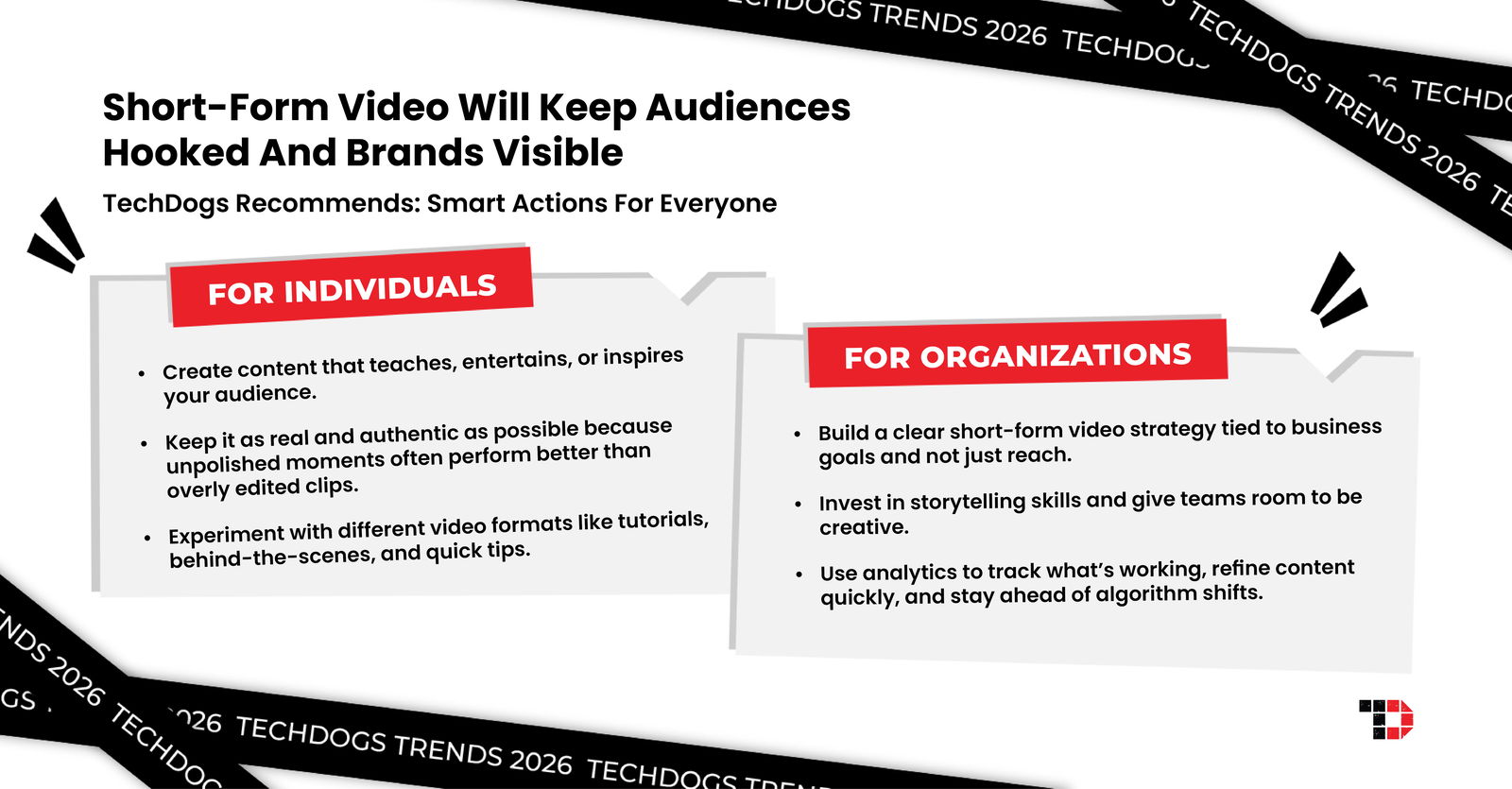
Trend 3: Short-Form Video Will Keep Audiences Hooked And Brands Visible
Short-form video has been dominating social media for a few years. Platforms like TikTok, Instagram Reels, and YouTube Shorts made quick, snackable content the norm. In 2026, it's no longer about volume. Every clip needs to deliver value. Shoppable videos, storytelling, and educational content are becoming essential, while authenticity and alignment with the audience drive engagement. Short-form video is now a central way to show creativity with strategy and turn each second into an opportunity to connect, inspire, and convert.
How Is The Industry Responding?
The numbers confirm short-form video's dominance. According to HubSpot's 2026 State of Marketing Report, short-form video delivers the highest ROI of all content formats. Wyzowl reports that 91% of businesses use video as a marketing tool in 2026. Over 82% of people say watching a video has influenced their purchasing decisions. Among content formats, short-form video has the highest ROI and engagement, and 63% of marketers say their video strategy will increase in 2026.
Gaurav Jain, former Chief Business Officer of ShareChat and Moj, noted that corporate professionals need to adapt to this change and make short-form video a go-to medium for connecting with both prospective and existing consumers. He highlights that short-form videos are no longer just an emerging trend but a powerful tool for storytelling and engagement.
The reality is this: with short-form video delivering the highest ROI across all content formats and 91% of businesses using video in their strategy, the question in 2026 is not whether to invest in video but whether your video strategy is tied to actual business goals rather than just reach and virality. Every clip should serve a purpose beyond a view count.
Challenges To Watch
Standing out in crowded feeds is tough, and producing creative and meaningful content takes time and resources. Algorithms change constantly, so what works today may not work tomorrow. Balancing entertainment with strategy and ensuring videos drive real engagement and results without feeling forced remains the central challenge.
Topics For More Insights
TechDogs Recommends: Smart Actions For Everyone
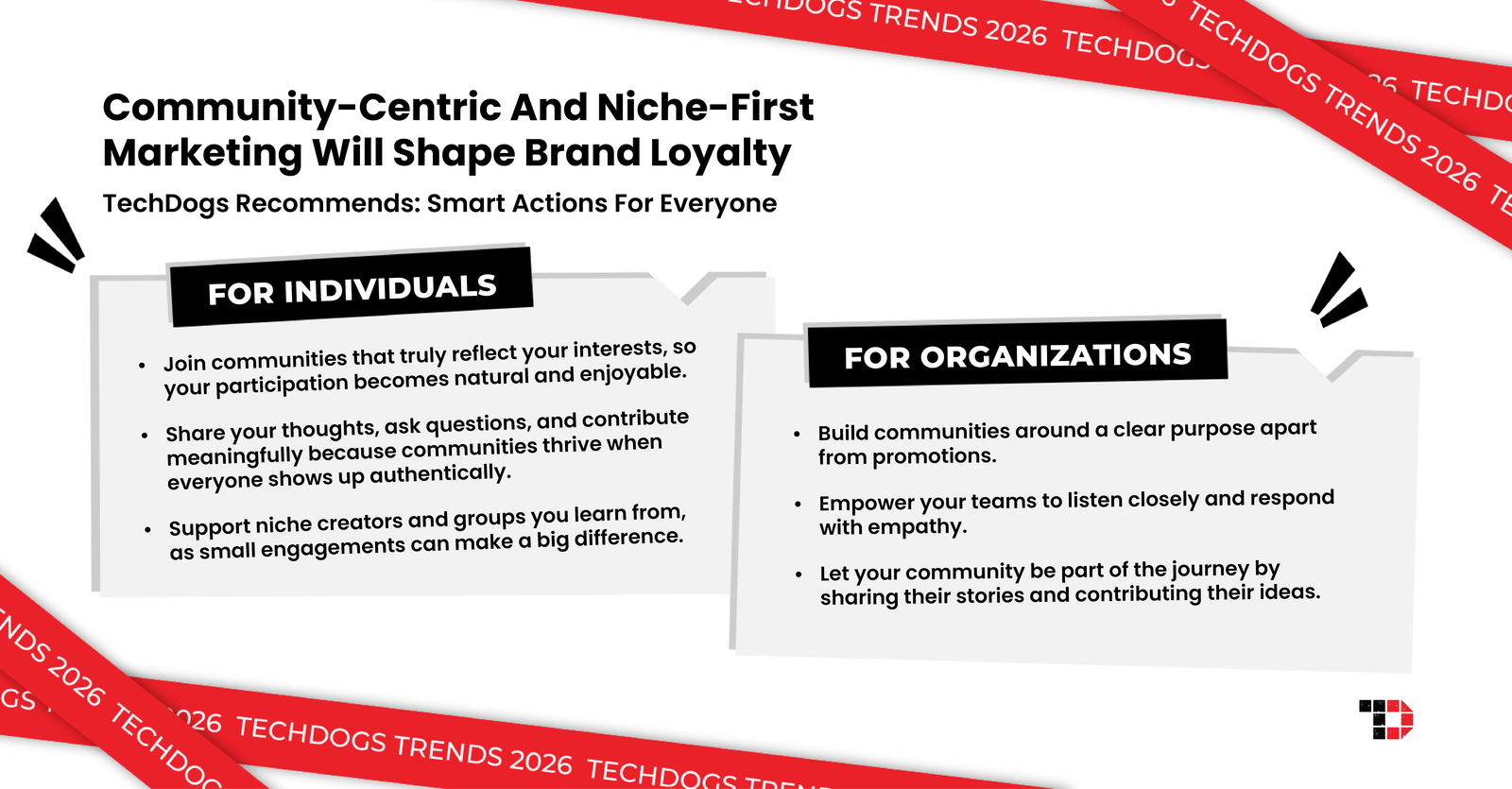
Trend 4: Community-Centric And Niche-First Marketing Will Shape Brand Loyalty
Social media is like a big public square, loud, open, and crowded. Yet people are finding comfort in smaller corners of the internet where they can speak freely, share honestly, and connect with others who understand their interests. That's why 2026 places communities at the center of marketing. Whether it's a private group, a creator who understands a very specific audience, or a niche space built around shared passions, people are choosing depth over reach.
When you show up in the right community with respect, warmth, and a desire to contribute, people notice. They remember how you made them feel, and that feeling becomes loyalty. This trend is about listening more than speaking, understanding instead of assuming, and choosing relationships over numbers.
How Is The Industry Responding?
According to Cropink, 64% of consumers stay loyal to a brand because they share the same values. With Aspire reporting that 92.3% of brands see a positive impact from their communities, community-building is becoming the foundation of lasting loyalty, not just a campaign tactic.
Pratik Gupta, Founder of FoxyMoron and Zoo Media, put it directly: "There are brands that want to build communities but are throwing short-term campaigns at a long-term problem. A community needs consistent focus, a clear purpose, and genuine participation. To be part of a community, a brand must genuinely belong. Participating or nurturing a community is not the same as sponsoring it. Your brand personality, tone, and ethos must align with the community's purpose."
The advantage is shifting to brands that treat community as infrastructure rather than a campaign. With 64% of consumers loyal because of shared values and 92.3% of brands seeing measurable community impact, the organizations investing in genuine belonging rather than broadcast reach are building the kind of loyalty that no algorithm change can disrupt.
Challenges To Watch
Building a community does not happen overnight. It takes time, consistency, and genuine participation beyond campaigns. Keeping conversations active, managing diverse expectations within a group, and striking the right balance between guiding a community and letting it grow naturally are all ongoing challenges.
TechDogs Recommends: Smart Actions For Everyone
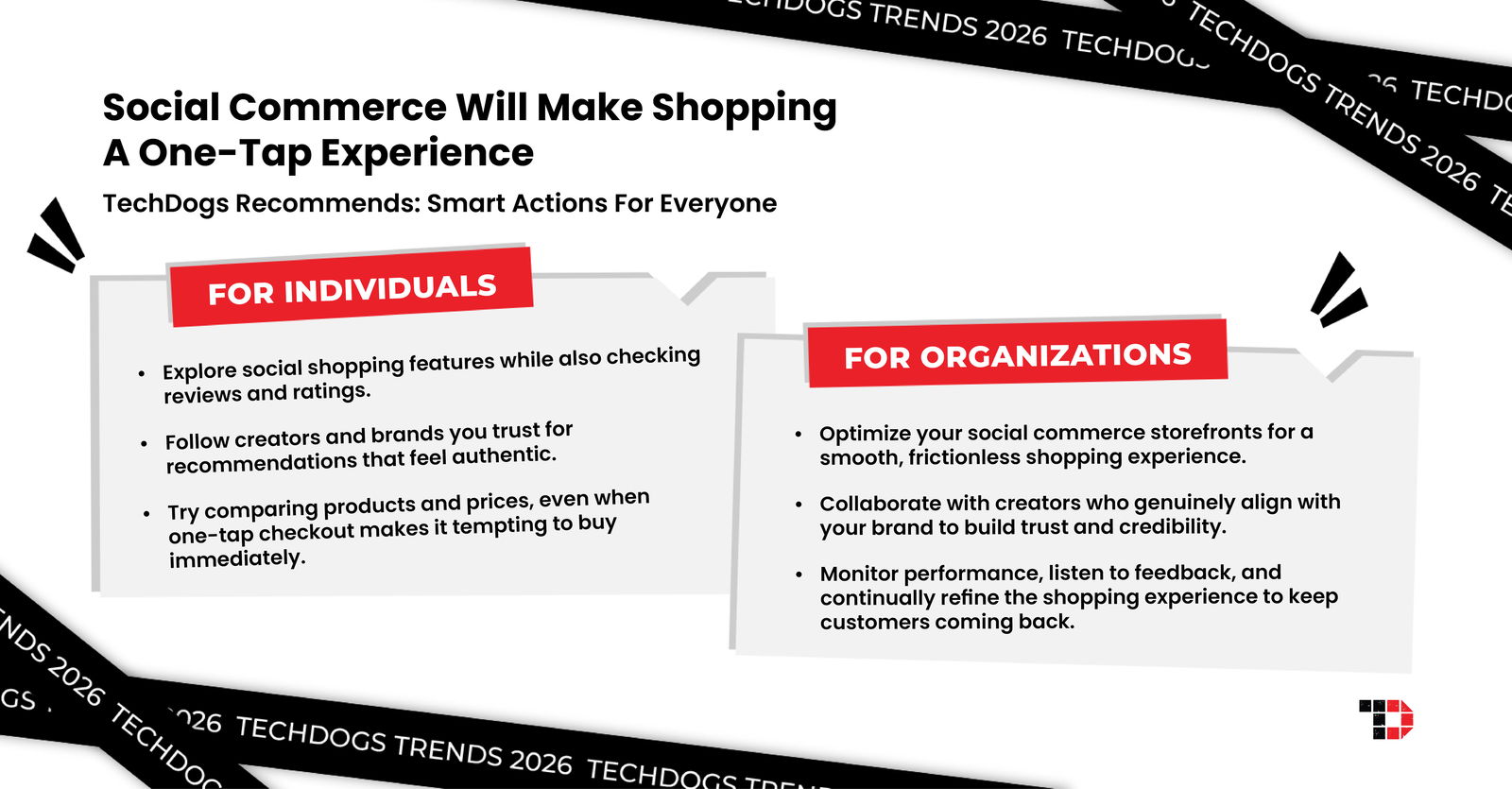
Trend 5: Social Commerce Will Make Shopping A One-Tap Experience
For years, social media was a platform where people discovered products and then purchased them elsewhere. In 2026, that gap has closed. When people already trust a platform and spend hours on it each day, it naturally becomes a go-to place for shopping. AR try-ons, 'shop the look' tags, live shopping sessions, and one-click checkout have turned interest into instant conversion. TikTok Shop, Meta Checkout, and Pinterest Catalogs are no longer experiments; they are everyday shopping tools. Content has become the storefront.
How Is The Industry Responding?
The scale of the opportunity is significant. According to Mordor Intelligence, the social commerce market was valued at $1.63 trillion in 2025, growing to $2.11 trillion in 2026 and projected to reach $7.55 trillion by 2031 at a 29.12% CAGR. In the U.S. alone, eMarketer confirms that social commerce sales will surpass $100 billion for the first time in 2026. According to Hostinger, 53% of global users now make purchases directly through social media platforms like Facebook, Instagram, and TikTok.
Michelle Grant, Director of Retail Strategy and Insights at Salesforce, shared: "Social commerce is the latest channel for digital spending that is fragmenting across a constellation of marketplaces, retailer websites, brand sites, and delivery apps, rather than consolidating into a single channel." Grant also added: "Brands that fully embrace their potential will be in a prime position to capture their share of the growing Gen Z market."
The takeaway for brands: at $2.11 trillion in 2026 and accelerating toward $7.55 trillion by 2031, social commerce is no longer a supplement to e-commerce; it is becoming the primary discovery-to-purchase channel for an entire generation. Hyper-personalized recommendations, live shopping, and one-tap checkout are compressing the funnel into a single scroll. The brands positioned to capture this will have invested in seamless social storefronts today.
Challenges To Watch
Even with one-tap shopping, users still need trust and transparency to feel confident. Hyper-personalized recommendations can sometimes feel intrusive. Payment issues or unreliable gateways can disrupt the seamless experience, especially in emerging markets. Brands also face growing competition and creator-driven promotion fatigue.
TechDogs Recommends: Smart Actions For Everyone
Conclusion
At the end of Ratatouille, it's not the complexity of the dish that moves the critic, it's the authenticity behind it. The best campaigns of 2026 will work the same way. The intelligence is invisible, but the connection is real.
Social media has evolved from a space for connection to a dynamic ecosystem where communities, content, and commerce coexist. Email delivers the highest ROI in the stack. AI makes personalization feel human. Short-form video drives the best engagement and conversion. Community builds the loyalty that algorithms can't disrupt. And social commerce turns the scroll into the sale.
The brands that listen, adapt, and evolve with these shifts will define this season. The question isn't whether the trends are real; the data makes that clear. The question is whether your strategy is already moving with them.
Frequently Asked Questions
What Are The Top Social Media Marketing Trends In 2026?
Top social media marketing trends in 2026 include hyper-personalized email marketing, AI-driven content, short-form videos, community-centric marketing, and seamless social commerce for instant buying experiences. With social commerce growing to $2.11 trillion in 2026 and short-form video delivering the highest ROI across all content formats (HubSpot 2026), the brands that integrate these five trends into a unified strategy will outperform those treating them as separate initiatives.
What Is Social Commerce And Why Does It Matter?
Social commerce enables users to shop directly within social platforms, providing a seamless experience that converts content into instant purchasing opportunities. At $2.11 trillion in 2026 and growing to $7.55 trillion by 2031, and with U.S. sales surpassing $100 billion for the first time this year (eMarketer), social commerce has crossed from emerging channel to primary purchase pathway for Gen Z and millennial consumers.
How Is AI Transforming Marketing Personalization?
AI analyzes user behavior and preferences to deliver tailored content, recommendations, and experiences, making campaigns more engaging and relevant for every individual. With 73% of business leaders believing AI will fundamentally change personalization strategies and AI-driven personalization boosting email revenue by 41%, the transformation is already measurable. The challenge in 2026 is ensuring that the intelligence behind every interaction stays invisible, and the human connection stays real.
Tue, Nov 18, 2025

Enjoyed what you've read so far? Great news - there's more to explore!
Stay up to date with the latest news, a vast collection of tech articles including introductory guides, product reviews, trends and more, thought-provoking interviews, hottest AI blogs and entertaining tech memes.
Plus, get access to branded insights such as informative white papers, intriguing case studies, in-depth reports, enlightening videos and exciting events and webinars from industry-leading global brands.
Dive into TechDogs' treasure trove today and Know Your World of technology!
Disclaimer - Reference to any specific product, software or entity does not constitute an endorsement or recommendation by TechDogs nor should any data or content published be relied upon. The views expressed by TechDogs' members and guests are their own and their appearance on our site does not imply an endorsement of them or any entity they represent. Views and opinions expressed by TechDogs' Authors are those of the Authors and do not necessarily reflect the view of TechDogs or any of its officials. While we aim to provide valuable and helpful information, some content on TechDogs' site may not have been thoroughly reviewed for every detail or aspect. We encourage users to verify any information independently where necessary.
Loading comments...