Digital Marketing
Search Engine Marketing Trends To Boost ROI In 2026
Share
TL;DR
-
Zero-Click Search: 58.5% of U.S. searches and 59.7% of EU searches end without a click (Semrush 2024). Searches triggering AI Overviews show an 83% zero-click rate (Bain-Dynata). Gartner predicts a 25% drop in traditional search volume by the end of 2026 due to AI chatbots. AI Overviews triggered queries grew from 6.49% in January 2025 to 13.14% in March 2025.
-
AI-Powered Search Campaigns: Google commands 90%+ of the global search market share. L'Oreal Chile saw a 2X higher conversion rate at a 31% lower cost-per-conversion with AI Max. MyConnect drove 16% more leads at a 13% lower CPA and a 30% increase in conversions.
-
Conversational Search and Voice: 58% of users aged 25–34 use voice search daily (Semrush). 70% of Google Assistant queries are in conversational format (Google). Domino's and Wingstop have integrated region-specific AI voice ordering with accent adaptation to make interactions feel natural.
-
Visual Search: IKEA's Kreativ tool boosted Gen Z engagement with 2x longer sessions. Sephora achieved an 80% increase in conversion rates. ASOS achieved 35% faster product discovery, with visual search accounting for more than 10% of app-based purchases. 62% of Gen Z prefer visual search.
-
Retail Media Networks (RMNs): 65% of global marketers say RMNs will play a larger role in their media mix (Nielsen).
Introduction
In Indiana Jones and the Last Crusade, Indy faces his most difficult test: a leap of faith across an invisible bridge. He can't see where he's going. He has no guarantee the path will hold. But he has to step forward anyway, because the bridge only reveals itself to those who commit. That's exactly what SEM looks like in 2026. Zero-click means you have to be visible without knowing if the click will come. AI campaigns automate paths you can't fully see. Conversational search requires following the user's lead. Visual search reveals intent before a single word is typed. And retail media places your brand at the moment of buying. Every trend requires stepping forward before the path is fully visible.
We already know that AI is enhancing industries and workflows worldwide. Going into 2026, AI is playing a key role in how users are served content on search engines. This includes enabling capabilities such as conversational voice search, zero-click search experiences, and visual search, and establishing retail media networks as a key player.
In 2025, marketers embraced AI as a co-pilot. It laid the foundation for personalized searches, the phasing out of third-party cookies, the emergence of zero-click searches as a mainstream strategy, and the rise of semantic search.
The five trends below define what SEM looks like when that leap of faith becomes a strategy. The invisible bridge has been there all along. The question is whether you're willing to step onto it.
Trend 1: Zero-Click Search Strategy Will Render Clicks Obsolete
Do you feel like users don't visit your site anymore? You may not be completely wrong.
In 2026, zero-click searches let users find answers directly on the SERP (Search Engine Result Page) without clicking through to a website. These snippets, initially called SGE (Search Generative Experience) and now labeled 'AI Overview', are generated at the top of the page when a user searches for a query, condensing information into a digestible but informative form. They come with reference links highlighting the sources from which Overviews draws its information.
This is the invisible bridge. The content that earns an AI Overview citation builds brand presence, trust, and recall, even without the click. The brands stepping forward and optimizing for inclusion are already visible in places their competitors haven't even looked.
How Is The Industry Responding?
According to Semrush, in 2024, 58.5% of U.S. searches and 59.7% of EU searches didn't result in a click. Semrush also noted that AI Overviews grew, with triggered queries rising from 6.49% in January 2025 to 13.14% in March 2025.
Searches triggering AI Overviews now show an average zero-click rate of 83% (Bain-Dynata Generative AI Consumer Survey). Gartner also predicts a 25% drop in traditional search engine volume by the end of 2026 due to AI chatbots and virtual agents. In Google's AI Mode, 93% of sessions end without leaving the search interface, integrating its AI chatbot capabilities into Search for advanced reasoning and multimodality.
In an interview with Search Engine Journal, Google's VP of Search Liz Reid revealed that AI Overviews favors content that's "richer and deeper," reflects "human perspective," is "unique," and exhibits the creator's "perspective" and/or "expertise." Reid said, "People want content from that human perspective. They want that sense of like, what's the unique thing you bring to it? And actually, what we see on what people click on in AI Overviews is content that is richer and deeper."
These requirements are leading businesses to rethink their content strategy. Publishers are optimizing content specifically designed as snippets and shifting success metrics from CTR to SERP impression visibility and engagement.
The shift is clear: in 2026, visibility and traffic are no longer the same metric. A brand can appear prominently in search results and receive zero referral traffic from that appearance. The SEM teams winning in this environment are the ones that have already rethought what 'success in search' means, measuring citation share, AI Overview inclusion, and brand awareness, not just clicks.
Challenges To Watch
AI Overviews can misfire on satirical content, presenting it as genuine information. Fan-generated content and outdated data can also fill gaps for new products with limited search history, leading to speculative or irrelevant results.
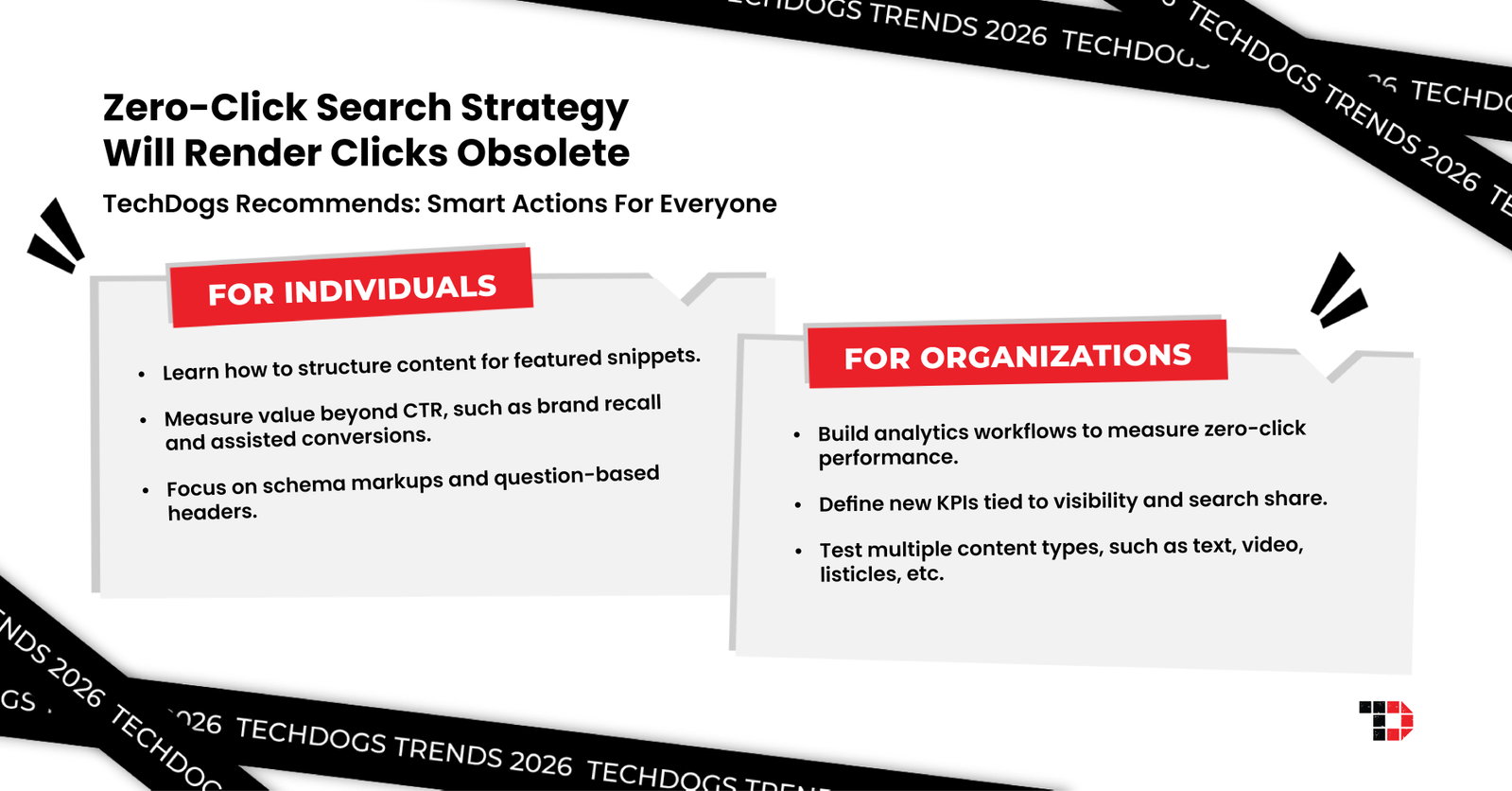
TechDogs Recommends: Smart Actions For Everyone
Trend 2: AI-Powered Search Campaigns Will Optimize Personalized Search
AI-driven SEM isn't new. However, in 2026, its capabilities are upgraded with a new set of tools, especially for SEM ad campaigns. Google's portfolio of AI tools helps businesses personalize marketing strategies across various media and platforms beyond simple text-based SERPs, including ads displayed on YouTube (subscribe to us already!), Display, Search, Discover, Gmail, and Maps, supported by GenAI capabilities.
How Is The Industry Responding?
Marketers are no longer just automating bid strategies; they're automating campaign orchestration, spearheaded by tools such as Google's AI Max for Search, Performance Max, and Demand Gen. With Google commanding 90%+ of the global search market share, its internal tools will naturally perform best.
These tools automate bidding, targeting, and creative generation using machine learning (ML), high-quality assets, and first-party advertiser data. L'Oréal used AI Max to find new search opportunities and enjoyed a 2X higher conversion rate at a 31% lower cost-per-conversion. Utility connection company MyConnect drove 16% more leads at a 13% lower cost-per-action and a 30% increase in conversions.
"AI Max not only allowed us to pioneer the use of AI in Search, but it also propelled us into new markets, reaching untapped audiences with lower costs, higher conversions, and more relevant ad experiences that significantly boosted engagement," said Nicolás Moya, CMO at L'Oréal Chile.
What this means in practice: AI campaign tools are no longer just bidding optimizers; they are campaign architects. The marketers who invest in understanding what the AI is doing, supplying it with high-quality assets and clean first-party data, and retaining strategic oversight of creative direction will consistently outperform those who either ignore AI or hand it the wheel with no guardrails.
Challenges To Watch
AI systems aren't always transparent. Cultural influences can cause unexpected shifts, leaving marketers with limited visibility into decision-making logic and leading to trust and compliance concerns. Over-reliance on AI may also stifle creative experimentation, leading to generic ad strategies.
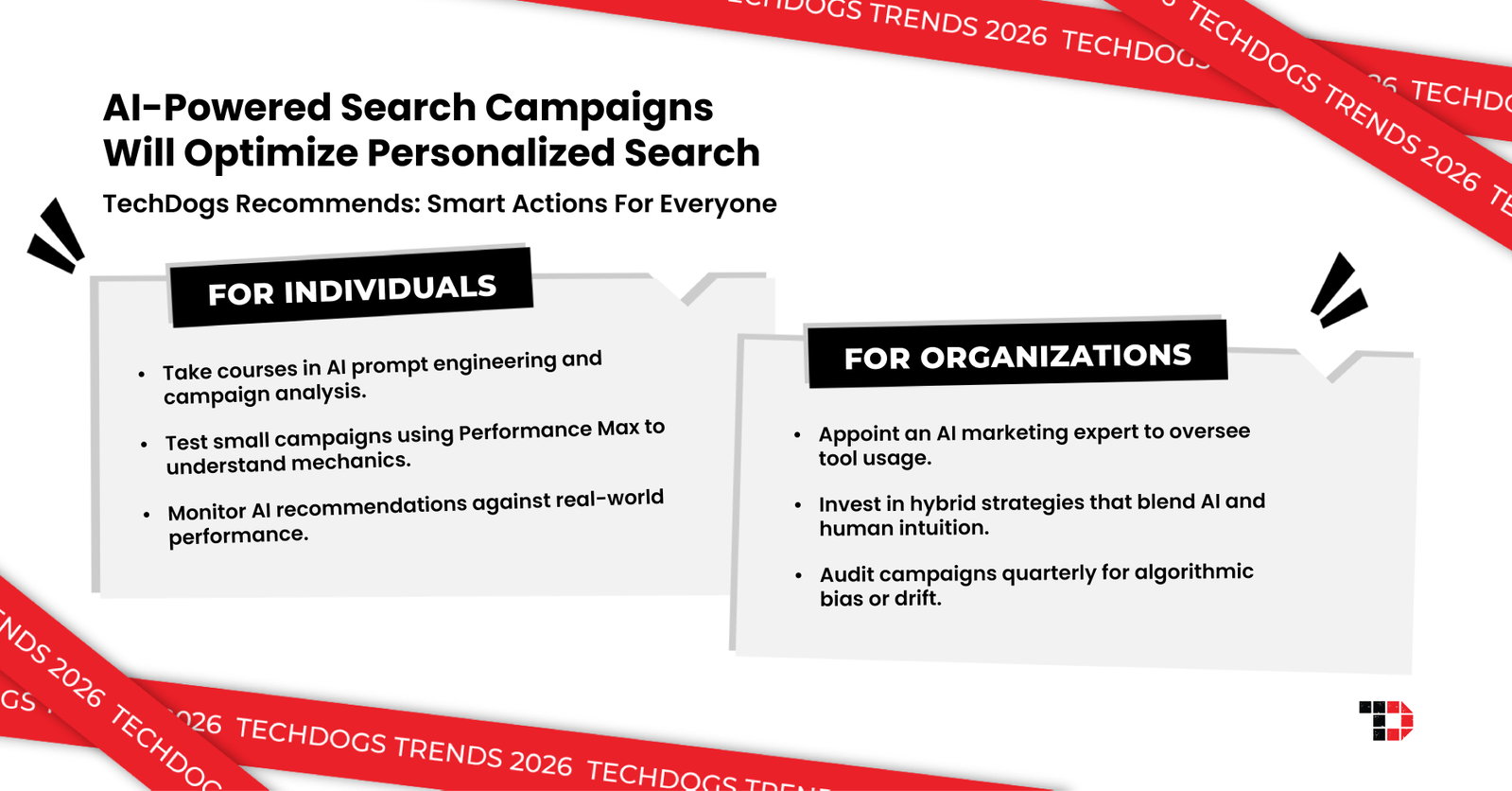
TechDogs Recommends: Smart Actions For Everyone
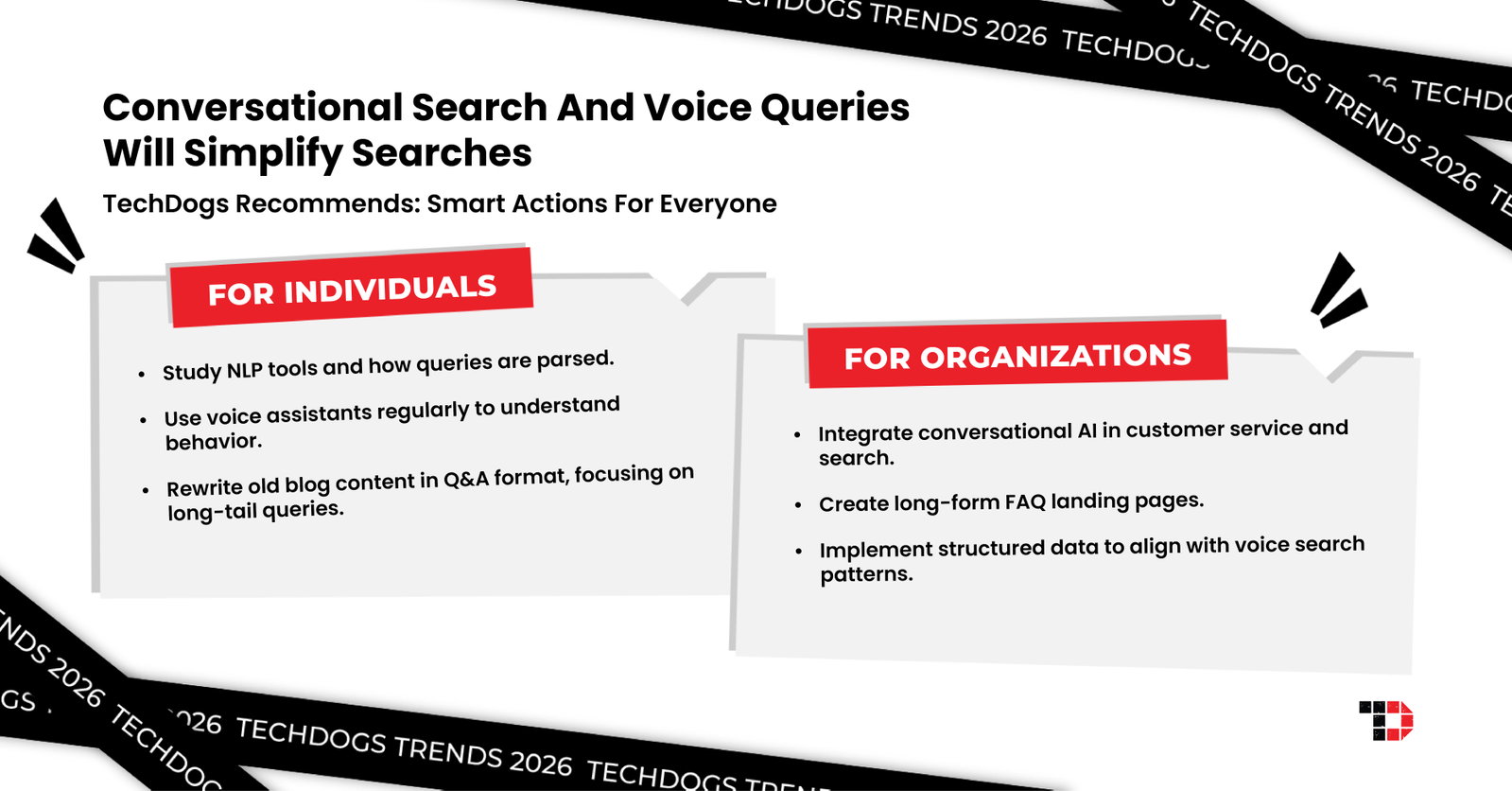
Trend 3: Conversational Search And Voice Queries Will Simplify Searches
The era of keyword searching is fading. Seekers now ask full questions in conversational formats. Search engines can now not only answer such queries but carry on complete conversations with follow-up questions, all with a high level of personalization. This comes courtesy of GenAI, which can interpret intent and generate answers to long-form, contextual, or incomplete queries.
How Is The Industry Responding?
It's not just Google Search that delivers this capability; it's also AI assistants such as Gemini, Copilot, Siri, and Alexa. Individual companies can build tailored AI assistants that offer services across their websites and apps by partnering with AI providers such as OpenAI, Google, Meta, Microsoft, and Anthropic.
Semrush found that 58% of users aged 25–34 use voice search daily, and 58% of U.S. smartphone users use voice search to find information about a product or service. Google reports that 70% of queries on Google Assistant were in a conversational format.
Domino's and Wingstop have used AI voice assistants to take orders and chat with customers, integrating region-specific accents to make conversations feel more natural.
Lily Clifford, CEO and founder of Rime Labs (the maker of the text-to-voice model used by Domino's and Wingstop), said: "If someone hears a really off-putting, unrelatable voice, they're going to hang up." He added: "It should sound like someone who could work at Domino's and not someone who is a 20th-century American broadcast radio announcer."
As such, marketers are going beyond simply optimizing web content for search engines, rewriting ad copy in question-and-answer formats, and building campaigns that leverage conversational capabilities. Search engines favoring paragraph-based answers now reward brands that use structured FAQs, schema, and NLP-optimized content.
The reality is this: voice search isn't just a format shift, it is a strategy reset. With 58% of adults aged 25–34 using voice daily and 70% of Assistant queries in conversational format, brands that still write content as if users type three-word keywords are already invisible to a large and growing segment of their audience.
Challenges To Watch
Conversational search requires a radical shift in keyword strategy, from short-tail to semantic and long-tail targeting. Voice data privacy and consent frameworks are also still evolving, which could pose compliance risks.
Topics For More Insights
TechDogs Recommends: Smart Actions For Everyone
Trend 4: Visual Search Will Drive Product Sales
Snap. Search. The future of SEM is shifting away from keyword-based ranking toward visual searches and reliance on image signals, alt text, metadata, and contextual content.
Visual search allows users to search for products or gather information using images instead of keywords. Google Lens identifies objects and elements; Pinterest Lens surfaces ideas on styles and aesthetics; Amazon's visual search powers shopping; Snapchat links barcodes to product info. Visual search finds critical applications across retail, fashion, furniture, home decor, travel, automotive, food and beverage, and healthcare.
How Is The Industry Responding?
E-commerce is one of the biggest beneficiaries. e-commerce brands are some of the biggest adopters of visual search. See a product you like but don't know where to buy it? Just take a picture and search. IKEA's Kreativ is an AI-powered, AR-delivered visual search and room-planning tool that lets users scan their rooms with a smartphone and digitally insert furniture. The move boosted Gen Z engagement and enabled 2x longer sessions.
Similarly, Sephora achieved an 80% increase in conversion rates and reduced returns, while ASOS achieved 35% faster product discovery and increased Gen Z conversion, with visual search queries accounting for more than 10% of app-based purchases.
Visual search is very popular among Gen Z: 62% prefer it, and 36% of online shoppers have used it. Meanwhile, Ray-Ban Meta smart glasses represent how visual search is moving from phones to wearables, turning everyday eyewear into search interfaces.
To rank higher in visual search, brands have begun renaming image files with keyword-rich filenames rather than generic ones, for example, "purple-bag-white-shoes-gym" instead of "IMG-4769." Clear alt text and descriptive image metadata also perform well in visual search ranking.
The advantage is shifting to brands that treat their image library as a search asset, not just a design asset. With 62% of Gen Z preferring visual search and ASOS seeing visual queries account for 10%+ of app purchases, the product images that rank will drive conversions that keyword campaigns can't reach.
Challenges To Watch
AI bias can lead to inconsistent image recognition accuracy, legal risks, copyright infringement, and privacy concerns. Optimizing for visual search also requires reworking product databases and content libraries, which can be time-intensive. Comprehensive tagging and ethical design practices can mitigate many of these issues.
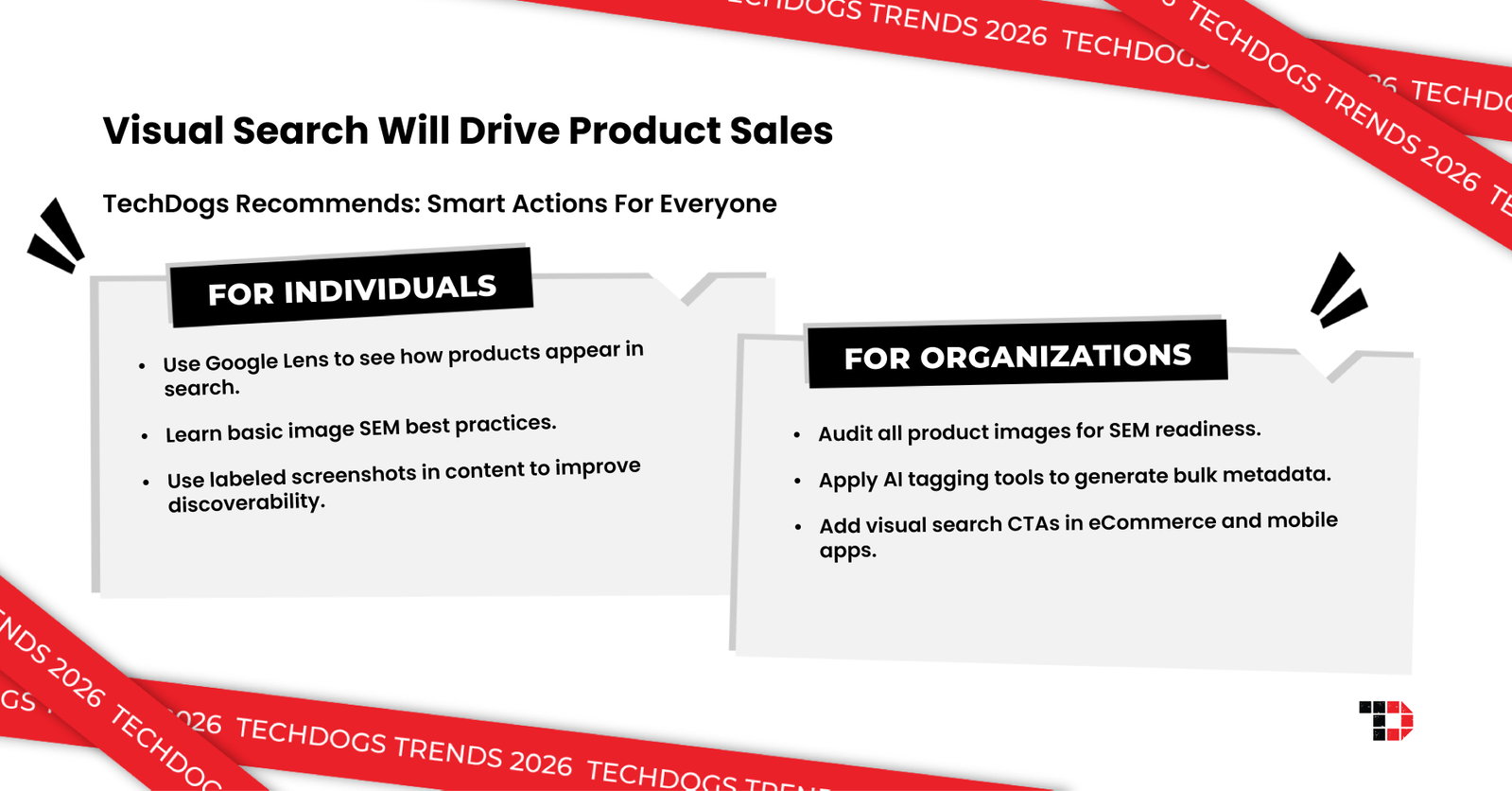
TechDogs Recommends: Smart Actions For Everyone
Trend 5: Retail Media Networks Will Drive The Future Of SEM
Retail media networks (RMNs) have attracted so much attention over the past two years that they are now hailed as the third wave of digital advertising, following search engines and social media.
Retail media networks are advertising platforms that enable retailers to sell ad space on their digital channels to third-party brands, allowing brands to reach a target audience at the exact moment of purchase intent, with full-funnel analytics, enhanced targeting, and direct purchase data, all on one platform or across a collection of digital channels.
For example, imagine Ray-Ban not just placing one advertisement on Amazon's shopping platform but running an entire campaign across its website and app, with conversion data tied directly to the purchase.
How Is The Industry Responding?
The scale is significant. The global retail media market reached $203.9 billion in 2026 (Coresight Research). eMarketer says U.S. retail media spending is expected to reach $60 billion in 2025 and $100 billion by 2028. Forrester puts the global figure at $184 billion in 2025, expected to reach $312 billion by 2030, outpacing virtually every other advertising channel.
Amazon Ads accounts for 77.3% of retail media ad spend and is the category's dominant force. However, growing competition from Walmart Connect, Instacart Ads, Target Roundel, and Uber Eats is reshaping the landscape. Instacart offers keyword bidding for grocery products, transforming its platform into a mini search engine for food. Uber Eats is testing location-based search ads that target users just before dinner.
A Nielsen report noted that 65% of global marketers said RMNs would play a larger role in their media mix.
The takeaway for marketers: retail media is no longer a supplementary channel; at $203.9 billion globally in 2026 and growing toward $312 billion by 2030, it is becoming the primary channel for brands that want to advertise based on buying intent rather than next to content. The SEM budget that was chasing clicks on Google is now being redistributed to where purchase decisions are already being made.
Challenges To Watch
Since each RMN has its own ad interface, metrics, and rules, brands find it tough to scale across platforms, and reporting becomes complex. Smaller brands may also face difficulties meeting minimum spend requirements or accessing premium placement tools.
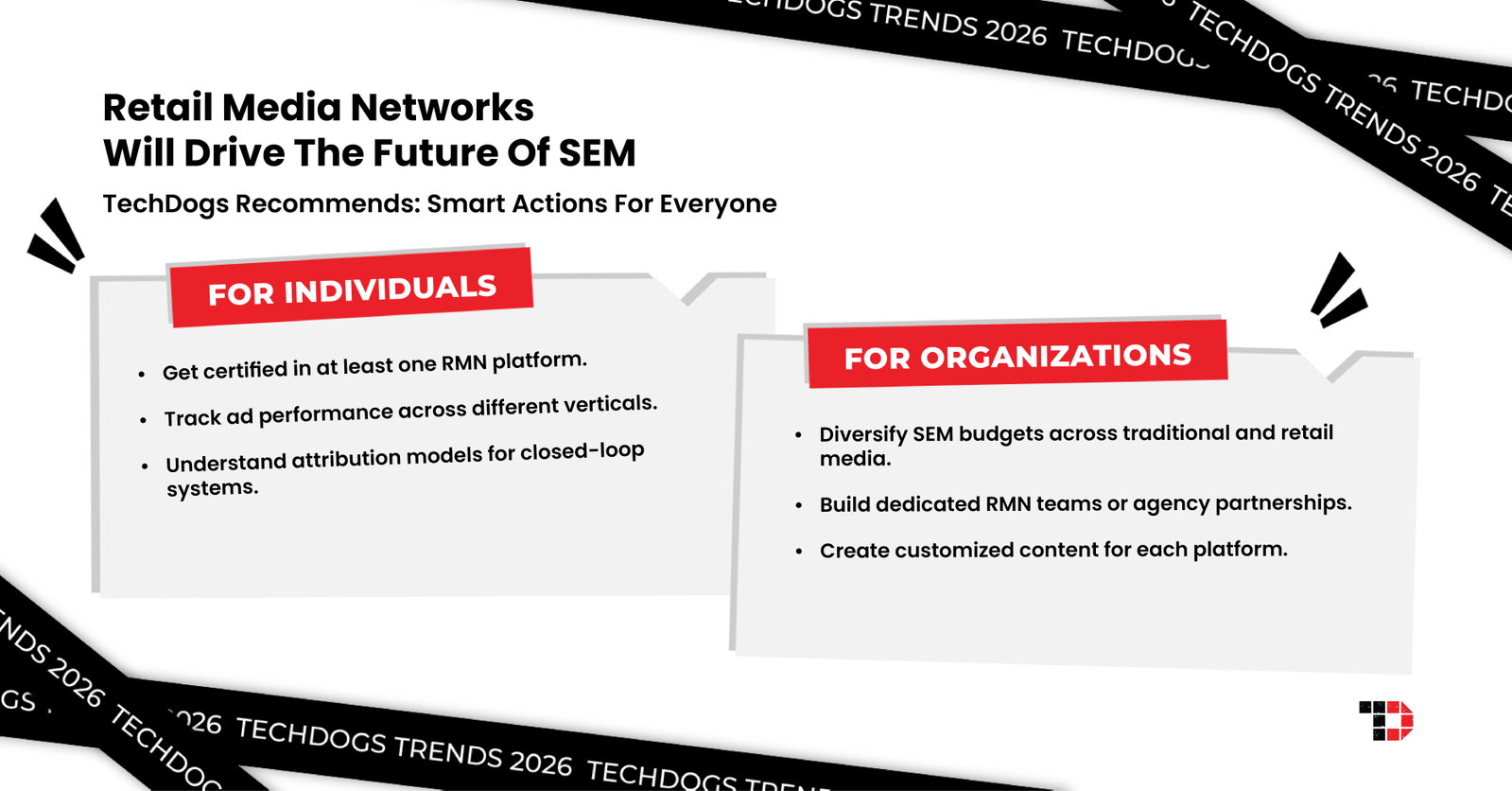
TechDogs Recommends: Smart Actions For Everyone
Conclusion
The bridge was always there. Indiana Jones committed to the step, and the path revealed itself beneath his feet. That is where SEM is heading in 2026: strategies that step forward into invisible territory, zero-click visibility, AI-driven campaign orchestration, conversational discovery, visual intent, and purchase-moment advertising, and trust that the signal will come.
In 2026, search engine marketing is not going to be about chasing clicks on a Google SERP. It is about understanding the various ways in which people search for information, from voice to visuals, from conversations to commerce. At the center, AI will transform into a campaign manager, and retail platforms will become preferred ad networks.
Moving into 2026, search will become even more intuitive and decentralized, as wearables and connected environments influence how and where queries originate. To stay SEM-smart, businesses must adapt quickly, test often, and always think one search ahead.
Frequently Asked Questions
What Are The Most Important Search Engine Marketing Trends For 2026?
The biggest SEM trends for 2026 include zero-click search dominance, AI-powered ad campaign orchestration, conversational and voice-driven search, visual search adoption across industries, and the rise of retail media networks. With 58.5% of U.S. searches already ending without a click and the global retail media market reaching $203.9 billion in 2026, these trends show how search is moving beyond traditional keyword-driven clicks toward AI-driven experiences, multi-format discovery, and platform-level advertising.
How Should Businesses Prepare For Zero-Click Searches In 2026?
Businesses should prepare by optimizing for AI Overviews, strengthening content schema, and shifting success metrics from clicks to visibility and engagement. With AI Overview-triggered queries doubling from 6.49% to 13.14% in just two months of early 2025 and zero-click rates of 83% for AI Overview-triggered searches (Bain-Dynata), the window for adaptation is narrowing. Brands now need their content structured so search engines can feature it directly on results pages.
How Will AI Change Search Engine Marketing Strategies In 2026?
AI will transform SEM strategies through automated bidding, personalized ad targeting, predictive campaign optimization, and multimodal search experiences. Tools like Performance Max, AI Max for Search, and conversational AI assistants will help marketers reach users across search, video, maps, email, and display with minimal manual setup. For businesses, this means shifting focus from micro-managing campaigns to supervising AI-driven systems while adding human creativity, governance, and strategic oversight, the Indiana Jones model: commit to the step, then guide the path as it reveals itself.
Thu, Nov 20, 2025

Liked what you read? That’s only the tip of the tech iceberg!
Explore our vast collection of tech articles including introductory guides, product reviews, trends and more, stay up to date with the latest news, relish thought-provoking interviews and the hottest AI blogs, and tickle your funny bone with hilarious tech memes!
Plus, get access to branded insights from industry-leading global brands through informative white papers, engaging case studies, in-depth reports, enlightening videos and exciting events and webinars.
Dive into TechDogs' treasure trove today and Know Your World of technology like never before!
Disclaimer - Reference to any specific product, software or entity does not constitute an endorsement or recommendation by TechDogs nor should any data or content published be relied upon. The views expressed by TechDogs' members and guests are their own and their appearance on our site does not imply an endorsement of them or any entity they represent. Views and opinions expressed by TechDogs' Authors are those of the Authors and do not necessarily reflect the view of TechDogs or any of its officials. While we aim to provide valuable and helpful information, some content on TechDogs' site may not have been thoroughly reviewed for every detail or aspect. We encourage users to verify any information independently where necessary.
Loading comments...