 Featured
Sales Technology
Sales Technology Trends Accelerating Revenue Growth In 2026
Share
TL;DR
-
Extended Reality In Sales: XR moves from experiment to strategy in 2026, with lighter hardware and 5G enabling immersive demos, AR try-ons, and XR training at scale across healthcare, automotive, and B2B sales.
-
Generative AI In Sales: Memory-enabled models deliver hyper-personalized support. Gartner projects 33% of enterprise apps will include built-in AI agents by 2028, up from under 1% in 2024.
-
Cybersecurity In Sales: 96% of manufacturers plan cybersecurity investment in the next five years. Cloud-native CSPM tools and Zero Trust models now protect every connected sales interaction.
-
Blockchain For Business: The global blockchain market is on track to reach $67.4 billion in 2026. Multi-chain frameworks and tokenization open new markets, from carbon credits to digital identity.
-
Sustainable Technology 2026: Green tech in business is projected to reach $80 billion by 2030 (Grand View Research). Smart grids, carbon-tracking platforms, and ESG-aligned finance reshape how sales organizations operate and grow.
Introduction
Ryan barely thinks about that café machine now. It just makes his hot chocolate exactly right, every morning. That is what the best sales technology does: it disappears into the workflow and makes the outcome better without drawing attention to itself.
The numbers confirm the shift. According to Research and Markets, the global sales tech market was valued at $4.1 billion in 2024 and is projected to reach $20.3 billion by 2034, a 17.1% CAGR. AI adoption in sales surged from 24% in 2023 to 43% in 2024. Digital transformation in sales is not a future state. It is today’s operating reality.
The top sales technology trends 2026 teams must track cover five areas: extended reality in sales, generative AI in sales, cybersecurity in sales, blockchain for business, and sustainable technology 2026. Five technologies. One direction: making selling more human, not less.
Sales has always been about people. Listening, understanding, connecting. AI-powered sales tools and sales innovation 2026 do not replace that. They amplify it, giving teams more context, more speed, and more ways to build real relationships.
Here are the five sales technology trends 2026 is built on, and what every sales team needs to know about each one.
Trend 1: Extended Reality In Sales Will Redefine Immersive Engagement
Extended Reality (XR) is the umbrella term encompassing Virtual Reality (VR), Augmented Reality (AR), and Mixed Reality (MR), has long promised immersive experiences. Until recently, adoption in sales was experimental at best. Early use cases were limited to virtual product demos and gamified campaigns, usually requiring bulky hardware and complicated setups. The pandemic accelerated things: lockdowns pushed businesses to find new ways to train, collaborate, and connect remotely. XR training and demos moved from experiments to essential tools.
In 2026, XR moved from experiment to strategy. Lighter AR glasses, near-real VR, and 5G connectivity make extended reality in sales practical at scale. Sales teams run immersive demos. Retail offers AR try-ons that cut returns. B2B sellers demonstrate complex products in 3D. Healthcare, automotive, and manufacturing now scale XR training and demos for onboarding and remote support, cutting costs and boosting confidence.
Extended Reality In Sales: The use of VR, AR, and Mixed Reality technologies to deliver immersive product demos, XR training and demos for sales reps, and AR-powered customer experiences that increase engagement and reduce purchase uncertainty.
How Is The Industry Responding?
According to Mordor Intelligence, the Extended Reality (XR) market was valued at USD 7.55 billion in 2025 and is expected to grow to USD 44.14 billion by 2030, at a CAGR of 42.36%. Another survey by HTC VIVE found that 81% of healthcare professionals believe XR training gives their organizations an edge in attracting top-tier talent.
As Lucky Gobindram, Co-Founder/President of CXR Agency and advisor to the VRARA New York chapter, emphasized, “Effective onboarding of XR has been proven to improve productivity, proficiency, satisfaction and engagement. XR can position organizations to better perform and advance new business opportunities.”
Challenges To Watch
Even with all its potential, XR adoption isn’t without challenges. The cost for advanced headsets and software remains high, many users find long sessions uncomfortable, and integrating XR into existing sales tools isn’t always smooth. On top of that, companies must be careful about security and privacy, since XR apps often capture sensitive customer data.
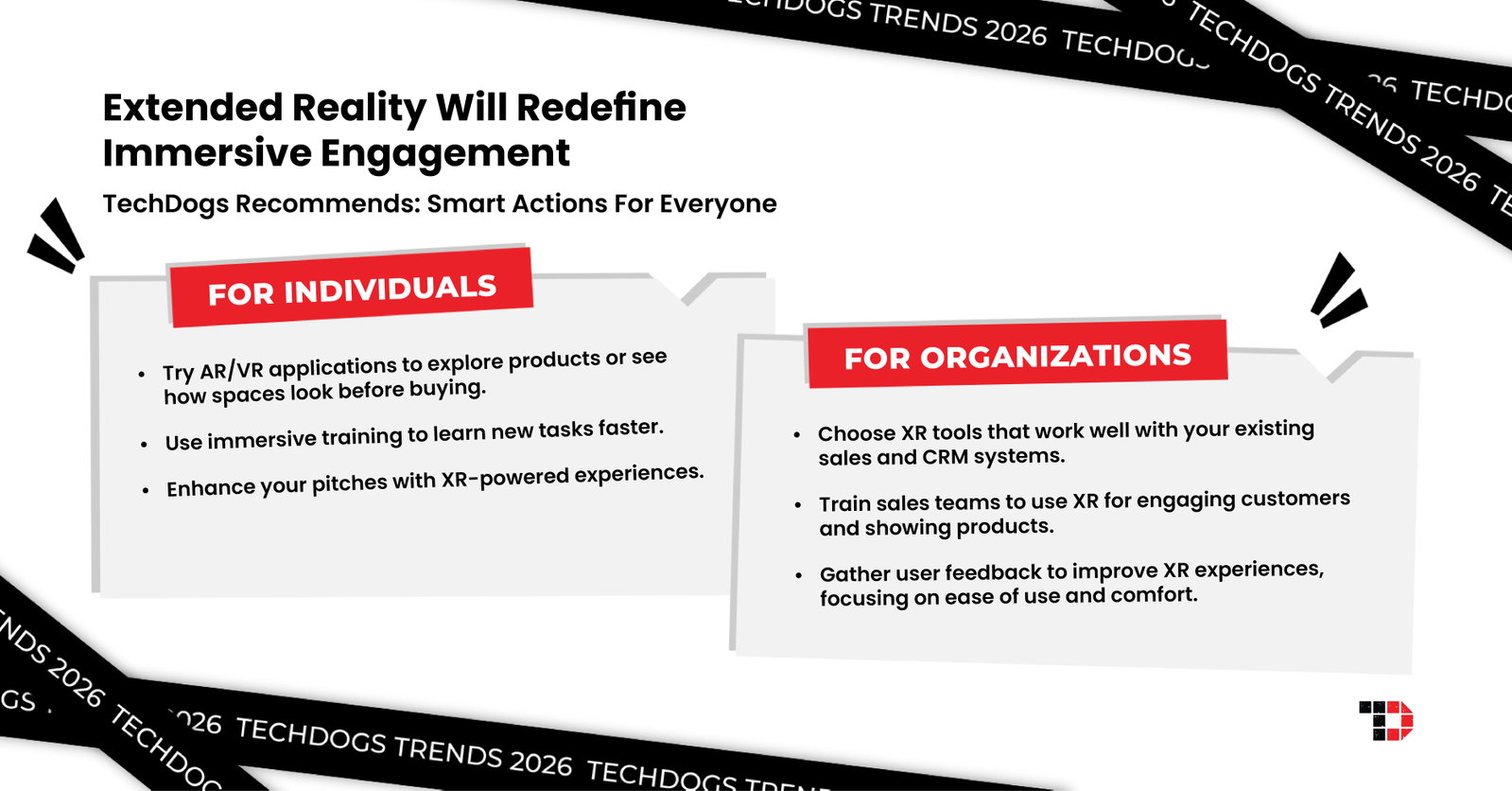
TechDogs Recommends: Smart Actions For Everyone
Trend 2: Generative AI In Sales Will Shape Personalized Digital Experiences
Generative AI (GenAI), which uses advanced machine learning models to create text, images, video, code, and even synthetic data, has moved from novelty to necessity. Initially, most organizations experimented with AI chatbots or content tools, treating them as side projects rather than core business drivers. The pandemic accelerated GenAI adoption as companies sought scalable solutions to automate communication, generate content, and boost digital engagement during the remote work period.
In 2026, generative AI in sales is smarter and more strategic. Memory-enabled models remember past interactions and preferences. They deliver hyper-personalized support with context and continuity across every touchpoint.
Companies use large language models for complex, deep tasks and small language models for specialized work like coding, compliance checks, or mobile development. AI-powered sales tools now summarize, contextualize, and interpret multimodal inputs. Research, customer queries, and decision-making move faster and more intuitively as a result.
How Is The Industry Responding?
Gartner forecasts a major leap in AI adoption, predicting that by 2028, around 33% of enterprise applications will have built-in AI agents, up from less than 1% in 2024. We are already seeing this shift in action, with nearly 65% of professionals using GenAI to write reports, emails, and presentations.
As highlighted by N Chandrasekaran, TCS Chairman, "Achieving near-human reasoning capabilities, GenAI is not just another tech cycle, it is a civilisational shift. Its widespread adoption is accelerating, powered by parallel advances in semiconductors, cloud computing, quantum technologies, robotics, and energy innovation. GenAI is already redefining analytics, customer experience, and marketing.”
Challenges To Watch
Intellectual property, data bias, false information, and compliance concerns remain active challenges. High compute costs and the need for large, clean datasets also make it hard for smaller companies to use generative AI in sales profitably.
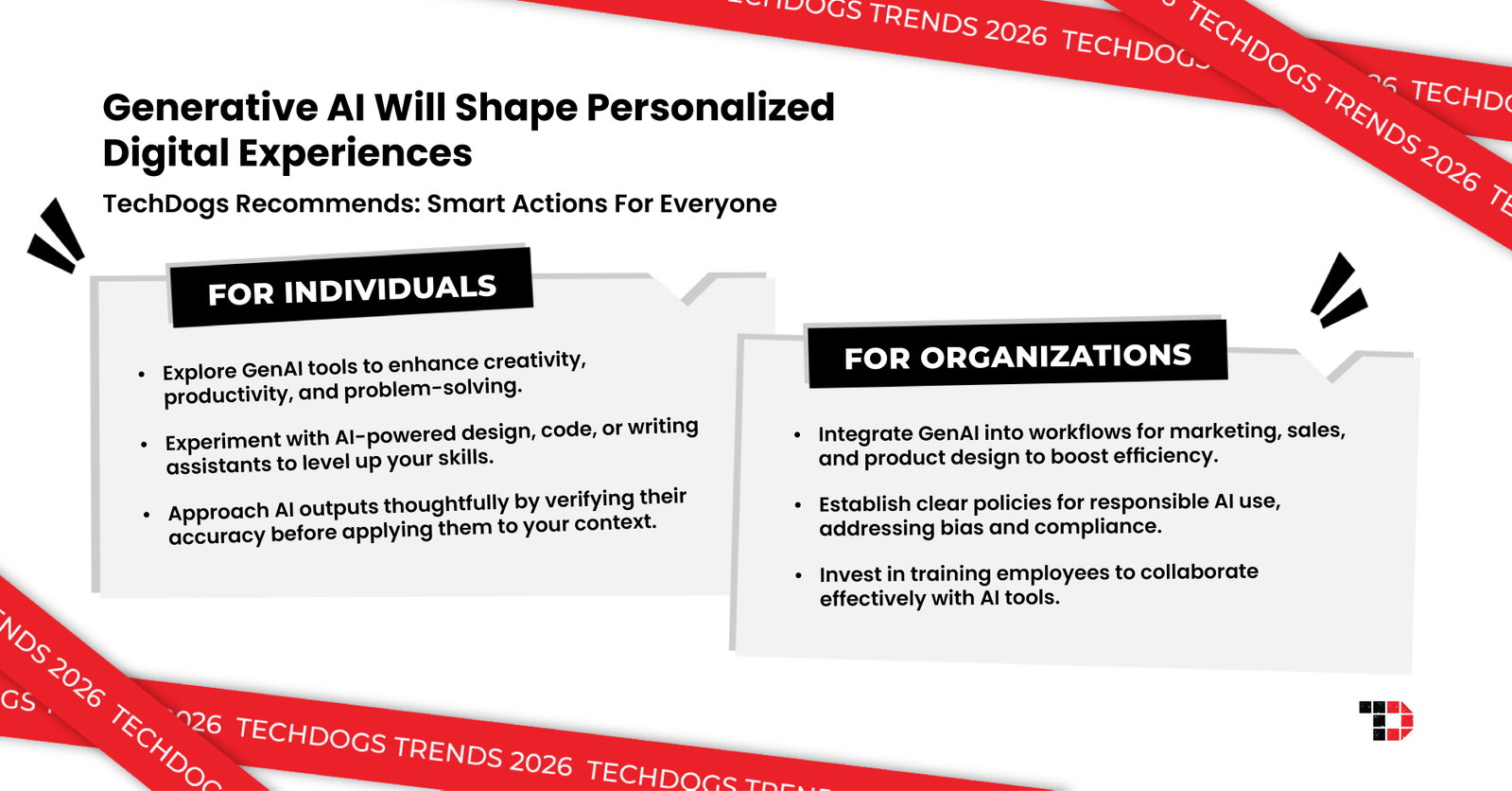
TechDogs Recommends: Smart Actions For Everyone
Trend 3: Cybersecurity In Sales Will Safeguard The Connected Enterprise
Cybersecurity has always been about keeping businesses safe in the digital space, whether it was blocking viruses, securing networks, or monitoring for unusual activity. Early security relied on firewalls and antivirus software. As businesses moved to the cloud and handled more sensitive data, those measures fell short. Cybersecurity became a boardroom priority tied directly to continuity and trust.
In 2026, cybersecurity has matured into an adaptive and built-in part of everyday operations. Most businesses now run multi-cloud and hybrid environments. Cloud-native tools protect workloads, APIs, and containers. Automated Cloud Security Posture Management (CSPM) continuously monitors cloud settings for gaps, identifies threats early, and strengthens defenses in real time.
How Is The Industry Responding?
The World Bank projects that digital infrastructure will grow by more than 12% annually. Considering the rise of remote work and cloud adoption, this growth is prompting governments to tighten cybersecurity policies and pushing businesses to build stronger defenses. In fact, Rockwell Automation’s 10th Annual State of Smart Manufacturing Report notes that 96% of manufacturers have either invested in or plan to invest in cybersecurity within the next five years, with more than half already deploying solutions at scale.
As Kay Pang, Board Director, Grand Bank Yachts, rightly emphasized, “Boards must recognize cybersecurity as a business risk, not just an IT issue. GCs play a vital role in embedding resilience into governance.”
Challenges To Watch
Despite progress, cyber defenders continue to face challenges. Ransomware-as-a-Service (RaaS), deepfake scams, and phishing are advancing faster than many can counter. Rising compliance demands and high costs, especially for smaller firms, add further strain, leaving many at risk.
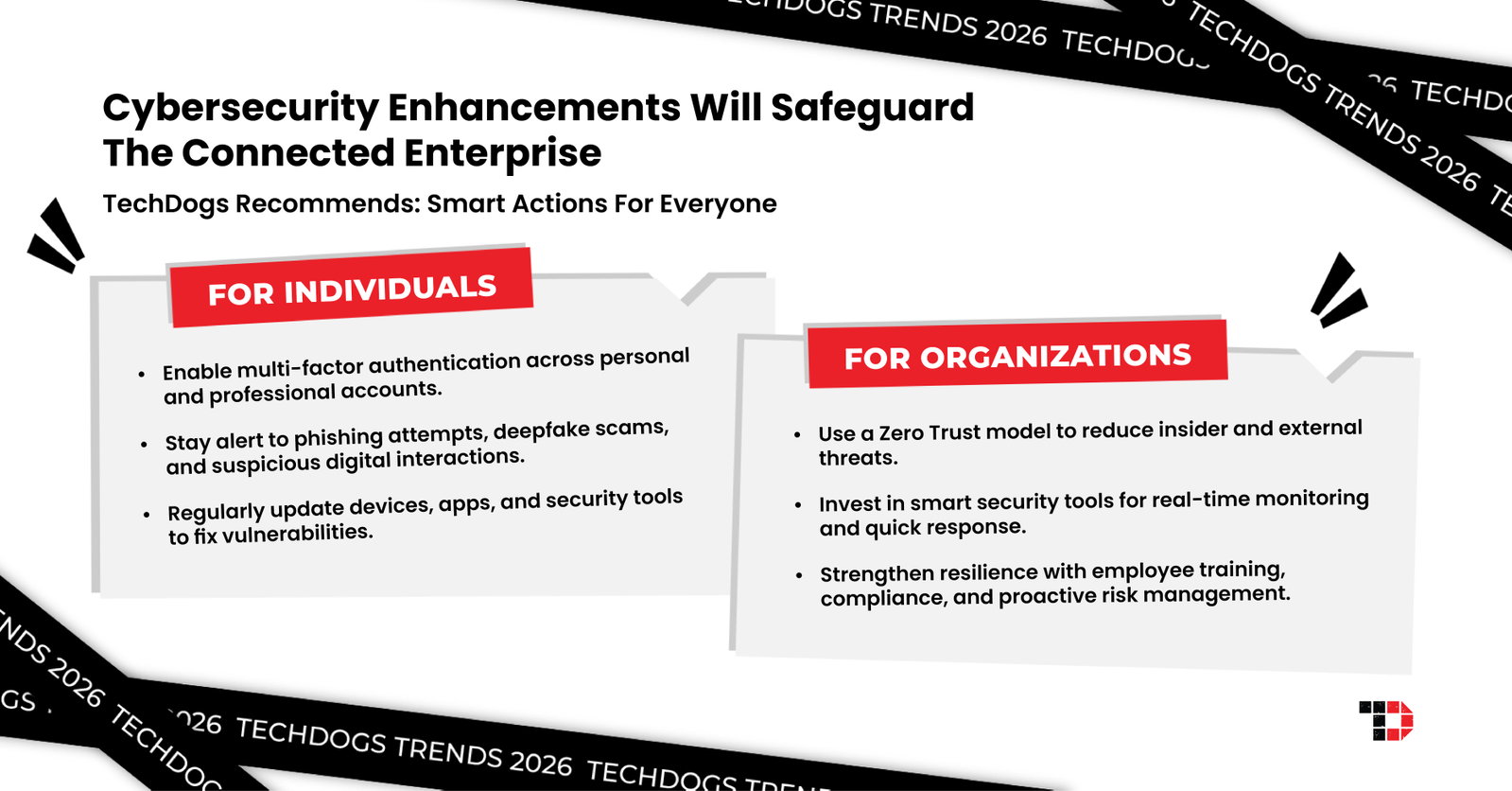
TechDogs Recommends: Smart Actions For Everyone
Trend 4: Blockchain For Business Will Build The Next Era Of Digital Trust
Blockchain has expanded well beyond Bitcoin. Early adopters ran small-scale pilots. As digital transactions and cross-border data sharing scaled, blockchain became a core instrument for establishing trust in business.
In 2026, blockchain has advanced to a more mature stage, becoming scalable, connected, and widely adopted across various industries. Instead of isolated systems, companies now use multi-chain frameworks that enable different networks to work together securely. Governments are also adopting blockchain technology for various services, including digital IDs, land records, and even voting. Combined with tokenization, blockchain is also opening up new markets for digital assets like carbon credits for greater transparency and accountability.
How Is The Industry Responding?
According to scoop.market.us, the global blockchain market is expected to reach $67.4 billion in 2026, with banking holding the largest share of this value. At the same time, industries beyond finance are exploring blockchain’s potential, just like Northern Trust did. The company has introduced a blockchain-powered carbon ecosystem to enhance the creation, verification, and trading of carbon credits.
As Martha Bennett, an analyst at Forrester Research, highlighted, “Using blockchain and blockchain-based tokens to reduce friction in cross-border transactions is another notable trend. That's where blockchain remains in use, with the idea that it would be both faster and lower cost for cross-border wholesale transfers, which are bank-to-bank.”
Challenges To Watch
Despite advancements, blockchain still has challenges. Different networks may not always function well together, rules are still evolving, and scaling up might delay transactions. Energy consumption, while reducing, remains a challenge for large projects. Smaller firms struggle with the costs and knowledge required to implement blockchain.
TechDogs Recommends: Smart Actions For Everyone
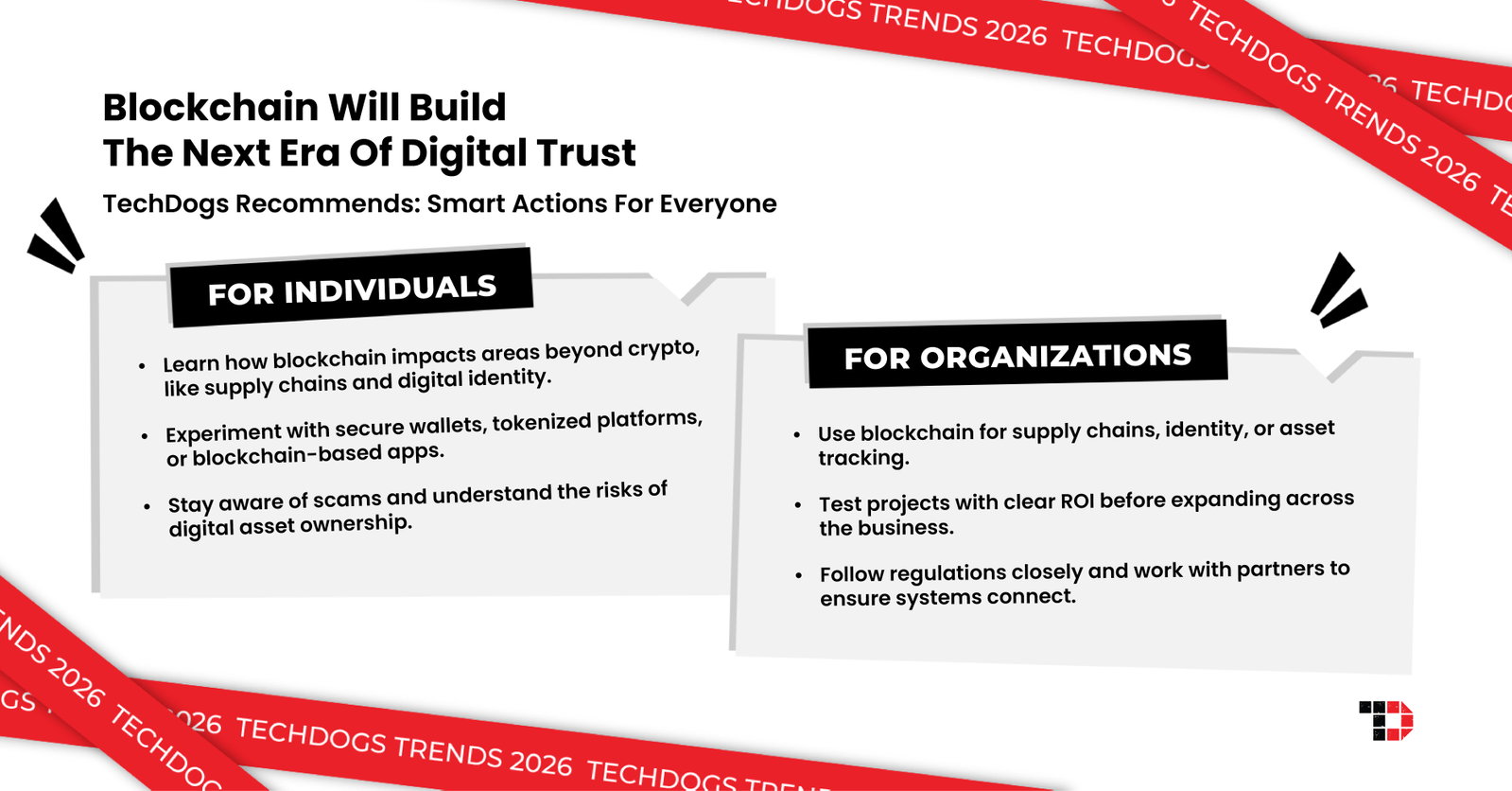
Trend 5: Sustainable Technology 2026 Will Drive Tomorrow’s Green Economy
Sustainability has moved from being a checkbox exercise to becoming a core driver of business strategy and growth. Rising energy costs, stricter reporting requirements, and growing consumer expectations push companies to embed sustainability into products, operations, and supply chains. Resource consumption and circular economy practices are gaining urgency. Sustainability now measures both long-term resilience and immediate responsibility.
In 2026, green tech in business is leading the charge. Renewable energy integration, low-carbon data centers, ESG-aligned finance, and climate resilience planning are reshaping how companies build and operate. Smart grids, carbon-tracking platforms, and innovative materials cut waste and emissions. Sustainable technology 2026 reaches daily sales life too: energy-saving devices, electric vehicles for field reps, and recyclable product packaging.
How Is The Industry Responding?
According to Grand View Research, the global market for green technology was valued at $23 billion in 2024 and is projected to reach nearly $80 billion by 2030, highlighting the rapid growth of the sector. According to another report from Market And Market, the demand for green technology in the Asia Pacific is rising as strict policies, net-zero goals, and industrial growth tighten emissions rules. Singapore and Japan are also investing in carbon tracking and ESG systems to meet climate targets and global standards.
Tim Christophersen, vice president of climate action at Salesforce, explains, "In a sector that is growing fast, it is important that we address the ways in which the technology industry depends on and impacts nature.”
Challenges To Watch
Small businesses face challenges, including inconsistent carbon reporting, supply chain issues, and limited access to sustainable resources, while greenwashing continues to erode trust. These challenges make scaling sustainability efforts slower and more complex.
TechDogs Recommends: Smart Actions For Everyone
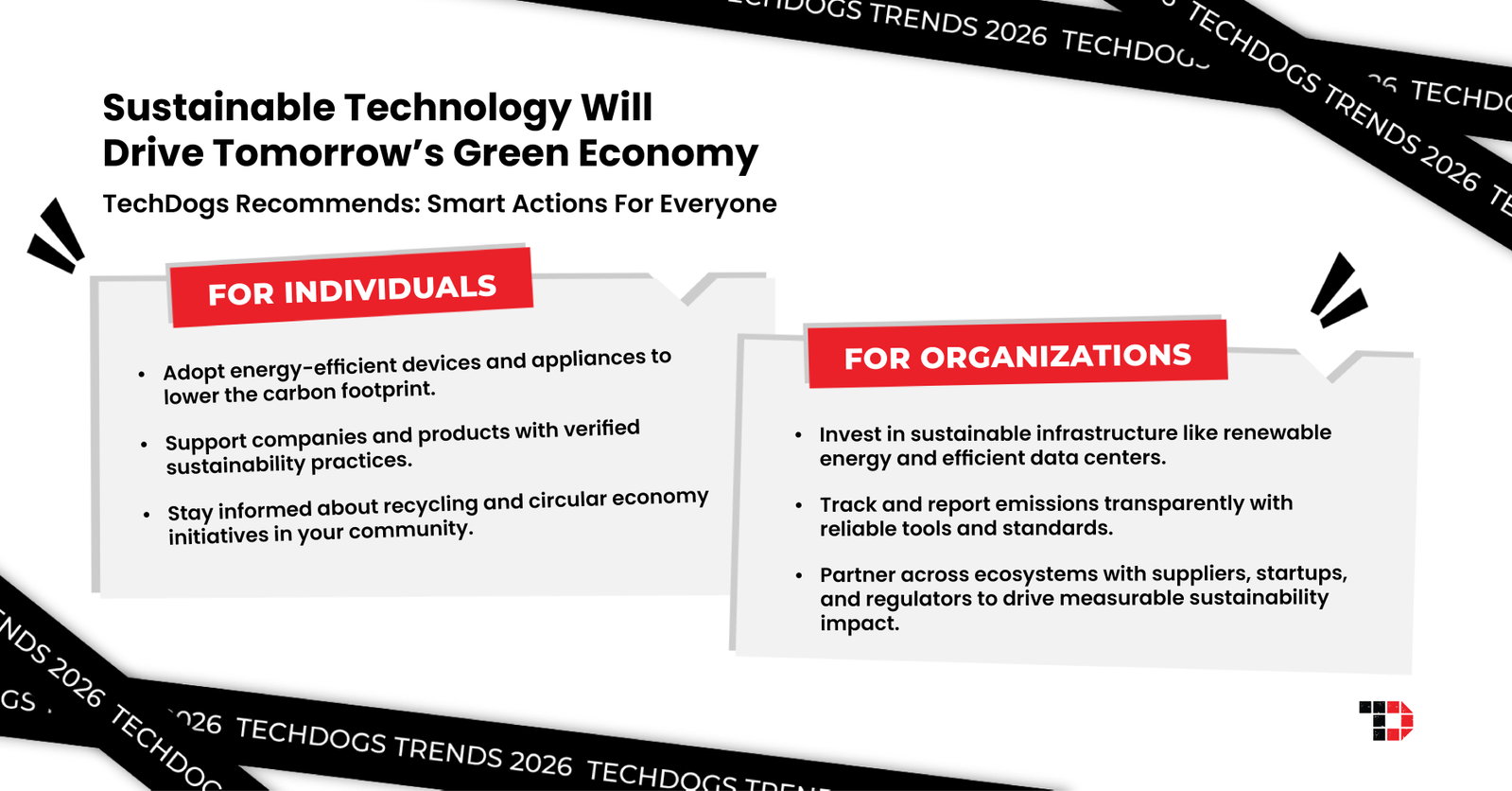
Conclusion
The sales technology trends 2026 brings are not disruptions. They are the café machine behind the counter: barely noticed once they work, but quietly shaping every interaction. Extended reality in sales, generative AI in sales, cybersecurity in sales, blockchain for business, and sustainable technology 2026 each started as novelties. They are becoming the infrastructure of digital transformation in sales.
The real story is about people. Sales innovation 2026 enhances the human side of selling. These tools build an ecosystem that is more secure, data-driven, and intelligent, where immersive experiences, trusted digital transactions, and sustainable operations become the backbone of modern business.
Frequently Asked Questions
What Are The Top Sales Technology Trends For 2026?
The top sales technology trends 2026 organizations must track are extended reality in sales, generative AI in sales, cybersecurity in sales, blockchain for business, and sustainable technology 2026. Together they reshape how businesses connect, secure, and deliver value.
How Is Generative AI Transforming Sales In 2026?
Generative AI in sales delivers hyper-personalized support, automates reports and presentations, and powers smarter, multimodal search. According to Gartner, 33% of enterprise applications will have built-in AI agents by 2028. Businesses use both large and small language models to make digital interactions faster and more intuitive.
What Are The Main Uses Of Blockchain Beyond Finance?
Blockchain for business supports supply chain transparency, digital identity, healthcare records, and even voting systems. Tokenization opens new markets like carbon credits, adding trust, accountability, and efficiency across industries. The global blockchain market is expected to reach $67.4 billion in 2026.
Thu, Oct 23, 2025

Enjoyed what you've read so far? Great news - there's more to explore!
Stay up to date with the latest news, a vast collection of tech articles including introductory guides, product reviews, trends and more, thought-provoking interviews, hottest AI blogs and entertaining tech memes.
Plus, get access to branded insights such as informative white papers, intriguing case studies, in-depth reports, enlightening videos and exciting events and webinars from industry-leading global brands.
Dive into TechDogs' treasure trove today and Know Your World of technology!
Disclaimer - Reference to any specific product, software or entity does not constitute an endorsement or recommendation by TechDogs nor should any data or content published be relied upon. The views expressed by TechDogs' members and guests are their own and their appearance on our site does not imply an endorsement of them or any entity they represent. Views and opinions expressed by TechDogs' Authors are those of the Authors and do not necessarily reflect the view of TechDogs or any of its officials. While we aim to provide valuable and helpful information, some content on TechDogs' site may not have been thoroughly reviewed for every detail or aspect. We encourage users to verify any information independently where necessary.
Loading comments...