
Retail Technology
Retail Technology Trends Reshaping The Shopping Experience In 2026
Share
TL;DR
-
AI-Powered Personalization: 97% of retailers plan to increase AI spending (NVIDIA). McKinsey confirms AI personalization drives 10-15% revenue uplift for implementing retailers. Amperity reports 45% of retailers already use AI daily, but only 43% are applying it to customer-facing personalization, where the biggest opportunity lies.
-
Autonomous Stores and Smart Checkout: 77% of shoppers prefer self-checkout for faster service and shorter wait times (NCR Voyix). Target has launched accessible self-checkout for disabled guests, rolling out nationwide through early 2026.
-
Immersive AR/VR Experiences: Over 90% of American shoppers have used AR or are open to using it for shopping, with 98% who tried it finding it helpful (Brand XR).
-
Advanced Retail Analytics: 87% of retailers have already deployed AI in at least one business area, while 60% plan to boost AI investments in the near future (Charter Global). Deloitte's 2026 outlook finds 68% of retailers expect to deploy agentic AI for key operational activities within 12–24 months.
-
Blockchain for Supply Chain Transparency: AURA Blockchain Consortium, backed by LVMH, Cartier, DIOR, and Prada, is leading the luxury retail's move to product-level traceability.
Introduction
In 1995, Clueless gave us Cher Horowitz's computerized closet, an AI that analyzed her wardrobe, rated outfit combinations, and made personalized recommendations in real time before she headed out. In 2026, the retail industry finally built it at scale. AI-powered personalization now operates across every touchpoint, from your first product search to the checkout counter, with systems that know what you want before you finish typing it.
Although e-commerce is the preferred way to shop, retail has been a pillar of modern trade for much longer. According to eMarketer, global e-commerce sales are expected to reach $6.86 trillion by 2027. As we enter 2026, the sector is poised for further advances.
Last year, we explored emerging retail technology trends, including the rise of GenAI-powered personalization, augmented and virtual reality experiences, omnichannel integration, retail analytics, and sustainable shopping. These innovations have set the stage for a transformative era.
The global AI in retail market reaches $18.4 billion in 2026 and is projected to grow to $130.88 billion by 2033 at a 32.4% CAGR (Coherent Market Insights). These aren't simple technological shifts but a fundamental change in how retailers engage with customers and outcompete rivals.
Here are the top five retail technology trends shaping 2026.
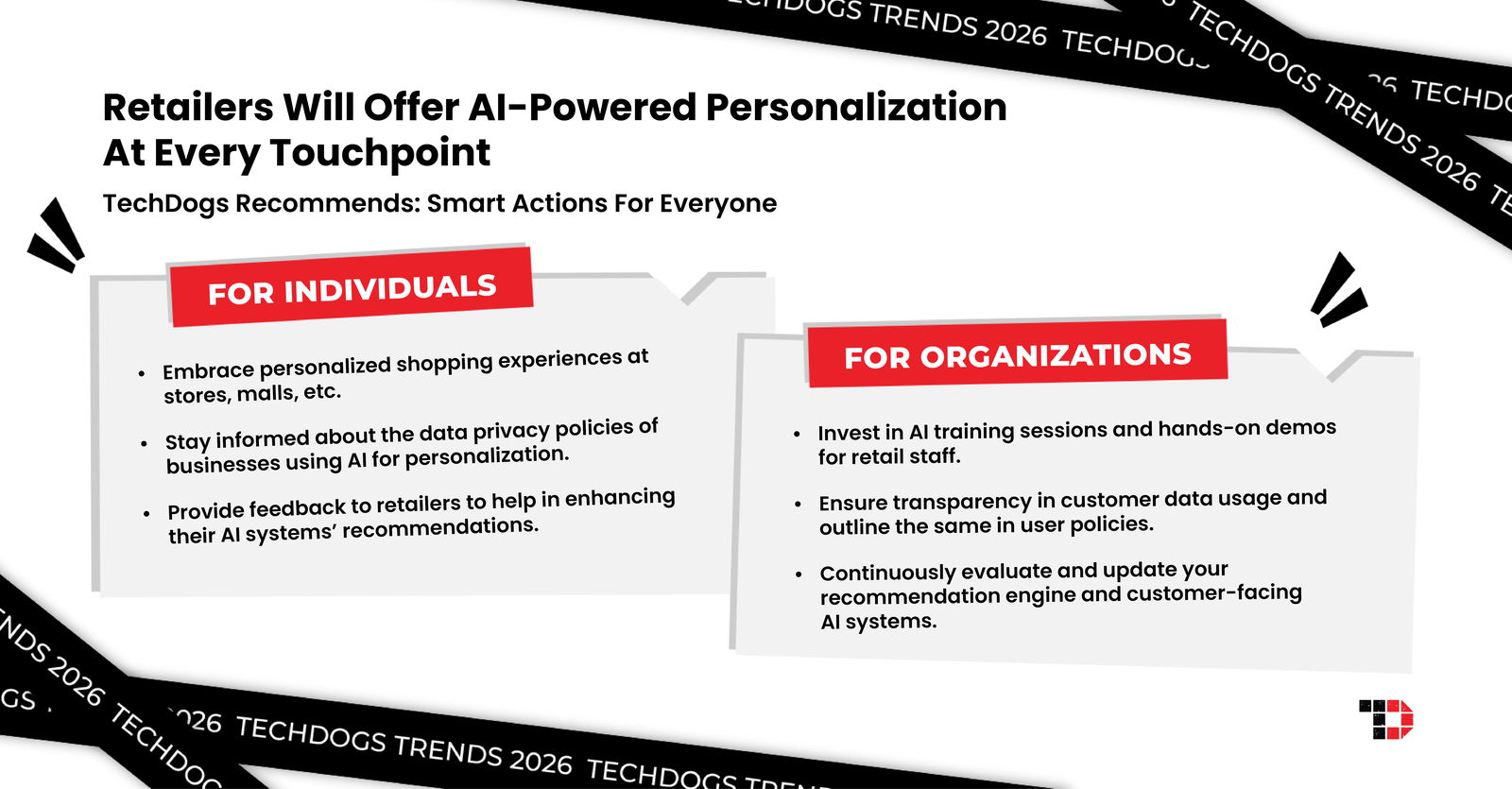
Trend 1: Retailers Will Offer AI-Powered Personalization At Every Touchpoint
Cher's closet didn't just pick outfits; it knew her style, her schedule, and what she'd worn before. That's exactly what AI-powered personalization is doing for retail in 2026: analyzing every signal a customer generates, browsing, purchasing, location, loyalty history, to deliver experiences that feel designed for them, not just served to them.
In 2026, retailers are implementing AI-powered personalization across each customer touchpoint, from online platforms and reward programs to in-store experiences. This shift is driven by advances in AI and machine learning algorithms, rising consumer expectations for tailored experiences, and clear revenue evidence. McKinsey confirms AI personalization drives 10-15% revenue uplift for implementing retailers.
How Is The Industry Responding?
Major retailers have begun integrating Generative AI and AI-powered tools into their operations. ShopRite has launched AI-powered shopping carts across 11 stores, offering automatic coupon clipping, real-time cost tracking, personalized recommendations, and gamified rewards, leading to higher engagement.
According to a recent Gartner study, 75% of organizations are expected to implement generative AI by 2026, with 97% of retailers planning to grow or maintain their AI investment in the year ahead (NVIDIA). While customer data service Amperity warns that 45% of retailers already use AI daily or several times per week, only 43% are currently leveraging AI in customer-facing applications such as personalization, representing the largest untapped opportunity in the industry.
Tony Owens, CEO of Amperity, says: "Retailers believe in AI's potential to drive loyalty and lifetime value, but belief alone won't close the gap between ambition and execution. What's needed is unified, actionable customer data, regardless of where it resides."
The shift is clear: with McKinsey reporting 10%–15% revenue uplift from personalization and 97% of retailers committing to AI investment, the gap between AI-enabled and AI-first retailers is widening into a structural competitive divide. Cher Horowitz had the right idea; she just needed better data.
Challenges To Watch
Despite its potential, integrating AI into retail spaces poses challenges. The primary considerations include data privacy concerns, the need for AI-skilled personnel, and the complexity of integrating AI tools with existing legacy infrastructures. Human shoppers still demand human assistance in many scenarios, something AI cannot yet fully emulate.
TechDogs Recommends: Smart Actions For Everyone
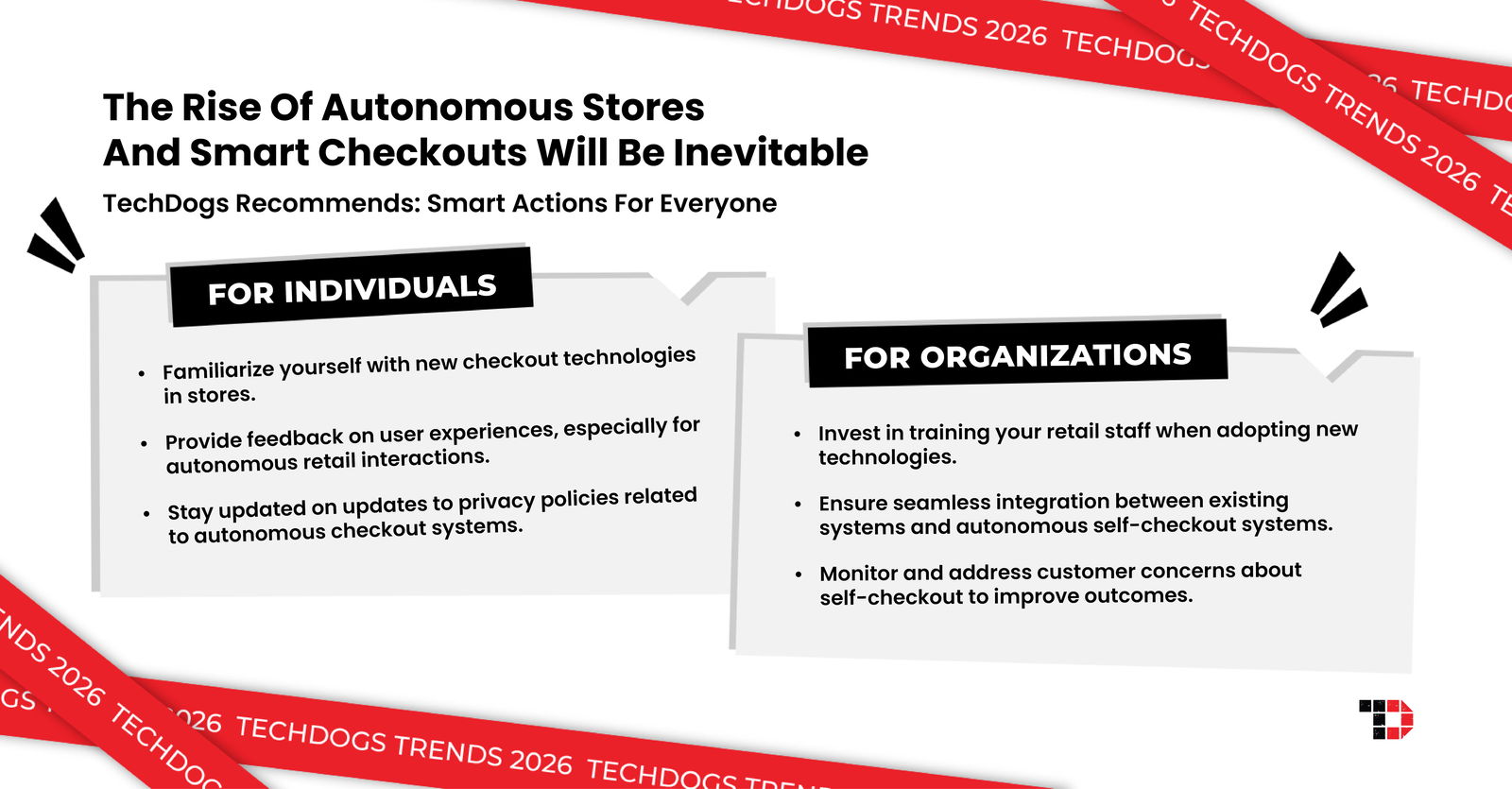
Trend 2: The Rise Of Autonomous Stores And Smart Checkouts Will Be Inevitable
With automation driving new efficiencies across industries, it was inevitable that retailers would adopt the latest automation technologies. In 2026, autonomous stores and smart checkout systems are going mainstream, potentially revolutionizing the retail landscape. These technologies utilize AI models, real-time sensors, and computer vision to create frictionless shopping experiences. The success of early adopters is paving the way for the widespread implementation of autonomous stores, smart checkouts, and frictionless shopping.
How Is The Industry Responding?
Top retailers are leading the adoption of smart checkouts, with Target launching a first-of-its-kind self-checkout for disabled guests. The retail giant is rolling out self-checkout stations nationwide through early 2026 as part of its checkout-improvement initiative. According to a new consumer survey from NCR Voyix, 77% of shoppers prefer self-checkout for faster service and shorter wait times.
The global self-checkout system market was valued at $4.2 billion in 2023, driven by consumer demands for efficiency, autonomy, and convenience. North America holds the largest share of the autonomous checkout market at over 40%, while European nations like the United Kingdom, Germany, and France are leading with a market share of nearly 30% in 2024.
Adrienne Costanzo, Executive Vice President and Chief Stores Officer at Target, said: "Our team is always laser-focused on delivering a better experience for guests, and that's exactly what they get with Express Self-Checkout. Whether guests are grabbing stuff for dinner or running in to pick up a post-soccer tournament treat, we know their time is valuable, and they often need to be on their way quickly."
What this means in practice: with 77% of shoppers already preferring self-checkout and North America commanding over 40% of the autonomous checkout market, frictionless shopping is moving from competitive advantage to baseline expectation. Retailers who delay adoption are not just missing an opportunity; they are actively disappointing customers who already know what good looks like.
Challenges To Watch
Implementing self-checkout or autonomous store technologies presents several challenges: high upfront costs, technical glitches in hardware and software, and customer adoption hurdles, as some shoppers still prefer traditional checkout methods.
TechDogs Recommends: Smart Actions For Everyone
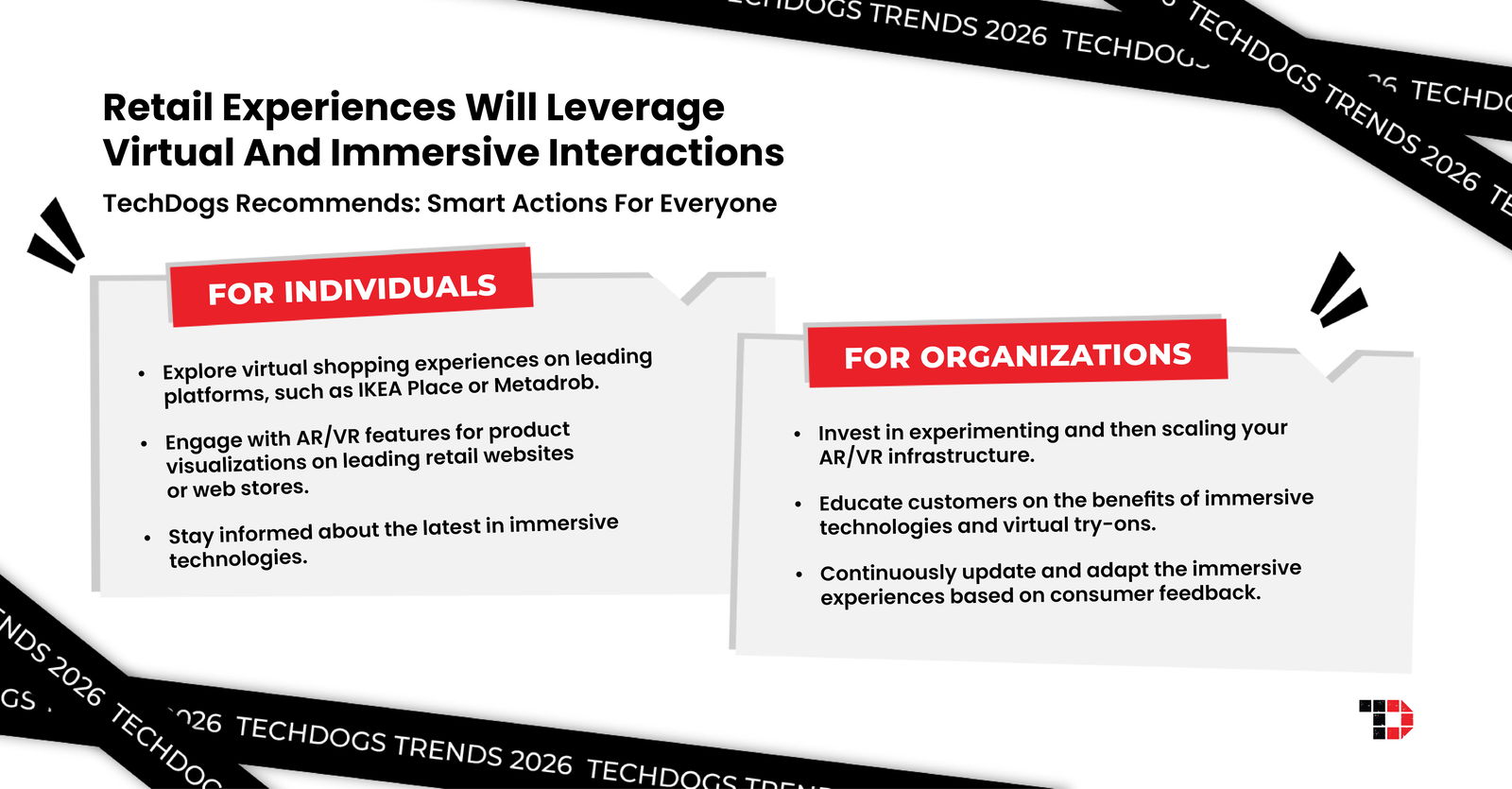
Trend 3: Retail Experiences Will Leverage Virtual And Immersive Interactions
Virtual and augmented reality have been transforming digital customer experiences for a while, and retail leaders are not keen to be left behind. Leading retail firms are designing experiences that allow customers to interact with products in real-time immersive environments. Adopting AR, VR, or mixed reality (MR) as a whole is enhancing product visualizations and engagement, creating more appealing shopping experiences than ever before.
How Is The Industry Responding?
According to The Business Research Company, the global immersive technology market is valued at $41 billion and is projected to reach $250–$270 billion by 2034. Digital-friendly retail consumers are driving this impressive growth. Brand XR reports that over 90% of American shoppers have used AR or are open to using it for shopping, and 98% of those who tried it found it helpful in making shopping decisions.
We are also seeing companies create more accessible AR/VR experiences for consumers who haven't used the technology. Bee VR Theme Park offers immersive experiences, including the Megaverse VR system with simulator rides and arcade games, to attract a broad customer base. Retailers are also adopting AR for virtual try-ons and product demonstrations, with the retail AR market expected to reach $93.07 billion in 2032, up from $6.68 billion in 2024.
Ganesh Sakhare, a Senior Analyst in Retail and E-commerce at QKS Group, explains: "From my standpoint, the question is no longer 'Is AR/VR the future?' but rather, 'How do we move from experimentation to value creation?'"
The reality is this: with 90% of American shoppers open to AR and a market growing toward $250-270 billion by 2034, immersive retail is no longer a novelty; it is a customer expectation that physical stores and digital platforms alike are being evaluated against. The move from experimentation to value creation is happening now.
Challenges To Watch
Adopting AR/VR in retail faces challenges, including high implementation costs and technological limitations for certain use cases. There is also a need for consumers to embrace immersive experiences that feel genuinely valuable, not just replacements for the tactile, hands-on experience of visiting a physical store.
Topics For More Insights
TechDogs Recommends: Smart Actions For Everyone
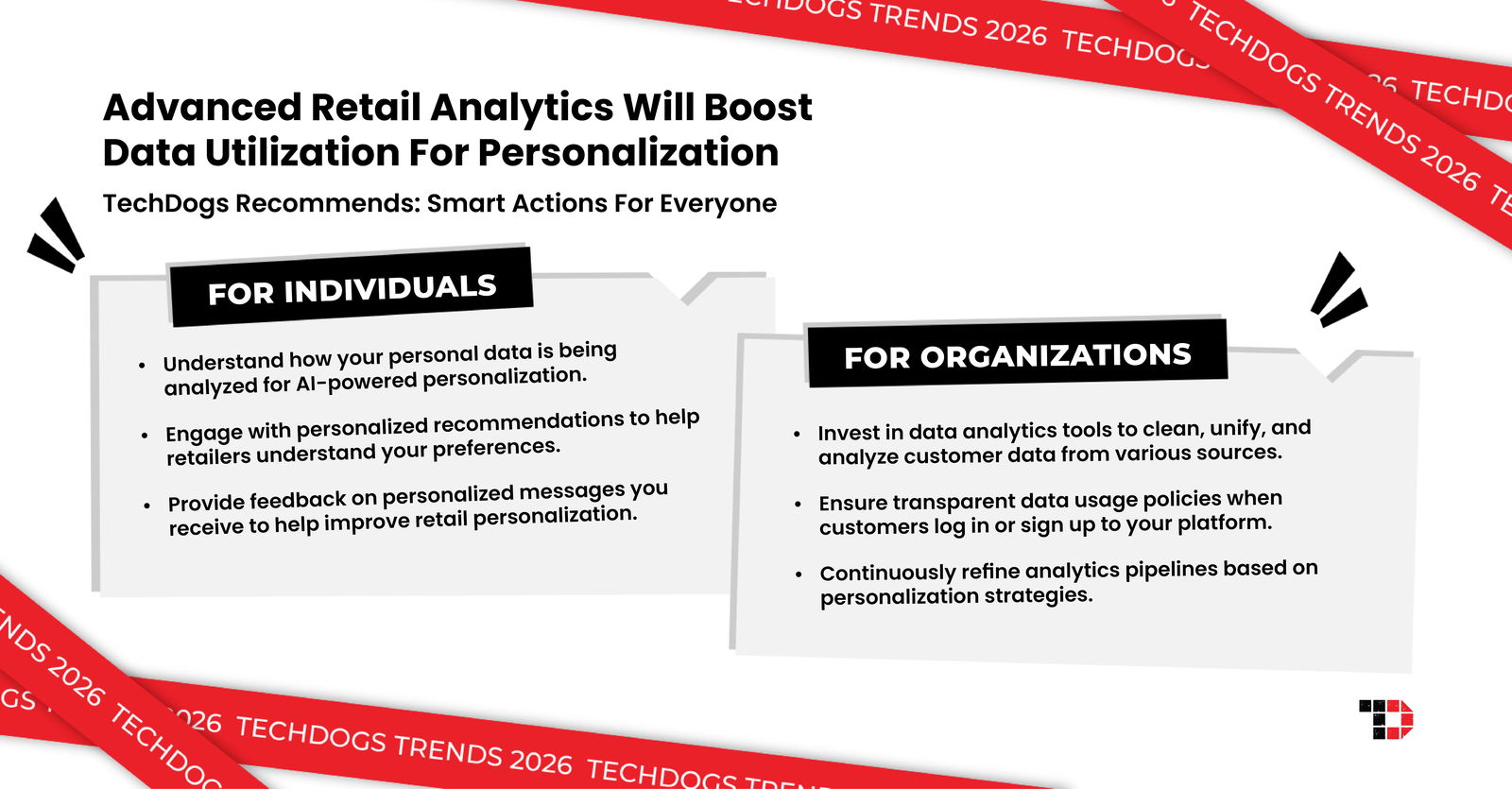
Trend 4: Advanced Retail Analytics Will Boost Data Utilization For Personalization
While AI-driven personalization is taking center stage, another powerful trend is happening behind the scenes. Tailored retail experiences demand advanced customer analytics, and retailers must harness vast amounts of customer data to deliver them. In 2026, retail analytics will become a standard practice for businesses leveraging AI-driven personalization to capture a larger market share.
How Is The Industry Responding?
Leading retailers are already implementing advanced analytics to enhance personalization capabilities across every touchpoint. As of 2025, 87% of retailers have deployed AI in at least one area of their business, while 60% plan to boost their AI investments in the near future. Deloitte's 2026 Retail Industry Outlook confirms that 68% of retailers expect to deploy agentic AI for key operational and enterprise activities within 12–24 months, moving analytics from insight generation to autonomous action.
Retailers are consolidating customer data from CRM, POS systems, online platforms, and social media to fuel analytics pipelines. Others are leveraging vast quantities of customer information for demographic-based targeting, predicting future actions, and uncovering hidden correlations between customer groups.
Jenna Posner, Co-Founder and Vice Chair of the Retail AI Council, gives an example of the utility of retail analytics: "Imagine a world where AI can tell you, 'I know customer 1234, and I've been aggregating data on them over the course of their lifecycle with the brand.'"
The advantage is shifting to retailers that treat analytics as infrastructure rather than a reporting function. With 87% of retailers already using AI in some capacity and 68% planning agentic AI deployment within two years, the question in 2026 is not whether to invest in analytics; it is how quickly you can move from data collection to autonomous action.
Challenges To Watch
Key challenges include data privacy concerns, the need for skilled data analysts, and the complexity of integrating analytics tools with existing business systems. Collecting data without consent may also feel intrusive, eroding consumer trust and compliance.
TechDogs Recommends: Smart Actions For Everyone
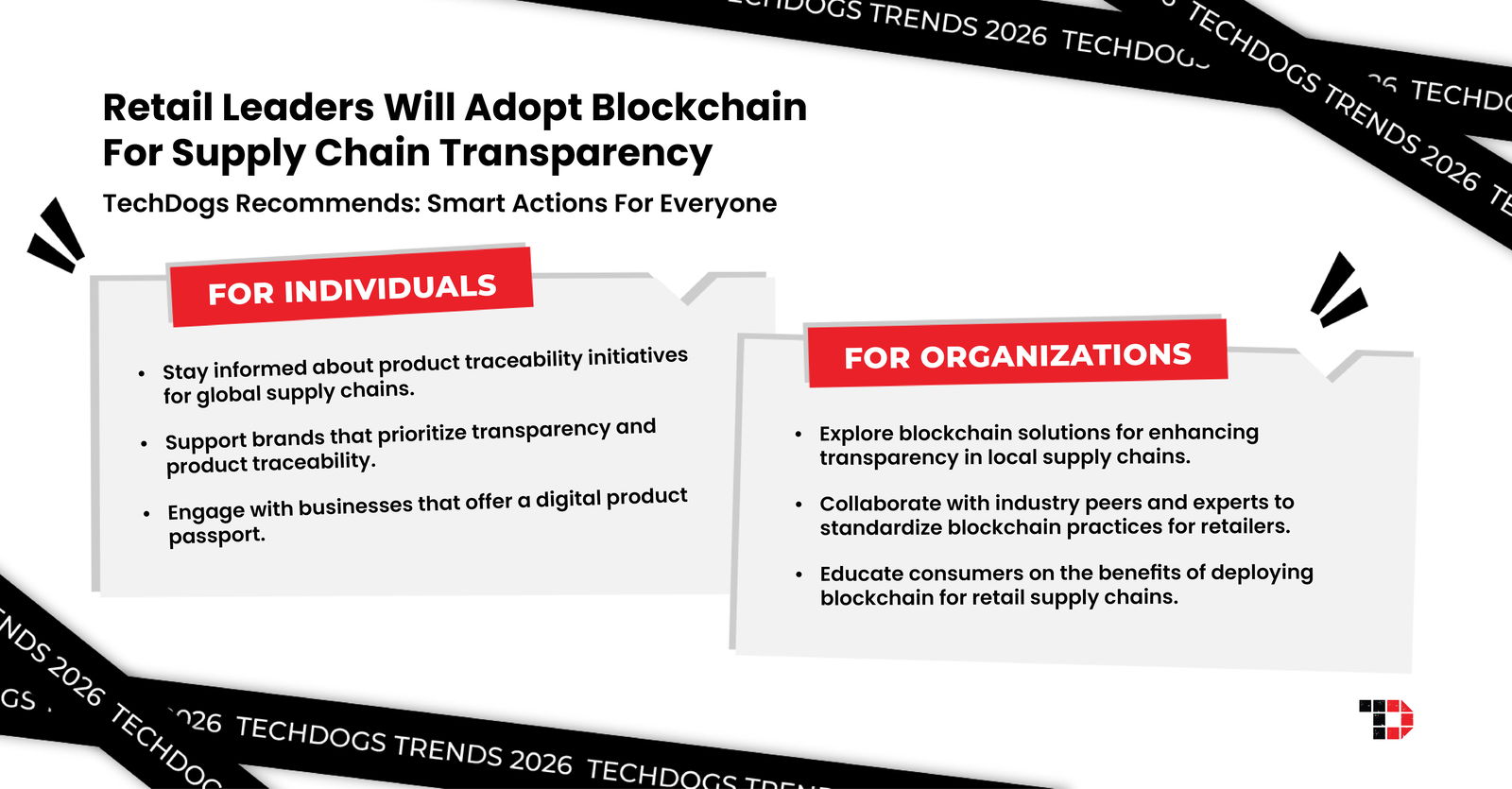
Trend 5: Retail Leaders Will Adopt Blockchain For Supply Chain Transparency
Blockchain technology provides a decentralized ledger for securely and transparently storing information. Future-ready retailers are adopting blockchain to track and verify products throughout the supply chain. In 2026, we expect retailers to develop and adopt proprietary blockchain networks to enhance product traceability and authenticity, leading to higher consumer trust and fewer counterfeit products.
How Is The Industry Responding?
The AURA Blockchain Consortium, comprising luxury brands such as LVMH, Cartier, DIOR, Prada, and others, is leading the way in implementing blockchain to enhance supply chain transparency. Its mission is to "create unique digital identities for each product in an effort to prevent counterfeits by tracking the entire supply chain."
Allied Market Research's report on the Blockchain in Supply Chain Traceability Solutions Market states that the market was valued at $2.2 billion in 2023 and is estimated to grow roughly 10x to $25.2 billion by 2032. Some estimates are higher: the IMARC Group's report projects the market to reach $33.25 billion by 2033.
Daniela Ott, Secretary General of AURA Blockchain Consortium, predicts: "This new solution will provide complete transparency on product sourcing history and verifiable authenticity documentation, which is key to strengthening consumer trust in brands and fostering a long-term relationship, critical in today's rapidly evolving retail landscape. We anticipate additional leading luxury brands will soon be joining our unique consortium."
The takeaway for retailers: blockchain's move from a luxury use case to mainstream retail infrastructure is accelerating. With the market projected to reach $25–$33 billion by 2032-2033 and the EU's Digital Product Passport requirements entering into force, supply chain transparency is no longer a brand differentiator; it is a regulatory and consumer expectation. Retailers who build traceability now will be ahead of a requirement that will eventually apply to everyone.
Challenges To Watch
Beyond the costs of implementing blockchain in a retail ecosystem, other challenges include scalability issues, regulatory considerations, and the need for industry-wide collaboration. Cross-chain interoperability is also a major barrier, and with a global supply chain, many retailers may find it impractical to develop and deploy a proprietary blockchain solution.
TechDogs Recommends: Smart Actions For Everyone
Conclusion
In Clueless, Cher doesn't just use her closet AI and stop there; she applies the same logic everywhere: understanding her environment, optimizing her choices, and building systems that help her stay ahead. That's exactly the mindset retail leaders need in 2026.
AI-powered personalization, autonomous checkouts, immersive AR/VR experiences, advanced retail analytics, and blockchain supply chain transparency are not five separate initiatives. They are five layers of the same transformation: a retail environment that knows you, serves you frictionlessly, shows you products in context, understands your data responsibly, and guarantees the authenticity of what you buy.
The latest retail technology trends are reshaping how retail businesses operate, how consumers shop, and how the global economy grows. Retailers that adapt with creativity, caution, and flexibility will lead in this dynamic environment. And as Cher herself might say, it's not about the outfit. It's about the system behind it.
Frequently Asked Questions
What Are The Most Important Retail Technology Trends To Watch In 2026?
In 2026, the retail industry is witnessing major transformations driven by five key technologies: AI-powered personalization, autonomous stores with smart checkouts, immersive AR/VR experiences, advanced data analytics, and blockchain for supply chain transparency. The global AI in retail market reaches $18.4 billion in 2026 and is projected to grow to $130.88 billion by 2033 (Coherent Market Insights), reflecting how deeply these trends are embedding themselves as competitive necessities rather than experiments.
How Is Artificial Intelligence Changing The Retail Shopping Experience In 2026?
AI is enabling hyper-personalized retail experiences by analyzing customer data and predicting preferences across every touchpoint. McKinsey confirms that AI personalization drives 10-15% revenue uplift for implementing retailers, and with 97% of retailers planning to increase AI spending (NVIDIA), the gap between AI-enabled and traditional retailers is accelerating. Retailers are using AI to deliver tailored offers, streamline inventory, and optimize marketing strategies while focusing on integrating AI responsibly.
Why Are Retailers Investing In Blockchain Technology For Supply Chains?
Major retailers, including luxury brands like LVMH and Prada, are adopting blockchain to improve transparency, authenticity, and trust across global supply chains. With the market growing from $2.2 billion in 2023 to an estimated $25.2-33.25 billion by 2032-2033, and EU Digital Product Passport requirements taking shape, blockchain traceability is transitioning from a brand differentiator to a compliance necessity. By tracking a product's journey from origin to shelf, blockchain ensures customers can verify sourcing, reduce counterfeiting, and promote ethical practices.
Fri, Oct 31, 2025

Enjoyed what you've read so far? Great news - there's more to explore!
Stay up to date with the latest news, a vast collection of tech articles including introductory guides, product reviews, trends and more, thought-provoking interviews, hottest AI blogs and entertaining tech memes.
Plus, get access to branded insights such as informative white papers, intriguing case studies, in-depth reports, enlightening videos and exciting events and webinars from industry-leading global brands.
Dive into TechDogs' treasure trove today and Know Your World of technology!
Disclaimer - Reference to any specific product, software or entity does not constitute an endorsement or recommendation by TechDogs nor should any data or content published be relied upon. The views expressed by TechDogs' members and guests are their own and their appearance on our site does not imply an endorsement of them or any entity they represent. Views and opinions expressed by TechDogs' Authors are those of the Authors and do not necessarily reflect the view of TechDogs or any of its officials. While we aim to provide valuable and helpful information, some content on TechDogs' site may not have been thoroughly reviewed for every detail or aspect. We encourage users to verify any information independently where necessary.
Loading comments...