 Featured
Networking Solutions
Networking Technology Trends Building The Connected Enterprise In 2026
Share
TL;DR
-
Wi-Fi 7: Dell'Oro Group confirms enterprise-class Wi-Fi 7 will become mainstream in 2026, with 59% of IT organizations initiating Wi-Fi upgrades this year (EMA). Wi-Fi Alliance expects 2.1 billion Wi-Fi 7 devices by 2028.
-
AI in Networking: Gartner predicts AI agent-based IT ecosystems will allow networks to collaborate dynamically across applications by 2028.
-
Hyperautomation: By 2026, 30% of enterprises will automate more than half of their network activities, up from under 10% in mid-2023 (Gartner). Hyperautomation is a cornerstone for 90% of large enterprises.
-
SASE: 90% of security leaders believe new cyber threats are already exploiting network gaps (Xalient Global SASE Report). Gartner's CIO Survey finds 39% of enterprises have deployed or plan to deploy SASE within two years. SASE is growing at a solid double-digit rate (Dell'Oro Group).
-
Edge Networks: Using edge computing can reduce latency by up to 90%.
Introduction
In the Iron Man films, JARVIS doesn't just respond to commands; he anticipates them, routes them, secures them, and delivers results before Stark finishes the sentence. In 2026, enterprise networking is finally building JARVIS. Not a single AI, but a converging system of five technologies, Wi-Fi 7 for the high-bandwidth backbone, AI for the intelligence layer, Hyperautomation for the workflow engine, SASE for identity-based access control, and Edge networks for the distributed sensor nodes, that together produce a network that senses, predicts, and secures itself in real time.
Everything hums around us, but what is this thing we call networking? It's the invisible thread that links our devices, homes, businesses, and dreams.
According to Cognitive Market Research, the global networking market was expected to hit $467.7 billion in 2025 and soar to $723.78 billion by 2033, growing at a steady CAGR of 5.61%. In 2026, this wave of growth is set to accelerate, powered by fresh innovations. While Networking as a Service (NaaS), Cloud Networking, and IoT Networks were the major trends in 2025, various breakthroughs are taking the spotlight this year.
Scale and speed are no longer the only metrics that matter. The networks of 2026 are expected to be resilient, intelligent, and self-securing, and the five trends below are how the industry is building them.
Here are the top five networking technology trends reshaping the industry in 2026.
Trend 1: Wi-Fi 7 Will Redefine Connectivity For Homes And Businesses
Decades ago, Wi-Fi was born to free us from cables and make mobility feel natural. That simple idea kept evolving. New generations of wireless technology came with each generation getting smarter, faster, and steadier. In 2026, Wi-Fi 7 (IEEE 802.11be) is here, shifting wireless into an entirely new gear with multi-link operation, wider channels, and smarter scheduling.
Large enterprises and universities are already experimenting, writing playbooks that smaller teams can soon copy. The timing makes sense: BYOD (Bring Your Own Device), the global 5G rollout, and the rise of smart home assistants have all accelerated demand. More devices mean more apps. More apps mean hungrier bandwidth.
How Is The Industry Responding?
Dell'Oro Group Research Director Sian Morgan confirmed in January 2026: "Enterprise-class Wi-Fi 7 will become mainstream in 2026. We expect the Wi-Fi 7 adoption curve to become steeper than it was for any other enterprise WLAN technology." Her research shows 59% of IT organizations will initiate a Wi-Fi upgrade in 2026 (Enterprise Management Associates), with the Wi-Fi 7 market growing from $8.63 billion in 2026 to $35.66 billion by 2031 at 32.8% CAGR (Mordor Intelligence).
Dell'Oro Group also predicts that by 2028, Wi-Fi 7 will account for over 90% of indoor access-point revenue, with 2025 already delivering 12% WLAN growth. The Wi-Fi Alliance expects more than 2.1 billion Wi-Fi 7 devices to ship by 2028.
Christian Gilby at Juniper Networks shares his view: "Before you even start to configure and run the network, you've got to make sure the infrastructure is deployed in the right places." Nat Chidambaram, Head of Products at NETGEAR, adds: "One of the biggest advantages is data rates. Speeds and feeds are very high with Wi-Fi 7 in order to support the rich, real-time applications with multilink operation." The question isn't who will adopt it, but who dares not to.
The shift is clear: with 59% of IT organizations planning a Wi-Fi upgrade in 2026 and a market growing toward $35.66 billion by 2031, Wi-Fi 7 is no longer an upgrade option; it is the baseline for any enterprise that wants to support AI workloads, IoT density, and real-time applications without bandwidth bottlenecks.
Challenges To Watch
Deployment is tricky, especially optimizing a 6 GHz design and avoiding interference. Wired underlays must catch up while device ecosystems still need to mature for smooth interoperability. With partner-led surveys, AIOps-driven tuning, and phased rollouts, these challenges look more like speed bumps than roadblocks.
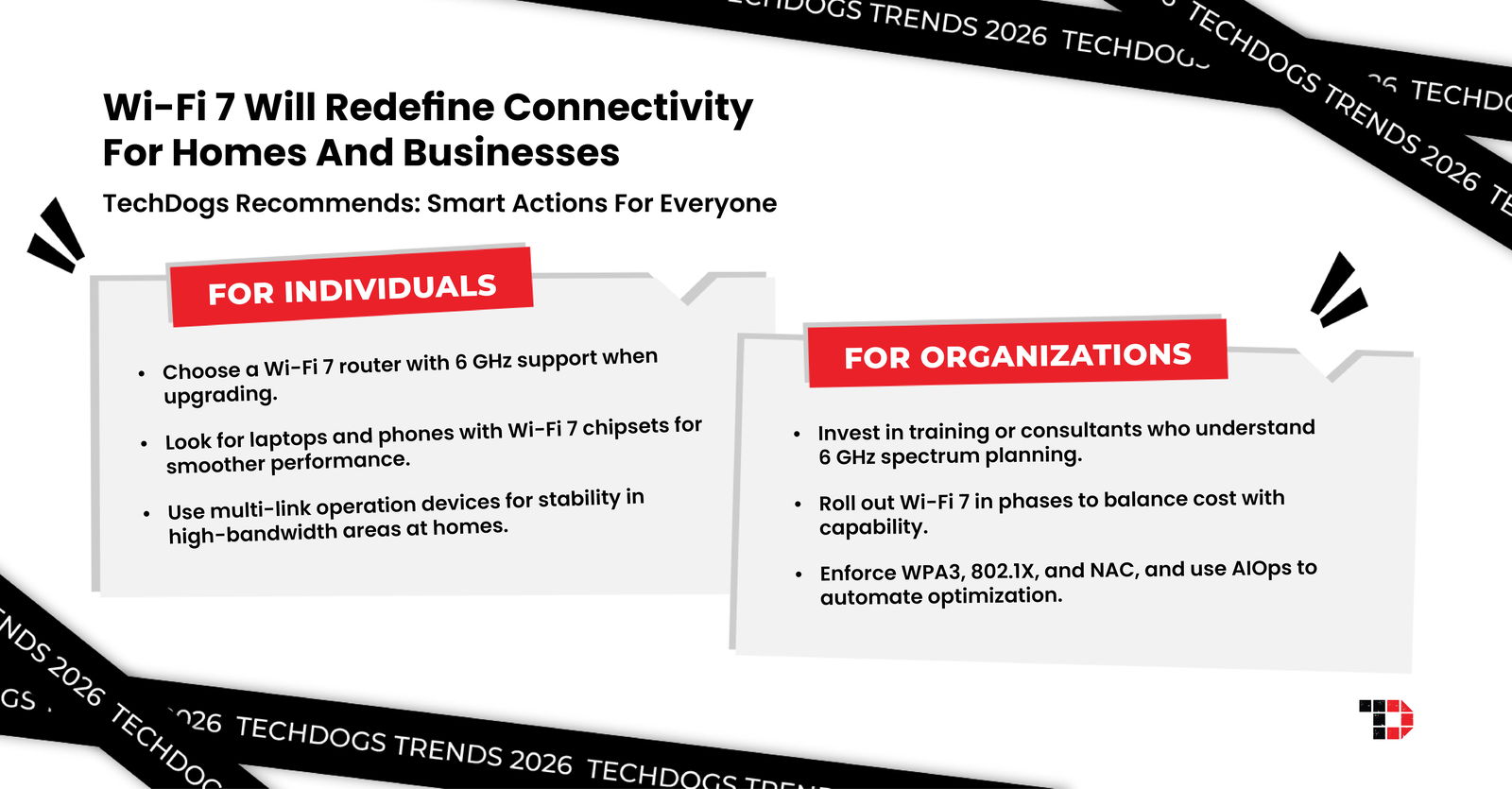
TechDogs Recommends: Smart Actions For Everyone
Trend 2: AI Will Redefine How Enterprises Stay Connected
This is the JARVIS layer. AI in networking has become a quiet force, transforming how enterprises run their digital operations. Networks can now sense, predict, and resolve issues on their own. From spotting anomalies to scheduling maintenance before something breaks, AI sits at the heart of enterprise IT to cut drift time, speed up troubleshooting, and make bandwidth allocation smarter.
Modern IT environments have already stretched human teams thin. Distributed workforces, IoT sprawl, and cloud-first strategies are waves of complexity. AI changes the game, helping teams move from firefighting to foresight. Gartner predicts that by 2028, AI agent-based IT ecosystems will allow networks to collaborate dynamically across applications without users having to hop between each one.
How Is The Industry Riding The Wave?
Cisco Catalyst Center (Cisco DNA Center) is helping enterprises predict faults before they happen. Ericsson's Operations Engine uses AI to automate troubleshooting, optimize performance, and improve customer experiences across telecom. As Dell'Oro Group analyst Sian Morgan puts it: "The path to an AI revolution begins with a high-performance network."
According to Grand View Research, the global AI in networking market was valued at $8.76 billion in 2023 and is projected to reach $60.60 billion by 2030, a CAGR of 32.5% from 2024 to 2030. Network World reports a dramatic increase in the percentage of network management tasks automated by AI, with that trend expected to gain more momentum over the next two years (IDC survey, 500+ respondents).
What this means in practice: in 2026, Tier 1 and Tier 2 infrastructure operations are predicted to go 'no human in the loop' for routine incident response and change management, with agentic AI systems handling remediation autonomously (Nick Lippis, ONUG). The network engineers of 2026 will supervise AI, not manage alerts.
Challenges To Watch
AI models can misfire if trained on weak data, leading to misconfigurations or outages. Costs are high, and retraining both systems and people in AI-driven operations isn't simple. Cultural resistance also lingers; handing control to machines takes trust. Yet with phased rollouts and clear governance, these hurdles are likely to become stepping stones.
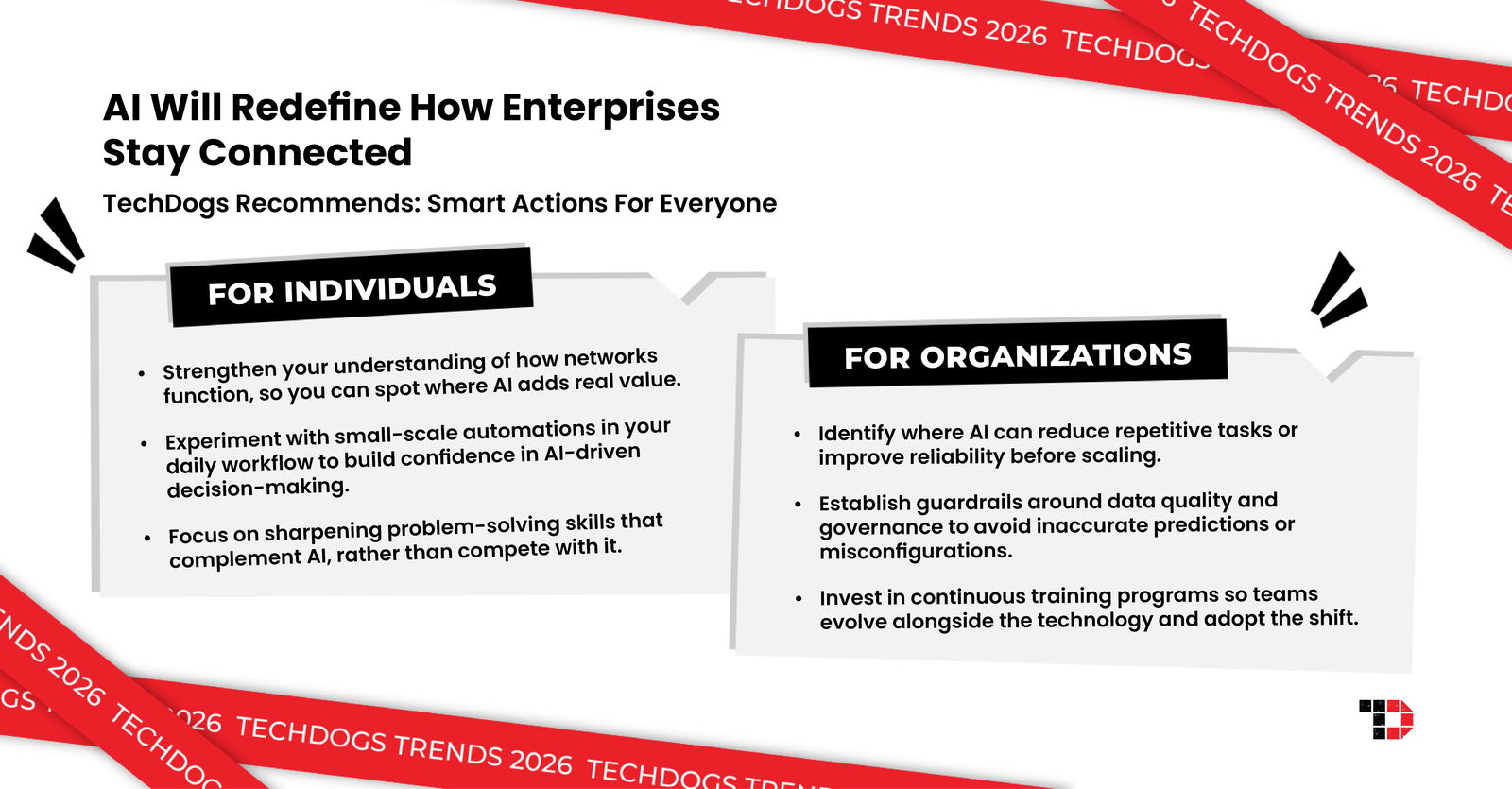
TechDogs Recommends: Smart Actions for Everyone
Trend 3: Hyperautomation Will Drive The Next Wave Of Efficiency
Is automation still a trend? It's been promising speed and scale for decades. True, but in 2026, hyperautomation is turning that promise into something bigger.
Hyperautomation combines AI, machine learning, robotic process automation, and event-driven architectures into a single, unified strategy. The goal is to streamline processes and deliver smarter, faster network operations. It's not only about speed, but automation also strengthens security by applying policies consistently and rolling out updates quickly, reducing the window for emerging threats.
How Is The Industry Responding?
Gartner has confirmed this is not an emerging play but an established one: by 2026, 30% of enterprises will automate more than half of their network activities, up from under 10% in mid-2023. Gartner also puts the hyperautomation-enabling software market at $1.04 trillion by 2026, and confirms hyperautomation is a cornerstone for 90% of large enterprises.
Chris Saunderson, Senior Director Analyst at Gartner, sums it up: "Infrastructure and Operations leaders are increasingly seeking AI-driven insights and augmented decision-making, including intelligent automation, to enhance operational resilience, handle complexity, and process large amounts of data through automation."
A survey by Enterprise Management Associates (EMA) reveals that 33.9% of IT organizations reported higher productivity from skilled staff, while 32.8% reduced security risks through automation. Generative AI is also accelerating hyperautomation adoption, with GenAI now embedded in workflow automation tools across the network management stack.
The reality is this: a $1.04 trillion software market and a 3x increase in network automation adoption between mid-2023 and 2026 confirm that hyperautomation is no longer a roadmap item. It is the operating standard for any enterprise serious about resilience, compliance, and scale.
Topics For More Insights
Challenges To Watch
EMA's Enterprise Network Automation Report highlights that only 18% of IT professionals claim complete success with automation projects. Legacy systems, integration headaches, fractured data, and skill gaps remain real hurdles. These challenges don't diminish the importance of hyperautomation; if anything, they underline why careful planning is the secret ingredient.
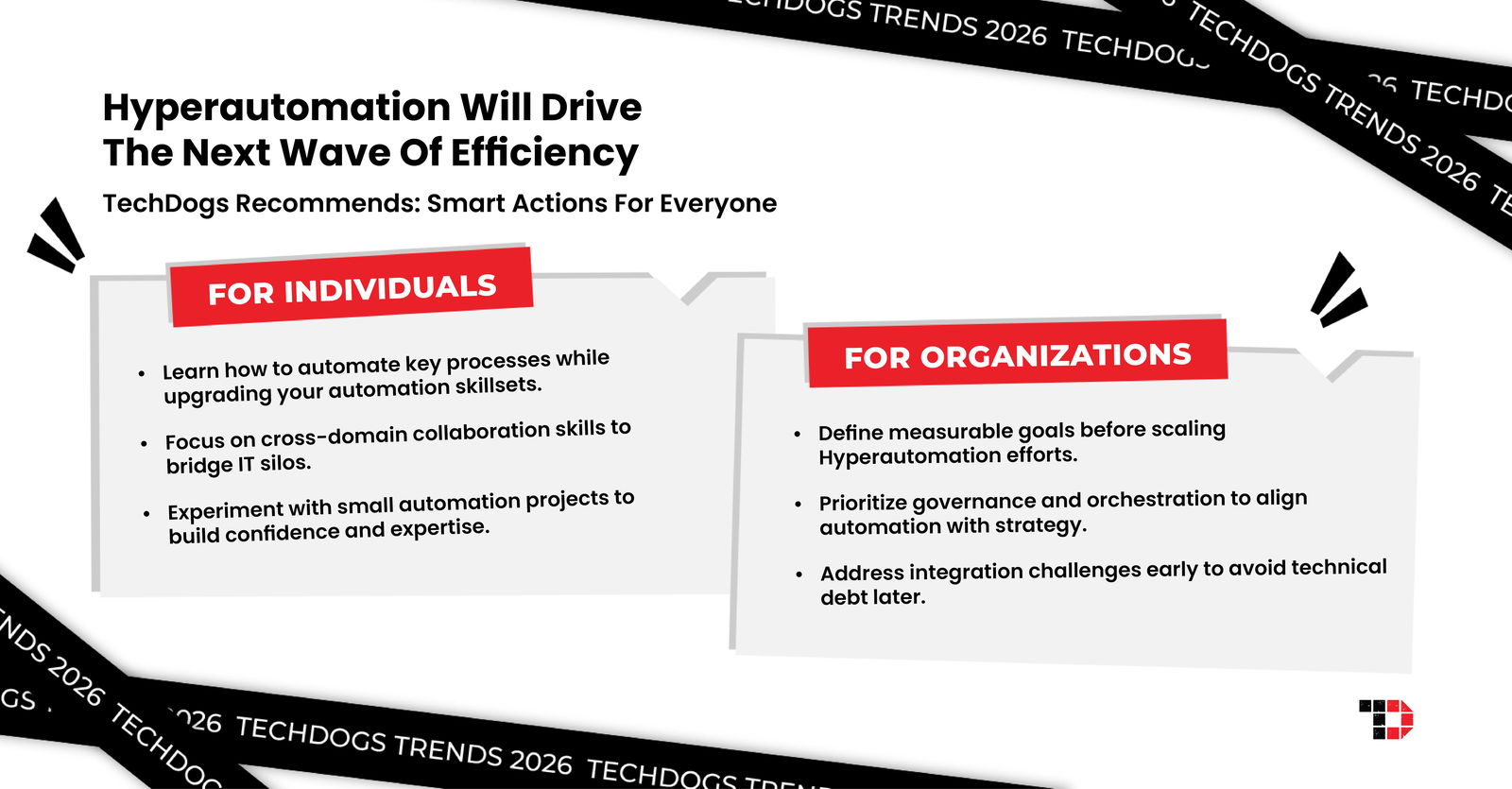
TechDogs Recommends: Smart Actions for Everyone
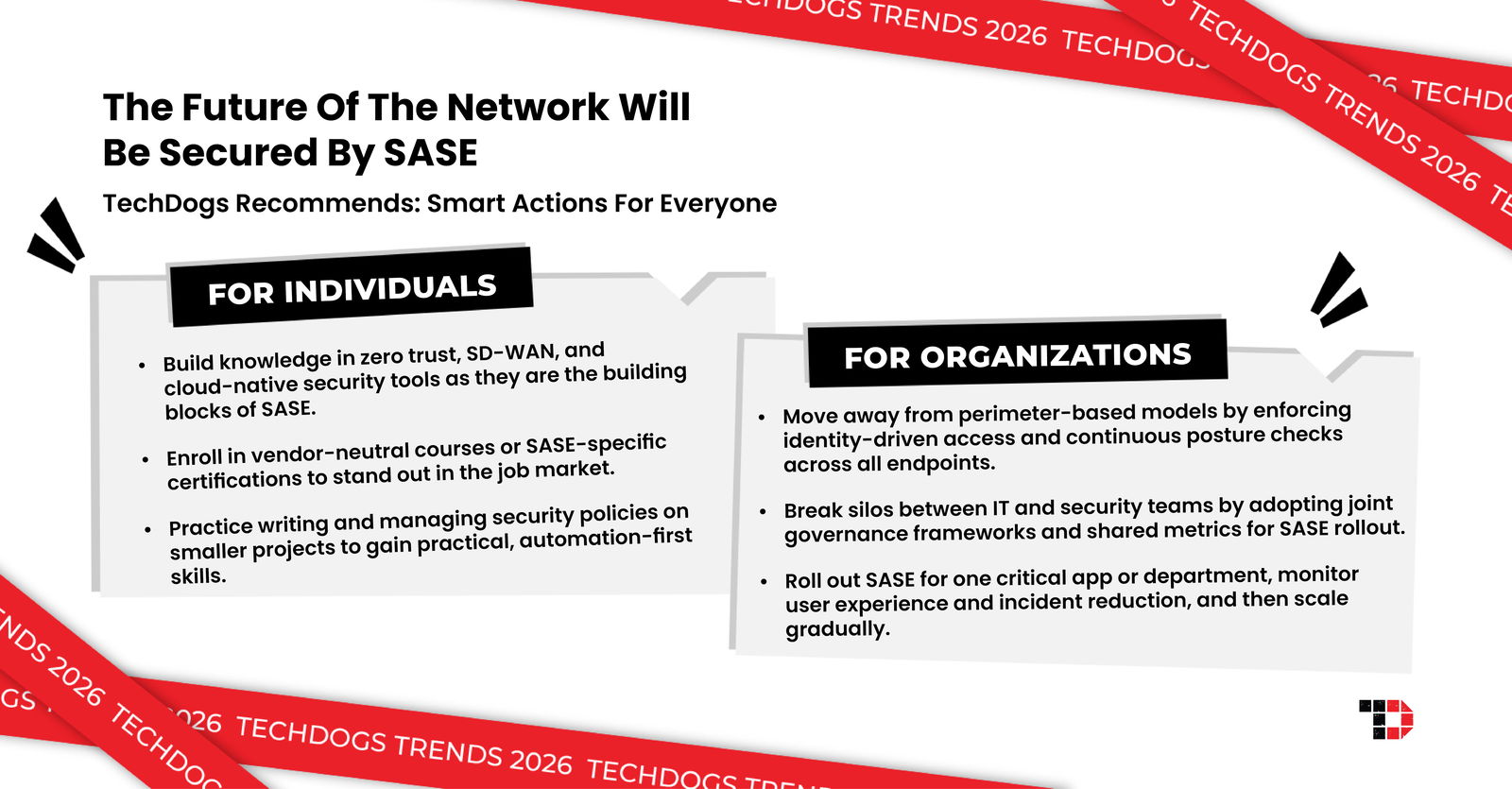
Trend 4: The Future Of The Network Will Be Secured By SASE
What is SASE? Secure Access Service Edge brings networking and security together into one cloud-delivered service. Instead of sending all traffic back to a data center chokepoint, sessions head to the nearest SASE Point of Presence (POP), where identity-aware policies step in. One pass, many controls, zero trust by default.
Why is it gaining traction now? Hybrid work, SaaS, and multi-cloud broke the old perimeter. SASE cleans up tool sprawl, cuts backhaul delays, and gives teams a single place to shape and see network traffic. Think of it less as a product and more as an architecture. The payoff is faster experiences and simpler, safer network operations.
How Is The Industry Riding The Wave?
Cato Networks, a Leader in Gartner's Magic Quadrant for SASE Platforms 2025, brings together SD-WAN, SSE, NGFW, and a global backbone under one console. CEO Shlomo Kramer puts it plainly: Cato enables IT "to deliver protection, performance, scalability, and simplicity" all in one go.
The momentum is clear. Xalient's Global SASE Report found that 90% of security leaders believe new cyber threats are already exploiting network gaps. Gartner's CIO and Technology Executive Survey reveals that 39% of enterprises have deployed or plan to deploy SASE within two years. Dell'Oro analyst Mauricio Sanchez confirms SASE has been growing at a solid double-digit rate, noting: "In 2026, we expect security and networking teams to budget less for discrete 'boxes' at the branch and more for recurring spend on SASE/SSE, WAF, and the underlying cloud connectivity."
The advantage is shifting to enterprises that treat SASE as an architecture rather than a product. With 90% of security leaders already identifying threat exploitation of network gaps and 39% of enterprises in active deployment or planning, the SASE window for strategic adoption is now. Organizations that delay will inherit both the security risks and the integration complexity that their early-mover peers are already avoiding.
Challenges To Watch
Despite the potential of SASE, there are tough choices to make. Do you juggle multiple vendors or commit to one? Teams need to craft identity-centric policies, constantly check device health, and manage challenges such as data storage, encrypted traffic inspection, and third-party integrations.
TechDogs Recommends: Smart Actions for Everyone
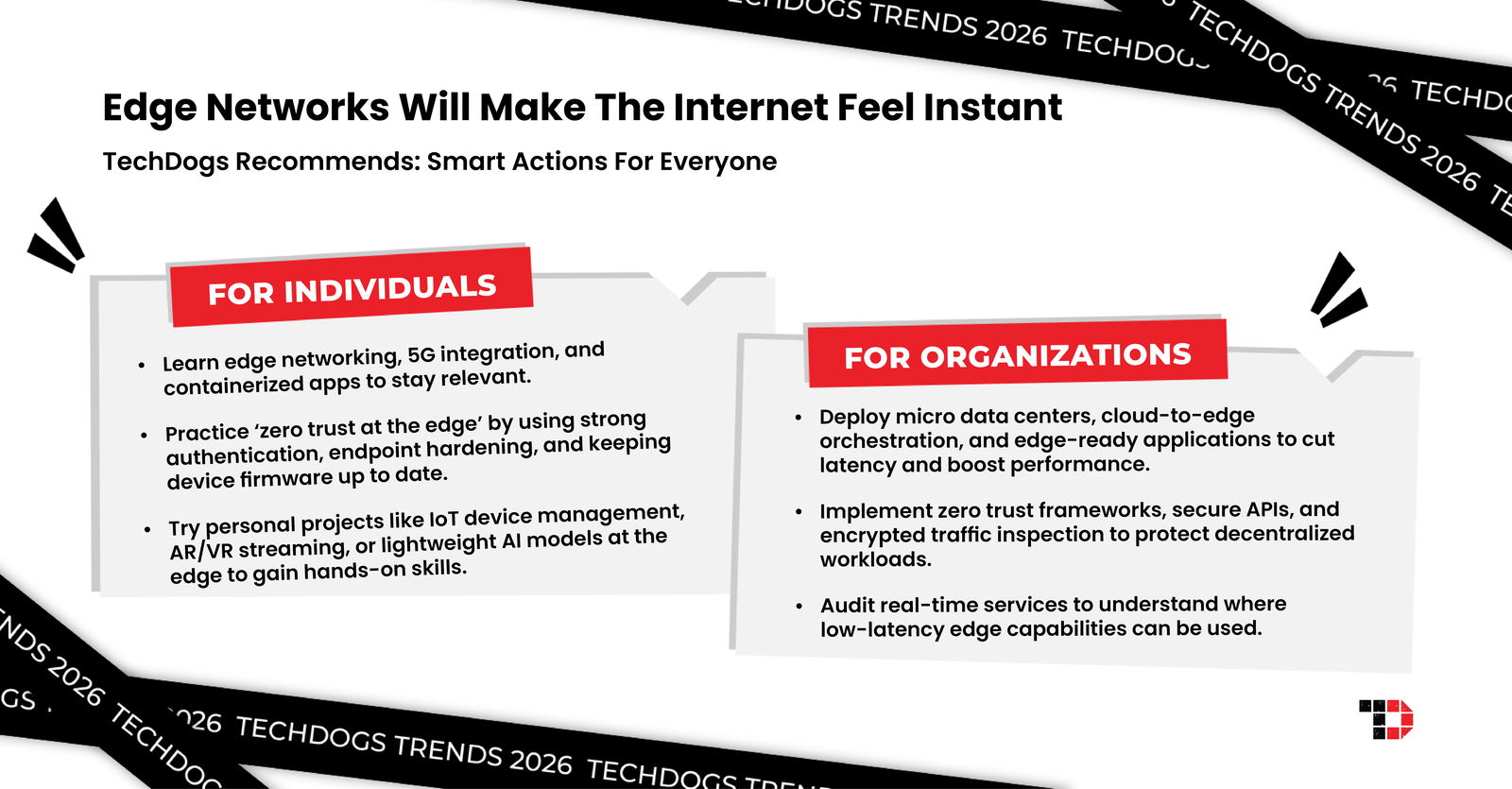
Trend 5: Edge Networks Will Make The Internet Feel Instant
Just like edge computing, edge networks bring compute, storage, and networking closer to where data is created and used, on factory floors, in retail stores, near cell towers, even inside mini data centers. Instead of sending every request off to a faraway cloud, apps now run logic at the closest 'edge' spot, returning answers in milliseconds. This allows applications to analyze and respond locally instead of bouncing across distant clouds.
This shift fuels everything from AI-powered factories and robotics to immersive media and connected retail. In 2026, hybrid work will give developers the freedom to place code right where users need it.
How Is The Industry Responding?
Slack is a great example. By improving its API security and tapping Amazon CloudFront, Slack cut response times by roughly 300ms. Average global latency for Slack.com dropped from 90ms to just 15ms, a global CDN plus serverless edge functions delivering secure, personalized, lightning-fast experiences.
The scale of investment confirms the urgency. The global edge computing market is expected to reach $82 billion by 2026, with edge computing reducing latency by up to 90%. IDC projected edge spending to hit nearly $261 billion in 2025 and soar to $380 billion by 2028, fueled by the adoption of AI and real-time data analytics.
IDC's Dave McCarthy sums it up: "Edge computing is poised to redefine how businesses leverage real-time data," pointing to low-latency networks and AI analytics as the perfect combination.
The takeaway for organizations: at $82 billion in 2026 and growing toward $380 billion by 2028, edge networking is no longer a specialist infrastructure play; it is a competitive capability. The enterprises that deploy micro data centers, cloud-to-edge orchestration, and edge-ready applications in 2026 will deliver experiences their competitors simply cannot match from a centralized cloud.
Challenges To Watch
Running code everywhere isn't easy. Teams must orchestrate workloads across heterogeneous hardware, multiple clouds, and Multi-access Edge Computing (MEC) sites while maintaining end-to-end visibility. Add data governance, zero trust for devices, model security for edge AI, and safe over-the-air updates, and the to-do list grows.
TechDogs Recommends: Smart Actions for Everyone
Conclusion
JARVIS didn't make Tony Stark's life easier by doing only one thing well. He made it easier by doing everything in coordination, sensing, routing, securing, predicting, and responding as a single coherent system. That's the networking story of 2026.
Wi-Fi 7, AI-driven networks, Hyperautomation, SASE, and Edge networks are not five separate upgrades. They are five layers of the same architecture, one that is fast, secure, and connected at every edge. The question isn't whether change is coming; it's whether your network is ready to handle it intelligently.
The enterprises that treat these trends as a coordinated system rather than individual investments will build the network infrastructure that gives them an operational edge for years to come.
Frequently Asked Questions
Why Should CEOs Pay Attention To Wi-Fi 7 Adoption?
Wi-Fi 7 goes beyond speed; it ensures seamless collaboration across devices, offices, and geographies. For CEOs, adopting it means empowering hybrid teams with reliable connectivity, enhancing customer experiences, and preparing the enterprise for real-time applications without bandwidth bottlenecks. With Dell'Oro confirming Wi-Fi 7 will become mainstream in 2026 and the market growing toward $35.66 billion by 2031, the window for strategic adoption is now.
How Does AI In Networking Benefit Executive Decision-Making?
AI transforms networks from reactive systems into proactive assets. For executives, this means fewer outages, faster troubleshooting, and predictive insights that reduce operational risk. With the AI in the networking market projected to reach $60.60 billion by 2030 and Gartner predicting autonomous Tier 1/Tier 2 operations in 2026, AI networking is moving from pilot to standard operating environment faster than most enterprises have planned for.
What Strategic Role Does Hyperautomation Play For Enterprises?
Hyperautomation unifies AI, machine learning, and automation to simplify complex infrastructures. For CEOs, it's not about cost-cutting alone; it's about securing operations, accelerating growth, and ensuring compliance while freeing skilled talent to focus on innovation and customer value. With 30% of enterprises set to automate more than half of their network activities by 2026 (Gartner) and a $1.04 trillion enabling software market, hyperautomation is the operational backbone of every competitive enterprise in 2026.
Thu, Oct 23, 2025

Enjoyed what you've read so far? Great news - there's more to explore!
Stay up to date with the latest news, a vast collection of tech articles including introductory guides, product reviews, trends and more, thought-provoking interviews, hottest AI blogs and entertaining tech memes.
Plus, get access to branded insights such as informative white papers, intriguing case studies, in-depth reports, enlightening videos and exciting events and webinars from industry-leading global brands.
Dive into TechDogs' treasure trove today and Know Your World of technology!
Disclaimer - Reference to any specific product, software or entity does not constitute an endorsement or recommendation by TechDogs nor should any data or content published be relied upon. The views expressed by TechDogs' members and guests are their own and their appearance on our site does not imply an endorsement of them or any entity they represent. Views and opinions expressed by TechDogs' Authors are those of the Authors and do not necessarily reflect the view of TechDogs or any of its officials. While we aim to provide valuable and helpful information, some content on TechDogs' site may not have been thoroughly reviewed for every detail or aspect. We encourage users to verify any information independently where necessary.
Loading comments...