
Media and Entertainment
Media And Entertainment Technology Trends To Watch In 2026
Share
TL;DR
-
AI Hyper-Personalized Streaming: Roku partnered with AWS in 2025 for contextual targeting based on time of day and engagement patterns. Netflix's "My Moments" feature curates highlight reels for decision-making. Deloitte confirms that entertainment providers must leverage AI personalization or face structural decline.
-
Cloud Gaming and Social Video Convergence: 78% of users aged 24 or younger report watching live gaming streams. Amazon Luna and Roblox are already fusing cloud gaming with real-time social video.
-
Generative AI in Content Creation: Deloitte reports movie studios allocated 3%–7% of budgets to GenAI in 2025. Netflix and Disney use Flawless AI for dubbing, reducing localization budgets by 60%.
-
Data-Driven M&A and Platform Consolidation: The $34.5 billion Charter-Cox merger, $8 billion Skydance-Paramount deal, and AT&T's $5.75 billion fiber acquisition reflect industry response to subscription fatigue. Deal volumes dropped ~15% in 2025, but deal values surged on mega-mergers.
-
AR and VR Immersive Entertainment: A BTS VR concert via WaveXR drew 1.2 million virtual viewers. PlayStation VR2 Resident Evil 4 VR Mode registered 184,000 players by February 2025.
Introduction
In Ready Player One, the OASIS is a fully immersive, interconnected entertainment universe where people don't just watch content, they live inside it. Every trend in this article is a piece of it being built in real life. AI hyper-personalization is the OASIS learning your preferences before you ask. Cloud gaming with social video is co-play and spectate in the same space. Generative AI content creation is the OASIS generating worlds on demand. Platform consolidation is the corporate battle to own the OASIS. And AR/VR immersive experiences are the prototype haptic suits. The OASIS was fiction in 2018. In 2026, it is an industry roadmap.
In 2026, media and entertainment are undergoing a seismic shift. As the battle for audiences' attention intensifies, businesses are creating hyper-personalized, high-quality experiences, a strategy going from novelty to necessity.
Last year, we saw early signs of change: podcast channels gaining traction, platforms racing for social-first features, generative AI tools evolving for content creation, and the rising risk of deepfakes. What began as experimentation in 2025 becomes a serious difference-maker in audience retention, engagement, and media dominance this year.
The scale of transformation is significant. The global media and entertainment market is expected to reach $3.08 trillion in 2026 (SQ Magazine), and the AI in media and entertainment segment expands from $28.32 billion in 2025 to $35.77 billion this year at 26.3% CAGR (Research and Markets), reflecting how deeply intelligent technology is embedding itself into content creation, distribution, and consumption.
Here are the top five trends reshaping media and entertainment technology in 2026.
Trend 1: AI Will Deliver Hyper-Personalized Streaming Experiences
Have you ever scrolled endlessly through your Netflix queue before settling on yet another rewatch of The Office? In 2026, that's ancient history.
Say hello to hyper-personalized streaming, powered by advanced recommendation engines, viewer sentiment models, and dynamic metadata tagging. The "You May Like" suggestions have evolved into adaptive streaming menus that analyze viewer mood to serve up the best recommendation. AI-driven personalization is taking center stage in 2026.
How Is The Industry Responding?
Major players are investing in next-gen personalization infrastructure. Roku, for example, partnered with AWS in 2025 to roll out contextual targeting based on time of day, user habits, and prior engagement patterns. Netflix's experimental "My Moments" feature curates highlight reels from a suggested series to hasten decision-making.
Doug Van Dyke, vice chair of Deloitte LLP, confirms: "The data is clear: Entertainment providers should embrace innovation and agility to help them thrive. This means understanding the nuances of younger audiences, leveraging technology to personalize content and advertising, and exploring new distribution and monetization channels. The status quo is likely no longer an option."
Media and entertainment businesses are adopting the ATSC 3.0 standard (NextGen TV) to gain localized viewing insights and tailor over-the-air content in real time. Metadata is expanding to include not just genre or language but also emotional tone, pacing, color palette, and character archetypes, helping machine-learning recommendation engines predict not just what users want to watch but how they want to feel.
The shift is clear: in 2026, content discovery is no longer a browsing problem; it is a data and AI problem. Platforms that invest in emotional metadata, real-time sentiment modeling, and contextual targeting will retain the audiences that scroll-fatigued competitors lose.
Challenges To Watch
The biggest challenge is data privacy regulation, as personalization requires in-depth data collection and consent management. Inconsistent metadata standards across platforms and overreliance on AI engines may reinforce biased or flawed insights.
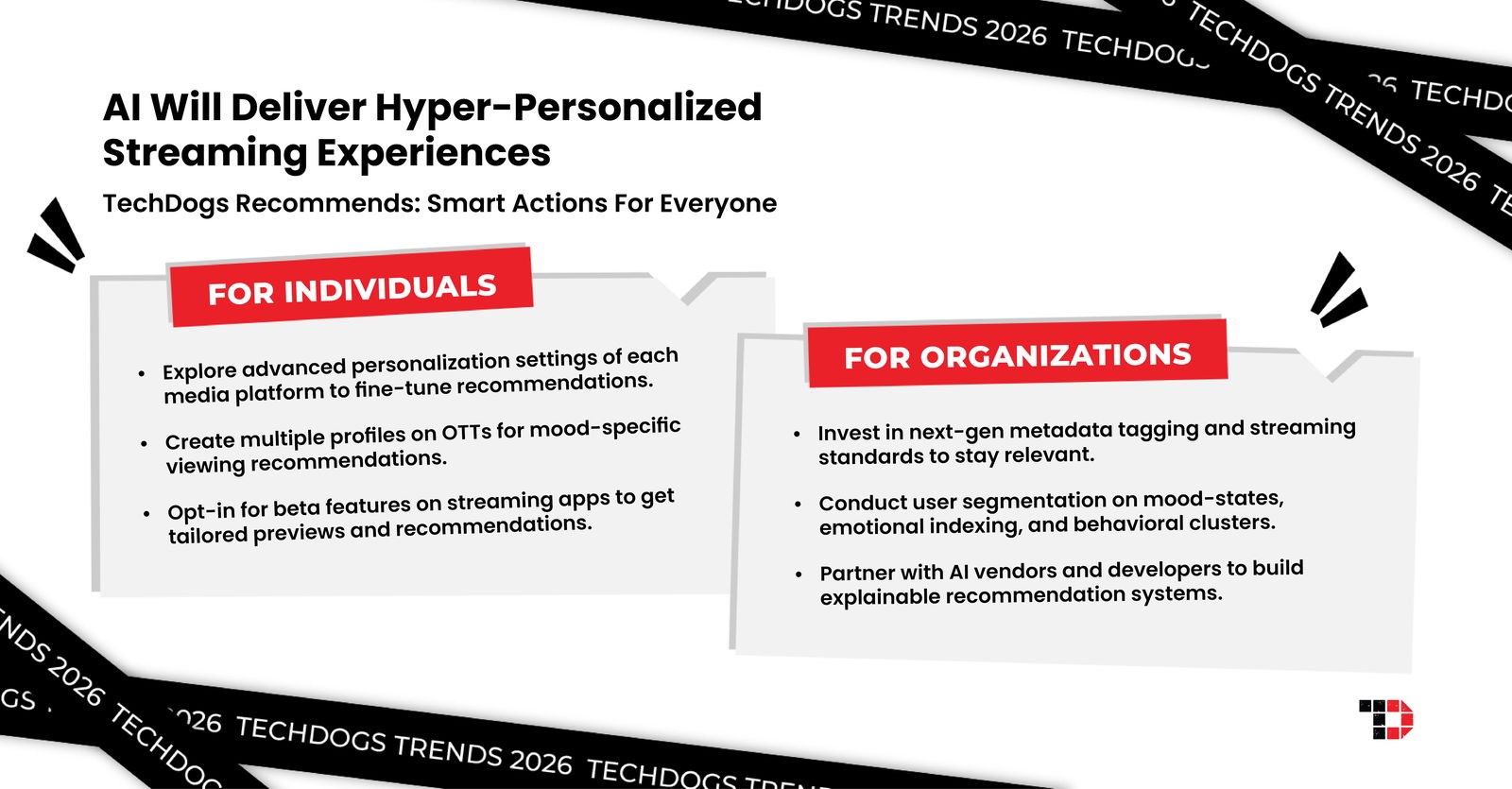
TechDogs Recommends: Smart Actions For Everyone
Trend 2: Cloud Gaming And Social Video Will Converge
Cloud gaming has been gaining traction for a while and will continue to evolve in 2026. Beyond blockbuster titles, cloud gaming platforms will soon be inseparable from social video platforms, where gameplay, commentary, and live interactions intersect. With low-latency 5G/6G networks and GPU-cloud scalability, "play-and-watch" experiences will become real-time events meeting Gen Z's demand for social-first interactions.
How Is The Industry Responding?
Top gaming players are already fusing cloud gaming with social video. Amazon Luna now offers Twitch chat during streaming, and Roblox hosts co-play sessions to enhance social gaming. According to Coherent Market Insights, the cloud gaming market was valued at $9.32 billion in 2025 and is projected to reach $159.24 billion by 2032, with 78% of users aged 24 or younger reporting that they watch live gaming streams.
Microsoft-owned Xbox CEO Phil Spencer said, "We always tend just to follow where we see people playing. It has been amazing to see the number of people now playing Xbox via the cloud." At scale, Microsoft's xCloud helps creator-gamers automatically generate short-form clips for TikTok and Reels, broadening outreach and engagement.
As we head into 2026, expect deeper cross-platform chat integration and AI-driven clip highlights on social media. Creators and brands will increasingly embrace the "ride-along" entertainment format, supported by reliable 5G connectivity and social video platforms.
What this means in practice: the boundary between playing and watching is dissolving. Cloud gaming in 2026 is not a platform; it is a social experience layer. Brands and creators who understand this will treat cloud gaming as a distribution channel, not just a game-delivery service.
Challenges To Watch
Buffering lag and regional latency variability remain ongoing operational challenges for cloud gaming and social video adoption. Platform fragmentation and the delicate balance of monetization between creators and sponsors add to the complexity.
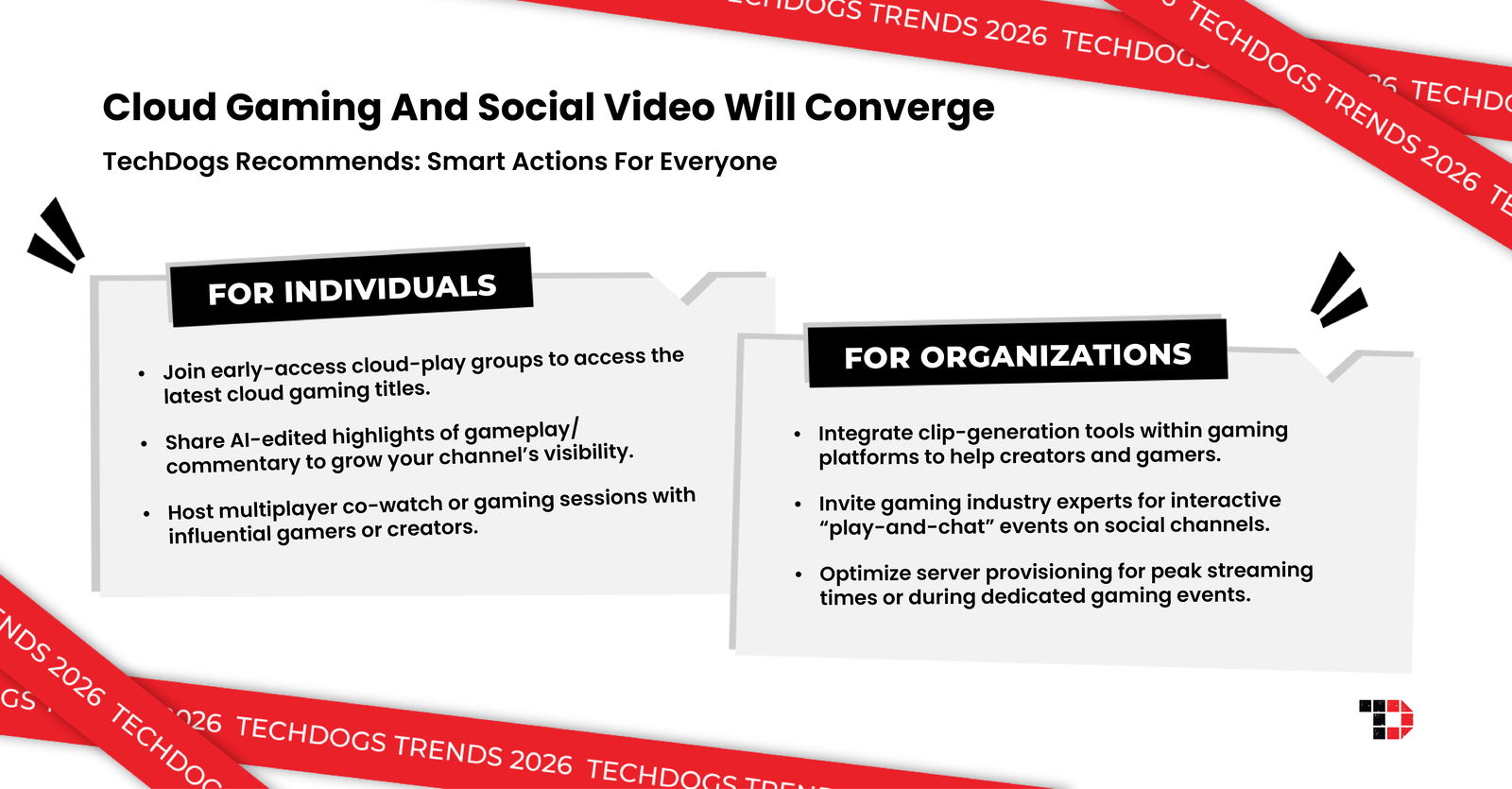
TechDogs Recommends: Smart Actions For Everyone
Trend 3: Generative AI In Content Creation Will Turbocharge Human Creativity
In 2026, generative AI spans all stages of content creation: from ideation and experimentation to the final cut. AI-powered scriptwriters, deepfake voices, and colorists are accelerating content workflows following the rise of AI dubbing and VFX automation last year. Some movie studios are now producing short proof-of-concept films entirely using AI tools such as Google Veo and Moonvalley's Marey AI. The top factors driving this trend include multimodal AI models, lower compute costs, and rising demand from indie creators.
How Is The Industry Responding?
Hollywood studios and indie filmmakers are embracing generative AI at every stage. AI startup Primordial Soup, founded by director Darren Aronofsky, has partnered with Google DeepMind on a proof-of-concept short film featuring AI voiceovers and automated color grading to unlock the next chapter of human-AI creativity.
Deloitte reported that movie studios allocated 3%–7% of their budgets to generative AI in 2025. Netflix and Disney are using Flawless AI for dubbing, reducing localization budgets by 60%. The AI in the media and entertainment market grows from $28.32 billion in 2025 to $35.77 billion in 2026 at 26.3% CAGR (Research and Markets), signaling that GenAI has crossed from experiment to infrastructure.
Naeem Talukdar, CEO of Moonvalley, highlights the need for greater control: "Our thesis is that to make production-grade generative video viable, the key missing piece is control. Today's video models are mostly text-to-video; type in a prompt, and you get a clip. That's nowhere near what's needed for professional filmmaking."
The advantage is shifting to content studios that treat generative AI as production infrastructure rather than a novelty tool. At 3%–7% of studio budgets in 2025 and growing, the studios that govern this capability well will produce more content, localize it faster, and scale it further than those still debating adoption.
Topics For More Insights
Challenges To Watch
One of the biggest concerns is intellectual property theft and the risk of training models on copyrighted data. Debates over content attribution and job displacement are intensifying as more studios adopt generative AI for production.
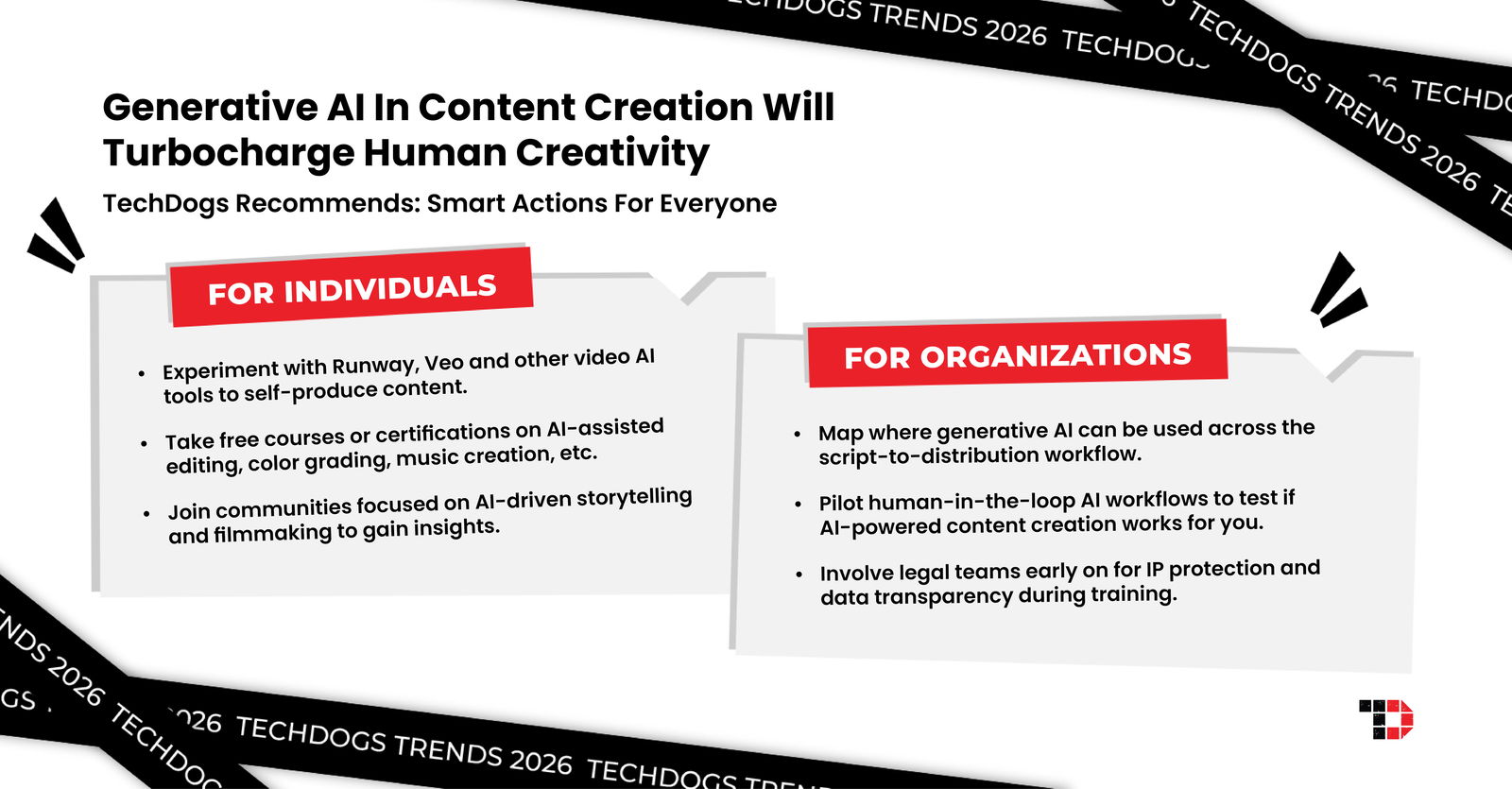
TechDogs Recommends: Smart Actions For Everyone
Trend 4: Data-Driven Mergers And Acquisitions Will Lead To Platform Consolidation
Imagine watching a criminal investigation series on YouTube and instantly being recommended a new crime drama on Google TV. That's powering one of the most disruptive trends of 2026, a fresh wave of mergers and acquisitions (M&As). Media and entertainment giants no longer focus solely on content libraries; they also seek to understand consumers' viewing habits, sentiments, and preferences. People are shaping the deals: what are they watching? How do they feel about it? Which devices do they use?
In 2026, entertainment media and technology will increasingly unify discrete ecosystems and services to solidify the advantage of shared user data.
How Is The Industry Responding?
In 2025, media and tech giants expanded their presence on OTTs, Free Ad-Supported Streaming TV (FAST) channels like Samsung TV Plus and Amazon Freevee, and social video platforms. Analysts predict 2026 transactions will focus on bundling streaming services as consumers continue to feel "subscription fatigue," overwhelmed by the growing number of available subscription services.
The industry is also responding to declining consumer interest in paid TV by consolidating the linear TV business. Warner Bros. Discovery split into two publicly listed entities: one for streaming and movie studios, the other for global linear cable networks. The $8 billion Skydance-Paramount merger and Charter Communications' $34.5 billion acquisition of Cox Communications are the industry's response to shifts in consumer behavior. AT&T's $5.75 billion acquisition of Lumen's mass-market fiber business further illustrates telecom consolidation to fund next-generation connectivity.
Jonathan Miller, CEO of Integrated Media, predicted an inflection point in M&As, saying, "Every banker that has pay-TV is crunching the numbers." Although deal volumes dropped almost 15% in 2025 compared to 2024, deal values skyrocketed on mega-mergers like Charter-Cox ($34.5 billion) and AT&T's fiber acquisition, a trend that will continue in 2026 and beyond.
The reality is this: M&A in media and entertainment is no longer about acquiring content libraries; it is about acquiring data relationships and distribution at scale. The companies that consolidate first-party data across streaming, social video, gaming, and commerce will have structural advantages in personalization, advertising, and subscription retention that no content budget alone can match.
Challenges To Watch
With massive mergers and buyouts, regulatory oversight will be the chief hurdle. M&As also present challenges, including data portability, retaining customers post-acquisition, and aligning different work cultures of merged entities.
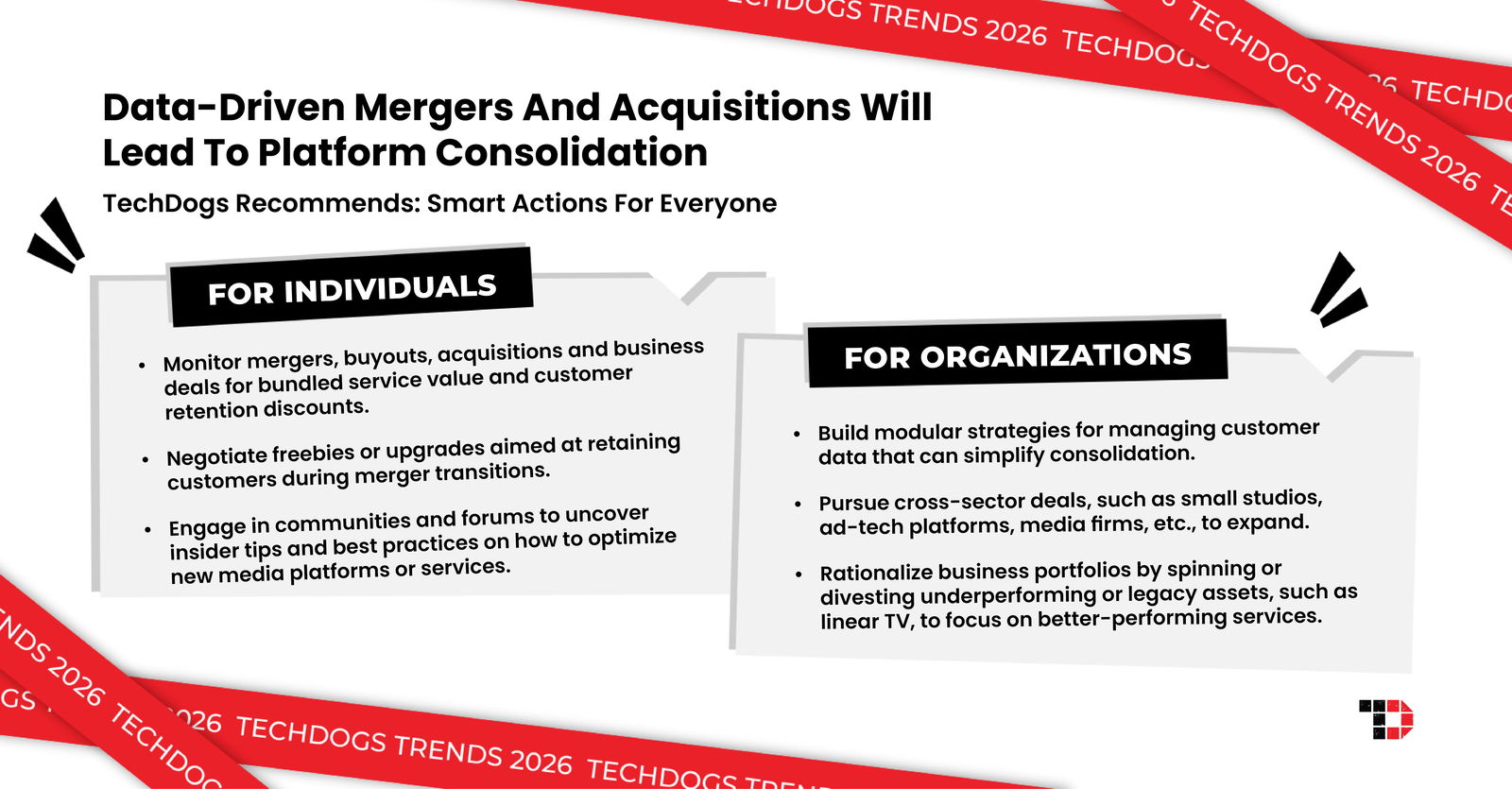
TechDogs Recommends: Smart Actions For Everyone
Trend 5: AR And VR Experiences Will Drive Immersive Entertainment
In Ready Player One, OASIS users strapped on haptic suits and full-immersion rigs to inhabit a digital world completely. In 2026, augmented reality, virtual reality, and the metaverse are the early hardware iterations of that vision, the prototype layer that Ernest Cline imagined. Adoption rates are rising, AR/VR ecosystems are maturing, and immersive content is expanding into concerts, sports, brand experiences, fitness, and more. Advances in spatial computing, including gesture and voice controls, are redefining how audiences inhabit entertainment.
Apple's Vision Pro and Meta's Orion AR glasses have been around since 2024, but 2026 is when immersive media reaches the mainstream, not as a novelty, but as a genuine entertainment format.
How Is The Industry Responding?
Spending on immersive technology grew from $9.8 billion in 2025 to an estimated $12.3 billion in 2026, signaling a slow but steady trend. Major platforms such as Meta Quest 3 and Apple Vision Pro have already hosted global VR concerts, with one performance by BTS via WaveXR drawing 1.2 million virtual viewers.
PlayStation VR2-based "Resident Evil 4: VR Mode" registered 184,000 players by February 2025. Nike Fit, an AR-powered foot-scanning tool, leveraged Snapchat's AR Mirror to offer shoppers mini mobile games for exclusive coupons, a case study in AR as both commerce and entertainment.
Sean Ahearn, CEO of Elevation XR, says: "In an age where so much of life is spent online, we're inviting the community to step away from the everyday, look up and engage with immersive experiences that spark wonder, reflection, and connection."
The takeaway for organizations: immersive entertainment in 2026 is not a technology experiment; it is a content format. Concerts, sports, fitness, and retail are already proving the model. The organizations that build brand-specific AR companion layers and spatial engagement concepts in 2026 will own the format that defines audience engagement in 2027 and beyond.
Challenges To Watch
Cloud rendering and compute costs will be the biggest logistical hurdles for scaling immersive experiences. High hardware costs and battery life issues for wearables remain concerns, as does the lack of interoperability among various extended reality systems.
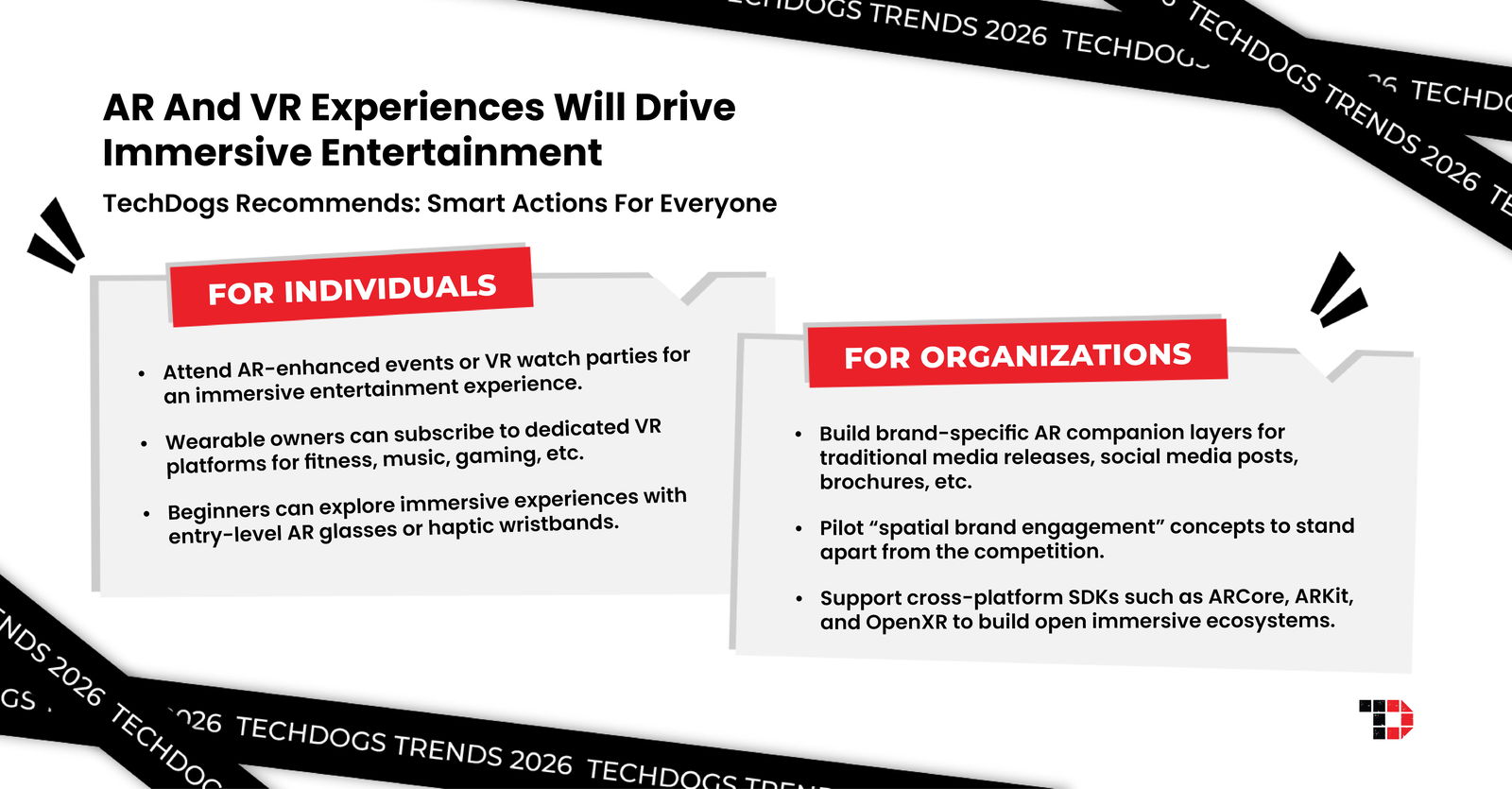
TechDogs Recommends: Smart Actions For Everyone
Conclusion
In Ready Player One, the OASIS isn't finished at the end of the story. It's better governed, more open, and more human. That's where media and entertainment technology is heading in 2026: not a completed product, but a living system that keeps learning, adapting, and expanding the definition of what entertainment can be.
Immersive entertainment will deliver new media formats while AI-driven personalization tailors them for each individual. Brands will offer easier social integrations for cloud gaming, GenAI-powered content will go mainstream, and media consolidation will define the competitive landscape. The M&E industry grows to $3.08 trillion in 2026, and every one of these trends is part of how that value gets created.
These trends signal a future where media and entertainment technology is immersive, instant, and interconnected. The show is not over yet. In fact, the most interesting scenes are still being written.
Frequently Asked Questions
What Are The Top Media And Entertainment Technology Trends To Watch In 2026?
In 2026, five critical trends are shaping the media and entertainment landscape: AI-powered hyper-personalization in streaming services, the fusion of cloud gaming with social video, the rise of generative AI tools for content creation, data-driven M&As to consolidate platforms and user data, and immersive AR/VR experiences.
How Will AI-Driven Personalization Affect Content Discovery And Viewer Engagement?
AI hyper-personalization replaces generic suggestions with mood-aware, context-sensitive experiences, leveraging metadata such as emotional tone, pacing, and viewing history. With the AI in the M&E market growing 26.3% year-over-year to $35.77 billion in 2026, and Deloitte confirming that entertainment providers must personalize or face structural decline, the investment case for AI-driven content discovery has never been clearer.
Why Are Generative AI Tools Becoming Essential For Content Creators And Studios?
Generative AI tools, from speech dubbing and scriptwriting to color grading and VFX, streamline production workflows, reduce localization costs, and empower creators to generate high-quality content faster. With studios already allocating 3-7% of budgets to GenAI and Flawless AI cutting localization costs by 60%, the ROI is proven. The next question is not whether to adopt it but how to govern it responsibly, protecting IP, attributing creativity, and maintaining quality standards.
Wed, Oct 29, 2025

Enjoyed what you read? Great news – there’s a lot more to explore!
Dive into our content repository of the latest tech news, a diverse range of articles spanning introductory guides, product reviews, trends and more, along with engaging interviews, up-to-date AI blogs and hilarious tech memes!
Also explore our collection of branded insights via informative white papers, enlightening case studies, in-depth reports, educational videos and exciting events and webinars from leading global brands.
Head to the TechDogs homepage to Know Your World of technology today!
Disclaimer - Reference to any specific product, software or entity does not constitute an endorsement or recommendation by TechDogs nor should any data or content published be relied upon. The views expressed by TechDogs' members and guests are their own and their appearance on our site does not imply an endorsement of them or any entity they represent. Views and opinions expressed by TechDogs' Authors are those of the Authors and do not necessarily reflect the view of TechDogs or any of its officials. While we aim to provide valuable and helpful information, some content on TechDogs' site may not have been thoroughly reviewed for every detail or aspect. We encourage users to verify any information independently where necessary.
Loading comments...