Manufacturing Technology
IoT Trends Connecting The Smart World In 2026
Share
TL;DR
-
IoT-Edge Convergence and Edge Intelligence: By 2026, over 55% of data analytics workloads on deep neural networks will be processed at the point of capture (Gartner), up from under 10% in 2021.
-
Next-Gen Trust Frameworks and IoT Security: The EU Cyber Resilience Act's reporting obligations take effect in September 2026.
-
Autonomous IoT Applications: Duke Energy's self-healing IoT grid has avoided 950,000 extended power outages and saved 6.3 million hours of outage time since January 2024.
-
Digital Twins in IoT: Gartner projects composite digital twins to see the largest growth opportunity by 2031.
-
Ultra-Low Power and Batteryless IoT: IoT soil moisture sensors achieved a 30% reduction in water use compared to traditional irrigation in a 2025 ScienceDirect study.
Introduction
In the film Arrival, the alien Heptapods don't experience time the way humans do. They perceive their environment continuously, past, present, and future simultaneously, and act with full situational awareness rather than reacting after the fact. IoT in 2026 is building toward that same model. Devices that once passively collected data and waited for cloud instructions are now processing at the source, acting autonomously, and responding before the problem fully forms.
We bet you've heard of the Internet of Things, or IoT, when it emerged a few decades ago. The term was initially introduced by Kevin Ashton, a British tech pioneer, in 1999. Today, it is no longer an 'emerging' technology. It is the backbone of modern enterprise networks, and the conversation has fundamentally changed.
It is no longer about connecting many smart devices. It is now about how to build a secure mesh of smart devices that runs independently, uses energy efficiently, and acts intelligently at the edge.
In 2025, we explored IoT trends focused on scaling adoption, including blockchain integration, smart mobility applications, real-time digital twins, voice-activated IoT devices, and artificial intelligence in IoT (AIoT). These initiatives set the stage for a bigger leap in 2026. Soon, IoT will look less like a patchwork of smart IoT gadgets. It will look more like the base of a digital-first mesh of business ecosystems.
The scale of that shift is measurable. Worldwide IoT spending is projected to surpass $1 trillion in 2026, according to IDC, with connected devices expected to reach 22 billion this year and exceed 40 billion by 2034.
Here are the latest IoT trends set to reshape the world in 2026 and beyond.
Trend 1: The IoT-Edge Convergence Will Lead To Edge Intelligence
For years, IoT sensors collected data and shipped it to the cloud for processing. Latency, bandwidth costs, and privacy concerns have made that model unsustainable. In 2026, we're seeing the convergence of IoT and edge computing; IoT devices now process and analyze data locally, just as edge devices do. This edge intelligence is becoming mainstream, fueled by federated learning and improved processing chipsets, delivering real-time responsiveness vital in healthcare, manufacturing, and autonomous mobility.
How Is The Industry Responding?
Qualcomm, NVIDIA, and Arm are investing in edge AI chipsets that enable IoT devices to run machine learning models locally. According to Gartner, by 2026, over 55% of data analytics workloads on deep neural networks will be processed at the point of capture on edge systems, up from under 10% in 2021. The same report says at least half of all edge computing deployments in 2026 will use machine learning, compared with just 5% in 2022.
Healthcare offers a clear use case for edge intelligence, with wearable devices detecting cardiac anomalies in real time and alerting both patient and provider instantly. Research highlights a 500% increase in AIoT cardiac sensing publications from 2018 to 2024. In manufacturing, edge-based IoT systems predict and prevent equipment failures by analyzing on-site vibration, temperature, and acoustic signals.
David Purón, CEO of Edge AI platform Barbara, says: "Edge Computing Platforms need to provide a unified, scalable foundation for managing diverse edge workloads across multiple industries. By standardizing key functionalities such as orchestration, security, and device management, ECPs reduce dependency on single-use solutions and enable enterprises to adapt more easily to evolving needs, fostering innovation and long-term growth."
The shift is clear: the cloud is no longer the brain of IoT. In 2026, intelligence migrates to the edge, closer to the sensor, closer to the decision, and closer to zero latency. Organizations that build for edge-first architectures today will have a structural advantage as device volumes scale toward 40 billion by 2034.
Challenges To Watch
A key challenge for edge intelligence is scalability: deploying and managing edge-capable IoT networks requires robust orchestration and management tools. Cost is another significant barrier, as edge-capable devices are much more expensive than traditional IoT sensors.
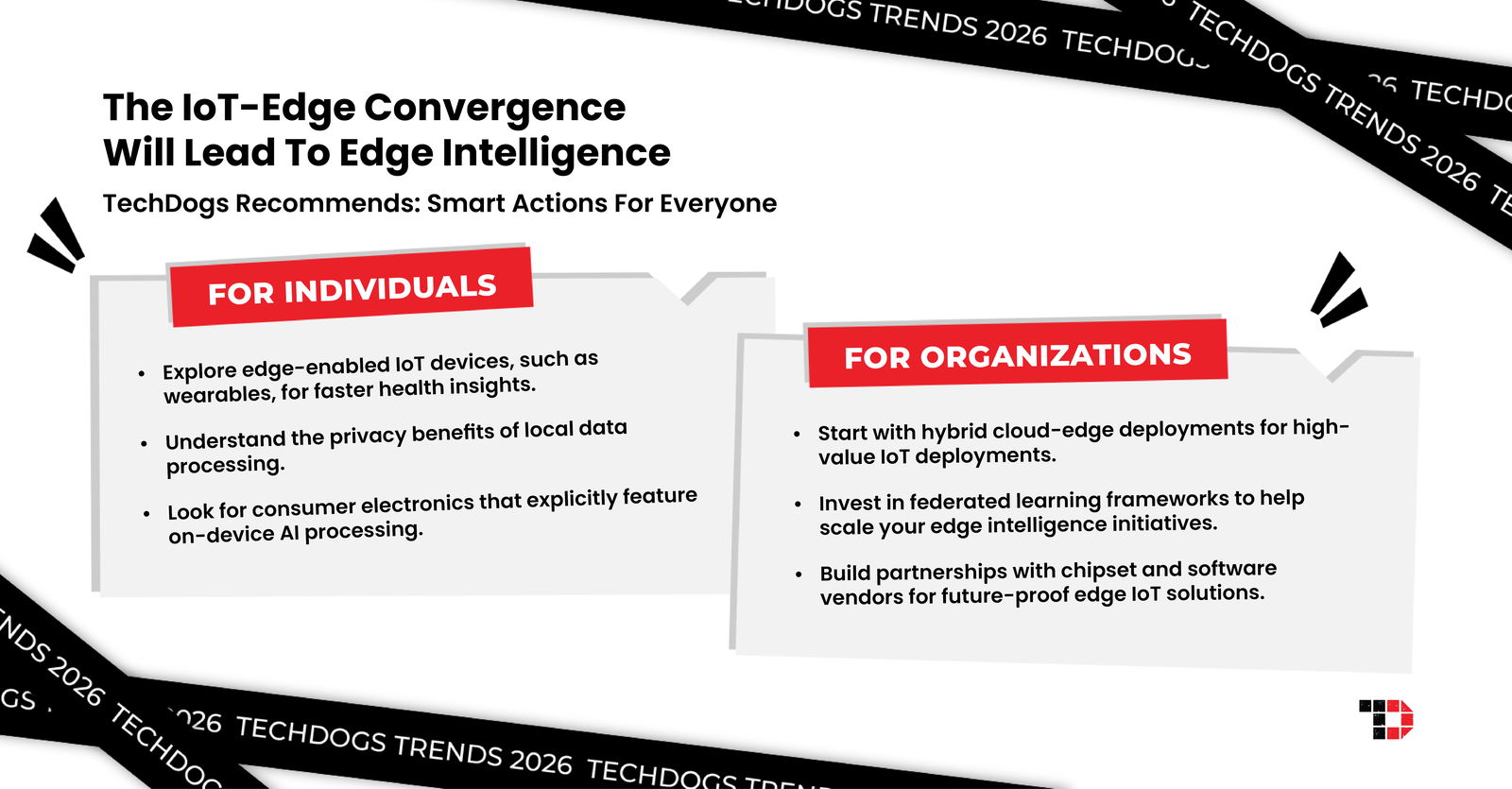
TechDogs Recommends: Smart Actions For Everyone
Trend 2: Next-Gen Trust Frameworks Will Bolster IoT Security
With 21.1 billion connected IoT devices globally in 2025, and projections exceeding 22 billion by 2026, IoT's Achilles' heel has always been security. Traditional patch-and-fix models aren't cutting it for today's risk-averse businesses. In 2026, organizations are adopting next-gen trust frameworks built on Zero Trust architecture, secure device identity, and blockchain-based registries to enhance IoT security. These approaches prevent data breaches and build better trust models directly into IoT systems.
How Is The Industry Responding?
With rising security incidents, CISA published IoT-specific security guidelines underscoring the criticality of risk. According to MarketsandMarkets, the global IoT security market is projected to more than double from $24.2 billion in 2024 to $56.2 billion by 2029.
The regulatory picture is tightening. The EU Cyber Resilience Act's reporting obligations take effect in September 2026, requiring manufacturers to report actively exploited vulnerabilities in connected products within 24 hours, a significant operational commitment for any IoT device maker selling into Europe.
Leading names such as Cisco and Palo Alto Networks are now offering IoT-specific Zero Trust platforms, after Gartner reported that IoT "devices can be hacked in as little as three minutes, with breaches taking six months or more to discover" when not secured in-house. Companies like IBM and Walmart are also leveraging blockchain combined with IoT to create tamper-proof supply chain logs through Hyperledger Fabric.
Carsten Rhod Gregersen, CEO at Nabto, validated the shifting priority: "Europe's Cyber Resilience Act and the United States' Cyber Trust Mark are finally arriving to set minimum security and production thresholds. Hopefully, depending on where you live, the threat of regulatory enforcement or the promise of increased market share will encourage device makers to up their game in an industry known for security laziness."
The reality is this: IoT security is no longer a compliance checkbox; it is a design imperative. With the EU CRA's September 2026 deadline and the IoT security market approaching $56.2 billion by 2029, organizations that build Zero Trust in from the start will be better positioned than those scrambling to retrofit it after deployment.
Challenges To Watch
The complexity of Zero Trust implementation is the biggest barrier; many organizations still lack the expertise to build Zero Trust-based IoT networks. Compliance with emerging regulations could also slow global standardization among IoT software developers and hardware manufacturers.
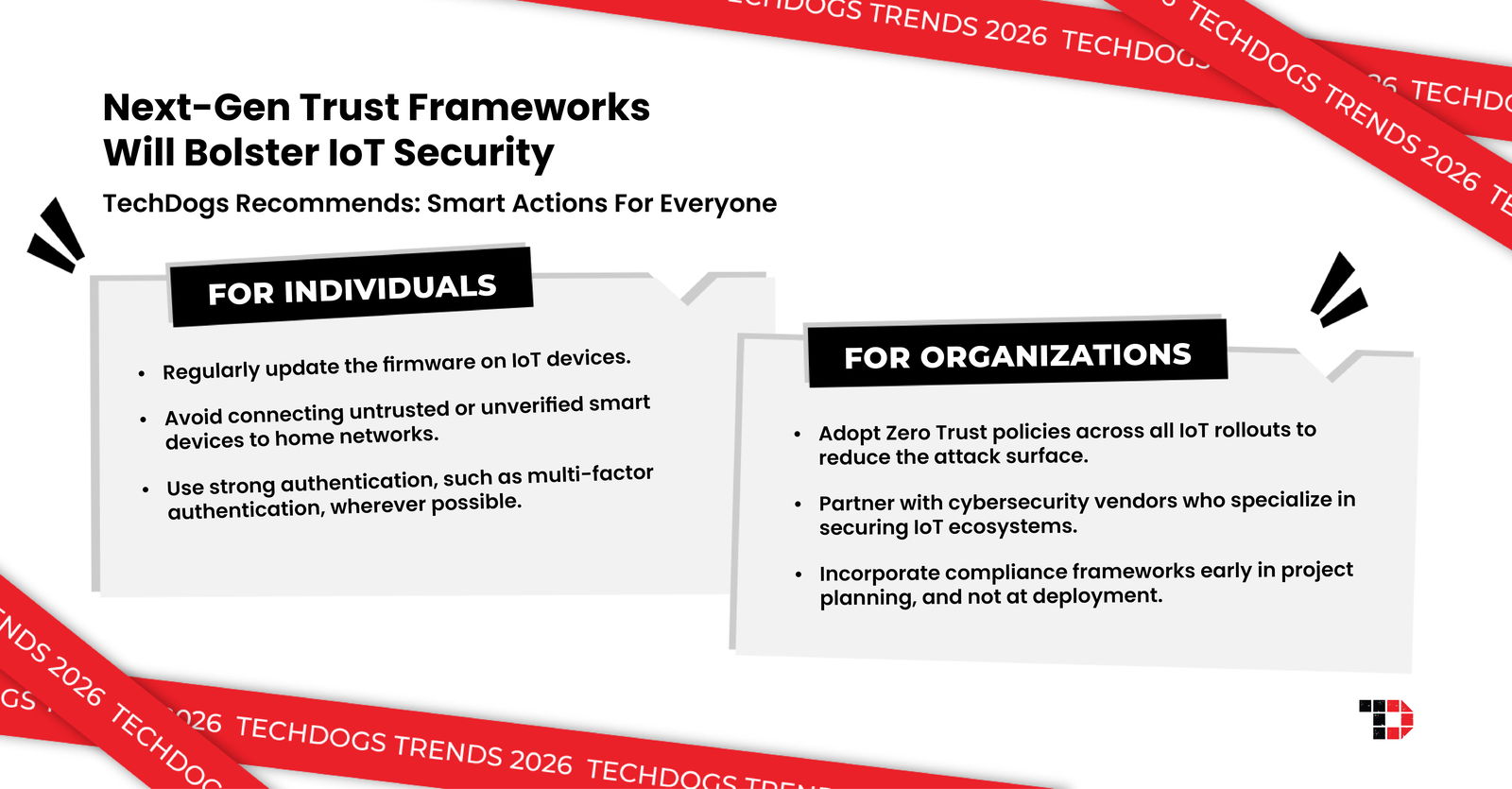
TechDogs Recommends: Smart Actions For Everyone
Trend 3: AI-Driven Systems Will Help Develop Autonomous IoT Applications
Remember the Heptapods from Arrival? Their ability to perceive and respond to events before they fully unfold is exactly what autonomous IoT systems are beginning to achieve. AI integration in 2026 allows IoT systems to predict and act accordingly, creating autonomous loops. Responsive autonomous IoT devices require minimal human input and support applications ranging from self-healing grids to autonomous drones. AI-powered systems are transforming IoT from smart devices into an intelligent ecosystem of independent agents.
How Is The Industry Responding?
Energy companies are leading the way. Duke Energy in the U.S. has developed self-healing IoT grids that automatically detect power outages and reroute power to alternative lines, often restoring service in under a minute. Since January 2024, the autonomous system has avoided over 950,000 extended power outages in Florida alone, saving 6.3 million hours in outage time.
AI-driven IoT systems are becoming more popular, poised to push the AI in IoT market to $172.8 billion from $92.9 billion in 2025 (Future Market Insights). Rafi Ezry, a managing partner at IBM, mentions the value-add: "Shop floor data powered by AI and IoT can come together to reduce downtime by 50%, reduce breakdowns by 70%, and reduce overall maintenance cost by 25%."
What this means in practice: autonomous IoT is already beyond the pilot stage in energy and manufacturing. Self-healing grids, predictive maintenance, and autonomous logistics agents are delivering measurable ROI in 2026, and the $172.8 billion AI-in-IoT market signals that investment will accelerate rather than plateau.
Challenges To Watch
A key concern is accountability: who is responsible if an autonomous IoT sensor makes a decision that leads to financial or reputational loss? Additionally, scaling autonomous IoT agents across regulated industries remains tricky, as compliance and regulations lag industry innovation.
Topics For More Insights
TechDogs Recommends: Smart Actions For Everyone
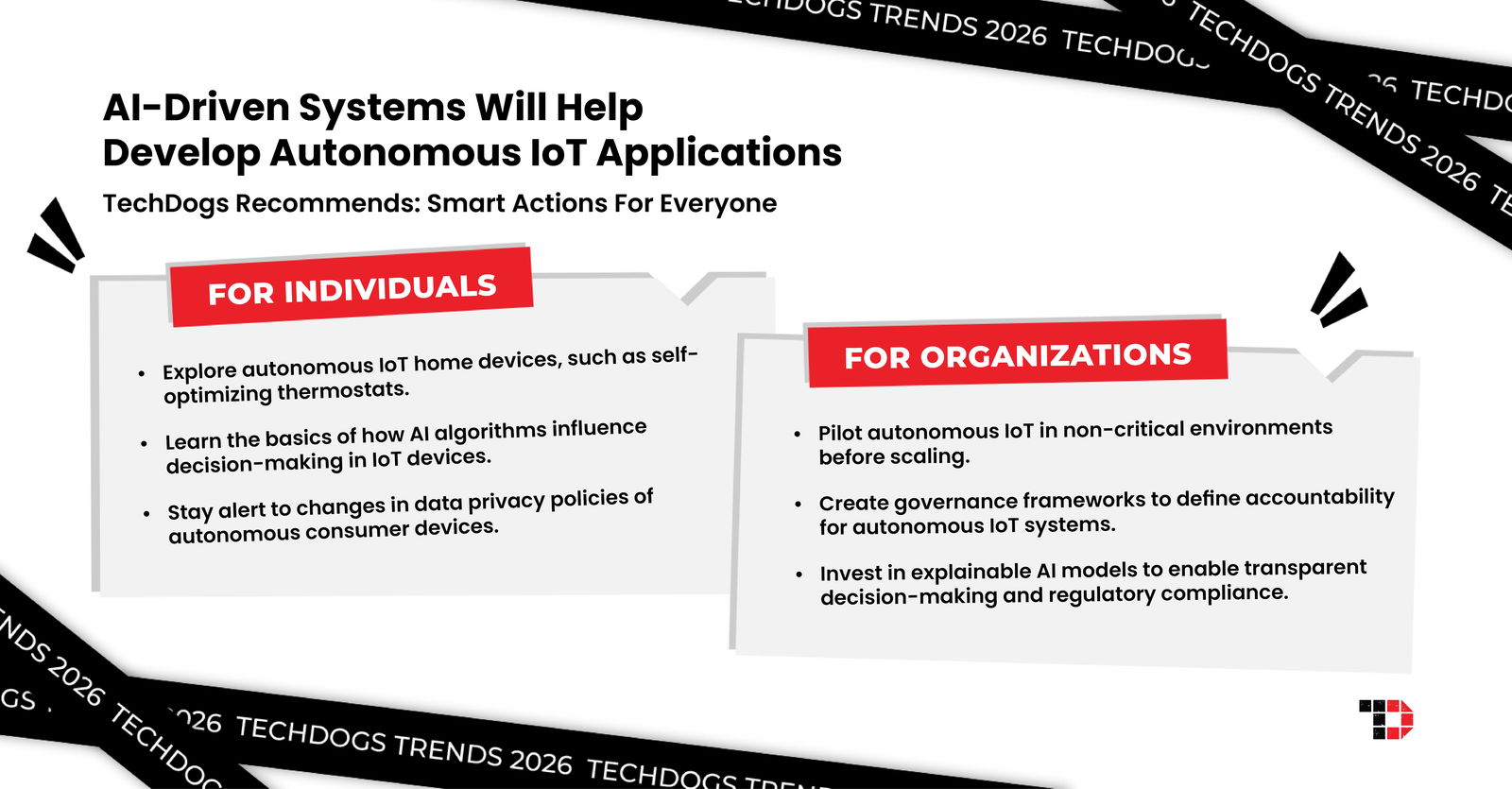
Trend 4: Digital Twins Will Enable Real-Time IoT "Mirror" Models
Digital twins are essentially virtual replicas of physical systems, from factories to entire cities, allowing businesses to run simulations, make predictions, and optimize operations. In 2026, IoT sensors feed real-time data into these digital mirror worlds, enabling monitoring and optimization at unprecedented scale. This convergence leads to smarter, faster, and more innovative applications of digital twin technology.
How Is The Industry Responding?
Singapore already uses a city-wide 3D digital twin to monitor and simulate traffic conditions, utilities, energy consumption, and urban planning in real time. In the U.S., General Electric has deployed IoT-driven digital twins, including the Predix simulation platform, to capture real-time data from power plants, reducing downtime and improving efficiency.
The digital twin market is valued at $49.2 billion in 2026 and projected to reach $228.46 billion by 2031, at a 35.95% CAGR (Mordor Intelligence). Gartner projects that composite digital twins will see the largest growth opportunity by 2031, with 183 billion dollars in total digital twin revenue, leveraging IoT sensors to collect real-time data from physical counterparts.
As Siemens USA CEO Barbara Humpton noted: "We are at the beginning of the next industrial revolution here in the United States, and IoT-powered digital twin technology will make it possible for manufacturers in the U.S. to actually be more productive, be more sustainable, and compete well on the global stage."
The advantage is shifting to organizations treating digital twins as operational infrastructure rather than innovation experiments. At $49.2 billion today and growing at 36% annually, the window for early-mover advantage is open, but it is closing as the technology approaches mainstream adoption.
Challenges To Watch
Creating accurate, real-time virtual twins requires massive data integration and near-zero latency. Interoperability between various platforms and the high cost of implementation remain ongoing barriers that have so far prevented the trend from going fully mainstream.
TechDogs Recommends: Smart Actions For Everyone
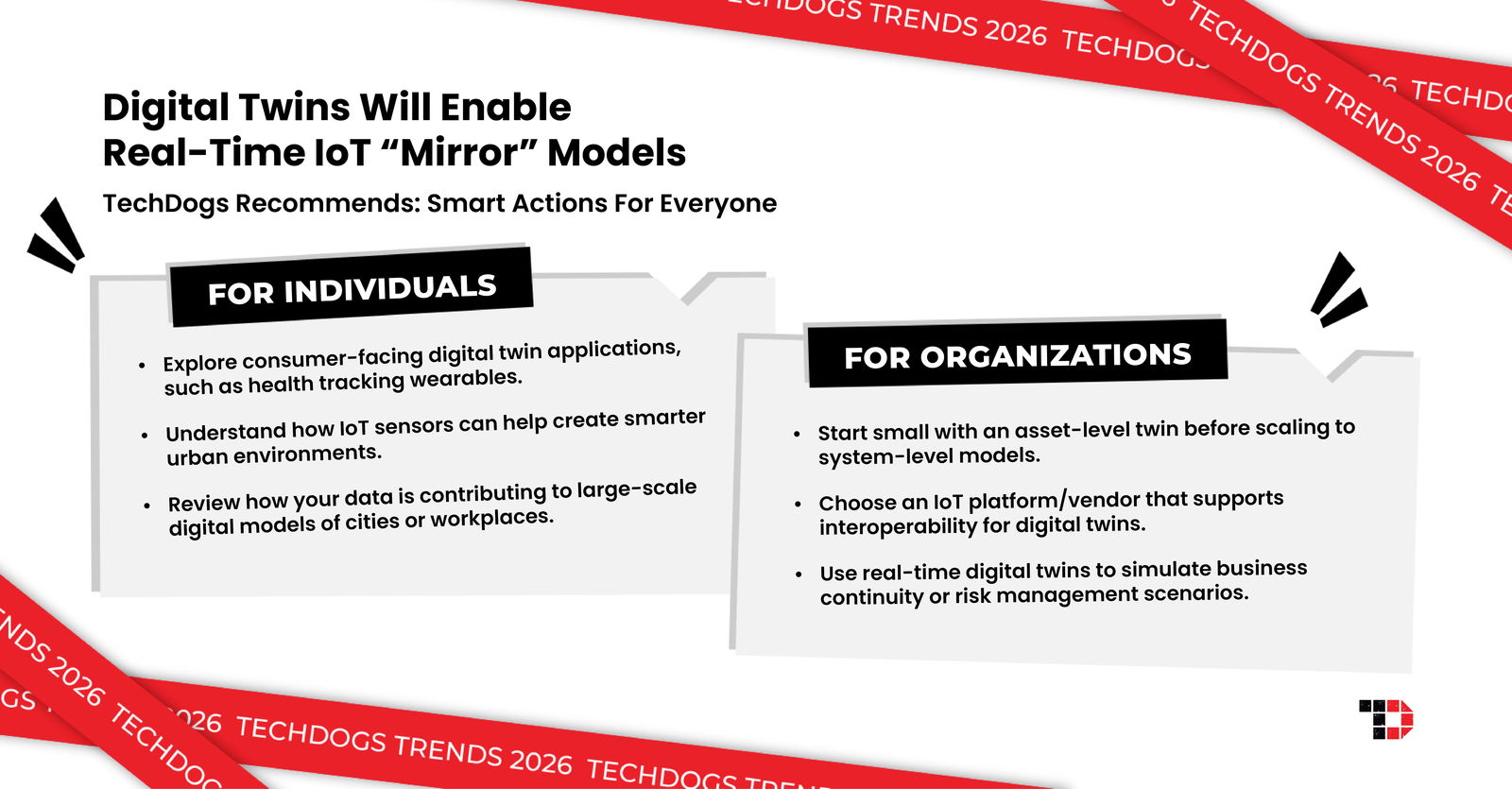
Trend 5: Adoption Of Ultra-Low Power And Batteryless IoT Will Grow
Apart from recurring security concerns, another barrier to IoT scale has been power constraints. Sensor batteries need replacement, and as device networks proliferate, so do the costs. In 2026, advances in energy harvesting, solar, RF, thermal, motion, and others are enabling ultra-low power and even batteryless IoT deployments, making large-scale, sustainable IoT finally achievable.
How Is The Industry Responding?
Leading the charge are businesses like Everactive, developer of ultra-low-power integrated circuits that harvest energy from indoor lights and vibrations, and Wiliot, an ambient IoT battery-free sensor that Walmart has adopted. Such batteryless IoT devices harvest ambient energy from radio waves, light, motion, and heat.
We're already seeing its promise in agriculture. A 2025 study published in ScienceDirect showed that a smart system using IoT soil moisture sensors achieved a 30% reduction in water use compared to traditional irrigation methods, while the SoilSense system claims up to 45% water savings through algorithmic recommendations.
With such innovative use cases, the low-power IoT global market is expected to grow at a CAGR of 13-15% from 2024 to 2031 (Allied Market Research). Irvind Ghai, Vice President at Silicon Labs, explains: "Ultra-low power is key because it removes a common IoT adoption hurdle, which is frequent battery replacements."
The takeaway for organizations: batteryless IoT is not just a sustainability play; it is a total cost of ownership argument. Analysis suggests that by 2026, the TCO for batteryless systems has dropped below that of battery-powered equivalents in many industrial settings, because the labor cost of replacing a $2 battery can exceed $50 in a factory context. The math increasingly favors the switch.
Challenges To Watch
Energy harvesting does not yet work in all environments, so performance varies. Costs remain higher for novel IoT devices compared to traditional battery-based devices, which can operate reliably as long as batteries last.
TechDogs Recommends: Smart Actions For Everyone
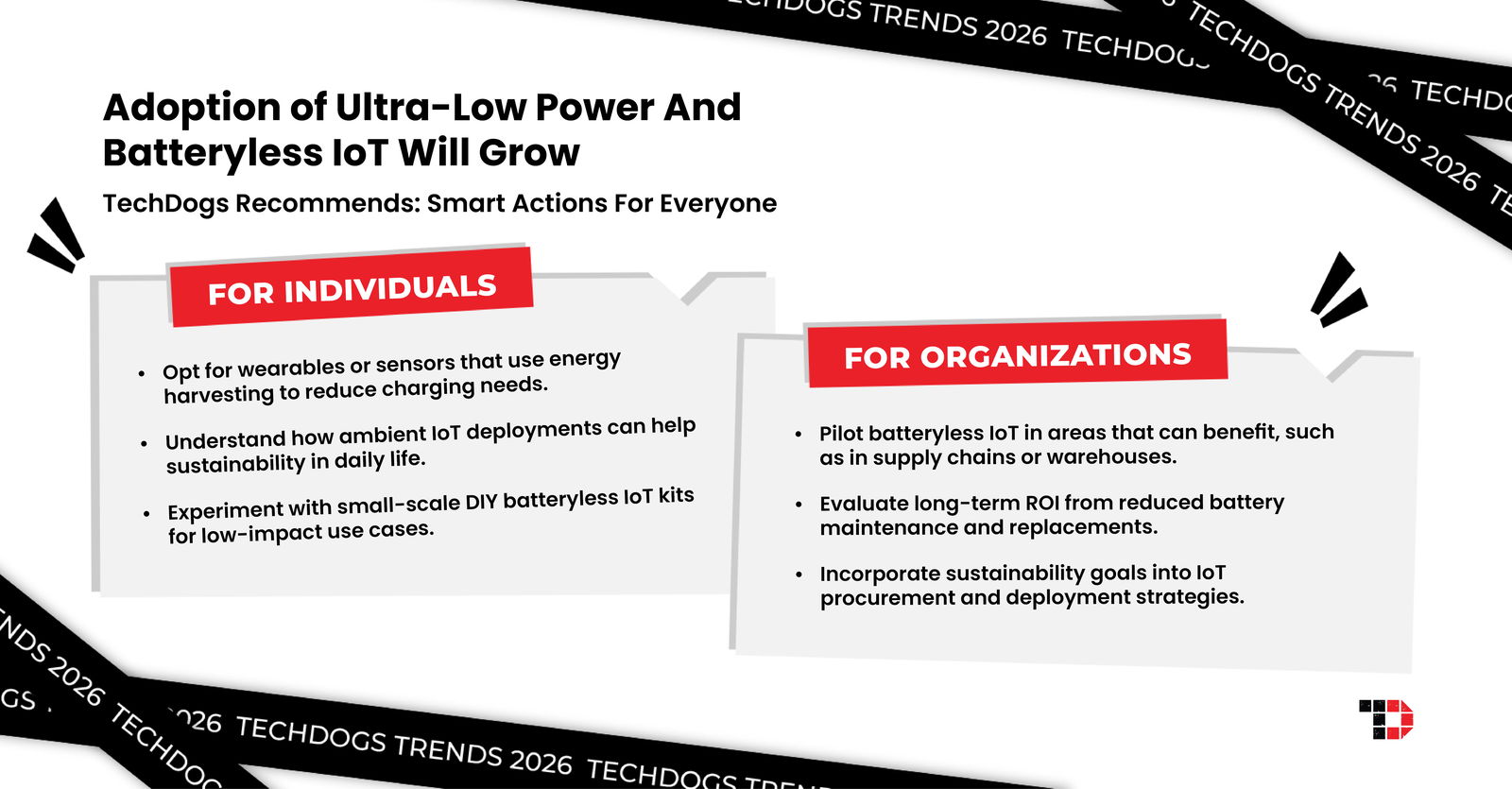
Conclusion
The Heptapods in Arrival don't wait to react. They already know. IoT in 2026 isn't there yet, but these five trends are laying the neural pathways of a connected world that perceives, decides, and acts with real-time awareness. Edge intelligence brings decision-making to the source. Next-gen trust frameworks make the mesh secure. Autonomous IoT systems act before failures form. Digital twins mirror physical reality in real time. And batteryless devices let the network sustain itself indefinitely.
The IoT landscape of 2026 is not just more connected. It is more autonomous, secure, sustainable, and intelligent, and it promises to be even more beneficial once remaining challenges around cost, interoperability, and governance are resolved.
Looking ahead, 2026 will bring several of these trends into the mainstream as businesses push past the 22 billion-device threshold and governments draft new regulations to shape global IoT standards. One thing is certain: IoT is no longer a supporting technology. It is taking center stage in the digital transformation narrative.
Frequently Asked Questions
What Are The Major Internet Of Things (IoT) Trends To Watch In 2026?
The top IoT trends of 2026 focus on making connected systems smarter, faster, and more sustainable. Key developments include the rise of edge intelligence; next-generation trust frameworks for IoT security based on Zero Trust and blockchain; AI-driven autonomous IoT systems; IoT-based digital twins to create real-time virtual replicas of physical systems; and ultra-low-power or batteryless IoT devices for enhanced sustainability.
How Will IoT Trends In 2026 Impact Businesses And Industries?
Businesses will see a significant transformation as IoT evolves from simple connectivity to intelligent autonomy. Edge computing enables faster, localized insights, while digital twins optimize operations through real-time data modeling. AI-driven IoT allows systems to self-correct and predict outcomes. With worldwide IoT spending surpassing $1 trillion in 2026 (IDC), the economic stakes of getting this transition right have never been higher.
Why Is IoT Security Becoming A Top Priority In 2026?
With over 21.1 billion connected devices in 2025 and projections exceeding 22 billion in 2026, security has become IoT's biggest challenge. Companies are adopting Zero Trust frameworks, device authentication systems, and blockchain-based registries to protect data integrity and privacy. The EU Cyber Resilience Act's reporting obligations, taking effect in September 2026, are also forcing manufacturers to embed security into device design from the outset, not as an afterthought.
Tue, Nov 25, 2025

Enjoyed what you read? Great news – there’s a lot more to explore!
Dive into our content repository of the latest tech news, a diverse range of articles spanning introductory guides, product reviews, trends and more, along with engaging interviews, up-to-date AI blogs and hilarious tech memes!
Also explore our collection of branded insights via informative white papers, enlightening case studies, in-depth reports, educational videos and exciting events and webinars from leading global brands.
Head to the TechDogs homepage to Know Your World of technology today!
Disclaimer - Reference to any specific product, software or entity does not constitute an endorsement or recommendation by TechDogs nor should any data or content published be relied upon. The views expressed by TechDogs' members and guests are their own and their appearance on our site does not imply an endorsement of them or any entity they represent. Views and opinions expressed by TechDogs' Authors are those of the Authors and do not necessarily reflect the view of TechDogs or any of its officials. While we aim to provide valuable and helpful information, some content on TechDogs' site may not have been thoroughly reviewed for every detail or aspect. We encourage users to verify any information independently where necessary.
Loading comments...