Human Resources Solutions
HR Technology Trends Transforming Workforce Management In 2026
Share
TL;DR
-
Agentic AI and Digital Assistants: 48% of large enterprises have already adopted agentic AI (ADP/Salesforce). CHROs project 327% growth in agent adoption by 2027. Gartner warns that over 40% of agentic AI projects will be canceled by 2027 without adequate governance.
-
Cloud E-HRM for Hybrid Workforces: 65% of HR departments have integrated cloud solutions (Worldmetrics). 90% of new HR tech investments in 2025 are cloud-based (Market.biz).
-
Unified HR Workflow Automation: HR automation leads to 85% higher efficiency and 30% lower onboarding costs (Deloitte). Automating HR onboarding slashes cycle time by up to 80%. HR automation adoption surged 600% over two years.
-
Hyper-Personalized Employee Experience: Personalization boosts employee engagement by 34%, productivity by 25%, and shows a 61% higher likelihood of retention (HRSTacks). Sage saw a 30% improvement in retention and a 10% uplift in performance using Viva Glint and Viva Insights.
-
AI Predictive Analytics and Talent Intelligence: 85% of firms are harmonizing data from HRIS, ATS, and learning apps. ML models yield 87% accuracy in predicting attrition. NLP shows 76% accuracy assessing employee sentiment (JobsPikr).
Introduction
In Moneyball, Oakland A's GM Billy Beane did something that broke every convention in baseball: he replaced gut-feel talent scouting with sabermetrics -- cold, data-driven statistical analysis that identified undervalued players and turned a budget roster into a 20-game winning streak. The scouts laughed. The results didn't lie. HR in 2026 is having its Moneyball moment. The gut-feel era of talent decisions is giving way to predictive analytics, AI-driven insights, and systems that surface what human intuition alone could never catch.
If you've been following TechDogs, you know we've tracked emerging trends in HR technology over the years. In 2025, we witnessed Gen Z entering the workforce, rising DE&I adoption, Gen AI and HR analytics tools, and policies to support employee well-being and mental health.
Fast-forward to today, and we're seeing an inflection point. The leap from GenAI to Agentic AI assistants has begun; HR analytics has started reshaping workflows across the organization; and cloud-based HRMS is now foundational for managing young, hybrid workforces that demand remote access and flexibility.
The scale of transformation is significant. The global HR technology market is projected to grow from $47.32 billion in 2026 to $95.95 billion by 2034 (Fortune Business Insights). SHRM reports that 39% of HR functions have already adopted AI, and 92% of CHROs anticipate even greater integration this year. Scaling last year's deployments and embedding HR workflows into core business operations is mission-critical for 2026.
Here are the top HR Technology Trends empowering HR teams in 2026.
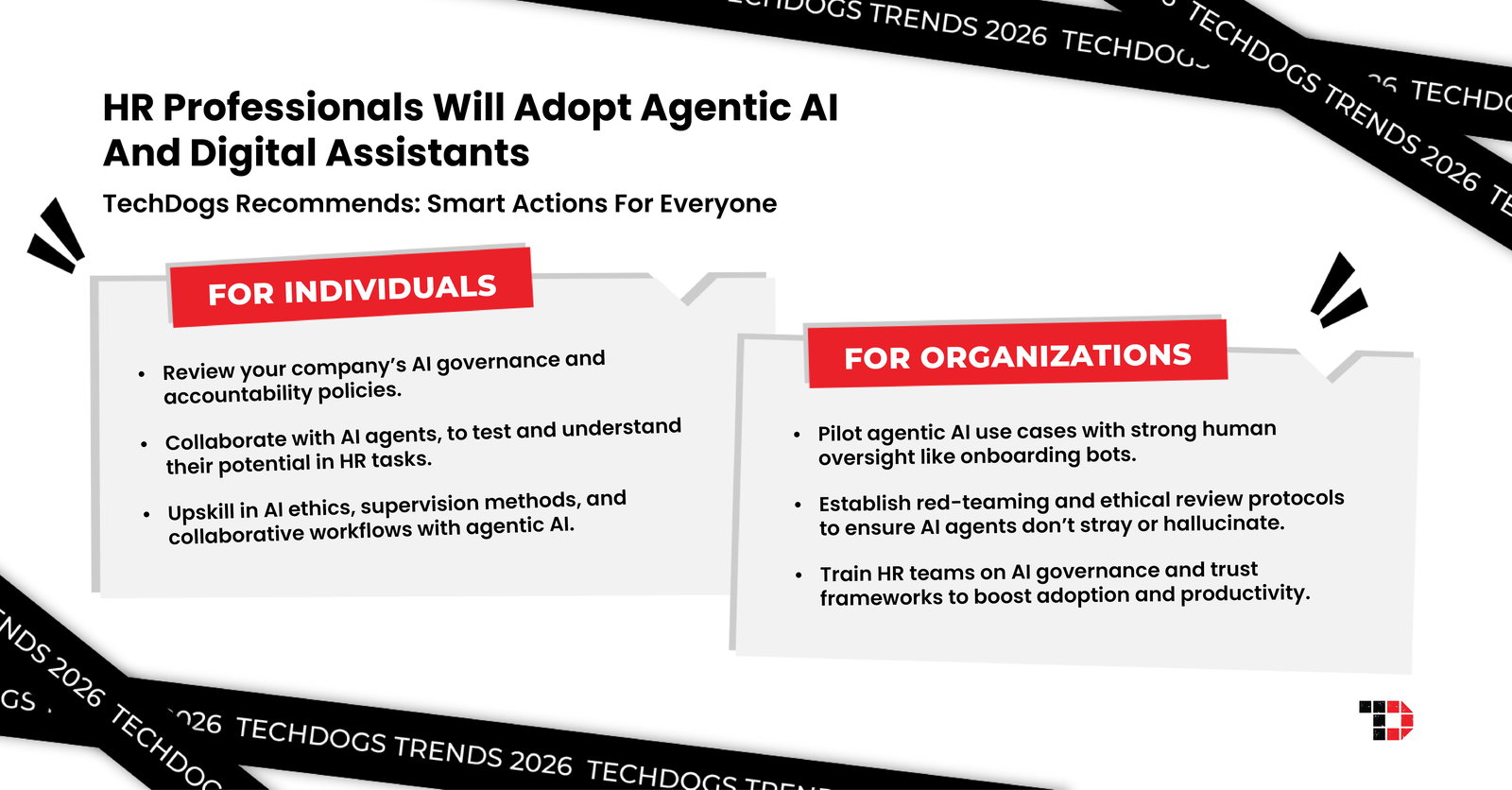
Trend 1: HR Professionals Will Adopt Agentic AI And Digital Assistants
Agentic AI is marking the next step in the evolution of workplace technologies, and HR professionals are opting in this year. These autonomous, context-aware systems analyze employee data and act in real time, allowing HR teams to respond proactively. Agentic AI bots can onboard employees, automate follow-ups and escalations, and help stakeholders understand new policies through Generative AI assistance. With advances in large language models (LLMs), integrated frameworks, and enterprise AI governance, agentic AI and digital assistants are poised to take center stage in HR tech in 2026 and beyond.
How Is The Industry Responding?
TechRadar has called this shift "the next phase of AI," with agentic AI bringing a "paradigm shift in how businesses operate, innovate, and scale." A 2025 Salesforce survey of HR chiefs shows that 80% believe most workforces will have humans and AI agents working together within five years.
The same report highlights 86% of CHROs saying that adopting and aligning digital labor with their existing workforce is a critical part of their job, projecting a 327% growth in agent adoption by 2027, from 15% adoption in 2025.
Adoption is already underway at scale: ADP reports that 48% of large enterprises have already adopted agentic AI, compared to 25% of midsized businesses and 4% of small businesses. Salesforce CEO Marc Benioff predicting: "We're the last generation of CEOs to only manage humans... I think every CEO going forward is going to manage humans and agents together."
The shift is clear: agentic AI in HR is no longer a pilot program conversation. Nearly half of all large enterprises have already crossed the line from experimentation to production, and the 327% projected growth by 2027 means the gap between early adopters and laggards will widen fast.
Challenges To Watch
Introducing agentic AI to HR workflows raises governance hurdles, security risks like prompt injection and data poisoning, and employee trust issues. Without careful oversight, autonomous agents could act unpredictably. Gartner warns that over 40% of agentic AI projects will be canceled by 2027 due to inadequate governance, escalating costs, and unclear business value -- making transparency and accountability not just ethical priorities but commercial ones.
TechDogs Recommends: Smart Actions For Everyone
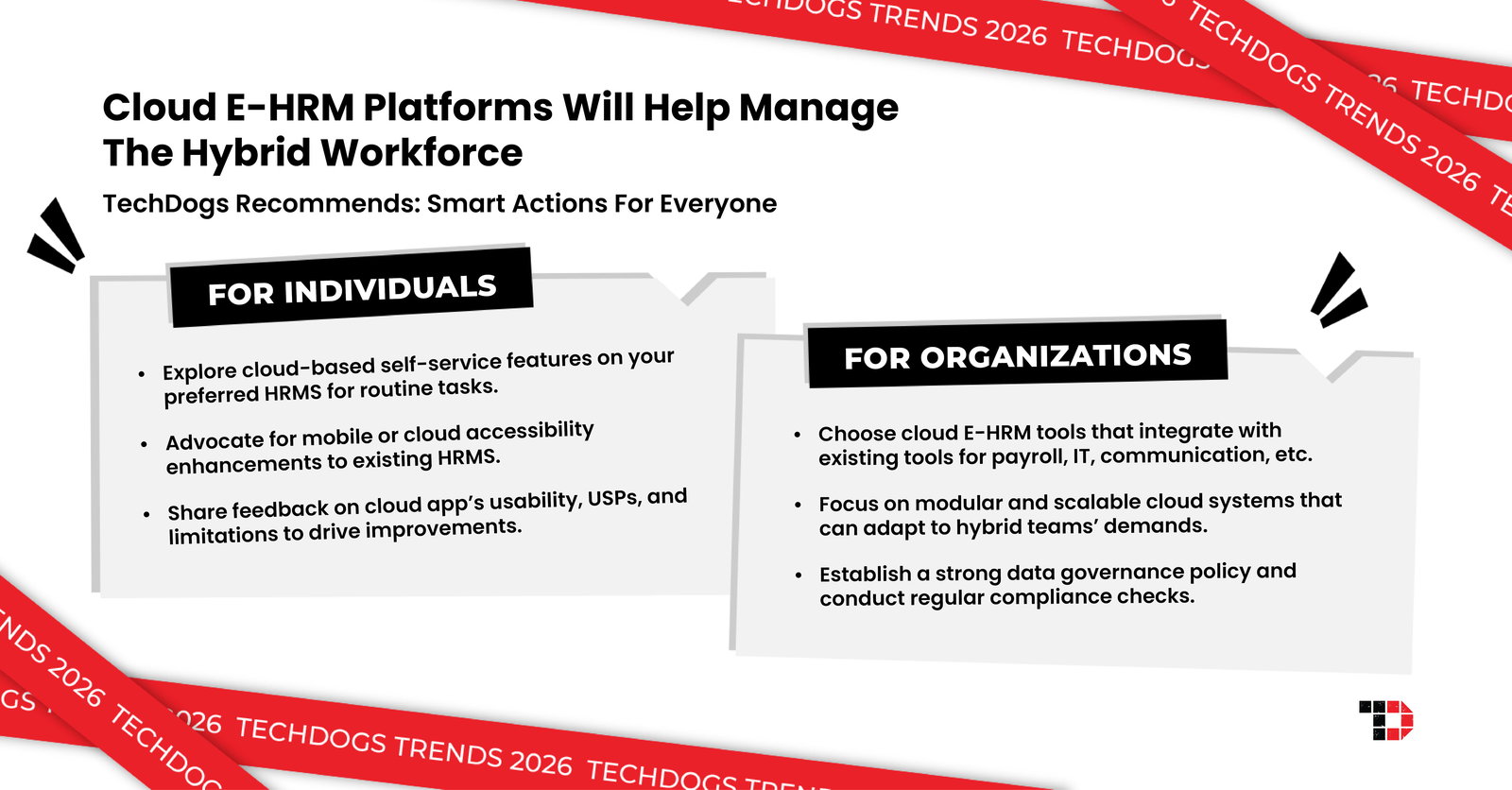
Trend 2: Cloud E-HRM Platforms Will Help Manage The Hybrid Workforce
The COVID-19 pandemic accelerated the creation of remote and hybrid roles, and in 2026, HR teams will take another step toward unifying and managing the diverse needs of such a workforce. A key strategy is the adoption of cloud-native Electronic Human Resource Management (E-HRM) platforms. These solutions are evolving from pure record-keeping systems to strategic, scalable data hubs, enabling seamless hiring, onboarding, performance reviews, and learning across dispersed hybrid teams. As work becomes more office-agnostic, organizations need to empower HR professionals with tools offering flexibility across locations and shifts.
How Is The Industry Responding?
By mid-2025, HR platforms with embedded GenAI and data analytics were standard, as we highlighted last year. In 2026, most HR management platforms are looking to scale using the cloud, bridging remote access gaps, enhancing cross-team collaboration, and enabling self-service across multiple time zones and devices.
According to Worldmetrics, 65% of HR departments have already integrated cloud solutions to remotely access data, streamline recruitment, and perform analytics. Market.biz reports that 90% of new HR technology investments in 2025 are expected to be cloud-based, with 55% of businesses implementing cloud-based learning management systems (LMS) for remote employee development and training.
Imran Sajid, an HR and payroll solution expert at SAP, validates: "What people want is to be part of a modern organization that gives them the tools that increase their productivity, give them confidence, and create engagement so they're successful in their jobs. Cloud HR, deployed effectively, makes this possible for everyone -- however and wherever they work."
What this means in practice: cloud E-HRM is the connective tissue that makes every other HR technology trend in this article possible. Predictive analytics, agentic AI, and hyper-personalization all depend on a unified, real-time data layer -- and cloud-native platforms are how that layer gets built.
Challenges To Watch
Despite the benefits, reliance on cloud-based HR systems raises risks of data breaches and vendor lock-in. Organizations also need to evaluate scalability, regional compliance, and remote access features when selecting a platform.
TechDogs Recommends: Smart Actions For Everyone
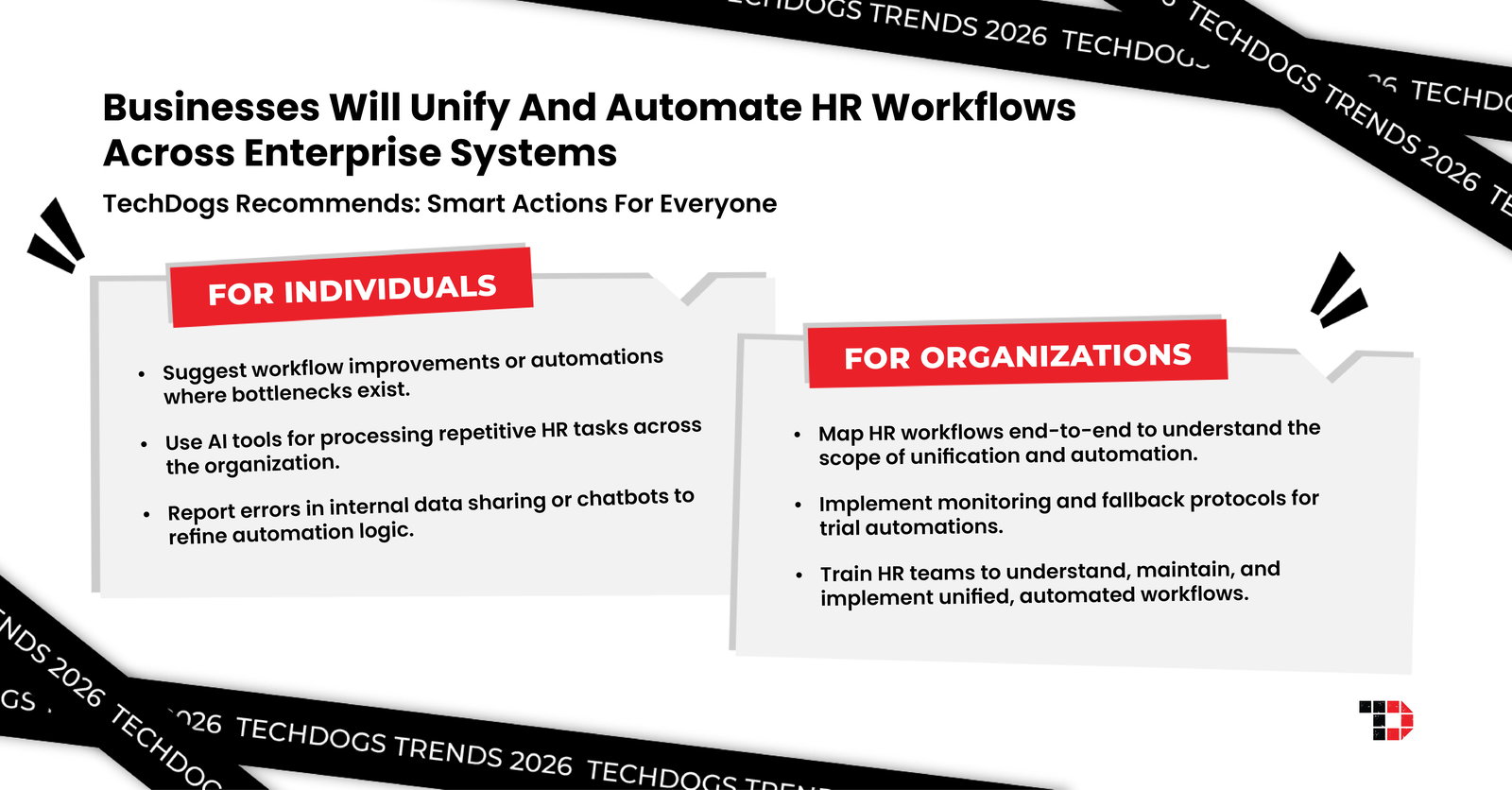
Trend 3: Businesses Will Unify And Automate HR Workflows Across Enterprise Systems
Historically, workflow automation was not an HR-related activity. In 2026, unified workflows flow through HR teams -- from recruitment to offboarding. By linking human resources with finance, IT, accounts, and operations, business leaders can move from siloed teams to an intelligent, connected workforce with HR at each touchpoint. This minimizes manual handoffs, boosts process efficiency, and keeps the human at the core of every workflow.
How Is The Industry Responding?
A Harvard Business Review study, adapted from a WorkplaceTech Spotlight "Automate HR While Keeping the Human Touch", predicted that 65% of managerial tasks will be automated by 2025, including high-volume activities such as payroll, onboarding, performance reviews, and data management.
The numbers are compelling. A Deloitte survey showed that HR automation led to 85% higher efficiency and 30% lower onboarding cost, driving a nearly 600% jump in HR automation adoption over two years. Separately, automating HR onboarding slashes cycle time by up to 80% -- visible time savings within the first quarter of deployment, according to workflow automation research cited by BigSur.ai (August 2025).
Deloitte's "2025 Workflow Automation Outlook" identifies uniting data and processes across the enterprise as one of the key takeaways for organizations looking to innovate and succeed.
The reality is this: HR automation has crossed from efficiency play to strategic infrastructure. When workflow automation connects recruitment, performance, payroll, and learning into a single ecosystem, HR stops being a support function and becomes an orchestrator of business outcomes.
Challenges To Watch
The complexity of automation creates risks of dependency on AI agents and can make interconnected workflows fragile. Process misalignment, improper tool configuration, and siloed systems can amplify human errors -- making end-to-end workflow mapping essential before organization-wide implementation.
Topics For More Insights
TechDogs Recommends: Smart Actions For Everyone
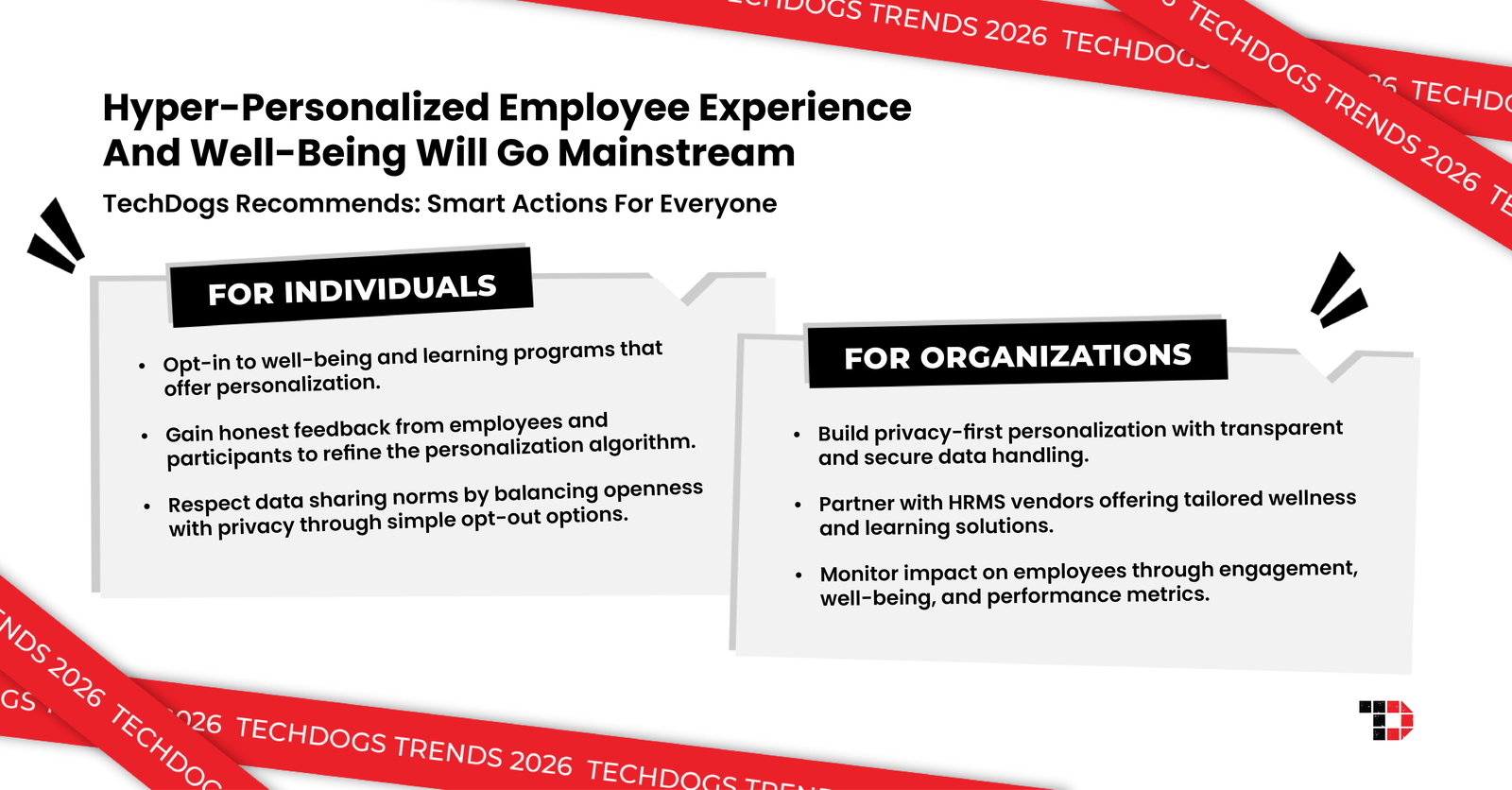
Trend 4: Hyper-Personalized Employee Experience And Well-Being Will Go Mainstream
In a world where hyper-personalization has become the norm, it was only a matter of time before it entered the business world. With employees still grappling with burnout and frustration, HR teams in 2026 are adopting deeply personalized experiences. From tailoring learning journeys and well-being nudges to custom benefits packages, HR professionals are reshaping employee experiences to be most responsive to individual needs, preferences, and moods.
How Is The Industry Responding?
Catering to every employee's unique needs is becoming simpler as HR tech leverages data analytics, sentiment analysis, and hyper-personalized interactions. We're already seeing an uptick in workplace tools delivering tailored learning paths, AI-led mentorship, and adaptive career planning -- addressing the new baseline employees expect from businesses.
Sage adopted Viva Glint and Viva Insights to listen to employee needs, resulting in a 30% improvement in retention and a 10% uplift in some employees' performance. Sharon Oley, Customer Services Director at Sage, said: "With the help of a Viva Glint survey, we were able to understand and focus on the areas of the onboarding experience that needed to change."
According to HRSTacks, personalizing employee experience boosts engagement by up to 34%, productivity by roughly 25%, and shows a 61% higher likelihood of employee retention. Jim Link, CHRO at SHRM, mentions: "Younger generations have grown up in a world of personalized experiences, from streaming services to online shopping. It's no surprise they now expect the same level of customization in their careers. HR leaders who fail to meet these expectations will struggle with engagement and retention."
The advantage is shifting to organizations that treat employee experience as infrastructure, not a perk. A 34% engagement boost and 61% higher retention likelihood are not soft benefits -- they are the kind of numbers that show up on a CHRO's dashboard and in the CFO's attrition cost models.
Challenges To Watch
As with any personalization, data privacy, sensitivity in handling personally-identifiable information (PII), and a transparent opt-in system are essential. Without careful planning, well-intended nudges can feel intrusive, especially when linked to an employee's performance or incentives.
TechDogs Recommends: Smart Actions For Everyone
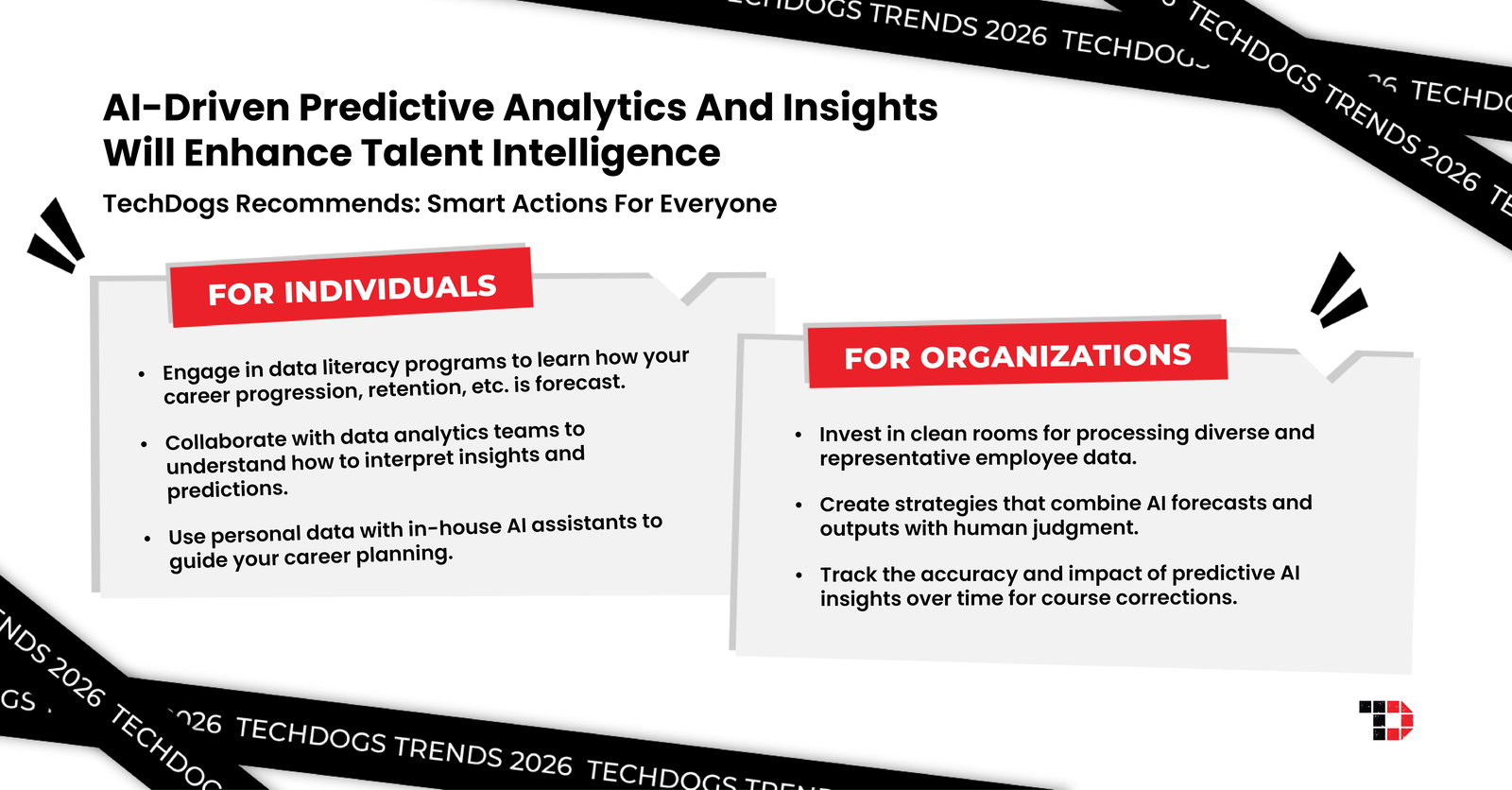
Trend 5: AI-Driven Predictive Analytics And Insights Will Enhance Talent Intelligence
Billy Beane's sabermetrics gave baseball teams a data edge over rivals still trusting scouts with clipboards. HR's version of sabermetrics is talent intelligence: AI-driven predictive analytics that let HR teams see attrition risk, skills gaps, and retention pressure before they become crises. AI in 2026 is addressing the talent crunch by giving recruiters and talent acquisition specialists access to smarter, proprietary insights that human judgment alone cannot generate at scale.
How Is The Industry Responding?
A study by the Hackett Group highlights that Gen AI-augmented talent intelligence platforms will enable predictive insights across future upskilling, workforce planning, and performance optimization. According to Aptitude Research Partners, back in 2023, only 28% of surveyed companies understood what talent intelligence was, and only 27% could identify providers in the space -- numbers expected to rise substantially in 2026 as awareness catches up with urgency.
85% of firms are now harmonizing data from internal HRIS, ATS, learning apps, and external job ads. Machine learning models analyzing 25 to 40 attributes can yield an 87% accuracy for predicting attrition, while assessing employee sentiments using natural language processing shows 76% accuracy, says AI-enabled job market analytics platform JobsPikr.
Josh Bersin, industry analyst and CEO of The Josh Bersin Company, warns: "Talent Intelligence has grown up, and it now threatens many of the incumbent HR technology vendors. Once organizations have all this data in one place, Enterprise Talent Intelligence accelerates the adoption of Systemic HR. No longer will companies need separate groups for L&D, recruiting, and rewards -- they can all use this common, intelligent system, disrupting many of the traditional HR tech markets."
The takeaway for HR leaders: predictive talent intelligence is not a niche analytics capability any more -- it is becoming the strategic core of how HR justifies its seat at the executive table. The teams that master it will make decisions before competitors even see the problem forming.
Challenges To Watch
Predictive models are only as good as the data they train on. Without ensuring high-quality data, such systems can amplify bias, misinterpret signals, or make misleading decisions. Human oversight remains essential -- even the best predictions are strategic inputs, not final calls.
TechDogs Recommends: Smart Actions For Everyone
Conclusion
At the end of Moneyball, the Oakland A's don't win the World Series. But they change the game permanently. Every team that followed had to take data seriously. HR technology in 2026 is the same story: these five trends will not resolve every talent challenge overnight, but the organizations that embrace them are rewriting the rules that everyone else will eventually have to play by.
Agentic AI and digital assistants will become collaborative teammates for decision-making. Cloud-based E-HRMs will keep hybrid workforces connected and agile. Unified workflow automation will nip bottlenecks before they form. Hyper-personalized experiences will put the human at the heart of every process. And AI-driven predictive analytics will take HR teams from reactive to strategically proactive.
Together, these five leading HR Technology trends will converge as a powerful combination, empowering modern organizations to be nimble, empathetic, and forward-looking. Adopt them wisely and your HR team will go from fighting fires to forging the future.
Frequently Asked Questions
What Are The Top HR Technology Trends Shaping 2026?
The top HR Technology trends of 2026 include the rise of agentic AI and digital assistants, the adoption of cloud-native E-HRM platforms for hybrid workforce management, unified workflow automation across business systems, hyper-personalized employee experience and well-being initiatives, and AI-driven predictive analytics for talent intelligence.
How Will HR Professionals Benefit From Adopting These Technologies?
By leveraging these emerging HR Technology trends, professionals can automate repetitive tasks, gain predictive insights into workforce needs, improve engagement through personalization, and create seamless workflows that integrate HR with core business functions. The global HR tech market is projected to nearly double from $47.32 billion in 2026 to $95.95 billion by 2034, reflecting how central these capabilities are becoming to how organizations operate.
What Challenges Should Organizations Watch Out For When Adopting HR Technology In 2026?
Organizations must address AI governance, data privacy, cybersecurity risks in cloud HRMS, process misalignment in workflow automation, and bias in predictive analytics. Success in 2026 depends on combining technological adoption with strong oversight, employee trust-building, and a clear balance between automation and human judgment.
Wed, Oct 29, 2025

Enjoyed what you've read so far? Great news - there's more to explore!
Stay up to date with the latest news, a vast collection of tech articles including introductory guides, product reviews, trends and more, thought-provoking interviews, hottest AI blogs and entertaining tech memes.
Plus, get access to branded insights such as informative white papers, intriguing case studies, in-depth reports, enlightening videos and exciting events and webinars from industry-leading global brands.
Dive into TechDogs' treasure trove today and Know Your World of technology!
Disclaimer - Reference to any specific product, software or entity does not constitute an endorsement or recommendation by TechDogs nor should any data or content published be relied upon. The views expressed by TechDogs' members and guests are their own and their appearance on our site does not imply an endorsement of them or any entity they represent. Views and opinions expressed by TechDogs' Authors are those of the Authors and do not necessarily reflect the view of TechDogs or any of its officials. While we aim to provide valuable and helpful information, some content on TechDogs' site may not have been thoroughly reviewed for every detail or aspect. We encourage users to verify any information independently where necessary.
Loading comments...