Education Technology
Education Technology Trends Transforming Learning In 2026
Share
TL;DR
-
Immersive Learning: AR and VR are moving beyond experiments into mainstream classrooms and corporate training.
-
Microlearning: Short 5-10 minute modules improve knowledge retention by 50% compared to traditional methods and achieve 83% completion rates versus 20-30% for conventional courses.
-
Blockchain Digital Credentials: 35% of academic institutions have adopted or plan to adopt blockchain for academic records. 72% of employers now prefer candidates with targeted micro-credentials over general degrees.
-
AI Personalized Tutoring: Students in AI-powered environments achieve 54% higher test scores and 30% better learning outcomes.
-
Hybrid and Flexible Learning: 69% of learners prefer hybrid models for their flexibility. Arizona State, Penn State, LinkedIn Learning, and EdX are all scaling blended programs as the post-pandemic norm.
Introduction
In Harry Potter, Dumbledore's Pensieve let you step directly inside a memory and experience it from every angle, not read about it, not watch it, but inhabit it. That is what education technology is trying to build in 2026: learning that you don't just consume, but enter. The difference between reading about a dissection and performing one in a VR lab is the same difference as reading Dumbledore's memory versus standing inside it.
One thing that never goes out of fashion is learning. Every year, the database of human knowledge grows, information becomes more accessible, and new avenues of education open to learners around the globe. This year, the global eLearning market is projected to reach $365 billion, growing at 14% annually, according to multiple research firms, including IMARC Group and Straits Research. It is not just growth. It is structural change.
This year won't just maintain the same momentum; it will mark a pivotal era of change. Last year, the adoption of microlearning, gamification pilots in classrooms, Social and Emotional Learning (SEL), AI-powered tutoring, and mobile learning gained traction. In 2026, these edtech trends will converge and scale, creating new learning models aligned with emerging educational standards. What makes the tech trends in education different this year is a shift from pilots to penetration.
Among the top trends in edtech are immersive simulations and experiential learning, microlearning for busy professionals, blockchain-enabled verifiable academic credentials, and flexible models that allow learners to choose their pace. Of course, Artificial Intelligence is integral to personalized learning at scale. Here are the five that matter most in 2026.
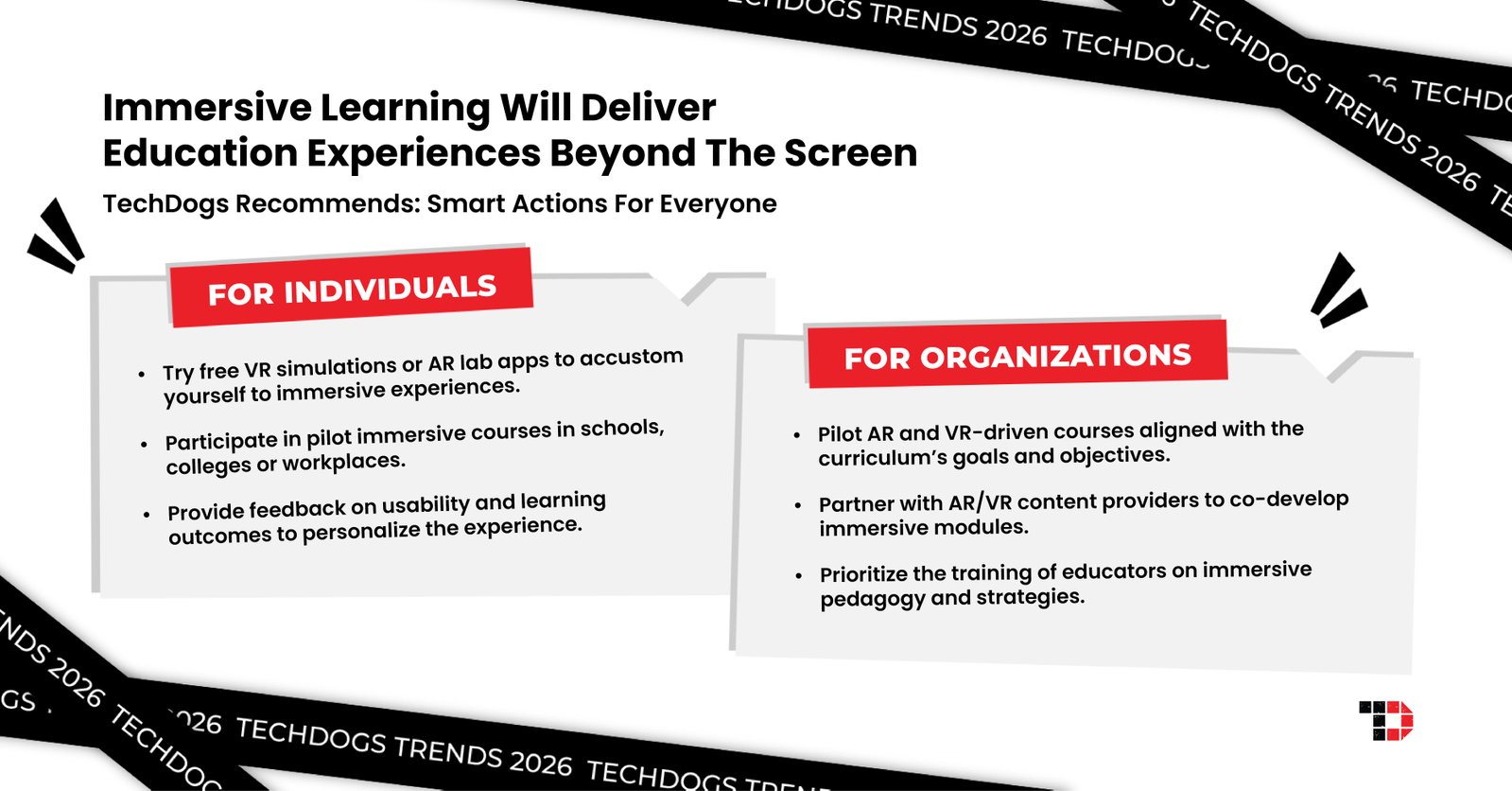
Trend 1: Immersive Learning Will Deliver Education Experiences Beyond The Screen
Dumbledore's Pensieve did not explain memories. It put you inside them. That is exactly what immersive learning aspires to do: instead of describing what a heart valve looks like, let a medical student repair one in VR; instead of narrating the Battle of Gettysburg, walk students across the battlefield through AR. The screen was always a window into learning. In 2026, the window is becoming a door.
Just as learning went from oral storytelling to pen-and-paper to screens, the next revolution will immerse students in virtual environments that bring concepts to life. In 2026, augmented reality and virtual reality environments will give students walkthroughs of historical events, show dissections of virtual organs, or help troubleshoot an assembly line issue at a factory remotely. With affordable AR headsets and classroom-focused AR apps, immersive learning is set to become mainstream.
How Is The Industry Responding?
The VR in education market stood at $17 billion in 2024 and is expected to reach $65.55 billion by 2032, growing at a CAGR of 16-30%, according to multiple research firms. With schools and universities partnering with learning platforms such as Nearpod, ImmerseU, and zSpace to deploy AR/VR devices and virtual learning environments, 70% of augmented reality users say it enhances their learning experience.
Boeing introduced VR to guide employees through tasks such as wiring and assembly, cutting training time by 75% and improving accuracy. Airbus embraced portable VR headsets and tools, resulting in a 25% faster maintenance workflow.
Kevin Daly, a longtime educator with Australia's largest VR education provider Mindflight7, told The Guardian: "Imagine you had a TV, but you could go into that TV and interact with the environment... it allows me to take students to the top of a volcano or to the deepest ocean trench... There's so much you can do with it."
The shift is clear: immersive learning is no longer the expensive experiment that only aerospace companies can afford. Affordable AR hardware and cloud-based VR platforms are bringing the Pensieve into the classroom.
Challenges To Watch
One of the key hurdles in the adoption of immersive education is hardware cost and the lack of interoperability between AR/VR platforms. Getting users comfortable with headsets and other devices takes time, as does the integration of immersive modules into traditional curricula.
TechDogs Recommends: Smart Actions For Everyone
Trend 2: Educators Will Adopt Microlearning And Adaptive Bite-Sized Content
TikTok, Instagram Reels, and YouTube Shorts all figured out something that formal education has been slow to accept: most people learn faster in focused 5-minute bursts than in 90-minute lectures. Taking a cue from these platforms, edtech is embedding microlearning into professional and academic settings, short but comprehensive learning units that work with the modern attention span, not against it. The short-form video format is now influencing how entire curricula are being restructured.
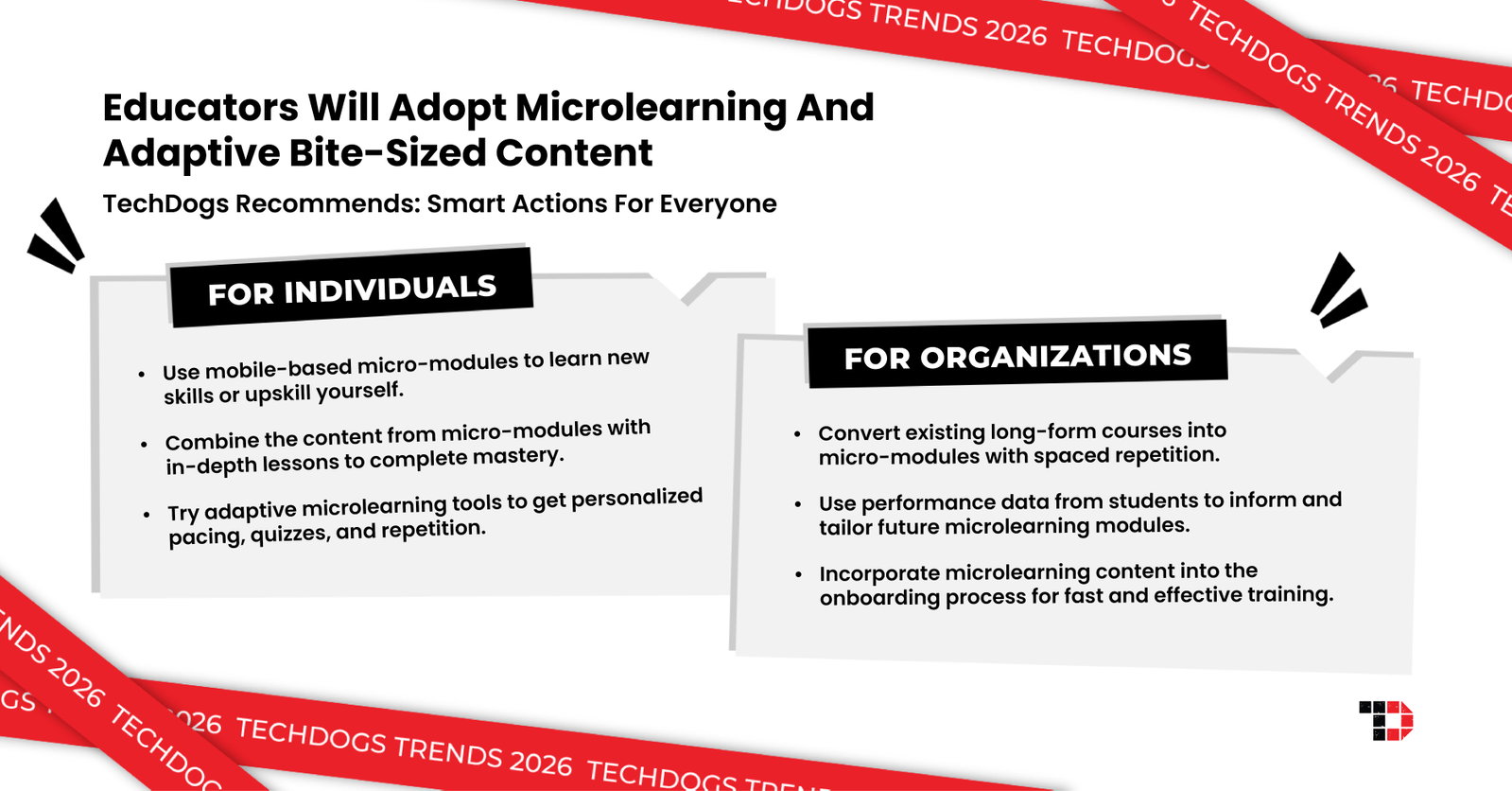
What is microlearning? It is a training approach that delivers content in focused modules, typically 5 to 10 minutes, using videos, quizzes, or interactive visuals. In 2026, adaptive microlearning takes this further, responding to every learner's behavior with quick lessons delivering maximum value in minimum time.
How Is the Industry Responding?
Leading platforms like LinkedIn Learning are expanding their role-based mini-programs while Coursera has launched Clips, a collection of nearly 200,000 bite-sized videos between 5 to 10 minutes. Adaptive microlearning platforms such as EdApp, Duolingo, and Quizlet are now customizing short lessons and repetition quizzes based on individual learner performance.
The data is compelling. Microlearning improves knowledge retention by 50% compared to traditional methods after 30 days, and achieves completion rates of 83% versus just 20-30% for conventional courses, according to Engageli's 2026 microlearning research. Organizations using microlearning report 50% higher engagement and 8% productivity growth. A study by eLearning Industry also highlights that bite-sized visual learning modules help improve information retention significantly. Another study says that 90% of the information transmitted to the brain is visual, as images are processed 60,000 times faster than other forms of information.
Corporate training teams report 30 to 40% quicker completion and higher recall with micro-modules. Matteo Penzo, the co-founder of Zick Learn, a corporate AI-powered microlearning platform, validates this trend by saying: "Mobile microlearning enables employees to engage with content in brief, focused sessions, making it easier to integrate learning into their daily routines."
What this means in practice: learners are not getting shorter attention spans, they are getting better at filtering irrelevant content. Microlearning works because it respects the learner's time, delivers exactly what is needed, and makes it easy to continue. The organizations building modular learning libraries now are building the training infrastructure of the next decade.
Challenges To Watch
One of the chief risks is over-fragmentation of content where micro-modules become too isolated for learners to connect ideas across topics. The quality of content also needs to be outstanding to engage learners, making it especially challenging for technical or complex subjects.
TechDogs Recommends: Smart Actions For Everyone
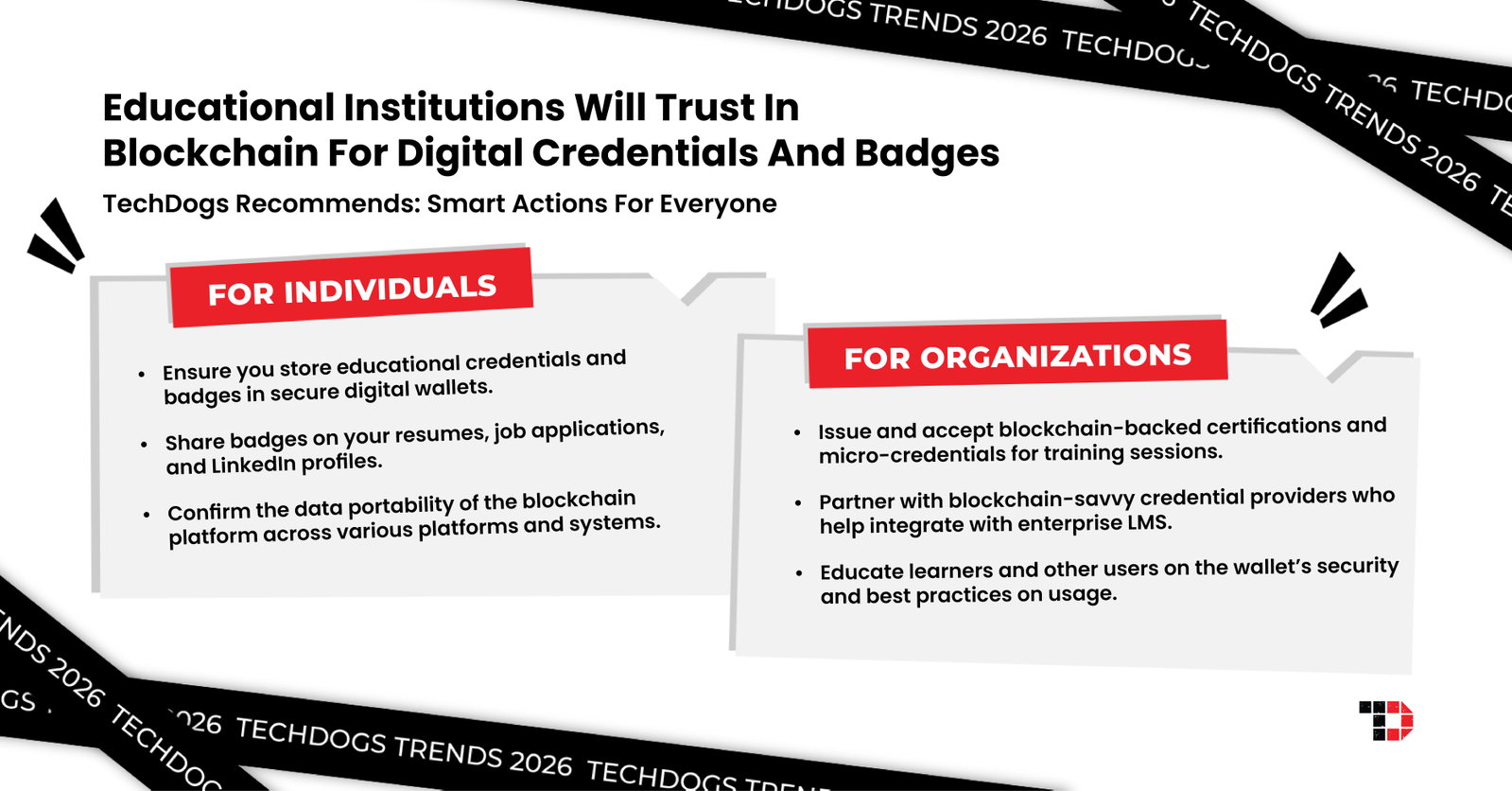
Trend 3: Educational Institutions Will Trust Blockchain For Digital Credentials And Badges
Credential fraud costs employers billions annually and creates a verification burden that slows hiring. When you put "education" and blockchain together, the solution becomes clear: tamper-proof records that any employer can verify in seconds, with no intermediary, no waiting for transcripts, and no possibility of falsification. Blockchain is about to become fundamental to academic and educational institutions, not as a topic of study, but as core infrastructure.
In 2026, blockchain-based credentials offer secure, tamper-proof digital records to verify students' skills, degrees, and certifications instantly. Without the need for a centralized institution or database, learners control and secure their digital wallets to update their credentials. The rise in credential fraud and shifts in global mobility are driving the integration of blockchain records with learning management systems, business databases, and online CVs.
How Is the Industry Responding?
According to Business Research Insights, 35% of academic institutions have already adopted or plan to adopt blockchain to manage academic records. MIT Media Lab partnered with Learning Machine to develop Blockcerts, a Bitcoin-based open-source platform for issuing and verifying educational credentials. Others, such as OpenBadge, 101 Blockchains, and Accredible, also issue blockchain-verifiable digital certificates. In 2026, employers are increasingly accepting verified blockchain records as credentials.
The employer side of this equation is equally significant. According to ClassPoint's 2026 EdTech analysis, 72% of employers now prefer candidates with targeted micro-credentials over those with only a general degree. The digital badge market is set to triple by 2032, jumping from $312 million to $970 million, creating a powerful commercial incentive for institutions to issue blockchain-verifiable credentials.
Imed Bouchrika, Co-founder and Chief Data Scientist at Research.com, writes in a blog: "Blockchain has successfully addressed such issues by completely digitizing the student's details, which helps maintain privacy and security."
The advantage is shifting to institutions that issue blockchain credentials now. Learners who carry portable, verifiable digital wallets of their achievements will move faster through hiring, transfer applications, and global mobility. Those still waiting for paper transcripts will not.
Challenges To Watch
Blockchain infrastructure and regulation varies across countries and regions, and technical adoption lags in legacy institutions. Educational institutions also have diverse user populations, making seamless interfaces for managing and sharing credentials essential but technically demanding.
TechDogs Recommends: Smart Actions For Everyone
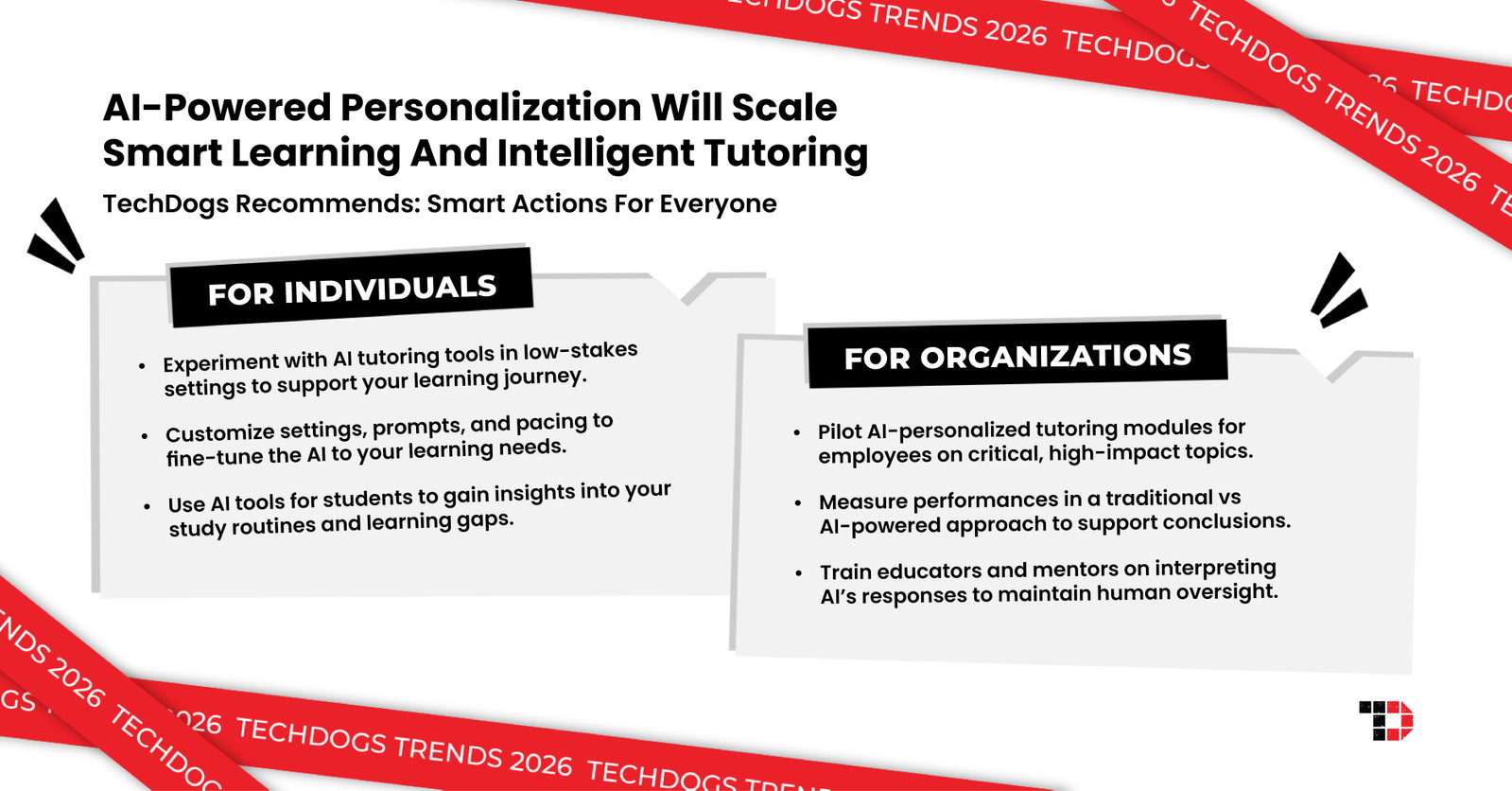
Trend 4: AI-Powered Personalization Will Scale Smart Learning And Intelligent Tutoring
Every classroom has students learning at different speeds, with different gaps, on different days. A single teacher cannot track all of them simultaneously. AI can. In 2026, AI-powered tutoring systems are providing real-time feedback, adaptive assignments, and custom-paced modules to individual learners, at a scale no human tutor could match.
A 2022 study showed that students using Korbit, an AI-powered tutoring platform, achieved learning gains 2 to 2.5 times higher than students in a control group. A 2025 randomized controlled trial published in Scientific Reports found AI tutoring outperformed in-class active learning with an effect size between 0.73 and 1.3 standard deviations.
How Is the Industry Responding?
The global AI in education market reached $10.4 billion in 2026, according to multiple research trackers, and is projected to grow to $32.27 billion by 2030 at a 31.2% CAGR (Grand View Research). According to IMARC Group, the market will reach $75.1 billion by 2033 as educators adopt AI-embedded LMS and AI-powered classroom apps. Students in AI-powered learning environments achieve 54% higher test scores and 30% better learning outcomes, while AI improves course completion rates by 70%.
Institutions have already started deploying tools such as Khanmigo and Kira Learning to support personalized workflows for learners. OpenAI and Canvas LMS announced a global partnership to embed AI technology directly into the learning management system, giving educators access to AI-driven workflows, auto-generated assignments, and automated test grading.
Anna Paul, an expert at eLearning Industry, explains the value of AI-powered learning in a blog: "The transformative power of AI-powered adaptive learning extends across multiple educational sectors, each experiencing its benefits in unique ways. In higher education, personalized learning pathways help nontraditional students balance their studies with professional and personal commitments, enhancing accessibility and flexibility."
The reality is this: AI tutoring is not replacing teachers. It is eliminating the parts of teaching that cannot scale, the individual diagnostic, the personalized exercise, the immediate correction at 2 AM when no teacher is available. That frees educators to focus on what AI cannot yet replicate: mentorship, judgment, and human connection.
Challenges To Watch
One of the main concerns is something that arises any time AI is mentioned: algorithmic bias and hallucinations. Plus, challenges such as securing student data, upskilling teachers, and avoiding overdependence on AI remain to be addressed. 95% of college faculty express concern about student overreliance on AI and its impact on critical thinking, per a January 2026 national survey.
TechDogs Recommends: Smart Actions For Everyone
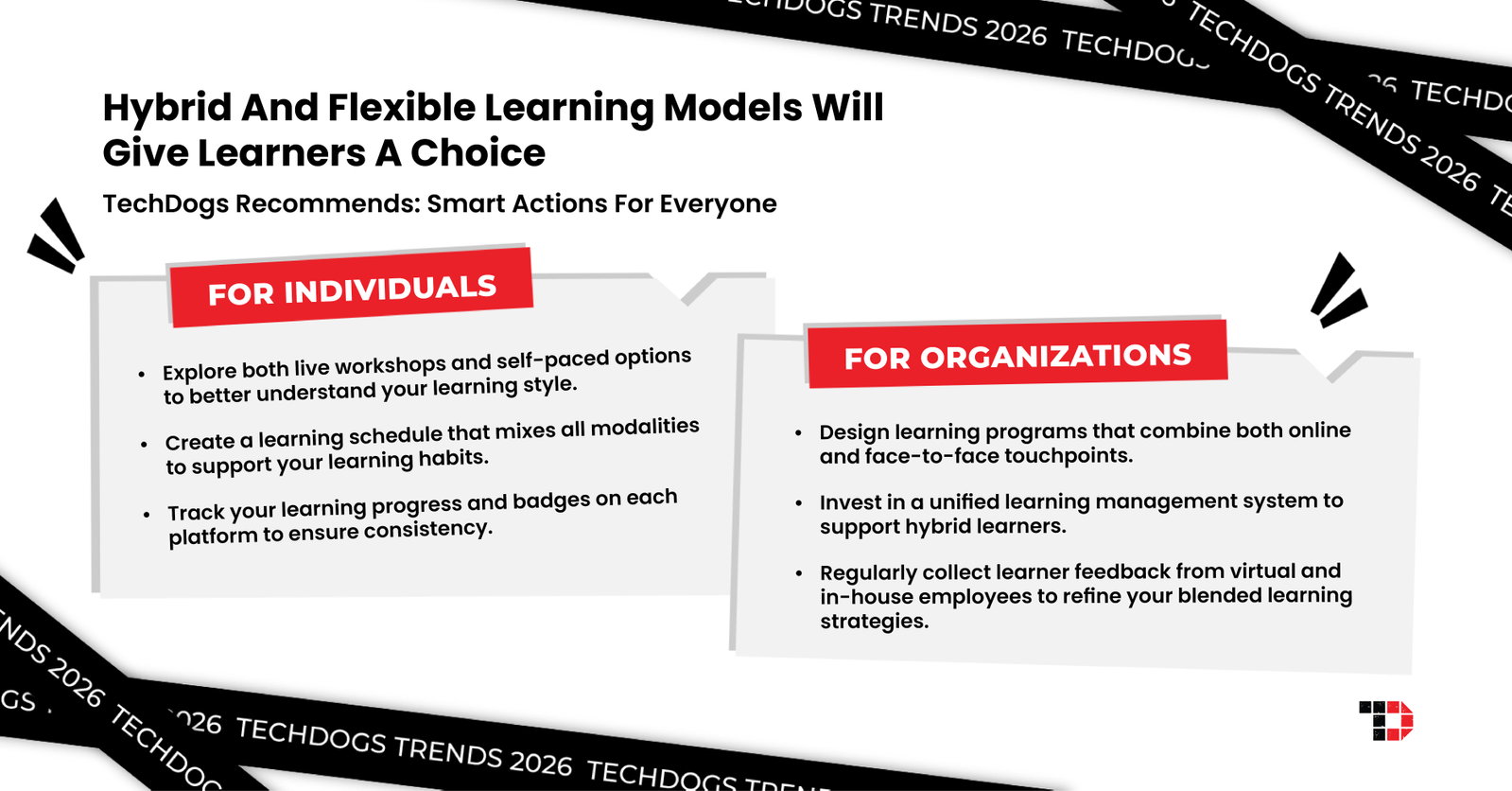
Trend 5: Hybrid And Flexible Learning Models Will Give Learners A Choice
Remember when the entire world pivoted to a remote/hybrid work routine almost overnight? That served as a proof of concept and is now powering a new style of learning. With hybrid and flexible learning models that combine virtual, in-person, and asynchronous modalities, learners can now choose when, where, and how they learn.
The demand is unambiguous: 69% of learners globally prefer hybrid learning models for their flexibility, according to eLearning research. In 2025, several colleges, universities, and corporate training programs had widely adopted blended learning. In 2026, the post-pandemic normalization of remote learning and the increased demand for flexibility are driving a full-scale resurgence of hybrid and flexible learning models.
How Is the Industry Responding?
Leading universities such as Arizona State University and Pennsylvania State University offer modular course schedules, allowing students to move between online synchronous lectures and on-campus labs. In the business setting, corporate training platforms such as LinkedIn Learning and EdX offer blended learning, including instructor-led live workshops or self-paced modules, allowing learners to choose between tuning into a group call on Zoom or learning alone at their own pace.
With employers adopting micro-credential programs (Trend #3), the ability to choose location, pacing, and content incentivizes employees to learn whenever they feel comfortable. Elena Koumparaki, a content writer for Epignosis specializing in learning and development (L&D), says in a blog: "Hybrid learning models cater to different learning styles. Some learners prefer face-to-face instruction, while others find online learning activities better for their needs. By offering both options with hybrid learning, all employees engage with the course materials in a way that suits them best."
The takeaway for organizations: designing one fixed learning format for everyone is a way of guaranteeing that some people will not learn. Hybrid models are not a compromise between in-person and online, they are a recognition that different people learn best in different contexts, and the most effective organizations build learning systems that reflect that.
Challenges To Watch
Although hybrid learning models offer flexibility, ensuring a consistent user experience for virtual and in-person learners simultaneously is operationally demanding. Other challenges include scheduling conflicts and ambiguity around accreditation for remote learners.
TechDogs Recommends: Smart Actions For Everyone
Conclusion
Dumbledore's Pensieve did not make knowledge easier to find. It made it impossible to forget, because you had lived it. That is the promise education technology is delivering on in 2026. The world of education technology is graduating to the next level.
From immersive learning experiences and bite-sized micro-modules to blockchain-backed credentials, intelligent AI tutors, and flexible learning models, 2026 is reshaping how we learn, upskill, and grow. These trends will not just improve access to information. They will transform learning into a personalized journey of growth and self-development. Students will benefit from more engaging media, globally verifiable credentials, and scalable AI tools, while institutions can redefine their educational policies and strategies.
The edtech trends of 2026 share one common thread: they treat learners as individuals, not as audiences. Adaptive, limitless, and learner-centric education is no longer a vision. It is becoming the standard.
Frequently Asked Questions
What Are The Top Education Technology Trends In 2026?
In 2026, education technology (EdTech) is being transformed by five major trends: immersive AR/VR learning environments, microlearning with adaptive bite-sized content, blockchain-powered digital credentials, AI-driven personalized tutoring, and hybrid-flexible learning models. Together, these trends are shifting learning from passive content delivery to active, personalized, and outcomes-verified experiences.
How Are Organizations And Schools Using AI And Immersive Tech In Education?
Organizations and schools are integrating AI for personalized tutoring, automated grading, and adaptive assignments tailored to each learner's pace and performance. According to multiple research trackers, the global AI in education market reached $10.4 billion in 2026, and students in AI-powered environments achieve 54% higher test scores. Immersive technologies such as augmented reality and virtual reality allow for experiential learning, where students can explore virtual environments, from dissecting organs to visiting historical landmarks.
Which Platforms Or Tools Offer Microlearning And Digital Credentials In 2026?
In 2026, popular platforms offering microlearning include LinkedIn Learning, Coursera Clips, Duolingo, Quizlet, and EdApp, delivering short, adaptive modules to support fast and effective learning. For digital credentials and blockchain-based verification, platforms like Blockcerts, Accredible, OpenBadge, and 101 Blockchains enable learners to earn and share tamper-proof badges and certificates that employers can verify instantly.
Thu, Oct 23, 2025

Enjoyed what you read? Great news – there’s a lot more to explore!
Dive into our content repository of the latest tech news, a diverse range of articles spanning introductory guides, product reviews, trends and more, along with engaging interviews, up-to-date AI blogs and hilarious tech memes!
Also explore our collection of branded insights via informative white papers, enlightening case studies, in-depth reports, educational videos and exciting events and webinars from leading global brands.
Head to the TechDogs homepage to Know Your World of technology today!
Disclaimer - Reference to any specific product, software or entity does not constitute an endorsement or recommendation by TechDogs nor should any data or content published be relied upon. The views expressed by TechDogs' members and guests are their own and their appearance on our site does not imply an endorsement of them or any entity they represent. Views and opinions expressed by TechDogs' Authors are those of the Authors and do not necessarily reflect the view of TechDogs or any of its officials. While we aim to provide valuable and helpful information, some content on TechDogs' site may not have been thoroughly reviewed for every detail or aspect. We encourage users to verify any information independently where necessary.
Loading comments...