
E-commerce
E-commerce Trends Driving Online Retail Growth In 2026
Share
TL;DR
-
AI Shopping Agents: Agentic AI is evolving from chatbots into personal shopping concierges that curate deals and complete purchases autonomously. 89% of retail brands are already testing or implementing AI commerce tools (NVIDIA, 2025).
-
Social Commerce: Live shopping has crossed from Asia into Western markets, with U.S. social commerce sales set to exceed $100 billion in 2026 and TikTok Shop generating $100 million on Black Friday 2024 alone.
-
PWA Mobile-First Commerce: Progressive Web Apps are replacing native apps as the mobile commerce default. Kaporal's PWA delivered 60% fewer bounces and a 40% longer visit duration (PWA Stats).
-
AR Virtual Try-Ons: AR reduces return rates by up to 50% and boosts conversions by up to 94%, per Shopify data. Sephora's Virtual Artist and Nike's AR sneaker builder are flagship examples.
-
Sustainable Resale Commerce: The global resale market is valued at $210-220 billion and growing 3x faster than first-hand retail (BCG). Amazon, Walmart, ThredUp, and Poshmark are all scaling resale channels.
Introduction
In Ready Player One, the OASIS was not just a game. It was the world's most powerful commerce platform: a fully immersive space where you could try on anything, buy from anyone, and have an AI-powered assistant that knew your taste better than you did. Spielberg set it in 2045. In 2026, the building blocks are arriving ahead of schedule.
Did you know that Fidelity National Information Services, Inc (FIS) projected $8.5 trillion back in 2022, but the current consensus from eMarketer and Fortune Business Insights puts global e-commerce at $6.88 trillion in 2026, still a staggering scale representing 21.1% of all retail worldwide.
Now consider the supporting forces: AI-powered e-commerce tools will grow to $11.2 billion in 2027, social commerce sales in the U.S. are set to exceed $100 billion, and mobile commerce already accounts for 59% of all online retail sales. These shifts are not incremental. They are foundational to the new age of e-commerce.
In 2025, the stage was set with emerging trends such as virtual experiences, social and voice commerce, AI-powered personalization, and influencer marketing. What was experimental in 2025 is becoming mainstream in 2026.
This year, e-commerce will grow beyond buying and selling. It will be all about the experience, driven by AI, social communities, virtual try-ons, a modern app ecosystem, and ethically aligned commerce. The five trends below explain how.
Trend 1: AI Shopping Agents Will Transform Online Shopping
Think about the last time you scrolled endlessly looking for the right product. Now imagine an assistant that already knows what you want, finds it, and buys it, while you do something else. That is not a 2030 vision. That is where Generative AI is taking e-commerce right now.
2025 was the year GenAI went global, but 2026 will be when it evolves from chatbots to shopping assistants that learn your tastes, curate tailored deals, and complete purchases autonomously. This trend emerged as retailers moved beyond basic recommendations, starting with platforms such as Amazon Rufus in late 2024 and evolving into AI agents that can suggest or buy items on your behalf. The AI personalization market is expected to reach $12.71 billion by 2030, from $4.54 billion in 2024, as forward-looking e-commerce brands embed agentic AI into websites and mobile apps.
How Is The Industry Responding?
Major players are deploying AI across the entire e-commerce funnel. Walmart is piloting a generative agent, Wallaby, that builds cart bundles for customers based on past purchases and current requirements. A NVIDIA survey shows that 89% of retail brands are already testing or implementing AI tools for commerce experiences. Meanwhile, a report by Rep AI found that shoppers with conversational AI completed purchases in 8 minutes on average, compared to 15 minutes without AI assistance, nearly twice as fast.
GenAI personalization now ranks among the top strategic priorities for digital commerce. Colin Bodell, the CTO of Bazaarvoice, validated the integration: "From personalized recommendations to automated customer service, these technologies offer insights and experiences at a previously impossible scale. Personalized offers drive 45% of shoppers to complete purchases online."
The shift is clear: agentic AI is not a feature upgrade. It is a structural change in how discovery, decision-making, and purchase happen. Brands that embed conversational and agentic AI now will own the customer relationship that those relying on static product grids are already losing.
Challenges To Watch
Privacy remains top of mind as AI-powered recommendation engines track browsing habits, purchases, and location history in real time. Misfires in personalization can erode trust quickly, and AI agents must be able to explain and align recommendations with consumer needs and business ethics.
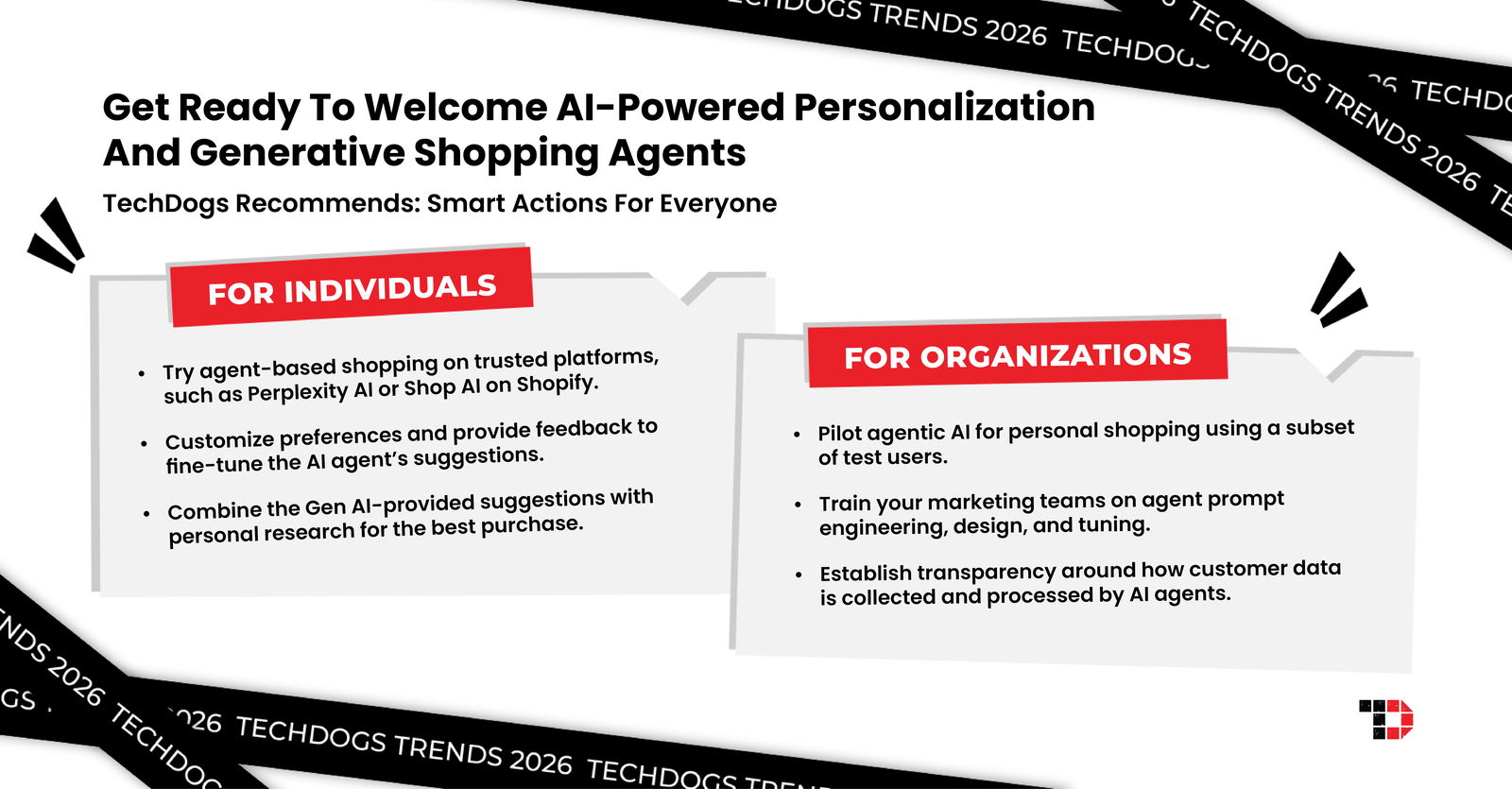
TechDogs Recommends: Smart Actions For Everyone
Trend 2: Social Commerce Will Simplify Live Shopping Experiences
You're watching a 90-second video. A product appears. You tap, pay, and it ships. You never left the app. That is the frictionless transaction that social commerce is delivering at scale in 2026, and Western markets are finally catching up with what Asia has known for years.
Remember when we introduced this emerging trend last year? Live shopping is no longer restricted to Asian markets. What started as a flash mob-like trend in 2020 is now a prime e-commerce channel, with U.S. social commerce sales projected to exceed $100 billion by 2026, representing 7.2% of total U.S. e-commerce sales.
How Is The Industry Responding?
Retailers and e-commerce brands are doubling down on the social commerce wave. Live-streamed drop events, such as Sephora's Live Tutorials, saw viewers spend an average of 10 minutes longer on streams and were 2.5 times more likely to make a purchase. TikTok Shop, hosted on the social media platform TikTok, generated $100 million in sales on Black Friday 2024, with one seller bagging $2 million in sales from a single livestream.
Business Insider highlights that LTK and Flip are evolving from social commerce apps into lifestyle-first platforms, blending fashion, parenting, cooking, and travel content with commerce. This keeps users engaged beyond purchases while building genuine platform loyalty. Highlighting the need for social commerce, Casey Gannon, VP of Marketing and Technology Partnerships at Bold Commerce, says: "In the coming year, we'll see this trend take off in online shopping, too. Consumers are increasingly discovering products everywhere but on e-commerce sites, from social media to blog posts and marketing emails. But with every additional click required to purchase, brands are losing shoppers' attention."
What this means in practice: every click between discovery and checkout is a lost customer. The brands building native purchase flows inside social content, rather than directing users to a separate website, will capture the conversions that others are quietly bleeding.
Challenges To Watch
Regulation around influencer marketing remains weak, with concerns about counterfeit products being sold during live sessions. Amazon reported it seized 15 million fake products in 2024. Moderating social platforms in real time for policy violations is an ongoing challenge, and live shopping events carry higher production and operational costs.
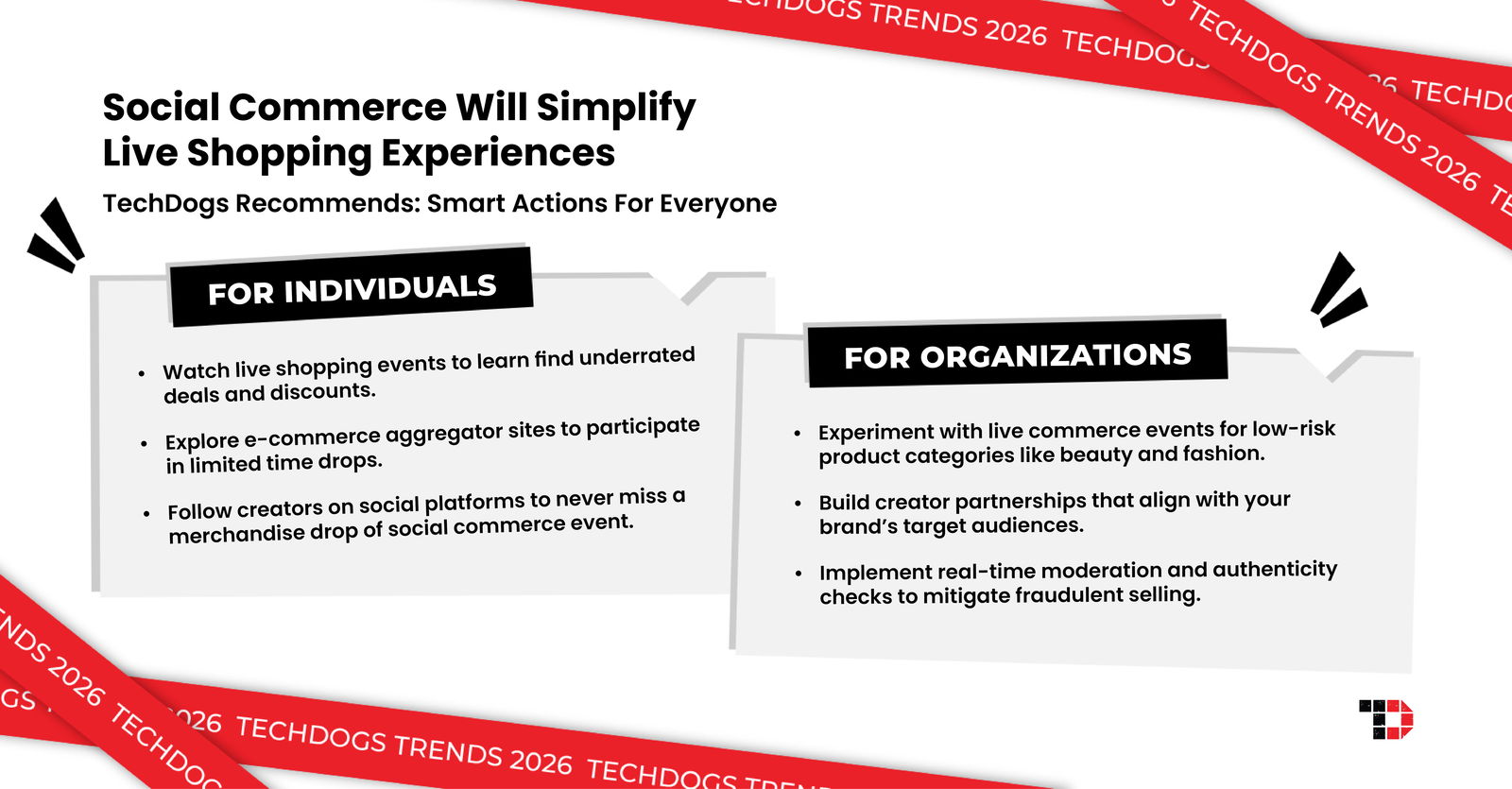
TechDogs Recommends: Smart Actions For Everyone
Trend 3: Progressive Web App (PWA) Integration Will Drive Mobile-First Commerce
Most e-commerce traffic is already mobile. According to Soax, mobile devices accounted for 59% of all online retail sales in 2025, totaling nearly $2.5 trillion globally. The problem: mobile conversion rates still lag desktop by nearly half. Progressive web apps (PWAs) are closing that gap.
PWAs deliver app-like speed, offline browsing, home screen installation, and push notifications, without requiring an app store download. In 2026, they are becoming the infrastructure layer for mobile-first commerce, reducing cart abandonment caused by slow load times and friction-heavy checkout flows.
How Is The Industry Responding?
Major retailers are aligned. Starbucks replaced its native app with a PWA that requires only 233 KB, compared to 148 MB for the native iOS app, while offering full ordering functionality offline. Even e-commerce platform leader Shopify now provides PWA integrations through third-party builders like AmpifyMe, Progressier, and Appify. Payment solutions are embedded within the PWA, offering a mobile shopping experience that minimizes cart abandonment and boosts engagement.
PWA Stats confirm that Kaporal's PWA led to 60% fewer bounces, 15% and 8% more conversions on desktop and mobile respectively, and a 40% increase in visit time. Strix also notes that faster-loading sites, a core advantage of PWAs, show consistently higher conversion rates. Steve Hutt, the founder of eCommerce Fastlane, highlights the strategic urgency: "PWAs offer a rare edge: not only will your conversion rates and retention climb, but your team will ship updates faster, snipe friction before it costs you real money, and adapt to the next market shift without locking yourself into yesterday's platform thinking."
The advantage is shifting to brands with PWA infrastructure in place. The global PWA market is projected to grow from $2.47 billion in 2025 to $34.58 billion by 2035, per Grand View Research, a 30.2% CAGR that signals this is no longer experimental technology.
Challenges To Watch
Not every enterprise system supports PWA features fully. Payment wallets, third-party apps, and feature compatibility vary by region and device, leading to fragmented experiences and adding to the complexity of deploying progressive web apps.
Topics For More Insights
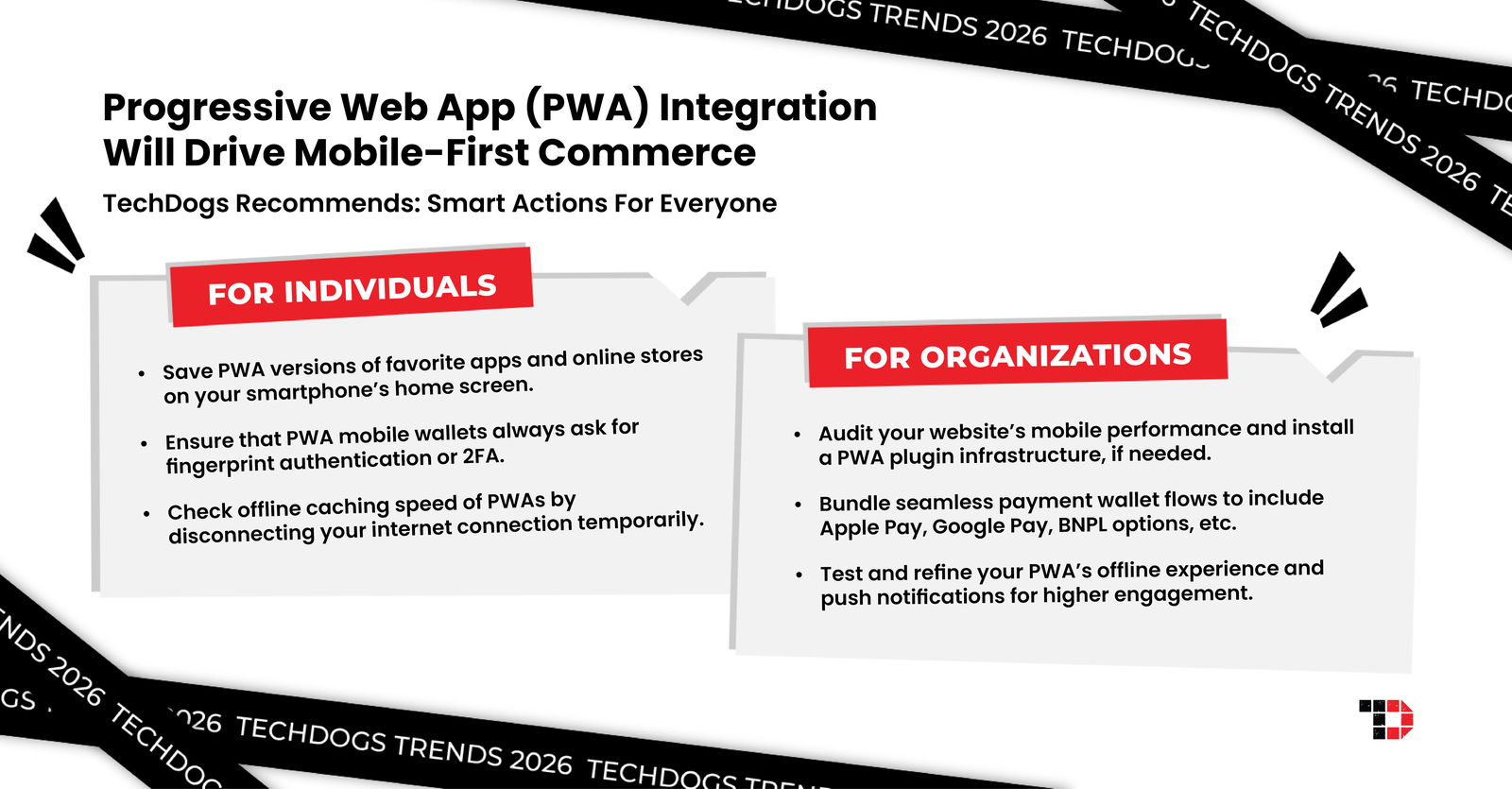
TechDogs Recommends: Smart Actions For Everyone
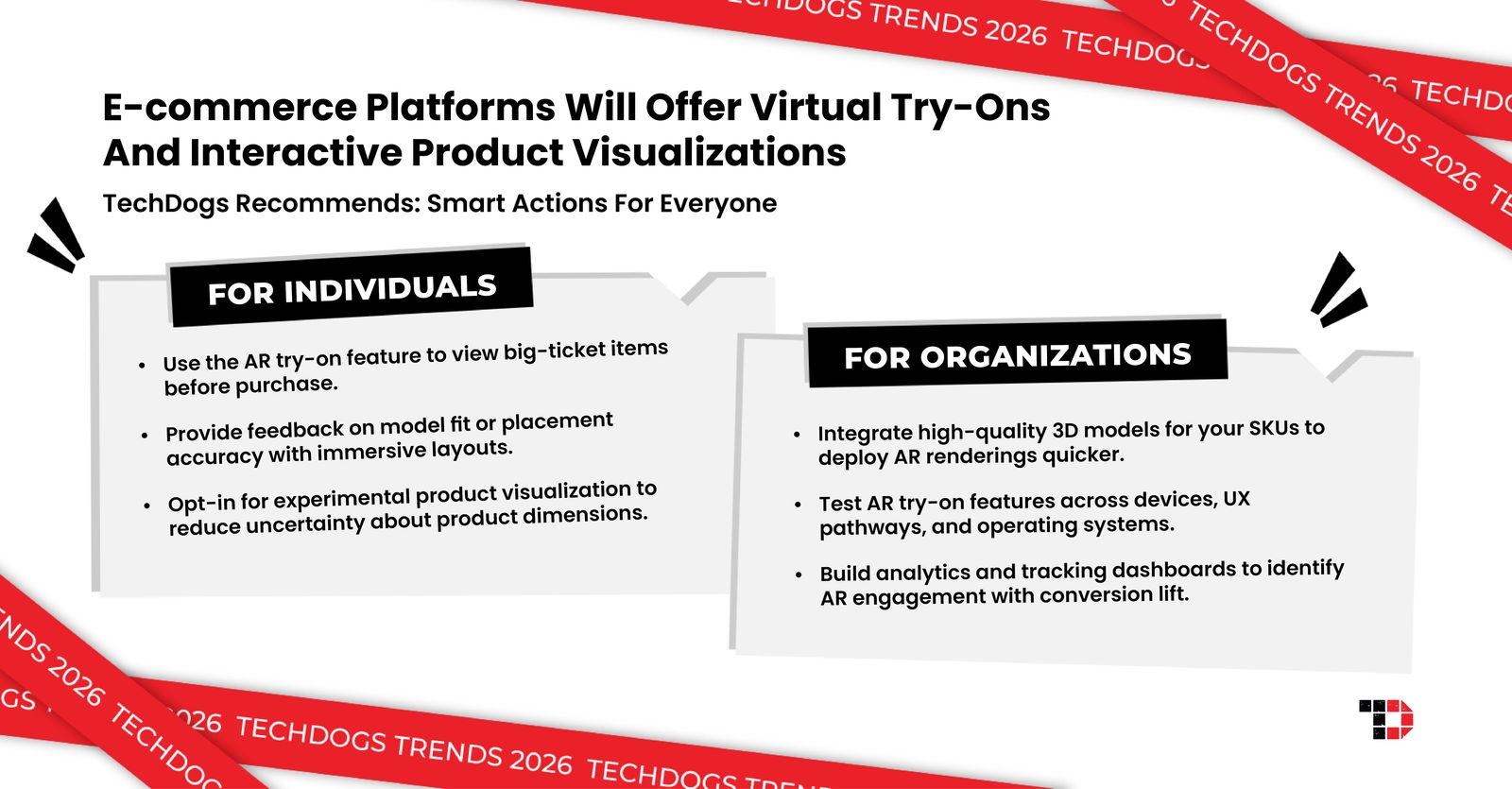
Trend 4: E-commerce Platforms Will Offer Virtual Try-Ons And Interactive Product Visualizations
The OASIS in Ready Player One let characters try on any outfit, furnish any room, and preview any product before committing to it. In 2026, the browser version is arriving. Static product pages with a 'hover to zoom' option are being replaced by AR fitting rooms and 3D visualization tools that let shoppers see, place, and test products in their actual environment before buying.
A trend that retains its place from last year, the emergence of augmented reality (AR) and virtual reality (VR) continue to flip the script on traditional e-commerce experiences. Customers can now virtually place furniture in their homes, try on makeup via their smartphone's front camera, or explore the texture of physical products via 3D visualizations. These features improve customer confidence and reduce the number of products returned.
How Is The Industry Responding?
A LinkedIn post by Dopple cites that Shopify reported a staggering 94% uplift in conversions and 40% reduced returns for brands utilizing AR try-ons. A Sustainability Directory report shows virtual try-ons can reduce return rates by up to 50%, depending on product type. Major retailers like Amazon are offering virtual product placement tools, with Sephora's "Virtual Artist" and Nike's AR sneaker builder being flagship examples of the category.
Not only do AR-driven try-ons reduce environmental impact and logistics costs, they are also accelerating purchases of high-ticket items that often have no return policy. With iOS and Android natively supporting AR Quicklook and Scene Viewer, the deployment barriers for immersive e-commerce are lowering. Milan Kordestani, CEO of Ankord Media, says: "AR can transform customer experiences by allowing users to visualize not only the product but its context in lifestyle, such as seeing a virtual design of a living room featuring a brand's furniture. This type of augmented storytelling can improve emotional connections with the brand."
The reality is this: every product category that relies on fit, scale, or visual context, fashion, furniture, eyewear, beauty, home decor, will eventually have an AR layer. The brands building that layer now are not just reducing returns. They are answering the question customers cannot ask in words: 'What will this actually look like in my life?'
Challenges To Watch
AR product rendering quality depends on device camera and internet connection. Poor AR overlays or slow loading speeds can reduce trust in the brand. Integration of inventory with AR try-on pipelines can be operationally complex, while privacy concerns around camera access and facial scanning remain.
TechDogs Recommends: Smart Actions For Everyone
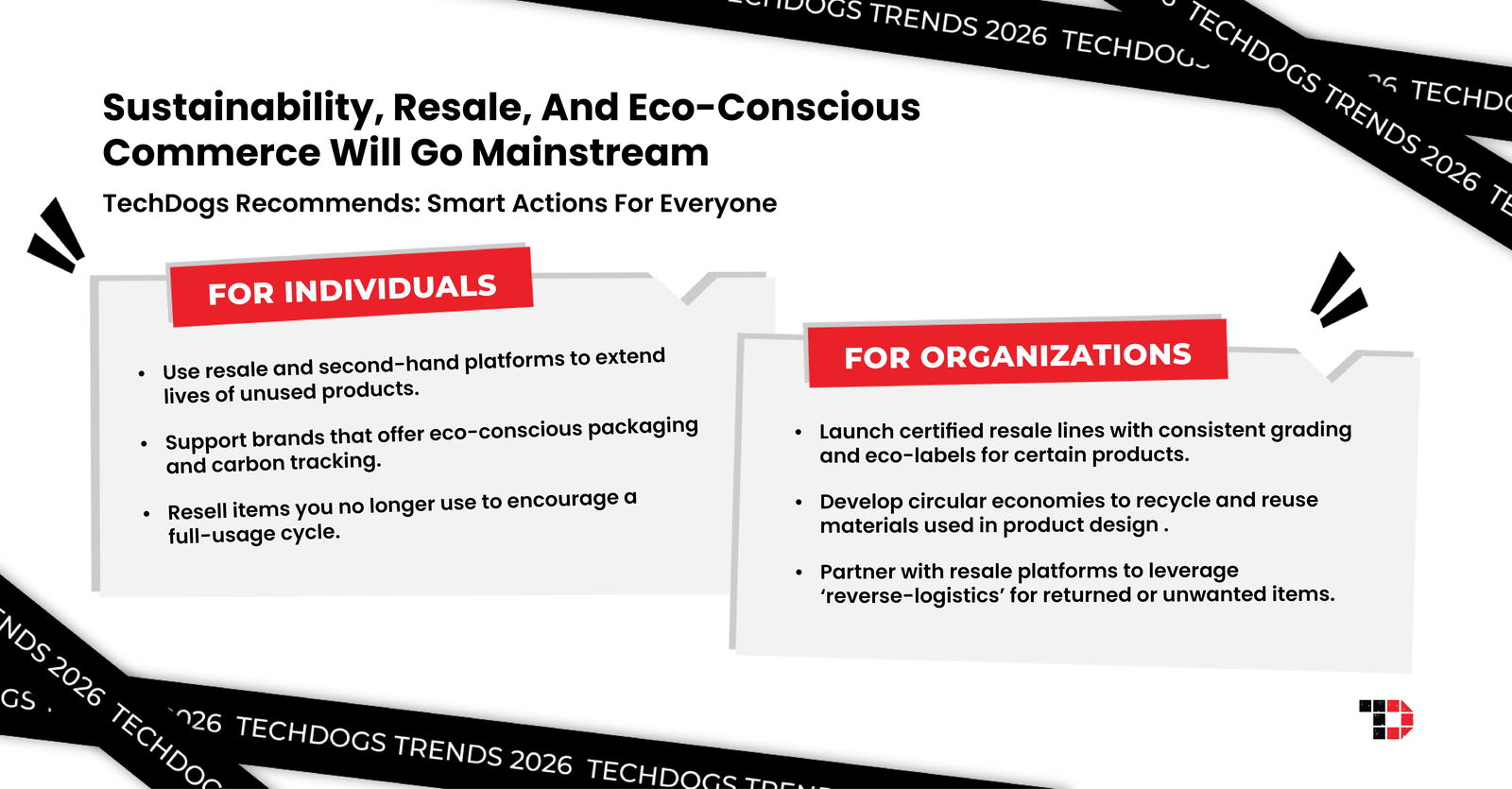
Trend 5: Sustainability, Resale, And Eco-Conscious Commerce Will Go Mainstream
Every returned package generates approximately 30% more CO2 emissions than the original delivery. 9.5 billion pounds of returned goods end up in U.S. landfills annually. Consumers are increasingly aware of this, and their shopping behavior is shifting accordingly. In 2026, resale and sustainability are not fringe concepts, they are part of the sales strategy.
Shoppers will increasingly choose second-hand or refurbished items, reduce product and packaging waste, and demand transparency in carbon footprint reports. ThredUp says global resale platforms will top $200 billion in gross merchandise value. According to BCG research via Barclays, the global resale market is already valued at $210-220 billion and growing at a 10% annual rate, three times faster than the first-hand market. E-commerce brands are pivoting to pre-owned products, eco-packaging, and carbon-offset shipping.
How Is The Industry Responding?
Major retailers are launching resale marketplaces to cater to more sustainable e-commerce offerings, including Amazon Luxury Stores listing 30,000 authenticated pre-owned luxury items from Rebag. Even Walmart is operating a resale luxury channel in partnership with Rebag, offering authentic second-hand high-end items from Hermès, Chanel, and other leading fashion brands. eMarketer reports that online resale operators like ThredUp, TheRealReal, Poshmark, and Depop are actively onboarding users, with pre-owned fashion accounting for 18.8% of total digital shopping in 2025.
In 2026, brands are using recycled materials and enabling resale of items after purchase, even offering customers who opt for reusable packaging the option to return it for discounts or rewards. E-commerce stores are introducing eco-labels to improve brand loyalty with eco-conscious consumers and reduce regulatory risk. ThredUp CEO James Reinhart validates the rise of sustainable resale, saying: "The niche apparel resale industry is turning into a mainstream consumer option, revitalizing an age-old industry by bringing it online and delivering the financial benefits of second-hand."
The takeaway for brands: sustainability in 2026 is not a marketing message. It is a supply chain requirement. The EU already mandates Digital Product Passports for clothing and footwear, turning carbon transparency from voluntary to legally enforceable. Brands that build circular commerce models now will be ahead of both consumer demand and incoming regulation.
Challenges To Watch
Resale logistics can be resource-intensive, requiring authenticity verification, condition grading, and shipping audits. Gaining consumer trust is also tough, as brands must be consistently transparent about sustainable initiatives, failing which they risk being perceived as participating in superficial "greenwashing." Carbon-offset calculations can vary widely based on methodology and product lifecycle.
TechDogs Recommends: Smart Actions For Everyone
Conclusion
In Ready Player One, the OASIS worked because it was built around what the user actually wanted, personalized, immersive, and responsive to every preference and value. 2026 e-commerce is not there yet, but these five trends are the architecture that gets it there. These leading e-commerce trends are not isolated experiments. They are here already.
From AI agents anticipating and making purchases, to live shopping, mobile-first access, AR try-ons and interactive visualizations, to sustainable resale shifts, the e-commerce industry is undergoing a major upgrade. These trends will form the foundation for an immersive, responsive, personalized, and sustainable e-commerce experience in 2026.
Brands that integrate these trends and align them to core e-commerce experiences will flourish. In 2026, e-commerce is not about transactions, but how consumers feel while shopping.
Frequently Asked Questions
What Are The Biggest E-commerce Trends To Watch In 2026?
The top e-commerce trends in 2026 include AI-powered personalization and GenAI shopping agents, social commerce with integrated live shopping, mobile-first commerce powered by progressive web apps (PWAs), immersive shopping experiences through virtual try-ons and interactive 3D product visualizations, and sustainability-driven commerce with resale and eco-conscious packaging.
How Will GenAI Change E-commerce Shopping Experiences In 2026?
GenAI in 2026 will go beyond basic product recommendations to provide generative shopping agents that learn individual preferences, curate personalized product bundles, and complete purchases autonomously. According to a Rep AI report, shoppers with conversational AI complete purchases in 8 minutes on average versus 15 minutes without AI, nearly twice as fast. Colin Bodell of Bazaarvoice confirms that personalized offers drive 45% of shoppers to complete purchases online.
Why Is Sustainability Becoming More Important In E-commerce?
Sustainability is gaining importance in e-commerce as consumers are increasingly aware of environmental impacts and demanding eco-friendly options. The global resale market is valued at $210-220 billion and expanding at 10% annually, three times faster than the first-hand market, according to BCG research. In 2026, this shift is driving the rise of resale marketplaces, refurbished goods, reusable packaging, carbon tracking, and circular economies. EU Digital Product Passports are now making sustainability reporting legally enforceable for clothing and footwear.
Wed, Sep 17, 2025

Enjoyed what you read? Great news – there’s a lot more to explore!
Dive into our content repository of the latest tech news, a diverse range of articles spanning introductory guides, product reviews, trends and more, along with engaging interviews, up-to-date AI blogs and hilarious tech memes!
Also explore our collection of branded insights via informative white papers, enlightening case studies, in-depth reports, educational videos and exciting events and webinars from leading global brands.
Head to the TechDogs homepage to Know Your World of technology today!
Disclaimer - Reference to any specific product, software or entity does not constitute an endorsement or recommendation by TechDogs nor should any data or content published be relied upon. The views expressed by TechDogs' members and guests are their own and their appearance on our site does not imply an endorsement of them or any entity they represent. Views and opinions expressed by TechDogs' Authors are those of the Authors and do not necessarily reflect the view of TechDogs or any of its officials. While we aim to provide valuable and helpful information, some content on TechDogs' site may not have been thoroughly reviewed for every detail or aspect. We encourage users to verify any information independently where necessary.
Loading comments...