Automation
Digital Transformation Trends Reshaping Industries In 2026
Share
TL;DR
-
AI-Powered Business Transformation: 72% of organizations now use AI in at least one function (McKinsey 2024). 65% are using generative AI in at least one business function.
-
Cloud-Native and Edge-First Innovation: Accenture finds organizations with an advanced digital core deliver up to 60% higher revenue growth.
-
Data Fabrics and Real-Time Intelligence: IDC forecasts more than 40 billion IoT devices by 2034. Gartner estimates organizations deploying data fabric will reduce time-to-insight by 70% by 2027. 82% of IoT enterprises use or plan real-time data processing (Omdia 2025).
-
Security-By-Design and Cyber Resilience: Accenture finds 90% of organizations are not ready to protect against AI-augmented cyber threats.
-
Human-Centric Digital Workforces: McKinsey research shows 70% of large-scale change programs fail due to human resistance and cultural misalignment. WEF reports 63% of companies cite skills gaps as a core barrier. 77% of organizations are now prioritizing reskilling and upskilling.
Introduction
Apollo 13 didn't succeed because everything went to plan. The oxygen tank exploded on the way to the Moon. What saved the crew was the team's ability to adapt in real time, knowing their systems deeply, trusting the data coming back from sensors across the spacecraft, and improvising solutions that held together under pressure. That is exactly what digital transformation demands in 2026.
Organizations are no longer running isolated modernization projects. They are building integrated, always-on operating systems where AI accelerates decisions, cloud scales execution, data connects every function in real time, security holds it all together, and people know their systems well enough to adapt when the unexpected happens.
IDC forecasts global digital transformation investments to reach $3.4 trillion in 2026 and $3.9 trillion by 2027, as organizations shift from isolated modernization projects to AI-native operating models that touch every function and workflow.
Here are the five transformation trends defining 2026.
Trend 1: AI-Powered Business Transformation Will Redefine How Work Gets Done
Nobody asked for another dashboard. What leaders want is faster decisions, simpler workflows, and growth that doesn't depend on throwing more people at problems. In 2026, AI is handling that pressure, not as a side project, but as the engine behind how work actually gets done. From marketing copy and product roadmaps to demand forecasting and support operations, AI is becoming the second brain of the enterprise.
How Is The Industry Responding?
McKinsey's 2024 global AI survey reports that 72% of organizations now use AI in at least one function, up from around 50% in prior years, and 65% are using generative AI in at least one business function, most commonly in marketing, product development, and IT. Half of respondents say AI is already embedded in two or more functions, indicating adoption is spreading across the value chain.
Spending patterns reinforce this shift. IDC forecasts enterprise investment in generative AI solutions, software, infrastructure, and services will grow at a CAGR of 73.3%, far outpacing overall IT spend. By 2027, generative AI is expected to account for over 28% of overall AI spending.
Enterprise sentiment has shifted from 'whether' to 'how fast.' A TechTarget survey found that almost 30% of businesses already run genAI in production, up from 18% in 2023, while 92% reported increased genAI use over the previous year.
"I think what a CEO does is maybe one of the easier things, maybe for an AI to do one day," Google CEO Sundar Pichai told the BBC in an interview in November 2025. It is high time businesses start embedding AI into their operations at scale.
The shift is clear: with 72% of organizations already using AI in at least one function and genAI investment growing at a 73.3% CAGR, the gap between AI-integrated enterprises and those still experimenting in pilots is compounding rapidly. The mission clock is running.
Challenges To Watch
AI-powered transformation isn't plug-and-play. Many organizations face fragmented data, unclear ownership of AI initiatives, and a lack of governance around model risk, privacy, and IP. Hallucinations, bias, and shadow AI tools can quickly erode trust. Without change management and new skills, AI rollouts risk becoming expensive prototypes rather than engines of real operational change.
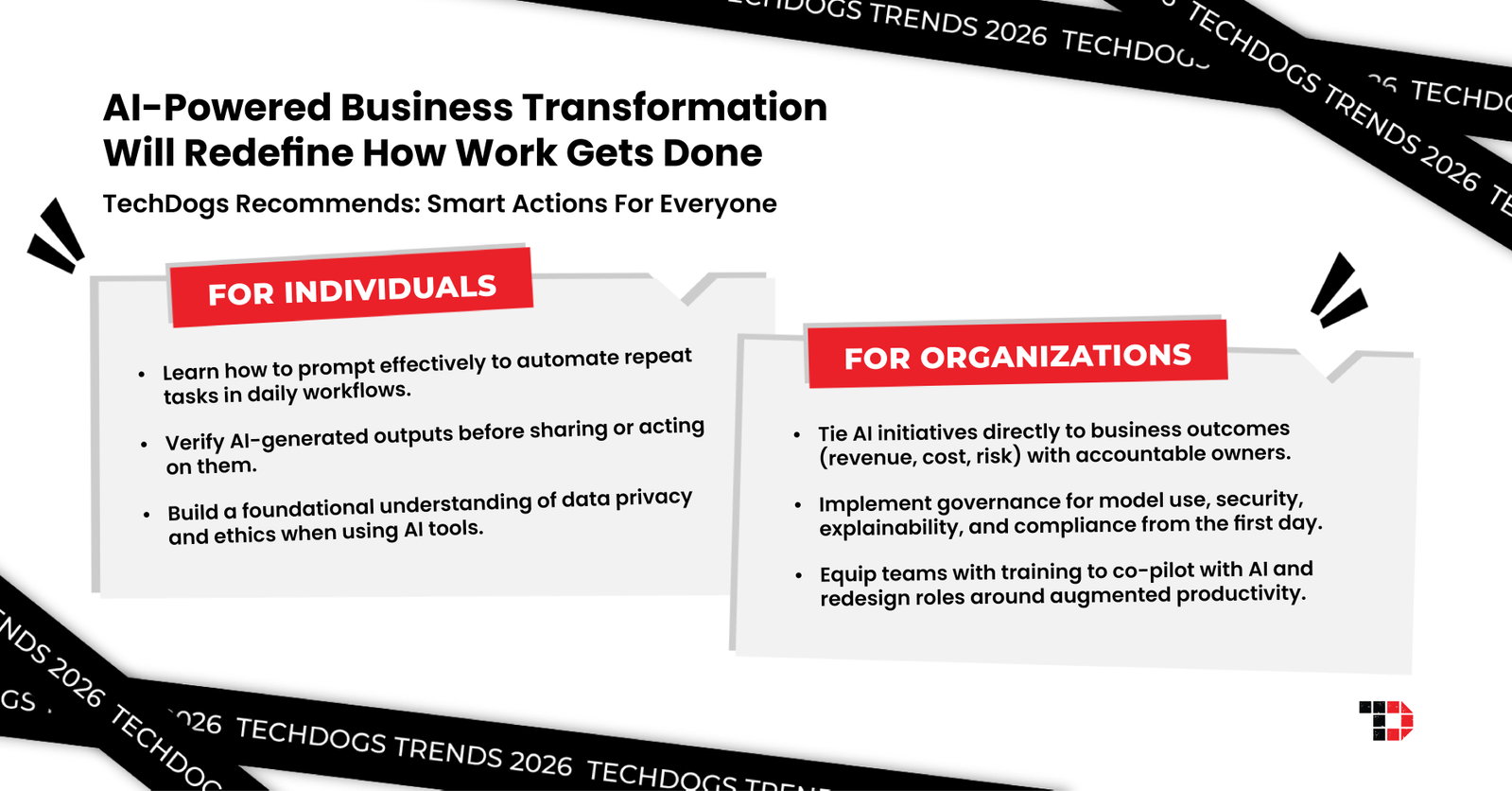
TechDogs Recommends: Smart Actions For Everyone
Trend 2: Cloud-Native And Edge-First Innovation Will Power Real-Time Digital Business
Nobody remembers the exact day Excel quietly started autosaving to the cloud, but work has never felt the same since. That is what 2026 looks like at scale: applications are born in the cloud, decisions happen at the edge, and users expect everything to be instant, always-on, and available everywhere.
According to Grand View Research, the global cloud computing market was estimated at $752.44 billion in 2024 and is projected to reach $2.39 trillion by 2030, growing at a CAGR of 20.4%. Simultaneously, edge infrastructure spending is forecast to reach $380 billion by 2028 (IDC).
How Is The Industry Responding?
Gartner forecasts worldwide public cloud end-user spending to reach $1.26 trillion by 2028, driven by cloud-native, hybrid, and AI-heavy workloads. IDC projects global edge computing investments to climb from around $228-232 billion in 2024 to nearly $380 billion by 2028.
By 2027, more than 70% of enterprises will use industry cloud platforms to accelerate their initiatives (Gartner), up from under 15% in 2023, bundling cloud, data, compliance, and domain capabilities into one composable layer.
Accenture's 2024 research found that organizations with an advanced digital core, across cloud, data, and AI, delivered up to 60% higher revenue growth and 40% higher profits than peers. Cloud-native and edge have become a direct business advantage, not just an infrastructure decision.
"As the focus of AI shifts from training to inference, edge computing will be required to address the need for reduced latency and enhanced privacy," explains Dave McCarthy, Research VP for Cloud and Edge Services at IDC.
What this means in practice: the organizations with a coherent cloud-plus-edge strategy are moving faster, at lower cost, and with better resilience than those still managing fragmented infrastructure. The $380 billion edge market is where real-time intelligence is born, and it is growing at a double-digit pace.
Challenges To Watch
Cloud-native and edge-first sound elegant on a slide but are messy in practice. Organizations face multi-cloud sprawl, inconsistent governance, and observability gaps across distributed apps and data. Edge deployments add complexity to lifecycle management, security, and skills, especially when OT environments, legacy systems, and AI workloads collide.
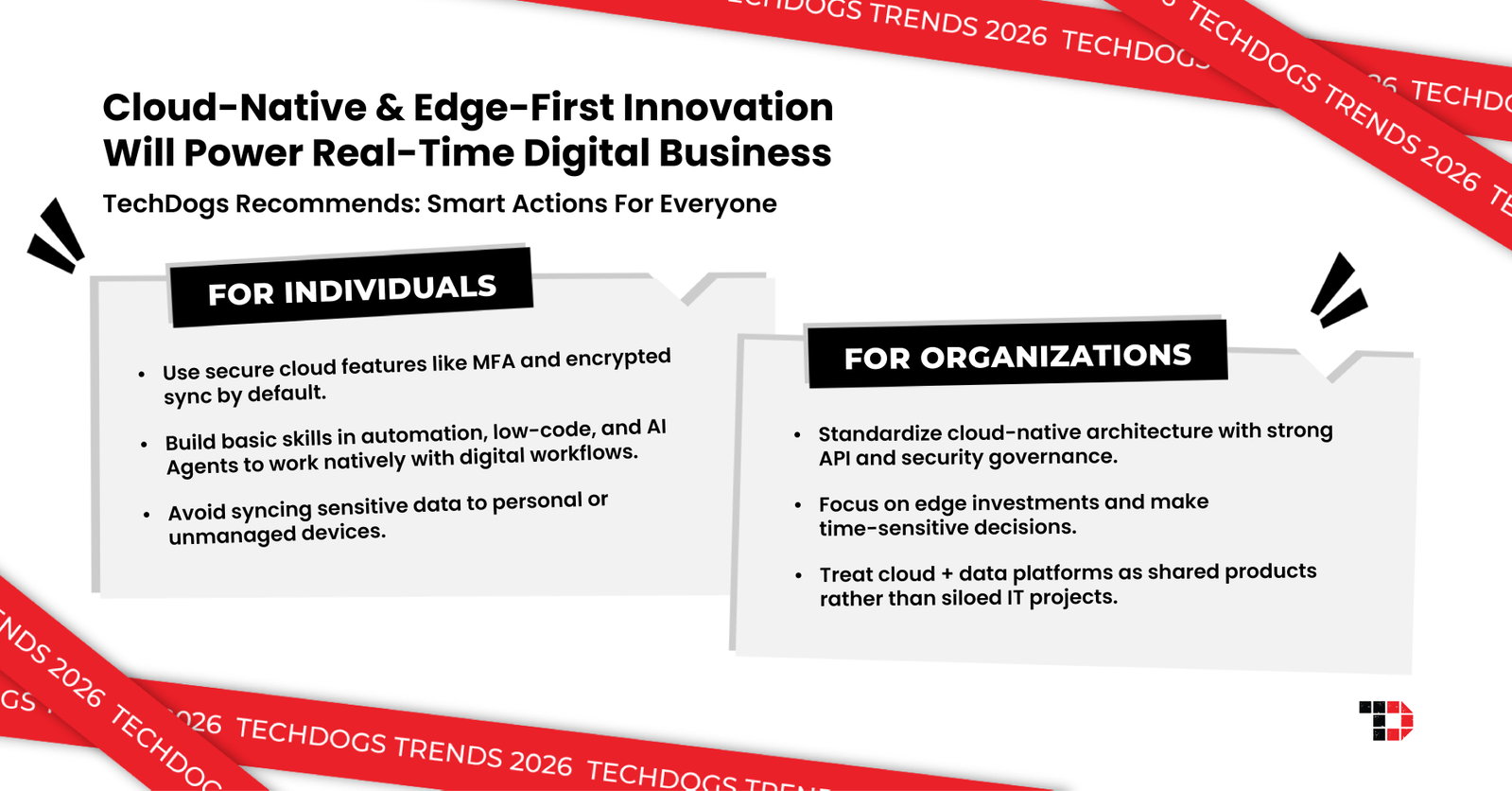
TechDogs Recommends: Smart Actions For Everyone
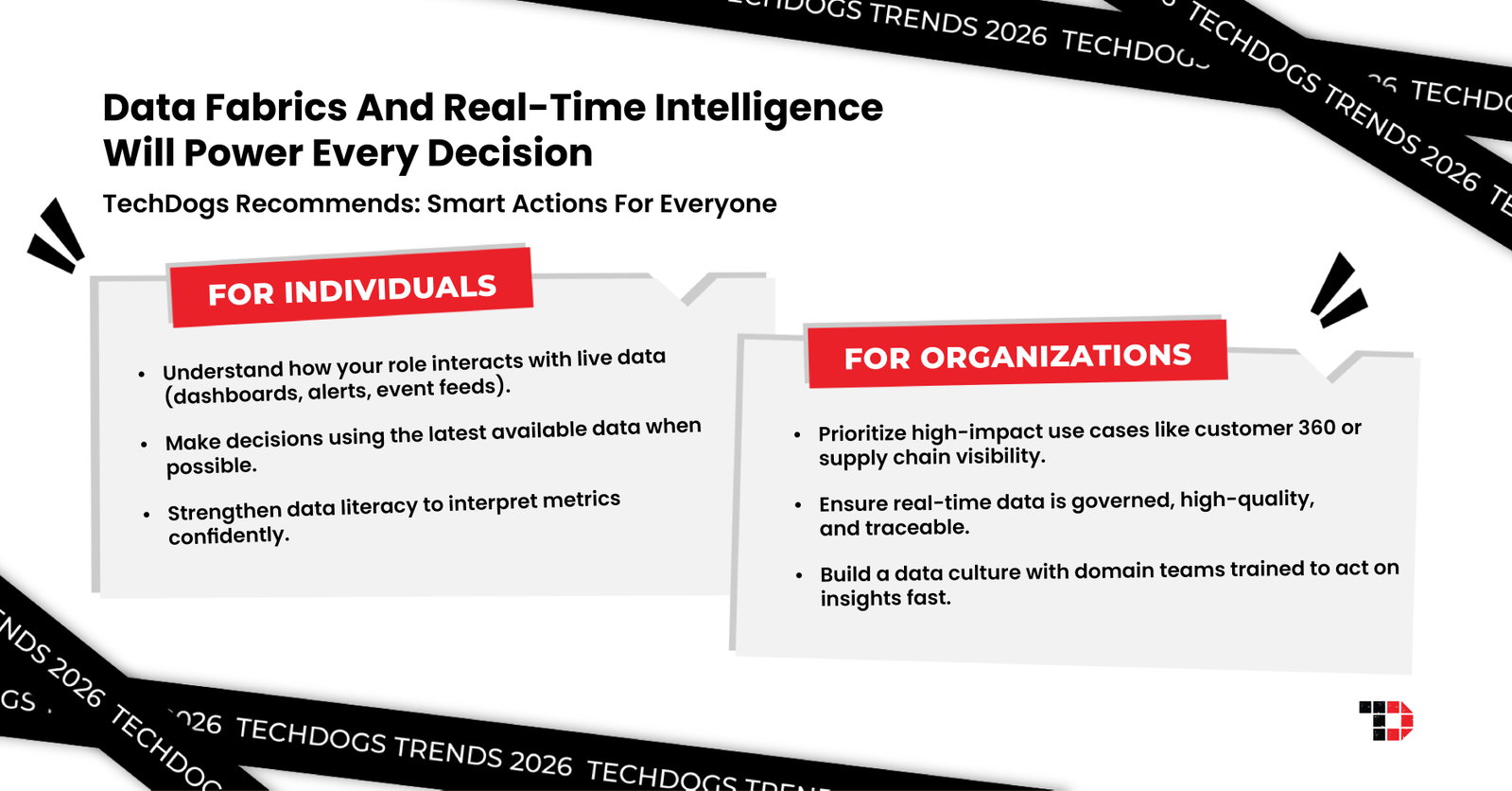
Trend 3: Data Fabrics And Real-Time Intelligence Will Power Every Decision
In 2026, thousands of tiny decisions happen inside every business each second: price changes, fraud checks, route optimizations, and content recommendations. Without an architecture that can see and connect this data as it happens, digital transformation simply stalls. That is why data fabrics and real-time analytics are moving from nice-to-have to the backbone of modern enterprises.
How Is The Industry Responding?
IDC's Worldwide IoT report forecasts more than 40 billion IoT devices by 2034, generating more real-time data than nearly 19.8 billion devices in 2025. This shift is forcing organizations to move from scattered data lakes and warehouses toward unified, metadata-driven data fabrics that can stream, stitch, and govern data across cloud, on-prem, edge, and SaaS.
Gartner estimates that by 2027, organizations deploying data fabric architecture will reduce their time-to-insight by 70%, as AI and metadata automation eliminate manual data discovery and integration bottlenecks.
A 2025 Celent survey found that 55% of banks plan to deploy a data-fabric architecture within 12 months to power real-time decision intelligence across fraud, risk, and customer analytics.
Real-time analytics is also rising across IoT-heavy sectors. Omdia's 2025 IoT Enterprise Survey reports that 82% of IoT enterprises either use or plan to implement real-time data processing, with over 75% layering AI and ML on those streams to move from reactive to predictive operations.
"Strong adoption of 5G and edge computing is laying the groundwork for real-time analytics," notes Omdia principal analyst John Canali, "turning millisecond-level decisions into a competitive advantage rather than an engineering experiment."
The reality is this: data fabric is not a technology project; it is a competitive infrastructure decision. The 55% of banks already planning deployment and the 70% time-to-insight reduction Gartner projects represent the difference between organizations that react to the market and those that anticipate it.
Challenges To Watch
Data fabrics and real-time platforms touch every system, making implementation complex. Many enterprises still wrestle with fragmented metadata, poor data quality, legacy integration patterns, and cultural resistance to self-service data. A rushed rollout can create a more expensive version of old silos rather than a governed, trusted decision fabric that business teams actually use.
Topics For More Insights
TechDogs Recommends: Smart Actions For Everyone
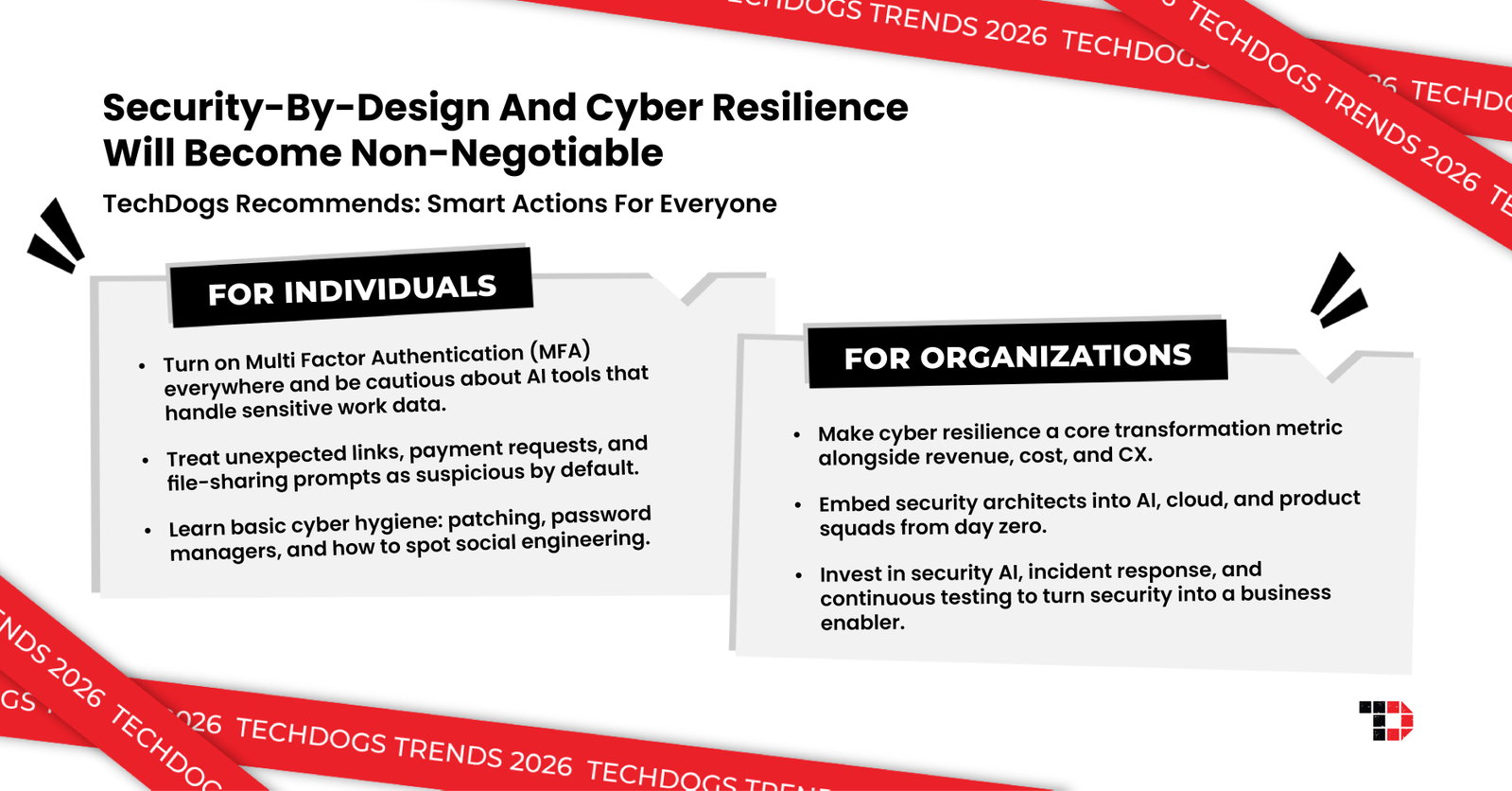
Trend 4: Security-By-Design And Cyber Resilience Will Become Non-Negotiable
In 2026, every new AI workflow, app rollout, cloud migration, or industry cloud platform expands the attack surface. Business outcomes are now judged by speed and experience, and by how well they hold up under attack.
IBM's 2024 Cost of a Data Breach report pegs the global average breach cost at $4.88 million, a 10% year-over-year increase, with 70% of breached organizations reporting significant operational disruption. Cyber incidents are now transformation failures, not just IT issues.
How Is The Industry Responding?
Global security spending reaches $308 billion in 2026, growing at 11.8% year-over-year (IDC). By 2026, 75% of CIOs will infuse cybersecurity into systems and processes as a design principle rather than a bolt-on. Yet capability gaps remain significant: Accenture's State of Cybersecurity Resilience 2025 finds that 90% of organizations are not ready to protect against AI-augmented cyber threats, with 63% stuck in an 'Exposed Zone' lacking both cohesive strategy and technical maturity.
Only 10% of organizations sit in a Reinvention-Ready Zone where cyber is embedded into transformation, and these firms are 69% less likely to experience advanced AI-powered attacks and 1.5x more successful at blocking them. IBM's data shows that organizations extensively using security AI and automation saved about $2.2 million per breach compared to those with no AI in prevention.
"Cybersecurity can no longer be an afterthought. It must be embedded by design into every AI-driven initiative," stresses Paolo Dal Cin, Global Lead, Accenture Security.
The advantage is shifting to organizations that treat cyber resilience as transformation infrastructure. With security spending at $308 billion and growing 11.8%, the investment is already there; the gap is in whether security is being embedded from day zero or bolted on after the fact.
Challenges To Watch
Security-by-design demands more than tools. Many organizations still bolt controls on late in projects, lack clear ownership among IT, security, and product teams, and underestimate AI-specific risks such as model abuse, data leakage, and shadow AI. Without culture, governance, and shared KPIs, cyber resilience remains a slide in a presentation, not an operational reality.
TechDogs Recommends: Smart Actions For Everyone
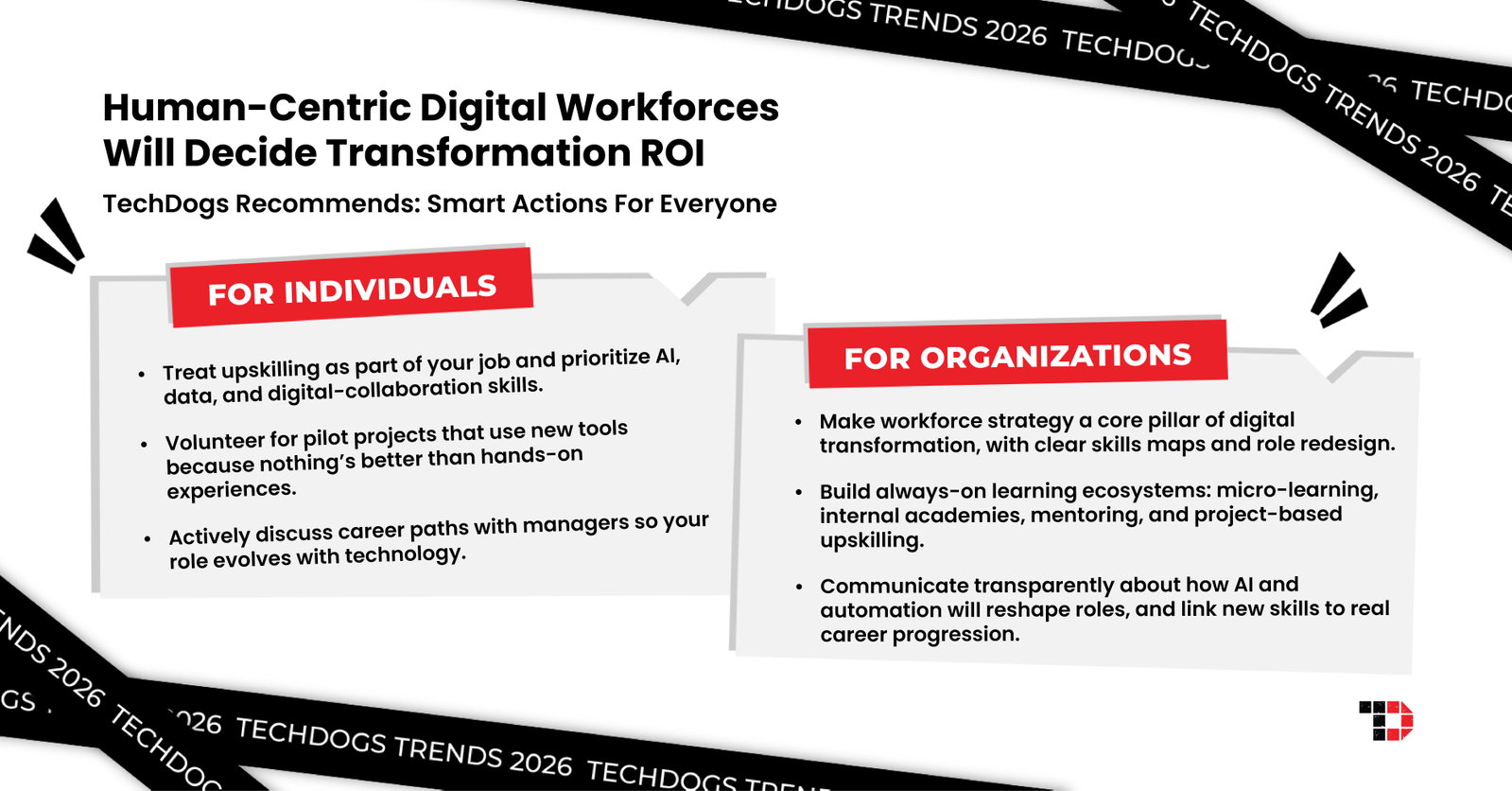
Trend 5: Human-Centric Digital Workforces Will Decide Transformation ROI
Most digital transformations don't fail because the cloud crashed or the AI model refused to run. They fail because people don't change how they work. In 2026, the real competitive edge is a workforce that is digitally fluent, AI-aware, and willing to rewire habits, not just tools.
The Apollo 13 crew survived because they knew their spacecraft intimately. Not because the manual said so, but because they had built deep competency over years of training and practice. Organizations that invest in the same depth of digital competency in their people will be the ones that adapt when the unexpected happens.
How Is The Industry Responding?
McKinsey & Company's transformation research consistently shows that around 70% of large-scale change programs fail due to human resistance and cultural misalignment. The WEF's 2025 Future of Jobs insights report states that 63% of companies cite a lack of digital skills as a core barrier to operationalizing new technologies. Autodesk's 2025 State of Design & Make Report notes that 58% of global leaders see talent shortages as their biggest barrier to growth.
To stay future-ready, 77% of organizations are now prioritizing reskilling and upskilling, especially in AI, analytics, cybersecurity, and digital collaboration (WEF/TechTarget). KPMG's Global Tech Survey shows a direct link between transformation ROI and workforce digital maturity.
"Employees are placing an increased premium on organizations that invest in their skills growth," notes Randa Bahsoun, Labour and Social Development Leader at PwC Middle East. "There is a strong appetite for employees to stay relevant and thrive in a fast-evolving business landscape driven by technology and climate change."
The takeaway for transformation leaders: the mission profile for digital transformation in 2026 requires people who understand their systems at the same depth the Apollo engineers understood theirs. Technology investments without workforce investment consistently deliver the same outcome: expensive hardware that nobody knows how to fly.
Challenges To Watch
Designing a human-centric digital workforce is slow, messy work. Skills frameworks, role redesign, incentives, and culture all have to move together. Many organizations treat upskilling as one-off training rather than a continuous system, and change fatigue can fuel resistance. Without clear communication and a visible career upside, employees may see AI and automation as threats rather than co-pilots.
TechDogs Recommends: Smart Actions For Everyone
Conclusion
Houston, the mission is on track. But only for the organizations that have built the right systems, trusted their data, and invested in the people who know how to adapt when the unexpected happens.
Digital transformation in 2026 is not about adopting technology. It is about re-architecting how businesses operate, innovate, and engage people. Cloud-native systems, AI-driven decision intelligence, and secure automation are now the baseline. The leaders of tomorrow are those building human-centered, data-confident, and AI-powered organizations that can sense change and respond in real time.
The companies that treat digital transformation as a living strategy, not a one-time project, will define the next era of competitive advantage. The mission is ongoing.
Frequently Asked Questions
What Are The Leading Digital Transformation Trends In Enterprise Software?
AI-native applications, cloud-native modernization, data fabric architecture, Hyperautomation, and zero-trust cybersecurity are now driving transformation in enterprise environments. Gartner notes the biggest shift is toward platform engineering and composable architecture, enabling faster innovation and reusable software capabilities across business units. With global DX spending at $3.4 trillion in 2026, the investment case is no longer theoretical.
What Are The Top 5 Digital Transformation Trends In 2026?
In 2026, transformation is driven by AI-native operating models, cloud-first modernization, data interoperability, cybersecurity-by-design, and human-centric digital experiences. These shifts prioritize smarter automation, faster innovation, and secure, seamless customer and workforce journeys, all underpinned by the same principle: systems that adapt in real time, built on people who know them deeply.
Which Cloud Platforms Are Driving Digital Transformation In Large Organizations?
Enterprise digital transformation is primarily driven by hyperscale platforms: AWS for global workload scale, Microsoft Azure for modernization, and Google Cloud for AI-first transformation, with Oracle Cloud, SAP BTP, and Snowflake expanding in regulated data environments. With public cloud end-user spending reaching $1.26 trillion by 2028 (Gartner) and edge infrastructure at $380 billion by 2028 (IDC), the infrastructure investment is now operating at a planetary scale.
Thu, Dec 4, 2025

Liked what you read? That’s only the tip of the tech iceberg!
Explore our vast collection of tech articles including introductory guides, product reviews, trends and more, stay up to date with the latest news, relish thought-provoking interviews and the hottest AI blogs, and tickle your funny bone with hilarious tech memes!
Plus, get access to branded insights from industry-leading global brands through informative white papers, engaging case studies, in-depth reports, enlightening videos and exciting events and webinars.
Dive into TechDogs' treasure trove today and Know Your World of technology like never before!
Disclaimer - Reference to any specific product, software or entity does not constitute an endorsement or recommendation by TechDogs nor should any data or content published be relied upon. The views expressed by TechDogs' members and guests are their own and their appearance on our site does not imply an endorsement of them or any entity they represent. Views and opinions expressed by TechDogs' Authors are those of the Authors and do not necessarily reflect the view of TechDogs or any of its officials. While we aim to provide valuable and helpful information, some content on TechDogs' site may not have been thoroughly reviewed for every detail or aspect. We encourage users to verify any information independently where necessary.
Loading comments...