
Content Management
Content Marketing Trends That Drive Engagement In 2026
Share
TL;DR
-
AI-Powered Content Creation - AI is moving from experimental tool to standard workflow, with 87% of marketers now using it for content creation.
-
Privacy-First Marketing - First-party data strategies and transparent consent are becoming competitive differentiators as third-party cookies disappear.
-
Short-Form and Multimodal Content - Short-form video delivers the highest ROI of any content format, with 73% of consumers preferring it for product discovery.
-
User-Generated Content - Community-driven UGC drives 10x higher conversion rates than brand content and now influences 84.3% of purchasing decisions globally.
-
Voice Search and Conversational AI - With 157.1 million projected US voice assistant users in 2026, optimizing for conversational queries is no longer optional.
Introduction
Don Draper once said the best advertising does not feel like advertising at all. It feels like a story, a conversation, or a truth the audience already believed. In 2026, that insight is finally operational at scale. AI handles the production. Algorithms handle the distribution. What separates the brands that win is whether the content actually connects.
Global content marketing revenue is projected to surpass $107 billion in 2026, according to Statista. Five trends define the shift from volume to resonance: AI-powered creation, privacy-first strategy, short-form multimodal content, user-generated content, and voice search optimization. Marketers who master all five will compound their ROI. Those who ignore them will find their content marketing ROI 2026 in decline.
Here is what each trend means and why it matters now.
Trend 1: AI-Powered Content Creation And Optimization Will Be A Key Differentiator
In 2026, AI content creation is no longer a competitive advantage. It is the baseline. What was once an experimental tool has now become central to how content is created and optimized.
How is AI transforming content marketing? It is automating topic ideation, first-draft generation, semantic search optimization, predictive analytics, and personalization, enabling content teams to produce more at higher quality without proportionally scaling headcount.
How Is The Industry Responding?
HubSpot reports that 87% of marketing professionals now use AI for content creation in 2026, up from around 50% just two years ago. According to Semrush, 65% of companies regularly used generative AI in 2025, with 68% reporting higher content marketing ROI. When marketers and content creators adopted AI-generated video titles and revised them, co-created titles resulted in 7.1% higher valid watch counts and 4.1% longer watch durations.
Paul Roetzer, founder and CEO of Marketing AI Institute, frames the stakes directly: "AI will not replace marketers, but marketers who use AI will replace marketers who do not."
Christopher S. Penn, co-founder of Trust Insights and one of the world's leading experts on AI in marketing, adds: "A single marketer who uses AI will replace several marketers who do not."
The shift is already underway: AI adoption in content marketing is no longer about whether to use it, but how deeply it is integrated. Teams using AI only for first drafts are just getting started, while those embedding it across the content lifecycle are gaining a measurable edge.
Challenges To Watch
Overreliance on AI tools can lead to generic content that lacks brand voice and differentiation. Quality control remains an issue, as AI outputs can contain factual errors that damage credibility. Gaps in AI skills also limit the effectiveness with which marketing teams can integrate AI into their workflows.
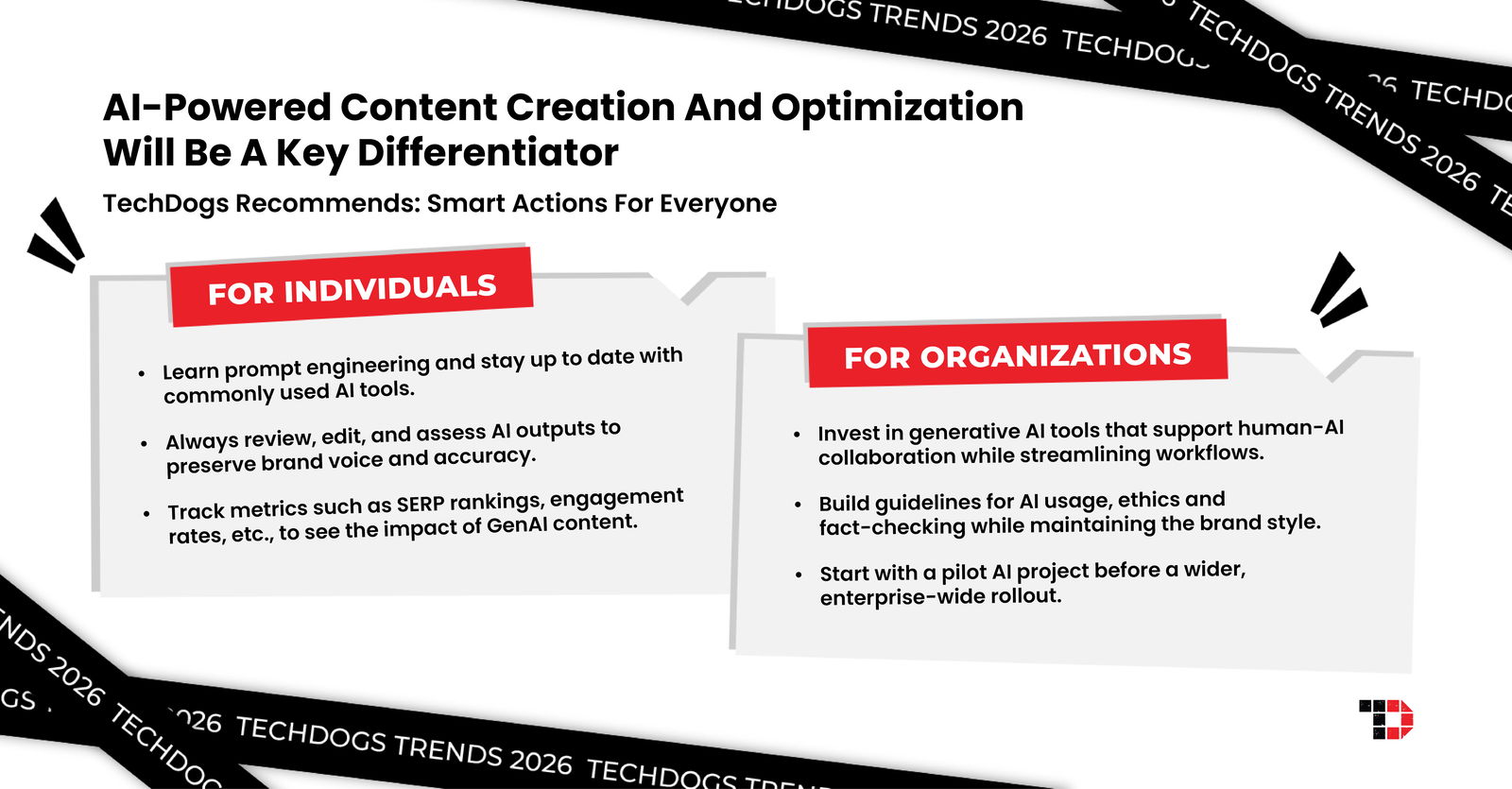
TechDogs Recommends: Smart Actions For Everyone
Trend 2: Ethical, Privacy-First Content Strategies Will Offer A Competitive Advantage
Consumers in 2026 know exactly how their data is being used. Brands that treat privacy as a compliance checkbox will lose to those that treat it as a content strategy.
A privacy-first marketing strategy builds content and personalization systems around first-party data, consent management, and transparent disclosures instead of third-party tracking. With the phase-out of third-party cookies, rising data breach incidents, and tightening global regulations, first-party data marketing is no longer a technical migration. It is a brand differentiator.
How Is The Industry Responding?
Twilio's State of Customer Engagement Report shows 89% of companies believe first-party data can improve customer experiences, while 71% of consumers trust brands that use only first-party data for personalization.
AO, an appliance retailer in the UK, used first-party data to enrich customer profiles, analyze web behavior, and automate content marketing workflows. The result: a 150% increase in newsletter engagement and a 12% rise in average order value.
"It's the brand's responsibility to take the consent of that data, to give clarity about all the things which are going to be captured," said Mayank Prabhakar, Chief Media Officer at Vivo India. "That's a mutually beneficial relationship between a brand and the consumer."
This makes one thing clear. Brands that build transparent, consent-driven content systems today will have a material data quality advantage over competitors still scrambling to replace cookie-based targeting. First-party data compounds in value every month it is collected cleanly.
Challenges To Watch
Navigating an evolving legal landscape, striking the right balance between personalization and privacy expectations, and maintaining audience trust are the key hurdles. Varying data protection standards across jurisdictions add complexity, while delivering relevant content with limited customer information remains a genuine operational challenge.
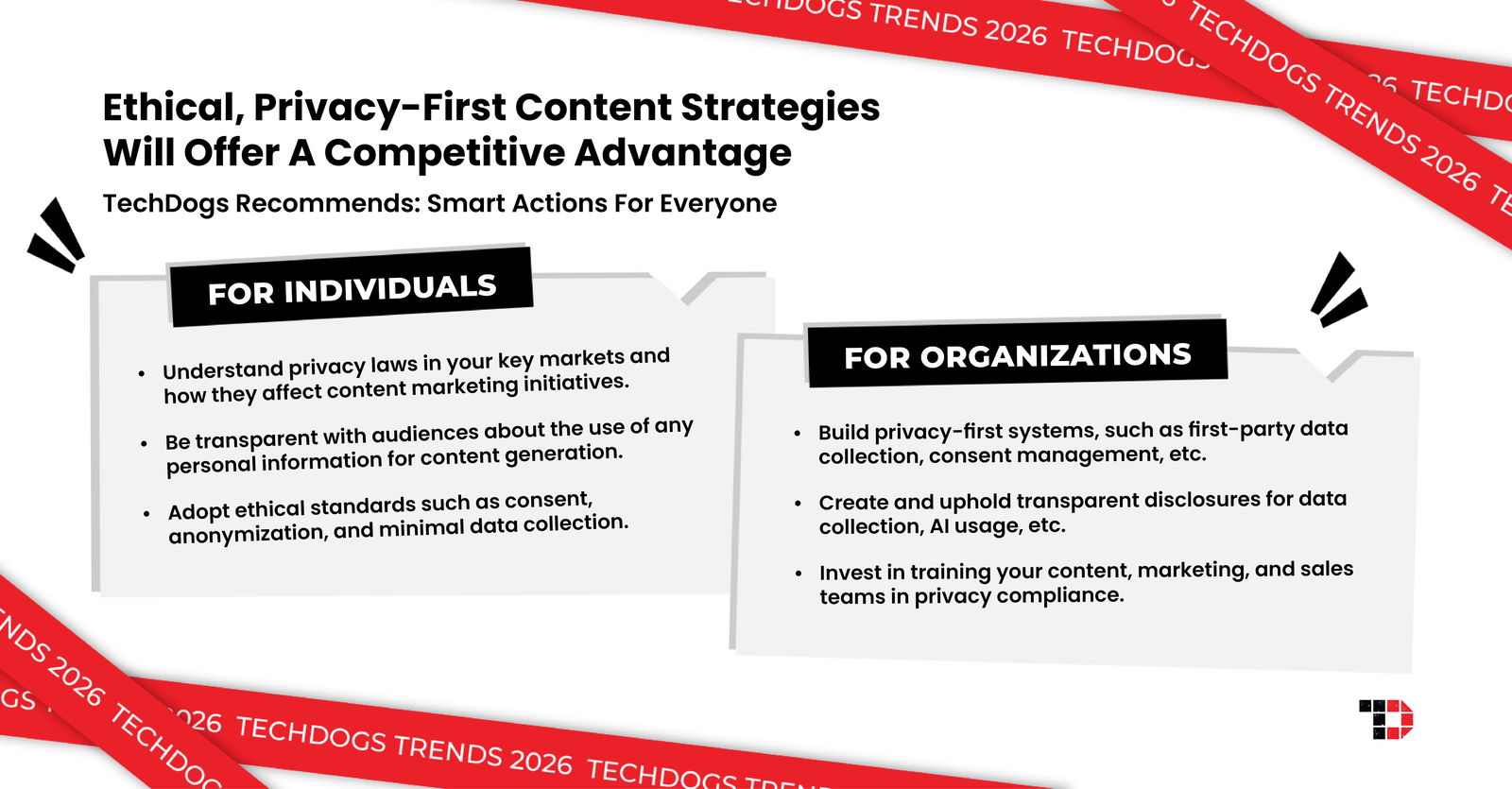
TechDogs Recommends: Smart Actions For Everyone
Trend 3: Short-Form, Snackable And Multimodal Content Will Dominate
Attention spans are not shrinking. Competition for attention is intensifying, and short-form video marketing in 2026 and multimodal content marketing are the formats winning that competition.
Multimodal content marketing combines text, video, audio, and interactive graphics into formats optimized for how audiences consume content on mobile. TikTok is forecast to surpass 2.2 billion monthly active users by the end of 2026, while Meta reports that 40% of user time on its platforms is now spent on Reels. Short, scrappy, honest videos are outperforming polished corporate content because they feel native in the feed.
How Is The Industry Responding?
Yaguara reports that 73% of consumers prefer short-form videos to search for products and services, while 66% of marketers say short-form content is the most engaging format. Short-form video now delivers the highest ROI of any content format, ahead of long-form video and live-action, according to HubSpot.
Talenti, a leading US gelato brand, worked with Dash Social to revamp its content strategy around short-form video. The result: a 366% increase in organic reach on Instagram.
"Short-form video continues to be the fastest-growing content format across social media and even e-commerce platforms," said Patrecia Meliana, Product Success Manager at C2 Media. "It's a surefire way to boost engagement, brand awareness, and visibility."
The gap is widening. Brands that rely on occasional video campaigns are falling behind, while those producing continuous, format-native content are capturing attention at scale.
Challenges To Watch
Maintaining a consistent brand voice across multimodal formats is difficult. Content teams face real production constraints delivering a steady stream of high-quality video. Platform algorithms on TikTok, Instagram, and YouTube Shorts are dynamic and require frequent recalibration.
Topics For More Insights
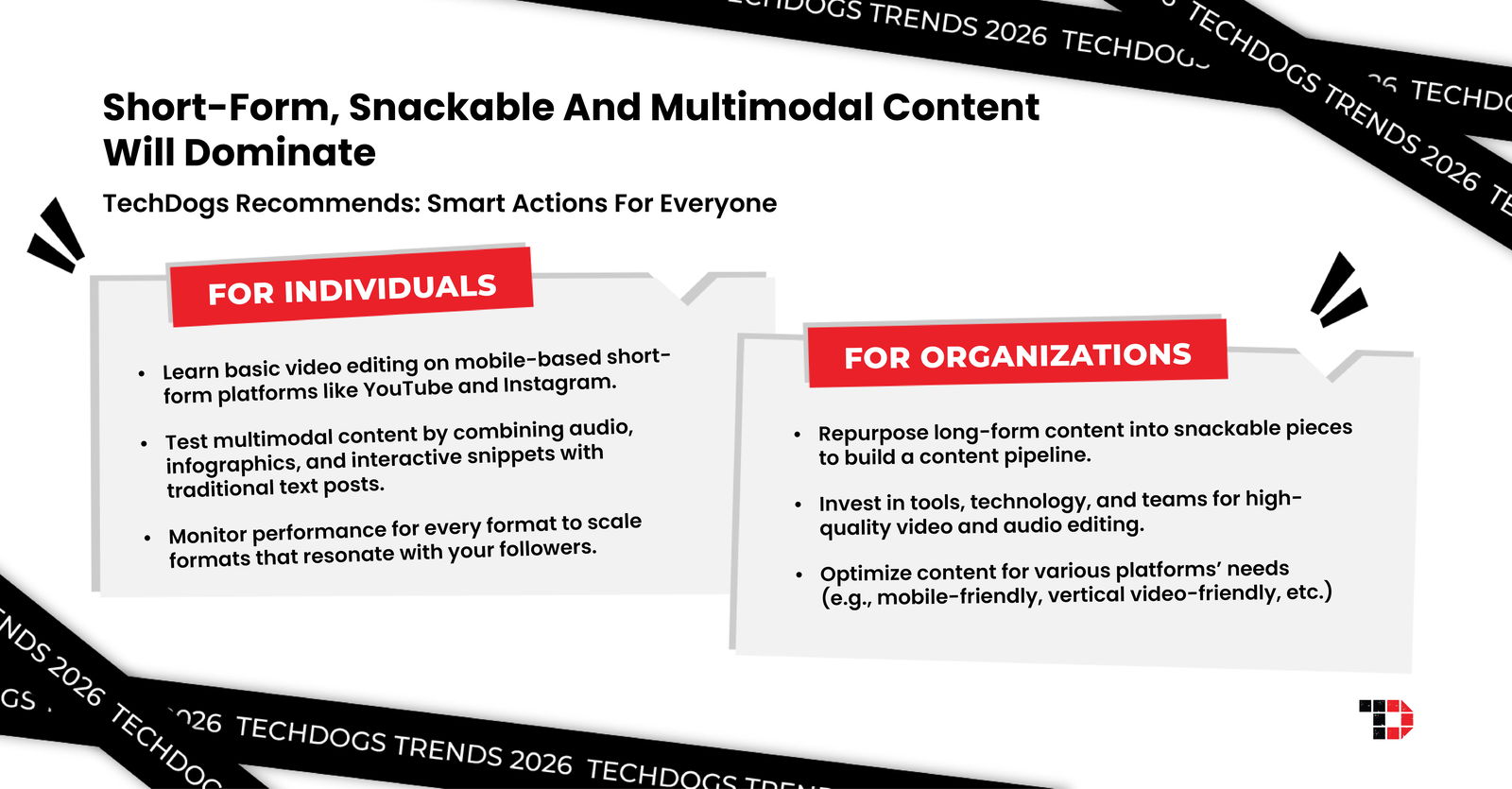
TechDogs Recommends: Smart Actions For Everyone
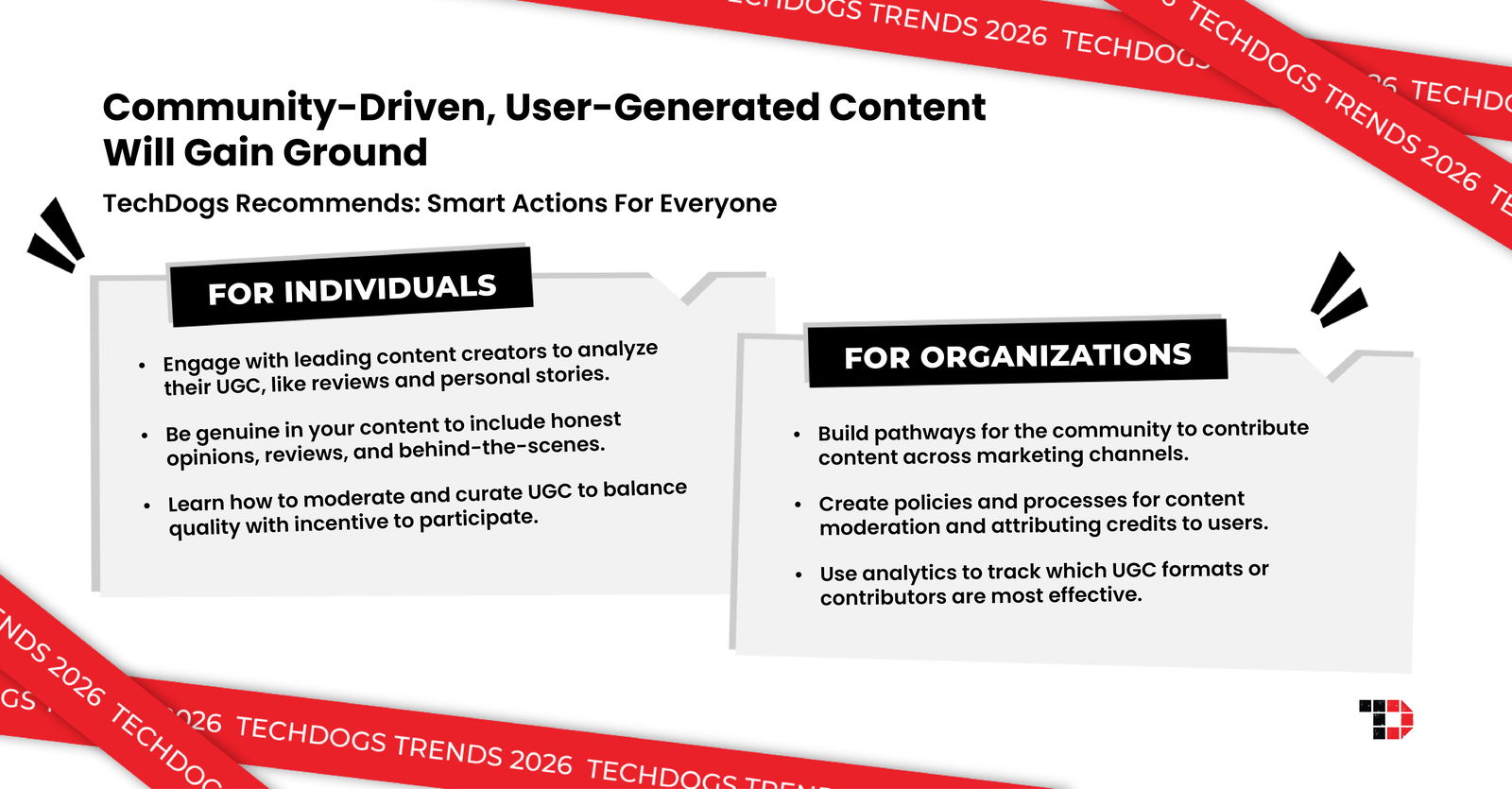
Trend 4: Community-Driven, User-Generated Content Will Gain Ground
Don Draper built campaigns around what brands wanted people to believe. UGC inverts that model entirely. It is content built around what real people actually feel. In 2026, that authenticity is measurable, scalable, and outperforming every format of branded content.
In practice, a user-generated content strategy in 2026 involves enabling, curating, and amplifying the voice of your community through UGC, micro-influencer content, and brand communities. Consumers want peer-verified content and genuine user reviews, regardless of platform or channel.
How Is the Industry Responding?
Nielsen Consumer Trust Institute found in 2026 that UGC now influences purchasing decisions for 84.3% of consumers globally, up from 79.3% in 2025. The UGC platform market is projected to reach $8.48 billion in 2026, growing to $64.31 billion by 2034, per Fortune Business Insights. Brands using UGC see a 29% higher UGC conversion rate compared to those without it, per Wisernotify. A study by Nosto found that UGC images resonate more with customers than professionally shot photos or influencer content.
At-home fitness brand Tonal gives influencers "loose guidance" only, letting them create genuine content about what they love about the product. "This approach enables a creator to tell a story in their own way," said Gina Hardy, Chief Marketing Officer at Tonal, thereby enhancing the authenticity and value of the content.
The advantage is already compounding. Brands that build structured UGC pipelines today will accumulate a content library competitors cannot buy. Every piece of authentic customer content becomes social proof, a conversion asset, and an SEO signal.
Challenges To Watch
Community-driven UGC increases risks around moderation, quality control, and brand alignment. Not all user submissions meet brand standards, and off-brand content can harm brand perception. Sustaining user participation is also a challenge, as contributors expect acknowledgment or incentive.
TechDogs Recommends: Smart Actions For Everyone
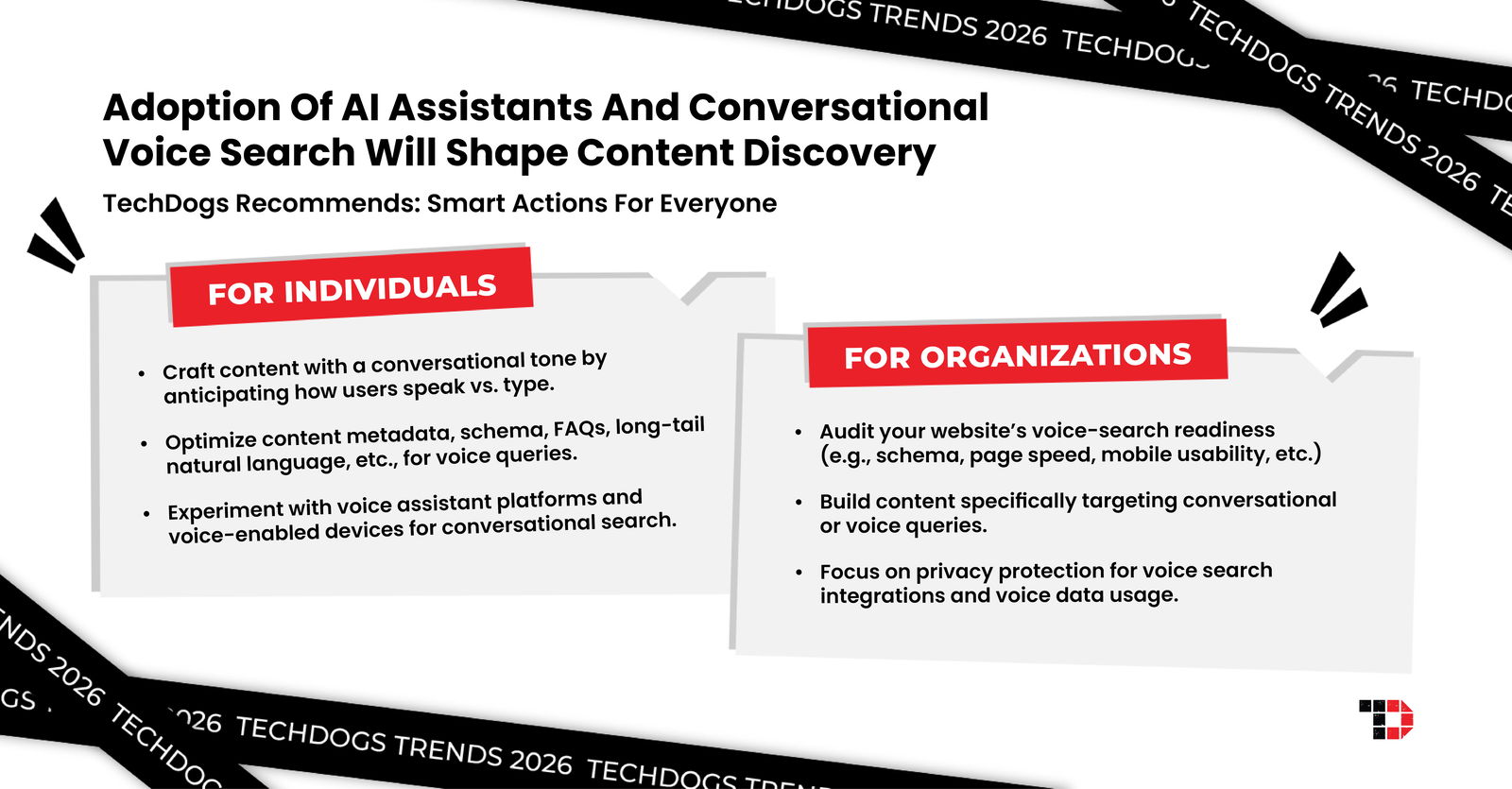
Trend 5: Adoption Of AI Assistants And Conversational Voice Search Will Shape Content Discovery
The way people search is changing. Typing is being replaced by talking, and content marketing needs to catch up.
Voice search optimization in 2026 focuses on structuring content so AI assistants and voice-enabled devices can retrieve, parse, and deliver it as a direct spoken answer. There are now more than 8.4 billion voice-enabled devices active globally, more than the world’s population, according to Statista. In the U.S., 162.7 million users are projected to use voice assistants by 2027, according to eMarketer. Conversational AI marketing is no longer a future channel. It is a present one.
How Is the Industry Responding?
Voice search is not just growing in volume. It is growing in trust. Research shows voice assistants accurately answer 93.7% of search queries, per DemandSage. Among adults aged 18 to 34, 77% now use voice search on smartphones, per Yaguara. Conversational voice search has been integrated into browsers and AI assistants, making it a key factor in branded content discovery.
Microsoft's AI chief, Mustafa Suleyman, predicted in 2024 that conversational AI has the potential to be "the next web browser."
"Customers still want answers, but they're not relying solely on Google," said Chris Brownlee, Vice President of Product at Yext. "Platforms like TikTok, ChatGPT, and voice assistants are now go-to tools for information."
The shift is already underway. Content teams that structure every piece for voice-query retrieval are building discoverability that compounds as voice and AI search adoption grows. FAQ blocks, conversational headings, short direct answers, and structured data are now core content requirements, not SEO add-ons.
Challenges To Watch
Voice SEO and natural language optimization require skills that many content teams currently lack. Voice outputs vary by accent, regional nuance, and dialect, making optimization complex for global enterprises. Marketers without an understanding of structured data and schema markup will need to invest in upskilling.
TechDogs Recommends: Smart Actions For Everyone
Conclusion
Don Draper's great insight was that the best advertising does not feel like advertising. It earns attention rather than demanding it. In 2026, content marketing has finally caught up to that standard.
AI-powered creation is removing the production bottleneck. Privacy-first strategies are building the trust that makes personalization welcome. Short-form multimodal content is meeting audiences where they already are. User-generated content is delivering the peer authenticity that no brand campaign can replicate. And voice search optimization is ensuring content gets found in the conversations that matter most.
The brands that win in 2026 will not be those with the biggest budgets or the most content. They will be those whose content feels like it was made for one person, by someone who understands them. That is Draper's insight, finally operational at scale. The only difference is that in 2026, the brands that get it right will not just be remembered. They will be chosen.
Frequently Asked Questions
What Are The Biggest Content Marketing Trends In 2026?
The top content marketing trends of 2026 include AI-powered content creation and optimization, privacy-first strategies, short-form and multimodal content, user-generated and community-driven content, and the rise of AI assistants with conversational voice search. Together, these trends are shaping how marketers create, personalize, and distribute content while meeting the evolving expectations of consumers.
How Is AI Transforming Content Marketing In 2026?
AI is now a standard part of content marketing workflows. According to HubSpot, 87% of marketing professionals use AI for content creation in 2026. Businesses report higher ROI and engagement when combining human creativity with AI-powered insights. The shift in 2026 goes beyond simply using AI tools. It includes deploying AI agents across content creation, campaign management, analytics, and personalization to scale impact without compromising authenticity.
Why Is Privacy Important In Content Marketing Today?
In 2026, privacy has become a competitive advantage as consumers demand greater transparency and control over their personal data. With the decline of third-party cookies and stricter data regulations, marketers are shifting to first-party data marketing strategies, opt-in personalization, and ethical content practices. According to Twilio, 71% of consumers trust brands that use only first-party data for personalization. Businesses that adopt these approaches not only ensure compliance but also build stronger trust with their audience.
Tue, Nov 4, 2025

Enjoyed what you've read so far? Great news - there's more to explore!
Stay up to date with the latest news, a vast collection of tech articles including introductory guides, product reviews, trends and more, thought-provoking interviews, hottest AI blogs and entertaining tech memes.
Plus, get access to branded insights such as informative white papers, intriguing case studies, in-depth reports, enlightening videos and exciting events and webinars from industry-leading global brands.
Dive into TechDogs' treasure trove today and Know Your World of technology!
Disclaimer - Reference to any specific product, software or entity does not constitute an endorsement or recommendation by TechDogs nor should any data or content published be relied upon. The views expressed by TechDogs' members and guests are their own and their appearance on our site does not imply an endorsement of them or any entity they represent. Views and opinions expressed by TechDogs' Authors are those of the Authors and do not necessarily reflect the view of TechDogs or any of its officials. While we aim to provide valuable and helpful information, some content on TechDogs' site may not have been thoroughly reviewed for every detail or aspect. We encourage users to verify any information independently where necessary.
Loading comments...