Cloud
Cloud Computing Trends Transforming IT Infrastructure In 2026
Share
TL;DR
-
AI-Native Cloud with RAG - Cloud platforms are embedding generative AI and retrieval-augmented generation directly into infrastructure for real-time, context-aware data access.
-
Micro Data Centers at the Edge - Modular mini-clouds bring computing close to users and devices, slashing latency for IoT and industrial workloads.
-
Serverless Hybrid Orchestration - Serverless architectures now run seamlessly across hybrid and multi-cloud environments, blurring the lines between AWS, Azure, and GCP.
-
Confidential Computing - Trusted Execution Environments protect sensitive workloads from the cloud provider itself, making regulated industries cloud-ready.
-
Sustainable and Green Data Centers - Renewable energy, AI-driven cooling, and carbon-aware scheduling are turning data center sustainability from a goal into an operational standard.
Introduction
In The Matrix, the protagonists discover they are living inside invisible infrastructure: a system so embedded in everything that nobody questions it until it goes down. Cloud computing in 2026 works the same way. It powers every app, transaction, and AI model your business runs. When it fails, everything stops. When it evolves, everything changes.
The cloud is not just evolving in 2026. It is fragmenting, deepening, and hardening. Global cloud infrastructure spending crossed $100 billion per quarter for the first time in 2025 and is on track to exceed $500 billion annually in 2026, according to CloudZero's 2026 cloud infrastructure spending analysis. The driver is no longer storage. It is AI.
Five cloud computing trends define this shift: AI-native cloud with RAG, micro data centers at the edge, serverless hybrid orchestration, confidential computing, and sustainable green data centers. Each is operational in 2026. Here is what each means and why it matters.
Trend 1: Retrieval-Augmented Generation Will Be The Norm For AI-Native Cloud Platforms
The cloud is no longer just about storing information. It is about making that information instantly usable. That is why generative AI and Retrieval-Augmented Generation (RAG) are increasingly being embedded directly into cloud infrastructure.
RAG gives AI models access to external, up-to-date data sources before generating a response, pulling live context from a company’s own databases, documents, or APIs in real time instead of relying only on training data. As demand grows for faster, more relevant data access, this capability is becoming a core part of AI-native cloud infrastructure rather than an added layer.
How Is The Industry Responding?
Leading cloud providers are already moving quickly to make RAG-ready platforms a practical reality. Google Cloud, for example, integrated Gemini AI in partnership with Oracle, making advanced generative models available directly via Oracle Cloud Infrastructure’s Generative AI service. This allows enterprise users to run text, image, and video generation models inside their existing cloud applications without data leaving their environment.
At the same time, hyperscalers are investing heavily in AI-driven cloud infrastructure. Microsoft committed $80 billion to AI-centric data center infrastructure in 2025, while AWS unveiled Project Rainier, a massive AI compute cluster built on EC2 for Anthropic. This aligns with Forrester’s 2025 cloud predictions that integrated RAG services will continue to expand and mature through 2026.
As Matt Garman, CEO of Amazon Web Services, put it, having a RAG index close to the data is what makes it possible to integrate these systems into production applications in a meaningful way. The broader takeaway is clear: organizations that have not yet aligned their data pipelines with AI-native cloud architecture risk building on foundations they may later need to rebuild. Starting with clean, high-quality data infrastructure now is the shortest path to production-ready RAG.
Challenges To Watch
Integrating AI models natively into cloud infrastructure introduces risks: hallucinations, data privacy concerns, and higher compute costs. Businesses will also face complexity in fine-tuning models to align with brand guidelines. Without effective guardrails, AI-native cloud services will deliver unreliable outputs that erode customer trust.
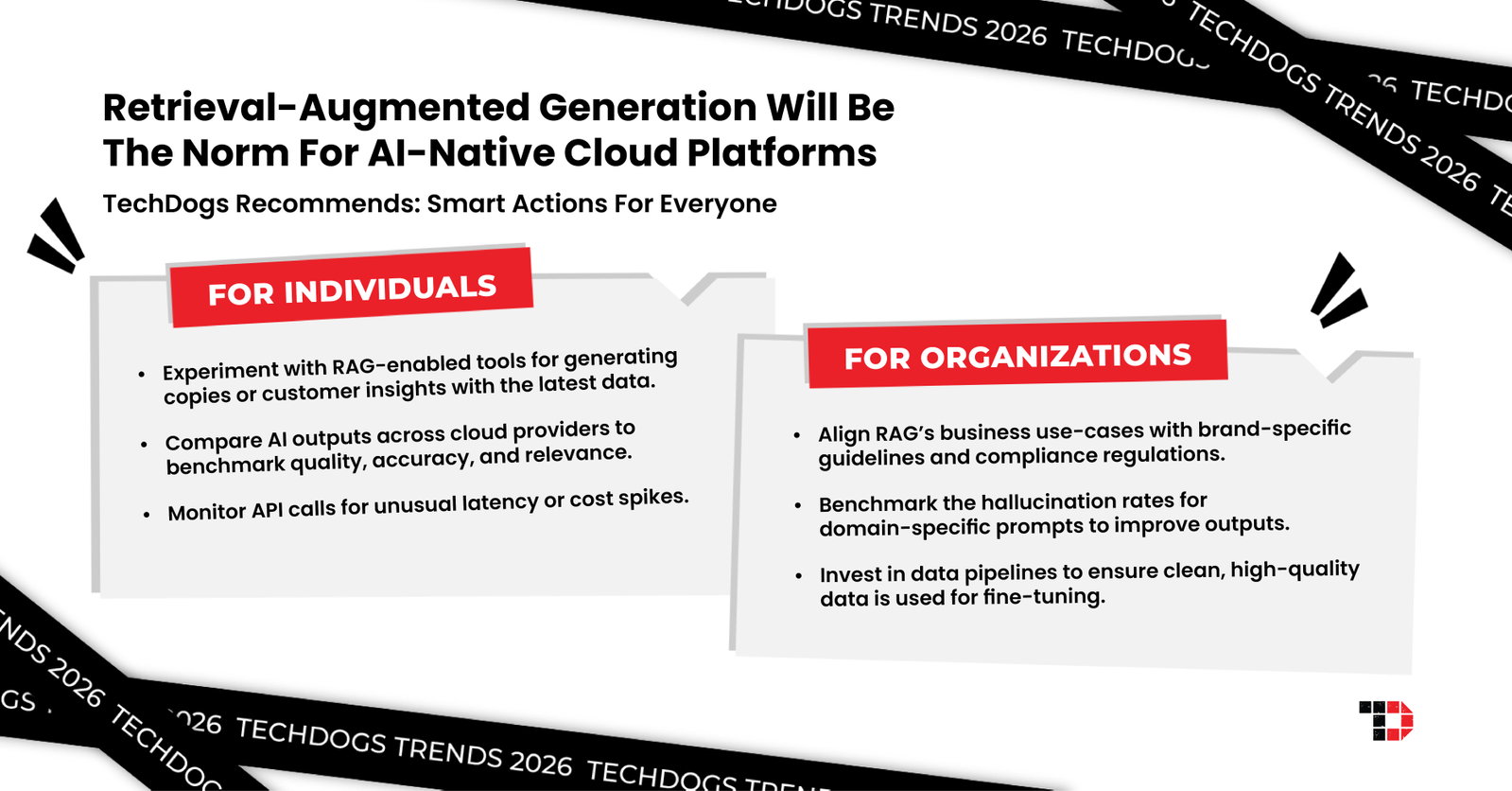
TechDogs Recommends: Smart Actions For Everyone
Trend 2: Micro Data Centers At The Edge Will Extend Cloud Services
The biggest challenge with cloud computing has always been that the computing is too far away. A new pivot is changing that by bringing computing closer to users and devices.
Micro data centers are modular, self-contained compute units deployed at the network edge, forming a critical layer in edge computing environments. Like taking the red pill in The Matrix and stepping outside the centralised system, edge micro data centers let enterprises break free from single-point cloud dependency, processing data where it is generated, not thousands of miles away. They are fast to deploy, efficient to run, and purpose-built for latency-critical workloads like IoT, industrial automation, and AR/VR.
How Is The Industry Responding?
JLL predicts the global edge data center market will reach $317 billion by 2026, posting 107% growth from 2020's $153 billion baseline. Major cloud providers are investing in edge infrastructure to bring compute closer to data sources.
Gartner validates that 15% of on-premises production workloads will run in containers by 2026, up from less than 5% in 2022, driving more specialized use cases for micro data centers across manufacturing, retail, and healthcare.
"Adopting micro DCs offers a compelling proposition," said Tony Grayson, ex-AWS, Oracle, and Meta executive. "It's not just about scalability; it's about flexibility and responsiveness to the changing demands of the digital world. When it's time for an upgrade or expansion, deploying a new set of micro DCs can be more straightforward and potentially more cost-effective than retrofitting an outdated infrastructure."
The implication: for enterprises running latency-sensitive workloads such as in-store analytics, autonomous systems, and real-time quality control, a centralized cloud-only strategy will become a competitive disadvantage. Micro data centers are not a replacement for the cloud; they are its intelligent extension.
Challenges To Watch
Deploying micro data centers requires careful physical planning for space, cooling, power, and security. Complexity rises as they scale, with each unit needing health monitoring, firmware updates, and network security. Seamless integration with central cloud platforms for cost management and performance remains the hardest part.
TechDogs Recommends: Smart Actions For Everyone

Trend 3: Serverless Architectures Will Simplify Hybrid And Multi-Cloud Orchestration
Serverless is not a new trend. It is leveling up in 2026.
Unlike the siloed models of the past, serverless cloud architecture in 2026 allows functions to run seamlessly across hybrid clouds and on-premises environments. Orchestration layers auto-deploy, scale, and optimize workloads across AWS Lambda, Azure Functions, and Google Cloud Run with unified control policies. The lines between public cloud, multi-cloud, and on-prem are blurring in ways that were not possible even two years ago.
How Is The Industry Responding?
Mordor Intelligence puts the global serverless computing market at $32.59 billion in 2026, growing at a 22.94% CAGR to reach $91.56 billion by 2031. Multi-cloud serverless is the fastest-expanding deployment model at 23.15% CAGR.
Hybrid orchestration tools like Crossplane and GitOps frameworks are enabling functions to run anywhere across public cloud, multi-cloud, or on-prem, with unified control policies. Enterprises are leveraging serverless to run latency-sensitive workloads for compute-heavy tasks without managing underlying infrastructure.
"Moving from a server-based deployment to a container-based deployment really increases agility around being able to update and deliver value faster," said Omar Khan, General Manager for Microsoft Cloud App Development and Tools. "When you look at serverless, it continues that trend."
The implication: hybrid cloud orchestration is no longer about picking the right cloud provider. It is about building a function-portable architecture that can survive any vendor pricing change, outage, or compliance requirement. Organizations that have not yet abstracted their serverless layer from a single provider are one pricing announcement away from a costly migration.
Topics For More Insights
Challenges To Watch
Hybrid orchestration introduces differences in function architecture, deployment models, and debugging methods across clouds. Vendor-specific features can cause lock-in, demanding that cloud teams balance orchestration flexibility with standardization and observability across all touchpoints.
TechDogs Recommends: Smart Actions For Everyone

Trend 4: Businesses Will Adopt Confidential Computing For Sensitive Cloud Workloads
Confidential computing is emerging as a critical security approach for protecting sensitive cloud workloads within the confidential computing cloud ecosystem. It enables data to be processed inside Trusted Execution Environments (TEEs), isolated CPU enclaves where neither the operating system, the hypervisor, nor even the cloud provider can access information while it is in use. In 2026, this capability is expected to become foundational for businesses in regulated industries handling financial data, healthcare records, and AI model weights.
How Is The Industry Responding?
Fortune Business Insights projects the global confidential computing market will grow from $42.74 billion in 2026 to $463.89 billion by 2034, at a 34.7% CAGR. Mordor Intelligence reports that the BFSI industry accounted for 46.8% of the confidential computing market share in 2024, with healthcare, government, and AI workloads emerging as the fastest-growing adoption segments.
In 2026, confidential computing is expected to underpin the trust layer for AI-native cloud services, keeping business data and AI algorithms protected even in shared cloud environments.
"Enterprises are rapidly moving data to the cloud, which has dramatically altered their security needs," said Stephen Walli, Governing Board Chair of the Confidential Computing Consortium. "The needs of protecting and managing sensitive data throughout the lifecycle, coupled with industry regulations and the proliferation of cyber risks, can make confidential computing a de facto technology for computational security."
Taken together, these developments point to a clear shift: confidential computing is no longer a niche security upgrade for heavily regulated sectors. With over 70% of enterprise AI workloads expected to involve sensitive data by 2026, according to Fortune Business Insights, it is becoming the baseline for any enterprise that processes proprietary data in a shared cloud environment.
Challenges To Watch
Trusted Execution Environments introduce performance overhead, require specialized hardware, need expert debugging, and present portability challenges across jurisdictions. Side-channel attacks remain a real risk that organizations must account for when adopting secure enclaves.
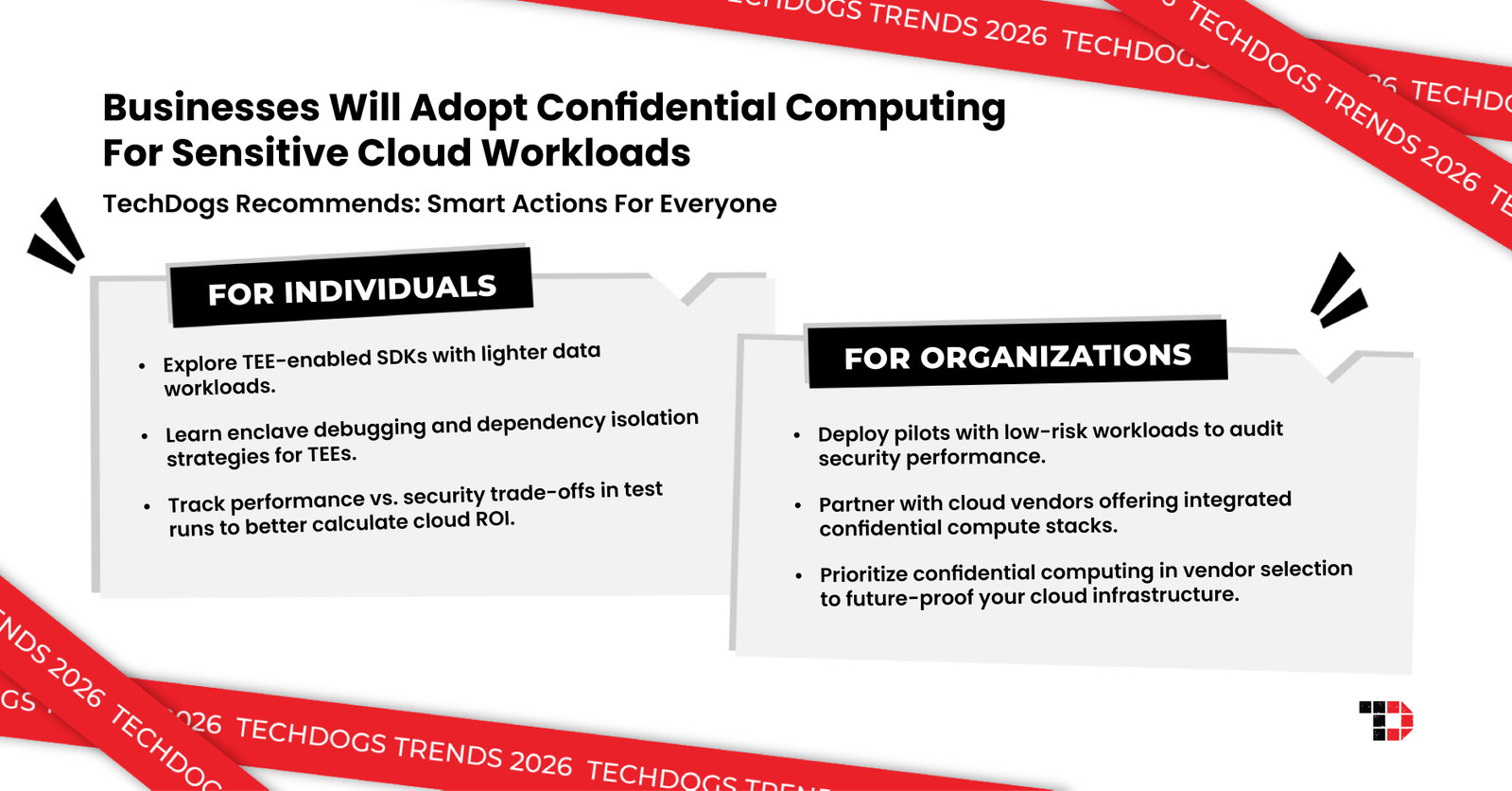
TechDogs Recommends: Smart Actions For Everyone
Trend 5: Sustainable Clouds And Green Data Centers Will Address Energy Efficiency Concerns
As demand for cloud data centers booms, so does the call for sustainable infrastructure. In 2026, businesses will focus not only on cloud uptime but also on environmental impact.
The 2024 United States Data Center Energy Usage Report (DOE) found that data centers represented 4.4% of total U.S. electricity consumption. Morgan Stanley estimates they will emit 2.5 billion metric tons of CO₂ through 2030, with 40% attributed to the U.S.
In response, green data centers in 2026 and sustainable cloud strategies are becoming the operational baseline, using renewable energy, carbon-efficient designs, and AI-driven workload-aware cooling.
How Is The Industry Responding?
Precedence Research projects the global cloud sustainability market will reach $175.82 billion by 2034, growing at a 19.23% CAGR from its $30.28 billion base in 2024.
Google and Intersect Power, backed by TPG Rise Climate, are developing an $800 million industrial park co-locating wind and solar farms with gigawatts of data center capacity, operational in 2026. Google reports its data centers deliver over six times more computing power per unit of electricity than they did five years ago, with an average PUE of 1.09 versus the industry average of 1.56.
"The window for taking advantage of current renewable energy economics is closing fast," said Jenny Gerson, Senior Director of Sustainability at DataBank. "Market consolidation will accelerate as speculative developers without secured power or capital exit the market."
"The future is being built in the cloud. It must be powered by the sun, the wind, and the promise of a better world," said António Guterres, U.N. Secretary General.
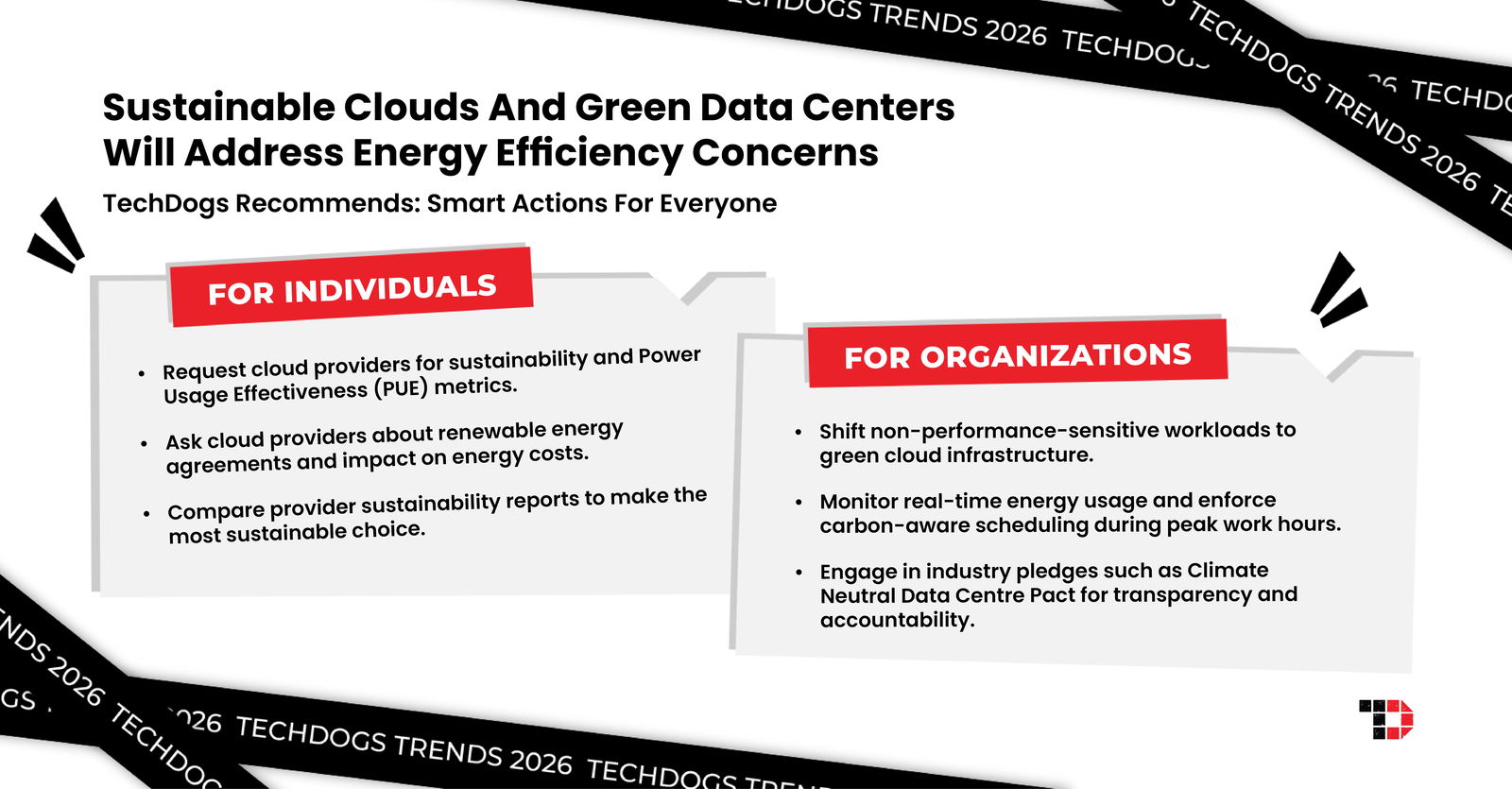
Together, these developments signal that sustainability is no longer just a reporting exercise for cloud-heavy organizations. Cloud providers now offer carbon-aware scheduling, real-time energy dashboards, and renewable energy matching. Organizations that do not embed energy efficiency into their cloud governance will face both cost and reputational exposure as reporting requirements tighten.
Challenges To Watch
Renewable energy infrastructure remains inconsistent, with grid access a significant barrier. Climate-specific cooling systems are expensive. Fragmented sustainability metrics make auditing performance difficult. Transitioning from legacy to sustainable data centers takes detailed planning and capital.
TechDogs Recommends: Smart Actions For Everyone
Conclusion
At the end of The Matrix, the system does not disappear. It gets reimagined. That is exactly what is happening to cloud computing in 2026.
AI-native cloud with RAG is making infrastructure intelligent. Micro data centers at the edge are distributing that intelligence where decisions are made. Serverless cloud architecture is removing the friction between environments. Confidential computing is making the cloud trustworthy for the most sensitive workloads. And green data centers are ensuring this expansion does not cost the planet.
Cloud providers and companies that invest in secure, sustainable, and intelligent infrastructure will not just outperform their peers. They will define what a modern digital business looks like.
The only question is: will you adapt to this shift, or be forced to catch up to it?
Frequently Asked Questions
What Are The Biggest Cloud Computing Trends To Watch In 2026?
The biggest cloud computing trends in 2026 include AI-native cloud platforms with Retrieval-Augmented Generation (RAG) and GenAI, micro data centers at the edge, serverless architectures for hybrid and multi-cloud orchestration, confidential computing for sensitive workloads, and sustainable cloud strategies with green data centers.
How Will AI-Native Cloud Platforms Impact Businesses In 2026?
AI-native cloud platforms embed generative AI and RAG directly into infrastructure, allowing faster, more accurate, and context-aware services. From real-time analytics to intelligent automation, companies adopting these platforms gain competitive advantages through reduced latency, improved productivity, and more personalized customer experiences. Cloud infrastructure spending surged 29% year-over-year in Q4 2025 and is on track to exceed $500 billion annually in 2026, according to CloudZero.
Why Is Sustainability Becoming A Key Focus In Cloud Computing?
Sustainability is now a priority as cloud infrastructure consumes massive amounts of energy, contributing significantly to global carbon emissions. In 2026, organizations and cloud providers are adopting green data centers powered by renewable energy, advanced cooling technologies, and AI-driven energy optimization. According to Precedence Research, the cloud sustainability market is growing at a 19.23% CAGR toward $175.82 billion by 2034. Businesses that embrace sustainable cloud practices reduce environmental footprint and lower long-term operational costs.
Thu, Oct 23, 2025

Enjoyed what you read? Great news – there’s a lot more to explore!
Dive into our content repository of the latest tech news, a diverse range of articles spanning introductory guides, product reviews, trends and more, along with engaging interviews, up-to-date AI blogs and hilarious tech memes!
Also explore our collection of branded insights via informative white papers, enlightening case studies, in-depth reports, educational videos and exciting events and webinars from leading global brands.
Head to the TechDogs homepage to Know Your World of technology today!
Disclaimer - Reference to any specific product, software or entity does not constitute an endorsement or recommendation by TechDogs nor should any data or content published be relied upon. The views expressed by TechDogs' members and guests are their own and their appearance on our site does not imply an endorsement of them or any entity they represent. Views and opinions expressed by TechDogs' Authors are those of the Authors and do not necessarily reflect the view of TechDogs or any of its officials. While we aim to provide valuable and helpful information, some content on TechDogs' site may not have been thoroughly reviewed for every detail or aspect. We encourage users to verify any information independently where necessary.
Loading comments...