
Enterprise Solutions
Business Process Management Trends Boosting Efficiency In 2026
Share
TL;DR
-
Agentic Process Orchestration: 81% of IT leaders in 2026 identify agentic orchestration as essential (Camunda). 79% plan to increase automation budgets by at least 20% over the next two years. 84% of organizations plan to increase AI adoption in automation strategies, but 85% struggle to scale AI effectively.
-
Low-Code and No-Code BPM: Low-code BPM achieved 86% enterprise adoption in 2025 (Mordor Intelligence). Gartner predicts 75% of large enterprises will use at least 4 low-code development tools for IT and citizen development. Platforms like Mendix, Appian, and Microsoft Power Platform are leading adoption.
-
Process Mining: Industries from banking to healthcare are integrating process mining with AI, RPA, and cloud technologies for real-time visibility.
-
Hyperautomation: Around 90% of large enterprises see hyperautomation as a key strategic priority.
-
Generative AI and ProcessGPT: McKinsey reports companies integrating Generative AI into BPM reduced operational costs by up to 20%. A Forrester study found AI-powered Process Intelligence identified bottlenecks 50% faster than traditional methods. Cornell University researchers demonstrate that ProcessGPT capabilities increase productivity, morale, and inclusion.
Introduction
In Formula 1, a pit stop takes two seconds. It works because every role is defined, every handoff is automatic, real-time telemetry tells the crew what to adjust before the driver even notices a problem, and the entire ecosystem, tire, fuel, aero, operates as one. In 2026, Business Process Management is building that same precision into the enterprise. Organizations are no longer following predefined workflows. They are adapting to change in real time, routing exceptions before they escalate, and deploying AI agents that make decisions without waiting to be asked.
The global Business Process Management (BPM) market reaches $18.68 billion in 2026, growing to $30.26 billion by 2031 (Mordor Intelligence), driven by the shift from task-based automation to intelligent process orchestration. Here are the five trends defining that shift.
Trend 1: Agentic Process Orchestration Will Transform Business Agility
For many years, process automation worked predictably: planned processes, specified rules, jobs executed as directed. This deterministic model brought order but didn't allow for change. In 2026, that static model is giving way to something far more dynamic: agentic process orchestration.
Unlike traditional automation bound by fixed rules, agentic orchestration uses AI-driven agents that learn, adapt, and make context-aware decisions. When a process hits an unexpected scenario, these agents analyze, decide, and act in real time, rerouting transactions, resolving exceptions, and suggesting next steps independently. The result is faster, smarter automation that combines machine precision with human-like judgment.
How Is The Industry Responding?
According to the Camunda 2026 Process Orchestration Report, 81% of IT leaders identify agentic orchestration as essential, and 79% plan to increase automation budgets by at least 20% over the next two years. Meanwhile, 84% of organizations plan to increase AI adoption in their automation strategies, but 85% still struggle to scale AI effectively, making agentic orchestration the missing framework for making AI operational, auditable, and enterprise-ready.
Payter, a leading payment terminal provider, applied agentic models to accelerate exception handling, reducing case resolution times by nearly 50%.
Chandar Pattabhiram, Chief Go-to-Market Officer at Workato Inc., said: "We define the formula that an agent equals AI plus orchestration. Think about how you make these agents for critical business processes, whether they order to cash or purchase to pay, not just some small agents on the side. Orchestration and agentic, the two layers can't be thought of as two different things. It's got to be thought of as one thing. It's one indivisible thing."
The shift is clear: with 81% of IT leaders identifying agentic orchestration as essential and adoption budgets rising by at least 20%, the gap between organizations that have moved from rule-based automation to adaptive agent-driven workflows and those still waiting is becoming a structural competitive divide.
Challenges To Watch
Trust, control, and governance are the biggest challenges with any AI-based technology. Autonomous agents can form new barriers or produce unexpected consequences without proper oversight. As more decisions shift from people to AI, keeping processes transparent, auditable, and secure is essential. Not every process should run on full autonomy; finding the right balance between rule-based control and agentic flexibility is critical.
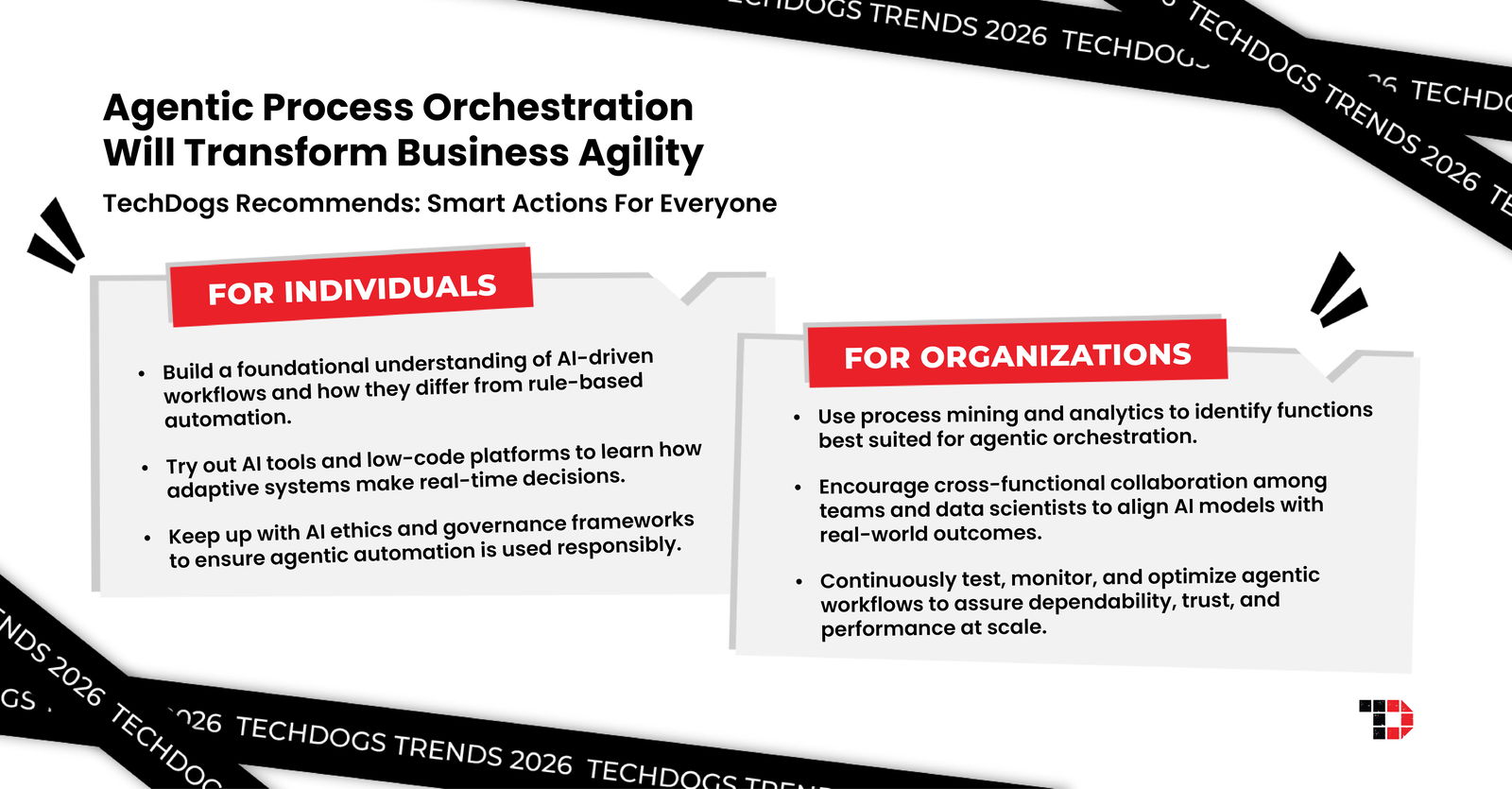
TechDogs Recommends: Smart Actions For Everyone
Trend 2: Low-Code And No-Code BPM Will Democratize Process Innovation
BPM platforms once required professional developers with extensive coding skills to set up, automate, and improve operations. Every change had to wait for IT. That dependency is rapidly disappearing in 2026. The rise of low-code and no-code BPM platforms is putting process innovation directly in the hands of business users, giving rise to a new generation of citizen developers.
These platforms use visual, drag-and-drop interfaces that allow users to design workflows, automate processes, and integrate systems without deep technical knowledge. Teams can now build and deploy process applications in weeks rather than months. Low-code BPM is emerging as the foundation of hyperautomation and composable enterprises, enabling organizations to adapt quickly, innovate faster, and scale securely.
How Is The Industry Responding?
Low-code BPM achieved 86% enterprise adoption in 2025 (Mordor Intelligence). Gartner predicts that 75% of large enterprises will be using at least four low-code development tools for both IT application development and citizen development initiatives. 87% of enterprise developers now rely on low-code platforms for areas such as CRM, marketing, sales, and HR.
Varsha Mehta, Senior Market Research Specialist at Gartner, said: "Organizations are increasingly turning to low-code development technologies to fulfill growing demands for speed of application delivery and highly customized automation workflows. Equipping both professional IT developers and non-IT personas, business technologists, with diverse low-code tools enables organizations to reach the level of digital competency and speed of delivery required for the modern agile environment."
What this means in practice: low-code BPM is not replacing professional development; it is redistributing it. When business users can build and iterate their own workflows, IT teams stop being the bottleneck and start being the architecture layer that governs, secures, and scales what citizen developers create.
Challenges To Watch
Many platforms remain complex to learn, costly to implement, and limited in flexibility or integration. Organizations face issues like handling unstructured processes, scalability constraints, and a lack of real-time insights. Shadow IT, security gaps, and inconsistent workflows can emerge quickly if IT and citizen developers don't collaborate within a clear governance framework.
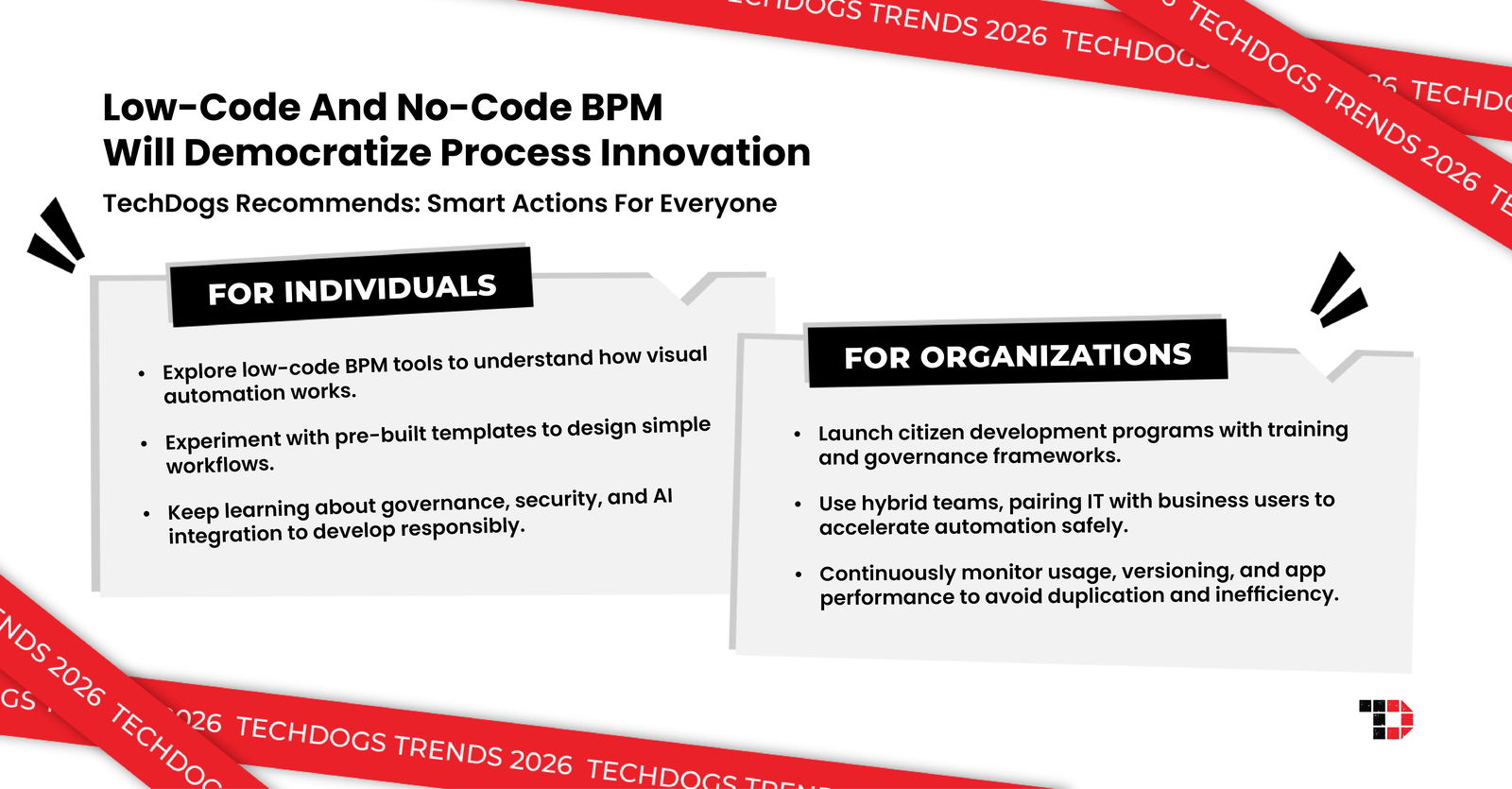
TechDogs Recommends: Smart Actions For Everyone
Trend 3: Process Mining Will Power Real-Time Process Intelligence
Businesses used interviews, predictions, and manual mapping to understand how their processes worked for decades. That approach is changing in 2026. With the rise of process mining and real-time process intelligence, organizations can now see how work actually gets done, not simply how it was designed to flow.
Process mining uses data from IT systems to reveal how workflows actually run, exposing inefficiencies and gaps in near real time. Combined with real-time process intelligence, it tracks performance, spots issues, and suggests improvements as they happen. The result is a proactive BPM model that identifies bottlenecks, compliance risks, and performance drops as they occur, enabling organizations to act instantly rather than retrospectively.
How Is The Industry Responding?
Verified Market Research estimates the process mining market will grow at a 44.3% CAGR from 2026 to 2032, driven by organizations' push for data-driven optimization and real-time insights. Industries from banking to healthcare are integrating process mining with AI, robotic process automation (RPA), and cloud technologies to achieve greater visibility, agility, and faster decision-making.
Alex Rinke, Co-founder and Co-CEO of Celonis, stated: "With Process Intelligence, processes don't just run, they work for you. It's the layer that knows how your business flows, how processes interact and impact each other across every department, every system."
The reality is this: process mining closes the gap between process design and process reality. Most organizations discover that the way work actually flows differs significantly from the documented model. In 2026, that gap is no longer invisible, and closing it is where the largest efficiency gains lie.
Challenges To Watch
Poor data quality and integration issues can lead to inaccurate results, while large-scale analysis demands significant computing resources. Data privacy laws also limit how event data can be used. A lack of skilled users and organizational resistance to change often slow adoption.
Topics For More Insights
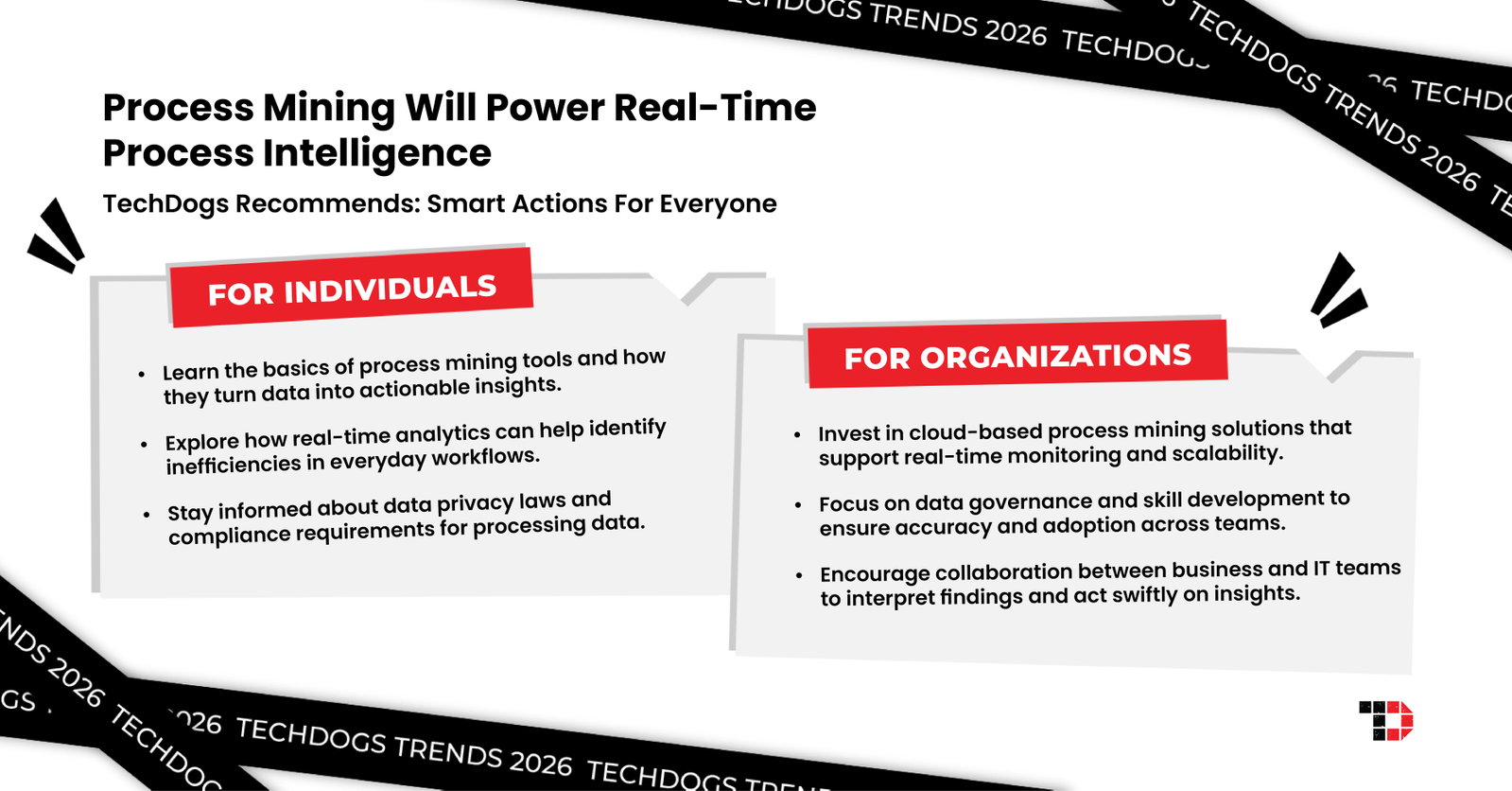
TechDogs Recommends: Smart Actions For Everyone
Trend 4: Hyperautomation Will Transform Enterprise Operations
Until 2025, automation primarily meant handling repetitive, rule-based tasks. Businesses used tools like RPA and Optical Character Recognition (OCR) to reduce manual effort. While this delivered short-term gains, it often operated in silos, automating tasks without connecting them across departments or systems.
Hyperautomation changes that. This unified, intelligent ecosystem combines RPA, AI, and Machine Learning (ML), Natural Language Processing (NLP), OCR, and Biometrics into a single, integrated automation stack. By connecting data, systems, and decisions, it creates a digital workforce that improves speed, accuracy, and scalability, making Hyperautomation a core pillar of modern BPM.
How Is The Industry Responding?
The hyperautomation market reaches $68.2 billion in 2026, growing to approximately $278 billion by 2035 (Mordor Intelligence/multiple analysts). Gartner notes that the broader software market enabling hyperautomation will reach $1.04 trillion by 2032. Around 90% of large enterprises now see hyperautomation as a key strategic priority.
At Coca-Cola's Singapore plant, combining predictive scheduling with computer-vision quality control increased throughput by 28% and productivity by 70%.
Frances Karamouzis, Distinguished VP Analyst at Gartner, said: "Hyperautomation involves the use of multiple technologies and tools, including AI, machine learning, event-driven software architecture, and robotic process automation, among others. Hyperautomation initiatives are often an integral part of a larger technology roadmap that includes systems of record on one end of the spectrum, and AI and GenAI on the other."
The advantage is shifting to enterprises that treat hyperautomation as a unified ecosystem rather than a collection of tools. Organizations that have moved from fragmented automation pilots to integrated orchestration platforms are already reporting 20-40% cost reductions and 40% faster process execution.
Challenges To Watch
High initial investment costs can limit adoption, especially among SMEs. Integrating different automation technologies with legacy systems adds complexity. Many organizations also face change management challenges as employees worry about job displacement. Without clear governance and training, these problems reduce ROI.
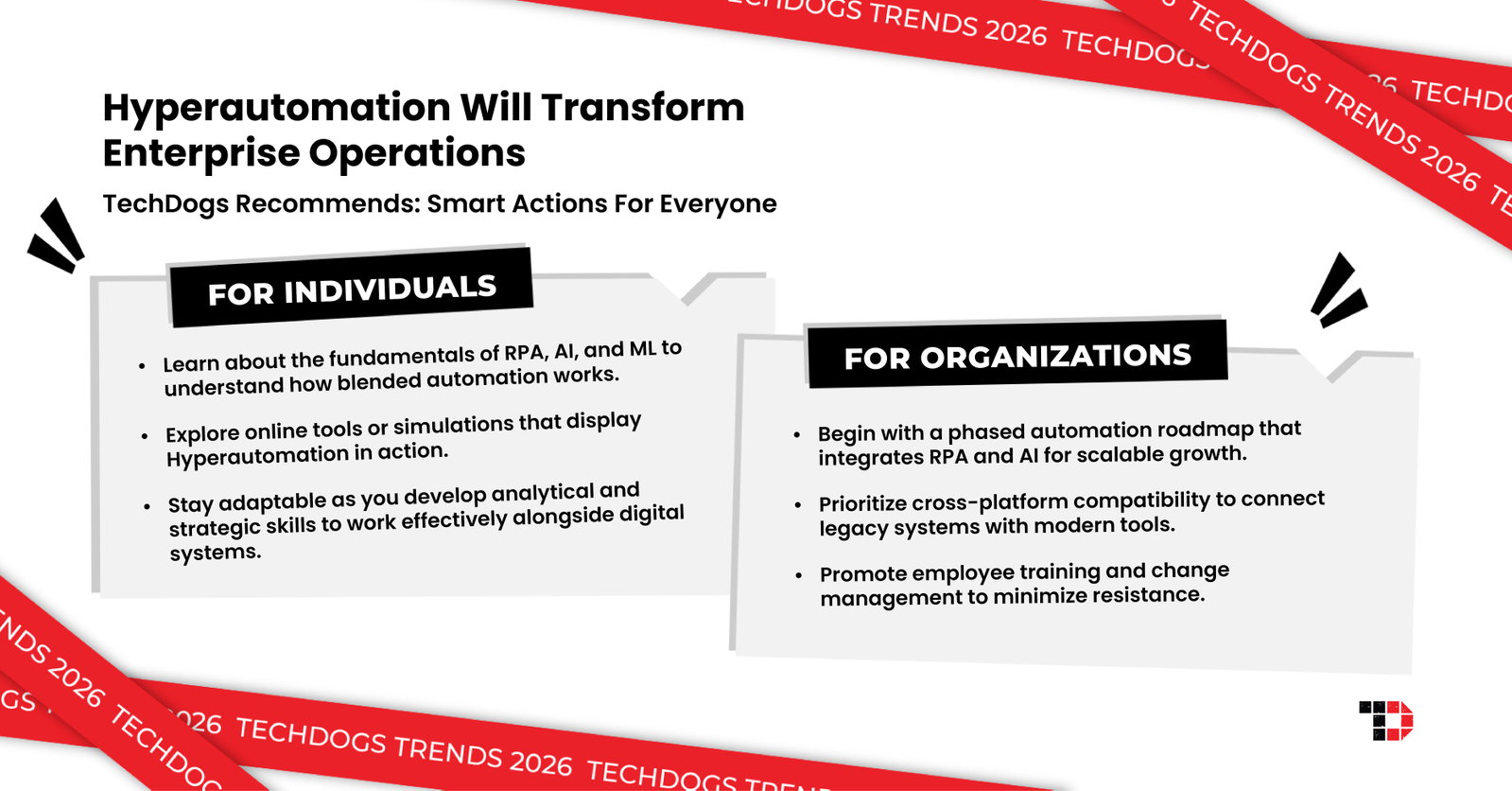
TechDogs Recommends: Smart Actions For Everyone
Trend 5: Generative AI And ProcessGPT Will Transform Process Intelligence
Automation in BPM has largely been task-based: systems run, track, and improve predefined workflows, but often lack the intelligence to design or adjust them. Generative AI is changing that. Models like GPT demonstrate that machines can produce human-like text, recognize patterns, and make context-aware predictions. This has led to emerging experiments with ProcessGPT, an approach where AI learns from business process data to design workflows, suggest improvements, and support real-time decision-making.
In 2026, these models have advanced from prototypes to intelligent co-pilots within BPM systems. ProcessGPT-style modeling enables organizations to train AI on large sets of process data so it can dynamically generate new process models. Combined with NLP and ML, Generative AI can now suggest process changes, automate decisions, and predict inefficiencies before they appear.
How Is The Industry Responding?
According to McKinsey research, companies that integrated Generative AI into their BPM practices reduced operational costs by up to 20%. A Forrester study found that organizations using AI-powered Process Intelligence identified process bottlenecks 50% faster than those relying on traditional methods.
Researchers from Cornell University highlighted the impact of ProcessGPT: "ProcessGPT provides a blueprint for designing efficient business processes that take into account human cognitive limitations. We also demonstrate that organizations implementing ProcessGPT-like capabilities will realize increased productivity, morale, and inclusion."
The takeaway for BPM leaders: Generative AI doesn't just automate the process; it understands it. When AI can read process logs, identify friction points, and suggest redesigns in natural language, the speed of process improvement goes from quarterly review cycles to continuous iteration. That compression is where the competitive advantage lives in 2026.
Challenges To Watch
Biased or low-quality training data can lead to unreliable outputs, and integrating AI with legacy BPM systems often proves complex. Privacy and regulatory hurdles remain significant, particularly for regulated industries. A lack of user training and change management can also create resistance to AI-driven process recommendations.
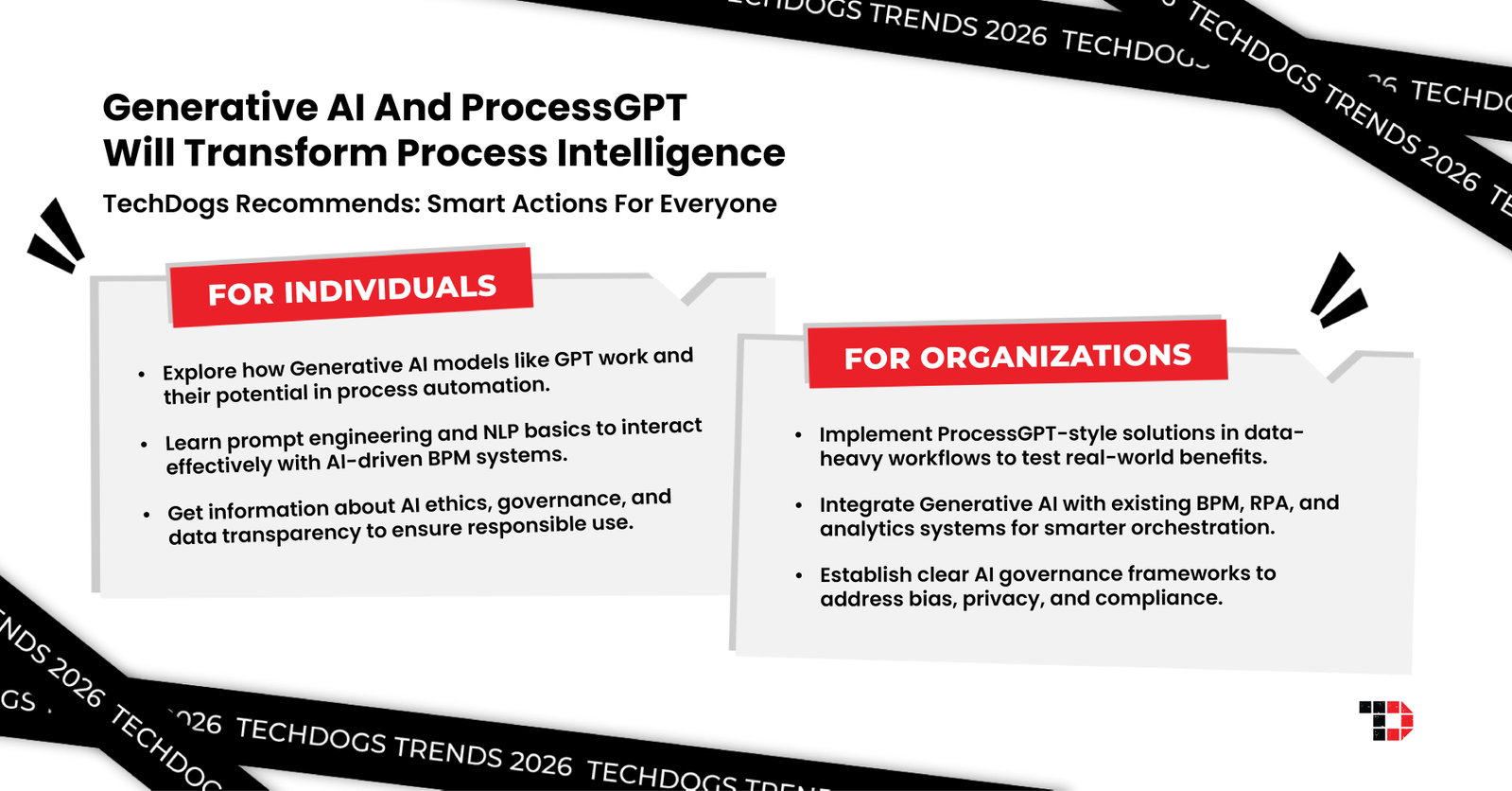
TechDogs Recommends: Smart Actions For Everyone
Conclusion
The pit stop is ready. Every role is defined, every handoff is automatic, and real-time telemetry is already telling the crew what to adjust. The only question is whether your processes are built to move at that speed.
From Agentic Process Orchestration and Low-Code BPM to Process Mining, Hyperautomation, and Generative AI with ProcessGPT-style modeling, the trends shaping BPM in 2026 mark a shift toward systems that think, learn, and act with precision. BPM is no longer a management discipline; it is the operating intelligence of the enterprise.
The organizations that will lead are the ones already investing in the infrastructure, governance, and talent to make this level of orchestration real. The race is already on.
Frequently Asked Questions
What Is Business Process Management (BPM) In 2026?
BPM in 2026 focuses on intelligent, adaptive systems that combine AI, automation, and data analytics to streamline workflows, enhance agility, and enable continuous improvement across organizations. With the global BPM market reaching $18.68 billion in 2026 and growing to $30.26 billion by 2031 (Mordor Intelligence), the investment case for modern process intelligence has moved from experimental to essential.
What Are The Top Business Process Management (BPM) Trends In 2026?
Key BPM trends in 2026 include Agentic Process Orchestration, Low-Code/No-Code BPM, Process Mining with Real-Time Intelligence, Hyperautomation, and Generative AI with ProcessGPT-Style Modeling. Together, these trends represent a complete shift from deterministic, rule-bound automation to adaptive, intelligent orchestration where AI agents, citizen developers, and process intelligence work in concert.
Why Is Low-Code/No-Code Important For Business Process Management (BPM)?
Low-code/no-code platforms empower non-technical users to build and automate workflows, accelerating innovation, reducing IT dependency, and improving operational efficiency. With 86% enterprise adoption in 2025 (Mordor Intelligence) and Gartner predicting 75% of large enterprises will use at least four low-code tools, these platforms are no longer optional for organizations that want to move at the speed the market demands.
Wed, Nov 26, 2025

Enjoyed what you've read so far? Great news - there's more to explore!
Stay up to date with the latest news, a vast collection of tech articles including introductory guides, product reviews, trends and more, thought-provoking interviews, hottest AI blogs and entertaining tech memes.
Plus, get access to branded insights such as informative white papers, intriguing case studies, in-depth reports, enlightening videos and exciting events and webinars from industry-leading global brands.
Dive into TechDogs' treasure trove today and Know Your World of technology!
Disclaimer - Reference to any specific product, software or entity does not constitute an endorsement or recommendation by TechDogs nor should any data or content published be relied upon. The views expressed by TechDogs' members and guests are their own and their appearance on our site does not imply an endorsement of them or any entity they represent. Views and opinions expressed by TechDogs' Authors are those of the Authors and do not necessarily reflect the view of TechDogs or any of its officials. While we aim to provide valuable and helpful information, some content on TechDogs' site may not have been thoroughly reviewed for every detail or aspect. We encourage users to verify any information independently where necessary.
Loading comments...