
Business Intelligence
Business Intelligence Trends Powering Smarter Decisions In 2026
Share
TL;DR
-
Agentic AI: Gartner projects 40% of enterprise applications will include task-specific AI agents by the end of 2026, up from less than 5% in 2025. Around one in three enterprise software systems will use agentic AI by 2028.
-
Conversational Intelligence and NLP: Microsoft, Google, IBM, Amazon, Oracle, and SAP are leading this space with their own AI assistants and NLP platforms.
-
Augmented Analytics: Tableau, IBM, Microsoft, SAP, Salesforce, Oracle, and SAS are actively expanding their augmented analytics portfolios.
-
Real-Time Edge Analytics: Databricks, AWS, Cisco, IBM, Intel, HPE, Dell, SAP, and Oracle are leading edge analytics innovations.
-
Responsible AI and Governance: With nearly 80% of enterprises expected to adopt AI by 2026 (Apptad), integrating AI governance into existing data frameworks has moved from optional to essential. Gartner also predicts that more than 80% of enterprises will have deployed GenAI-enabled applications by 2026.
Introduction
In Moneyball, Billy Beane didn't wait for scouts to deliver verdicts after weeks of observation. He used data to act before the traditional process even started, finding signals others missed, deciding faster than anyone thought possible, and building a team that outperformed its budget. In 2026, Business Intelligence is having its Moneyball moment. Organizations are no longer waiting for end-of-month reports to understand what happened. They are using AI-driven analytics to sense change as it happens, act before problems escalate, and make decisions with a precision that intuition alone can never match.
For years, BI acted like a rearview mirror: useful, but only for looking back. In 2026, that mirror is turning into a windshield. Today's BI is no longer limited to static dashboards and retrospective reports; it's becoming a real-time guide, alerting teams to potential risks, forecasting outcomes, and even suggesting the best course of action.
Here are the five BI trends defining 2026.
Trend 1: Agentic AI Will Revolutionize Data-Driven Decisions
Until recently, AI in BI mainly acted as a supporting layer, automating dashboards, organizing data, and providing predictions based on what humans asked. Now things are changing. New AI tools have become proactive partners that can analyze data independently, find patterns, and suggest actions without waiting to be asked.
Agentic AI has become the key force transforming BI from a reporting tool into an autonomous decision-making system. These agents don't wait for instructions; they explore data, detect issues, suggest improvements, and sometimes carry them out automatically. From adjusting supply chains in real time to analyzing markets on the go, Agentic AI connects different data sources to deliver continuous insights.
How Is The Industry Responding?
Global AI spending is expected to exceed $300 billion by 2026 (IDC). Gartner projects that 40% of enterprise applications will include task-specific AI agents by the end of 2026, up from less than 5% in 2025. Around one in three enterprise software systems will use agentic AI by 2028, up from almost none in 2024.
Satya Nadella, CEO of Microsoft, highlighted the importance of Agentic AI: "AI agents will become the primary way we interact with computers in the future. They will be able to understand our needs and preferences and proactively help us with tasks and decision making."
The shift is clear: with 40% of enterprise applications expected to integrate AI agents by the end of 2026, the gap between organizations that have automated their analytics workflows and those still waiting for weekly reports is widening into a structural competitive divide.
Challenges To Watch
Ensuring governance and trust is vital as AI makes independent decisions. Integration with legacy systems can be difficult, and a lack of ethical oversight may cause bias. Data security risks also increase as autonomous agents access multiple sources, demanding strong accountability frameworks.
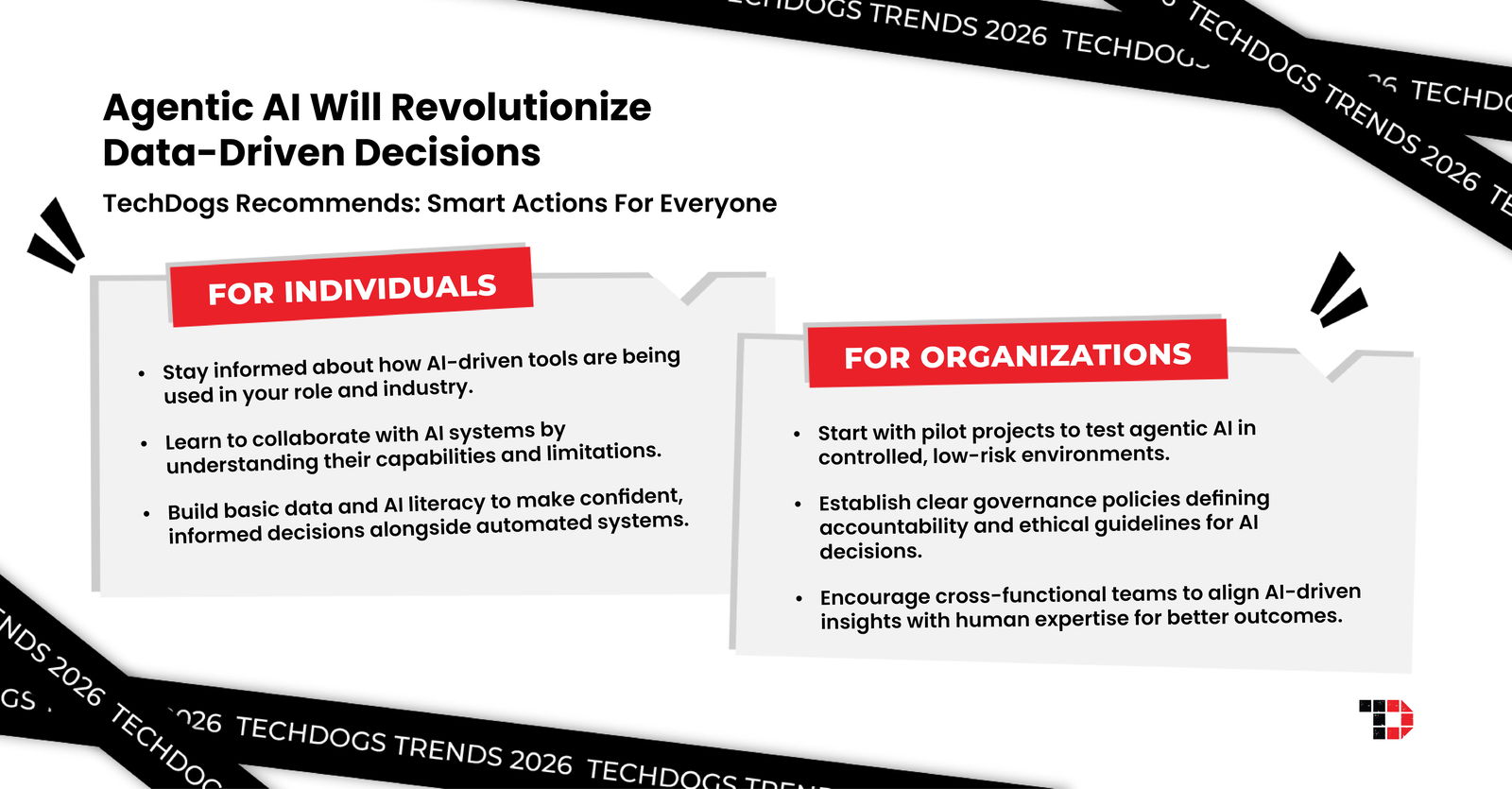
TechDogs Recommends: Smart Actions For Everyone
Trend 2: Conversational Intelligence And NLP Will Transform Business Insights
Data-driven decision-making has traditionally required a technical bridge, analysts, coders, or data scientists who could translate business questions into complex queries. In 2026, that gap is rapidly closing. Conversational and natural language BI are making analytics accessible to everyone, not just specialists.
Instead of relying on static dashboards, decision-makers can now engage in dialogue with their data, revealing patterns, sentiment, and intent from natural language sources such as emails, chat transcripts, customer feedback, and call recordings. BI tools are evolving into conversational partners that translate unstructured language into actionable intelligence.
How Is The Industry Responding?
The conversational AI software market was worth about $235 million in 2024 and is expected to grow to nearly $590 million by 2031. Big tech companies like Microsoft, Google, IBM, Amazon, Oracle, and SAP are leading this space with their own AI assistants and chatbot platforms.
Andrew Bolster, Senior Manager of Research and Development at Black Duck, emphasized this shift: "AI did change the world for cybersecurity, as it did for everyone else; it made it easier to bridge the interface between Natural Language and Machines and made it easier for subject matter experts to collate, assess, and act on their data and their context, and above all, to scale expertise in ways that wouldn't have been possible just a few years ago."
What this means in practice: organizations that deploy conversational BI are removing the bottleneck between data and the people who need to act on it. When a supply chain manager can ask 'Why did our fulfillment costs spike last week?' and receive an answer in seconds rather than submitting a ticket to the data team, the speed of the whole organization improves.
Challenges To Watch
Language nuances like tone or sarcasm can confuse algorithms, and poor query phrasing may distort results. Integrating NLP with legacy systems and maintaining privacy across voice or chat data remains difficult, demanding strong governance, transparency, and ethical oversight.
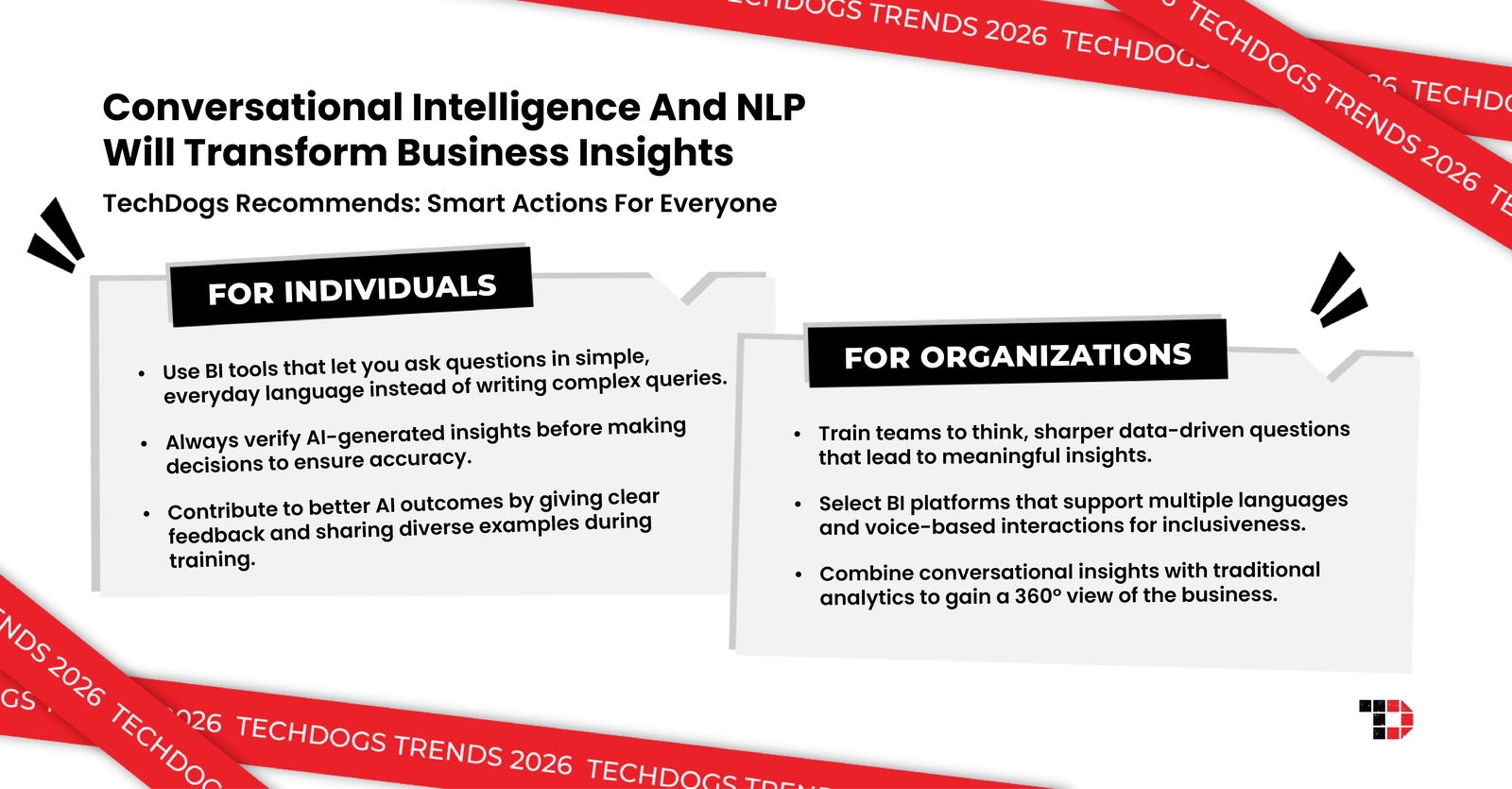
TechDogs Recommends: Smart Actions For Everyone
Trend 3: Augmented Analytics Will Simplify Business Intelligence
Traditionally, analysts spent significant time preparing data, running models, and interpreting results, which slowed business response times. The next evolution of BI in 2026 lies in augmented analytics, a fusion of NLP, machine learning (ML), and automation that enhances how organizations collect, analyze, and share data.
With augmented analytics, data preparation, insight generation, and visualization are becoming intelligent and automated. Small and medium-sized enterprises are becoming major adopters, using augmented analytics to automate repetitive tasks and make data-driven decisions with minimal effort, across telecom, BFSI, healthcare, and retail.
How Is The Industry Responding?
The global augmented analytics market was valued at over $2.1 billion and is forecast to grow at a CAGR of over 39% by 2026, driven by increasing adoption of advanced analytics tools. Major companies like Tableau, IBM, Microsoft, SAP, Salesforce, Oracle, and SAS are partnering with start-ups and mid-sized firms to expand their augmented analytics portfolios.
Bidish Sarkar, Digital CxO, put it plainly: "Augmented analytics is more than a technological shift. When done right, it doesn't just democratize data, it turns it into a shared, strategic asset that empowers every decision-maker across the enterprise."
The reality is this: the organizations gaining the most from augmented analytics are the ones that have stopped thinking of it as a BI feature and started treating it as operational infrastructure. When insight generation is automated, analysts shift their focus from building reports to acting on them.
Challenges To Watch
Augmented analytics faces challenges, including dependence on high-quality data, risks of over-automation, and skill gaps in interpreting AI-generated insights. Hidden algorithmic bias and lack of transparency can also distort results, making it difficult for organizations to fully trust automated analytics systems.
Topics For More Insights
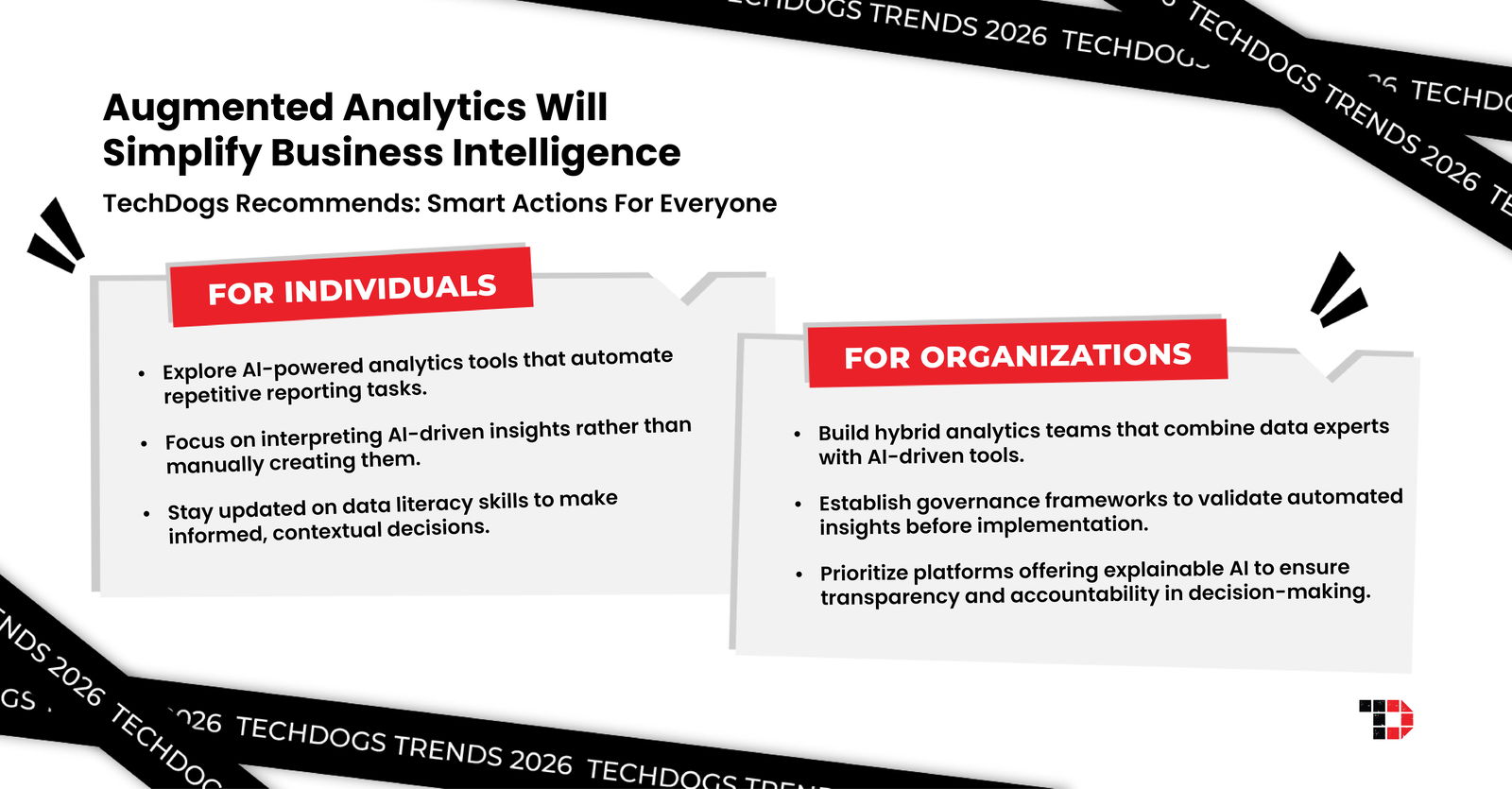
TechDogs Recommends: Smart Actions For Everyone
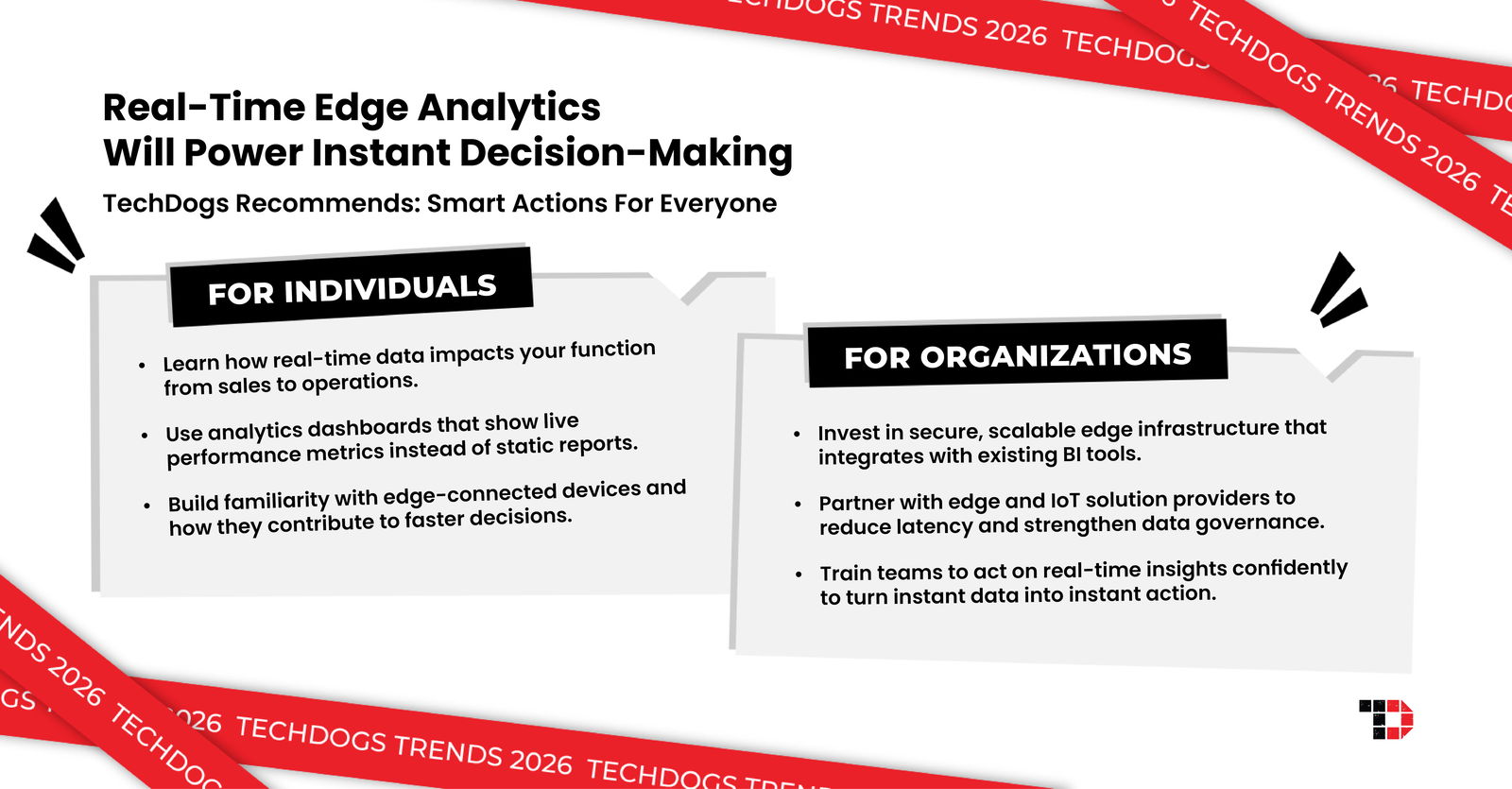
Trend 4: Real-Time Edge Analytics Will Power Instant Decision-Making
By 2025, businesses had reached a breaking point with centralized analytics; valuable insights often arrived too late, held up by the back-and-forth of data with the cloud. In 2026, real-time edge analytics is changing that: data is processed the moment it is created, at the source, cutting latency and enabling decisions before the moment passes.
Sectors like manufacturing and healthcare are leading the way, where even a split second can change outcomes. Machines can find problems before they occur, and connected devices notify doctors immediately when a patient's status changes. Edge analytics is helping businesses move from static reports to insights based on events happening right now.
How Is The Industry Responding?
Grand View Research reports that the global edge analytics market was worth $9.78 billion in 2024 and is expected to rise to $40.71 billion by 2030. Companies like AWS, Cisco, IBM, Intel, HPE, Dell, SAP, Oracle, and Databricks are helping edge analytics grow through innovation and collaboration.
Antonio Neri, President and CEO of HPE, said: "The next evolution in enterprise technology will be in edge-to-cloud architecture. Enterprises will require millions of distributed clouds that enable real-time insights and personalized experiences exactly where the action is happening."
The advantage is shifting to organizations that process data at the edge rather than waiting for centralized processing cycles. With the market growing from $9.78 billion to $40.71 billion by 2030, the infrastructure investments made today will determine which organizations can act in seconds and which are still waiting for the morning report.
Challenges To Watch
Huge amounts of continuous data can overwhelm systems, while network delays affect real-time accuracy. Processing sensitive data at multiple points increases security risks. Integrating edge data with enterprise systems is complex, and there is a growing shortage of skilled professionals to manage distributed, real-time information.
TechDogs Recommends: Smart Actions for Everyone
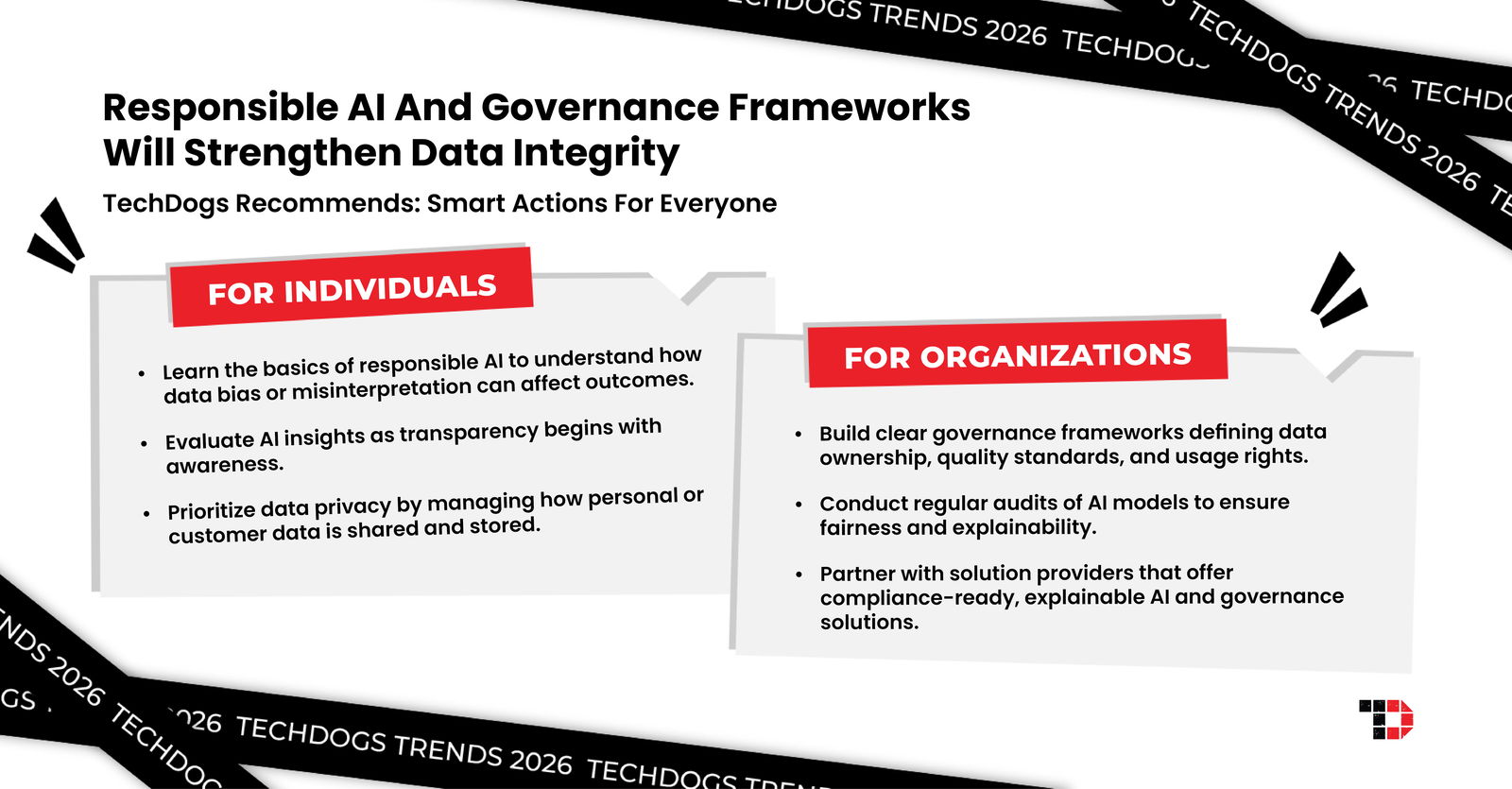
Trend 5: Responsible AI And Governance Frameworks Will Strengthen Data Integrity
As organizations embed AI deeper into analytics, the primary focus has shifted from what AI can do to how responsibly it can do it. BI leaders recognize that the real value of AI lies not just in automation but in trust. Reliable insights depend on clean data, clear governance, and ethical oversight. In 2026, responsible AI has evolved from a compliance requirement into a business imperative.
The development of AI in the public sector, often called GovAI, is changing how services and resources are distributed. Governments' spending billions on these systems need strong rules to prevent bias and ensure equitable outcomes. For business leaders, the lesson is the same: trust is the foundation that makes AI-driven BI worth acting on.
How Is The Industry Responding?
With nearly 80% of enterprises expected to adopt AI by 2026 (Apptad), many are integrating AI governance into their existing data governance frameworks. Gartner separately predicts that more than 80% of enterprises will have used generative AI APIs or deployed GenAI-enabled applications by 2026. Organizations that have already introduced automated governance systems are seeing fewer access risks, quicker compliance checks, and stronger data quality overall.
Jorge Amar, McKinsey Senior Partner, shared: "Companies need a real commitment to building AI trust and governance capabilities. These are the principles, policies, processes, and platforms that assure companies are not just compliant with fast-evolving regulations, but also able to keep the kinds of commitments that they make to customers and employees in terms of fairness and lack of bias."
The takeaway for BI leaders: governance is not a constraint on AI adoption; it is the condition that makes adoption sustainable. The organizations building trust frameworks now are the ones that will scale AI-driven BI with confidence when regulations tighten and auditors ask questions.
Challenges To Watch
Data silos make it hard to get a complete, consistent view of information. Fast-changing technology means teams must keep updating their governance practices. New AI-related risks, from inaccurate or biased outputs to intellectual property concerns, are emerging. If not managed carefully, these issues can damage trust, harm reputations, and weaken data governance foundations.
TechDogs Recommends: Smart Actions for Everyone
Conclusion
Billy Beane didn't just use data; he trusted it enough to act on it before everyone else was ready to. That is the posture BI demands in 2026.
From agentic AI and conversational insights to augmented analytics, edge processing, and responsible governance, BI is evolving into a proactive force that connects intelligence with integrity. What once served as a rearview mirror has turned into a windshield, helping organizations see what is coming next.
The organizations that will define the next era of business intelligence are the ones already building the instincts that Billy Beane proved work: data-driven, fast, and disciplined.
Frequently Asked Questions
What Are The Top Business Intelligence Trends In 2026?
In 2026, the key BI trends include Agentic AI, Conversational Intelligence, Augmented Analytics, Real-Time Edge Analytics, and Responsible AI Governance. With global AI spending exceeding $300 billion by 2026 (IDC) and 40% of enterprise applications expected to include AI agents by year-end (Gartner), these trends represent a fundamental shift from retrospective reporting to proactive, autonomous decision intelligence.
Why Is Conversational Intelligence Important For Businesses In 2026?
Conversational BI allows users to interact with data using natural language, making insights more accessible, faster to interpret, and easier to act on across all roles. As the conversational AI market grows from $235 million in 2024 toward $590 million by 2031, organizations that eliminate the technical barrier between business users and their data will make decisions faster than competitors still routing requests through analyst queues.
How Does Real-Time Edge Analytics Benefit Organizations?
Real-time edge analytics processes data instantly at its source, reducing latency, improving responsiveness, and enabling quicker, more accurate business decisions. With the global edge analytics market growing from $9.78 billion in 2024 to $40.71 billion by 2030 (Grand View Research), the move from centralized batch processing to distributed real-time intelligence is one of the highest-ROI infrastructure investments a data-led organization can make in 2026.
Wed, Nov 26, 2025

Enjoyed what you've read so far? Great news - there's more to explore!
Stay up to date with the latest news, a vast collection of tech articles including introductory guides, product reviews, trends and more, thought-provoking interviews, hottest AI blogs and entertaining tech memes.
Plus, get access to branded insights such as informative white papers, intriguing case studies, in-depth reports, enlightening videos and exciting events and webinars from industry-leading global brands.
Dive into TechDogs' treasure trove today and Know Your World of technology!
Disclaimer - Reference to any specific product, software or entity does not constitute an endorsement or recommendation by TechDogs nor should any data or content published be relied upon. The views expressed by TechDogs' members and guests are their own and their appearance on our site does not imply an endorsement of them or any entity they represent. Views and opinions expressed by TechDogs' Authors are those of the Authors and do not necessarily reflect the view of TechDogs or any of its officials. While we aim to provide valuable and helpful information, some content on TechDogs' site may not have been thoroughly reviewed for every detail or aspect. We encourage users to verify any information independently where necessary.
Loading comments...