 Featured
Data Management
Big Data Trends Shaping Analytics And AI In 2026
Share
TL;DR
-
Generative AI with RAG - Retrieval-Augmented Generation grounds AI analytics in verified enterprise data, reducing hallucinations and delivering context-aware insights.
-
Unified Data Fabrics - Composable data fabric architecture integrates scattered on-prem, cloud, and edge data sources into a single, governable layer.
-
Edge Analytics - Processing data close to its source cuts latency, enables real-time decisions, and handles the exabyte-scale output of IoT and 5G devices.
-
Ethical Data Practices - Explainability, privacy compliance, and bias detection are moving from legal obligations to competitive differentiators.
-
Sustainable Data Infrastructure - Energy-efficient servers, liquid cooling, and carbon-aware workload scheduling are making big data greener without sacrificing performance.
Introduction
Sherlock Holmes never had more information than anyone else in Victorian London. He had the same clues. What made him exceptional was his ability to connect fragmented evidence into a conclusion that others missed entirely. Big data in 2026 works the same way. The bottleneck is never the volume. It is always the intelligence applied to it.
According to IDC, global spending on big data and analytics will reach $420 billion in 2026. Around 221 zettabytes of data will be generated globally this year, according to Statista and DemandSage. As the big data analytics market in 2026 continues to expand, organizations are not drowning in data but in data they cannot yet interpret.
Big data trends in 2026 are not about collecting more. They are about making sense faster, more responsibly, and more sustainably. Five trends define this shift: generative AI with RAG, unified data fabrics, edge analytics, ethical data practices, and sustainable infrastructure. Here is what each means and why it matters now.
Trend 1: Generative AI And Retrieval-Augmented Generation (RAG) Will Power Data Analytics
GenAI in 2023 was a demo. GenAI in 2026 is a data pipeline. That shift is being driven by Retrieval-Augmented Generation (RAG), a technique that gives AI models access to a verified enterprise knowledge base before generating any output. Instead of relying on what a model learned during training, RAG pulls live, structured context from internal documents, databases, and APIs in real time. In 2026, this capability is being embedded directly into enterprise analytics platforms, not bolted on afterward.
The result is generative AI data analytics that is grounded, auditable, and context-aware.
How Is The Industry Responding?
Microsoft Copilot leverages RAG to pull information from SharePoint and Teams, enabling its 320 million monthly active users to glean data-driven insights without sifting through different files. Databricks offers an end-to-end platform for RAG development, encouraging enterprises to combine generative AI with their own data layers for more reliable query responses.
Gartner predicts 40% of enterprise applications will feature task-specific AI agents by 2026, up from less than 5% in 2025, driving RAG-enhanced workflows into mainstream data operations. According to Google Cloud's 2025 GenAI ROI Report, 52% of enterprises using GenAI now run AI agents in production, with 88% reporting positive ROI. The RAG market itself is projected to grow from $1.2 billion in 2024 to $11 billion by 2030 at a 49.1% CAGR, per Grand View Research.
"RAG allows AI models to answer queries by drawing on external texts, be it company documents or a news website," said Patrick Lewis, Director of Machine Learning at Cohere. "It can also reduce hallucinations and even give models access to up-to-the-minute information."
Taken together, these developments point to a clear shift: organizations still running generic large language models against unverified data are training on noise. RAG is the architecture that turns enterprise knowledge into a competitive asset rather than a liability.
Challenges To Watch
Over-reliance on generative AI without proper human oversight remains a real risk. Integrating RAG into GenAI pipelines using legacy architectures is expensive and creates security vulnerabilities that organizations must address before scaling.
TechDogs Recommends: Smart Actions For Everyone
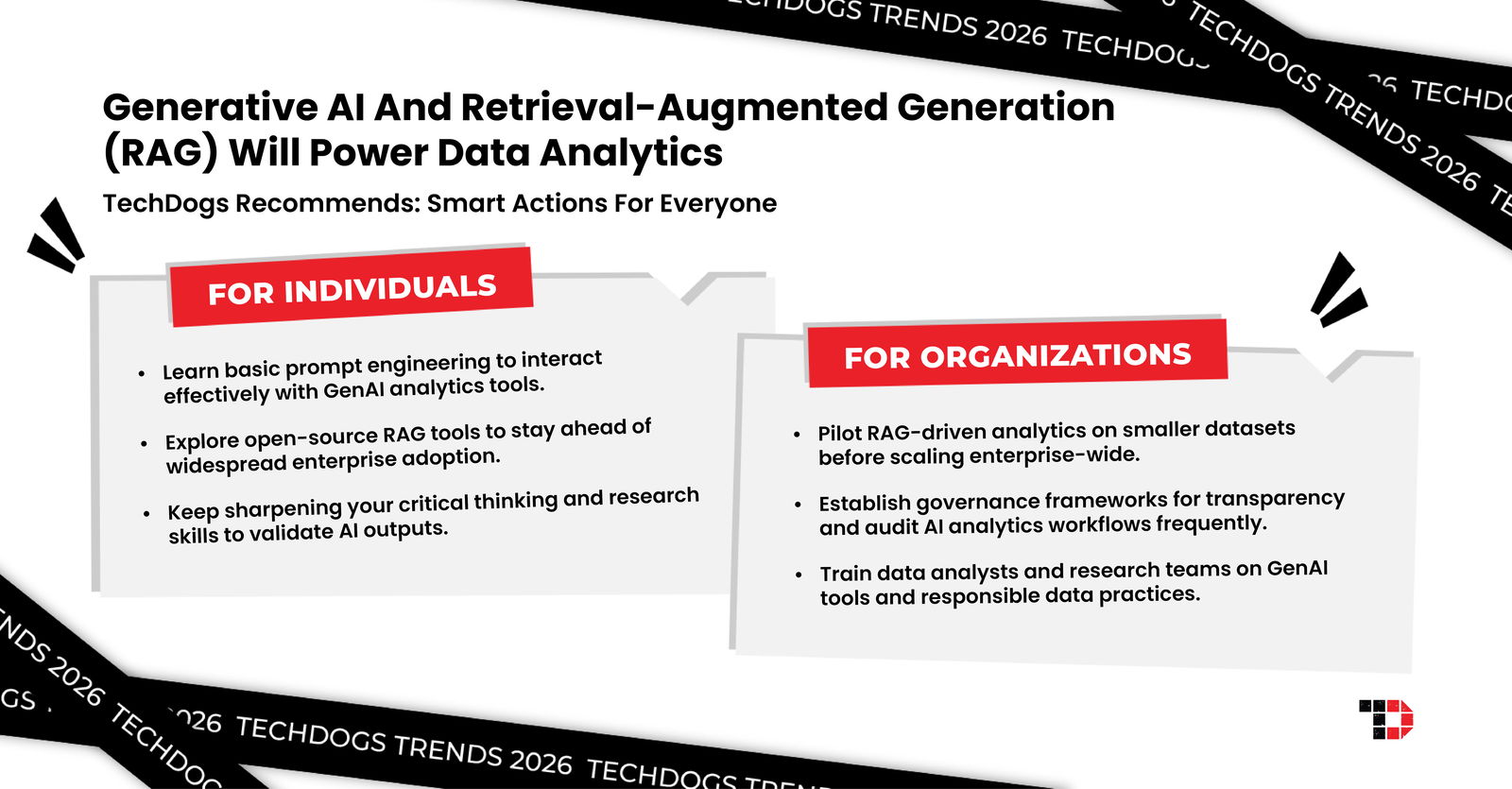
Trend 2: Unified And Composable Data Fabrics Will Be The Need Of The Hour
Think of how Sherlock Holmes connected evidence scattered across crime scenes, witness testimony, and newspaper archives into a single coherent case. Data fabric architecture does exactly that for enterprise data.
Data fabric is a unified, composable data architecture that integrates disparate data sources, whether on-premises, in the cloud, or at the edge, into a single, continuously governed layer. Unlike data mesh, which decentralizes ownership, data fabric provides interoperability without surrendering governance. In 2026, enterprises prioritizing data agility are adopting it as the architectural backbone for AI-ready operations.
How Is the Industry Responding?
Fortune Business Insights projects the global data fabric market will grow from $4.11 billion in 2026 to $16.46 billion by 2034 at a 19.04% CAGR. More than 61% of large enterprises have initiated data fabric implementation to unify structured and unstructured data sources, per Global Growth Insights.
IBM's Global Chief Data Office generated $1.3 billion in business benefits and a 10x ROI from data and AI-based transformation initiatives over three years, demonstrating what a governed, fabric-based approach delivers at enterprise scale.
An aerospace organization tracked by Appian used a data fabric to manage its spacesuit development lifecycle, accelerating decision-making and improving process transparency across engineering teams.
"Mashing up your data with data from other sources can lead to valuable insights," said Monica Rogati, Data Science Advisor and Former VP of Data at Jawbone. "This might give you a few great ideas about what experiments to run next, or even influence your growth strategy."
Together, these developments highlight a clear shift: organizations still operating siloed data environments are not just inefficient—they are building AI models on incomplete pictures. Data fabric is the connective tissue that makes enterprise AI trustworthy at scale.
Challenges To Watch
Migrating legacy systems onto modern data fabrics is highly complex and resource intensive. Many organizations also face the risk of vendor lock-in when relying on proprietary fabrics. Balancing strict governance requirements with real-time accessibility remains a difficult operational trade-off.
TechDogs Recommends: Smart Actions For Everyone
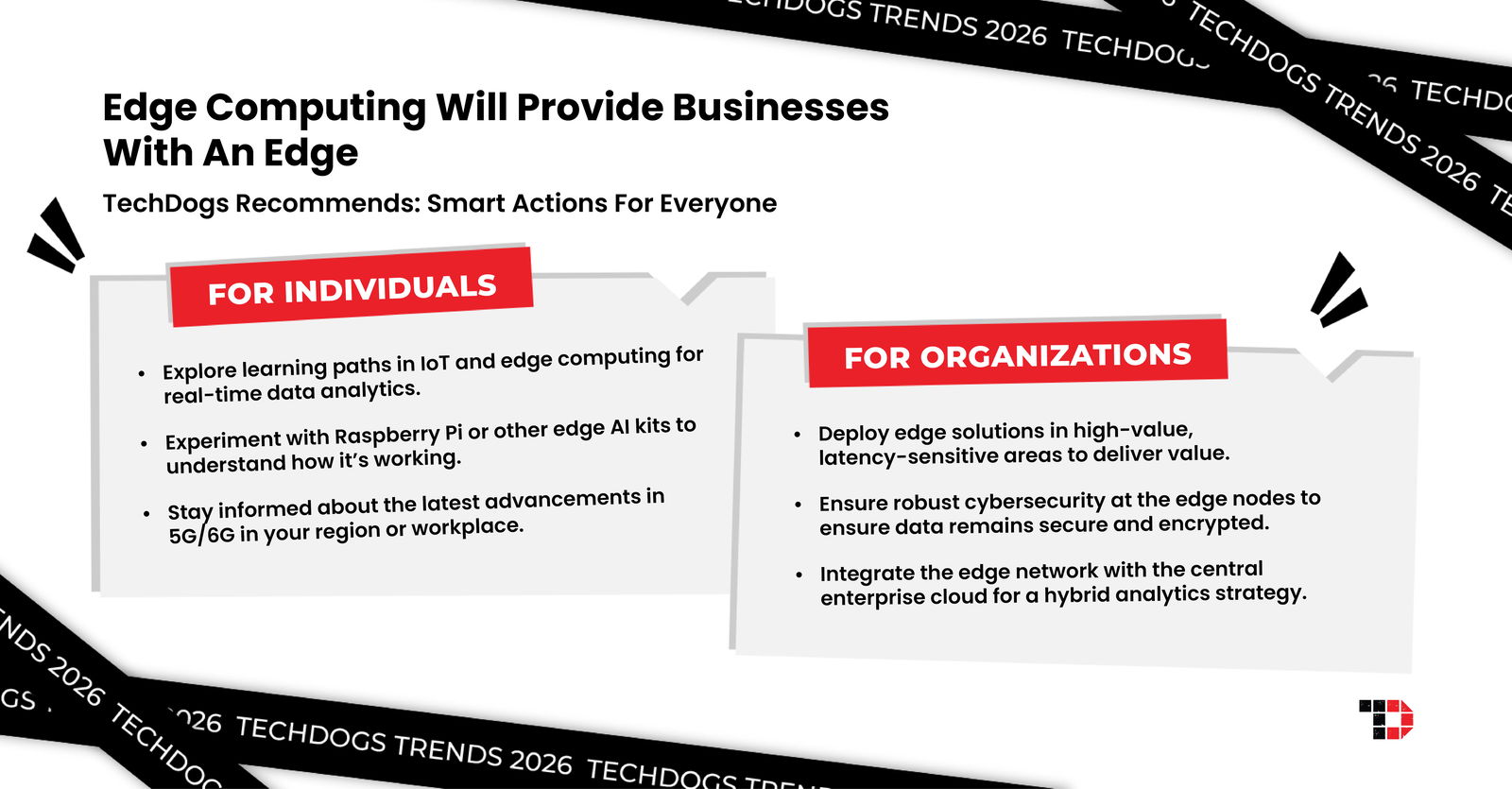
Trend 3: Edge Analytics Will Provide Businesses With A Real-Time Advantage
IoT devices, autonomous vehicles, and wearable sensors are producing exabytes of data daily. Sending that data to a central cloud for analysis is not feasible because of latency, bandwidth, and cost constraints.
Edge analytics is the practice of processing data close to its source, at the network edge, rather than routing it to a central cloud. With 5G now widespread and early 6G pilots underway, edge analytics in 2026 is enabling real-time analytics at scale. Gartner predicted that 75% of enterprise data would be created and processed at the edge by 2025, a trajectory that has accelerated through 2026.
How Is the Industry Responding?
NVIDIA's Edge AI platform is deployed across diverse industries with its EGX platform for enterprises, IGX Orin for industrial applications, Jetson for embedded edge analytics, and Isaac for robotics. Amazon Web Services has expanded AWS IoT Greengrass to help businesses run analytics locally on edge devices.
MarketsandMarkets projects the edge analytics market to grow from $11.2 billion in 2023 to $46.4 billion by 2026. UPS has deployed edge analytics for route optimization, saving millions of gallons of fuel annually while improving delivery times.
"While endpoints continue to be the primary location for data creation, the fastest growth is forecasted to happen at the core and the edge," said David Reinsel, Senior Vice President at IDC. "More data will be stored in the core than in the world's endpoints."
Taken together, these developments signal a clear shift: organizations treating edge analytics as a future investment are already behind. Manufacturing, healthcare, and logistics companies that run real-time decisions at the edge are building the operational resilience that centralized cloud architectures cannot match.
Challenges To Watch
Deploying edge infrastructure involves high upfront costs and higher security risks at distributed nodes. The data science industry also faces a shortage of specialized talent capable of managing real-time data engineering at scale.
Topics For More Insights
TechDogs Recommends: Smart Actions For Everyone
Trend 4: Explainability, Privacy, And Compliance Will Shape Ethical Data Practices
AI systems are only as good as the data they were trained on. As AI drives critical decisions across finance, healthcare, and governance, ethical data practices are no longer optional.
In 2026, AI explainability, data privacy compliance, and bias detection are becoming business mandates, not just legal obligations. Regulators are tightening frameworks worldwide, while consumers are demanding greater transparency into how their data is used. Organizations that cannot explain how their AI reached a decision risk losing trust faster than they gain efficiency.
How Is The Industry Responding?
Google introduced Model Cards, simple overviews of how its AI models were designed and evaluated, and published its Responsible AI Progress Report to promote transparency into model creation, function, and intended use.
IBM rolled out its open-source AI Fairness 360 toolkit to help businesses detect and mitigate bias in their data pipelines. According to PwC's 2025 Global Compliance Survey, 89% of respondents were somewhat or very concerned about data privacy and security, while cybersecurity and data privacy were a top priority for 51% of respondents.
Deloitte finds that 38% of respondents said data residency constraints were 'extremely important' to their organization's strategic AI planning.
"We looked at the cold, hard business model of tech and realized that if we were a for-profit, it is very likely that we would be pushed to erode privacy guarantees in an industry where collecting, selling, and making use of personal data is the primary economic driver," warned Meredith Whittaker, President of the Signal Foundation.
Taken together, these developments highlight a clear shift: data governance compliance in 2026 is not just about avoiding fines. Organizations that build explainability and bias detection into their analytics workflows are building faster trust cycles with customers, regulators, and investors than those still treating ethics as an afterthought.
Challenges To Watch
Balancing innovation with strict regulatory compliance can slow time-to-market. Organizations that cannot explain "black box" AI models to non-technical stakeholders struggle to gain trust. Compliance audits and reporting obligations significantly increase operational costs.
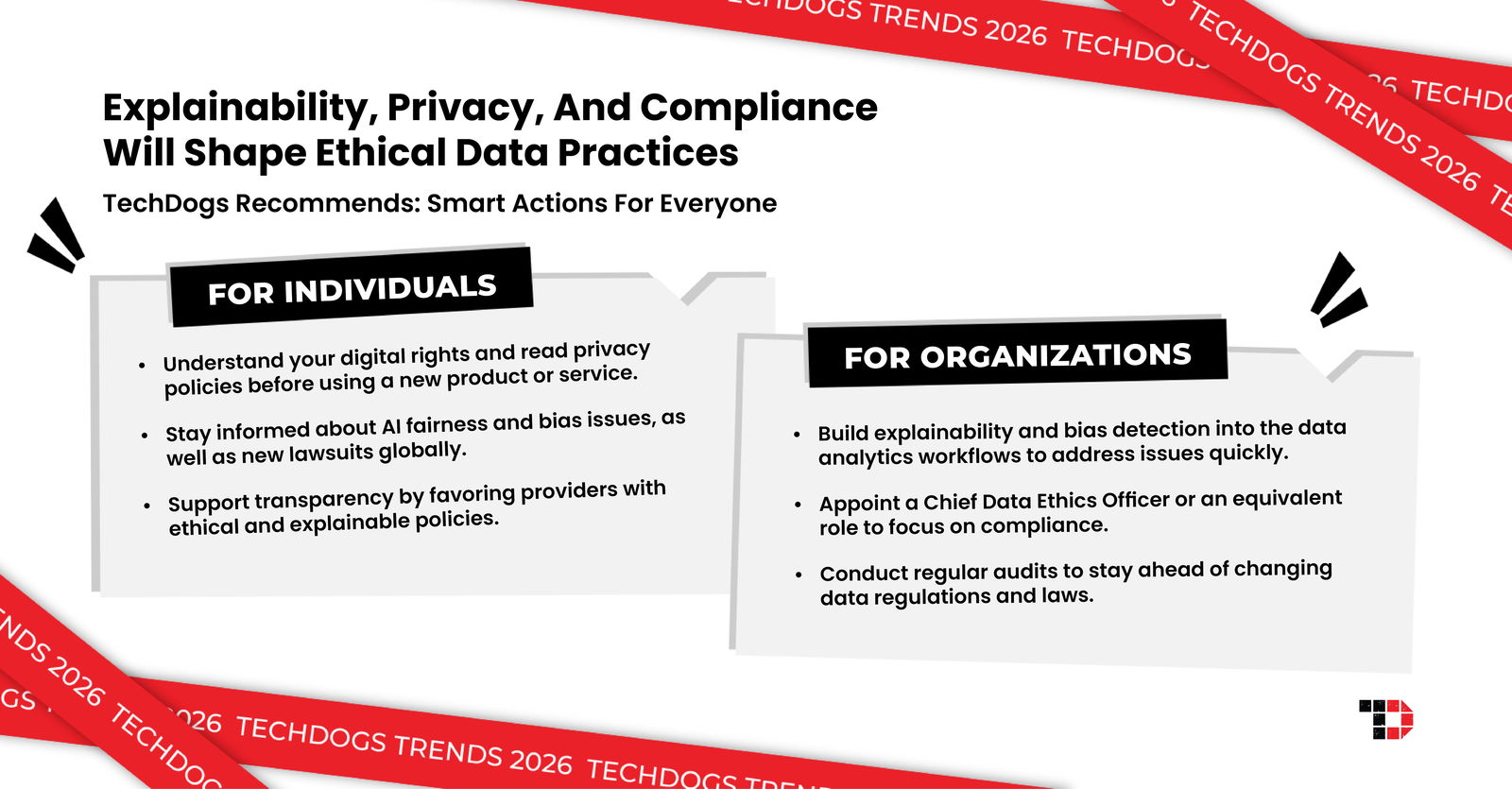
TechDogs Recommends: Smart Actions For Everyone
Trend 5: Sustainable, Energy-Efficient Infrastructure Will Make Big Data Greener
A single ChatGPT prompt consumes roughly 10 to 15 times the energy of a standard Google search, highlighting the growing energy demands behind modern AI systems. Behind every AI model or data analytics platform is a power-hungry data center.
According to IDC, 221 zettabytes of data will be generated globally in 2026. The International Energy Agency warns that data center energy consumption could rise above 1,000 TWh by 2026 in a worst-case scenario. Sustainable data infrastructure is no longer just a corporate responsibility commitment—it is an operational necessity.
How Is The Industry Responding?
Goldman Sachs Research forecasts global data center power demand will increase 50% by 2027 and up to 165% by 2030, driven by AI adoption.
Google is committed to achieving 24/7 clean energy use and its data centers deliver over six times more computing power per unit of electricity than five years ago, with an average PUE of 1.09 versus the industry average of 1.56. Microsoft achieved its goal of matching 100% of its annual global electricity consumption with renewable energy in February 2026, and has contracted 34 GW of renewable energy across 24 countries. Its water-positive target remains 2030.
"With the rise of AI, the energy sector is at the forefront of one of the most important technological revolutions of our time," said Dr. Faith Birol, Executive Director at the International Energy Agency.
Taken together, these developments signal a clear shift: sustainability is now a data infrastructure decision, not just a marketing commitment. Organizations that adopt carbon-aware scheduling, energy-efficient cooling, and green cloud providers now will face lower operational costs and reduced regulatory exposure as energy reporting requirements tighten through 2027.
Challenges To Watch
The high upfront cost of retrofitting existing data centers with sustainable infrastructure is often the primary financial hurdle. Renewable energy availability varies greatly by region. Organizations must also balance sustainability goals with rising AI and big data computing demands.
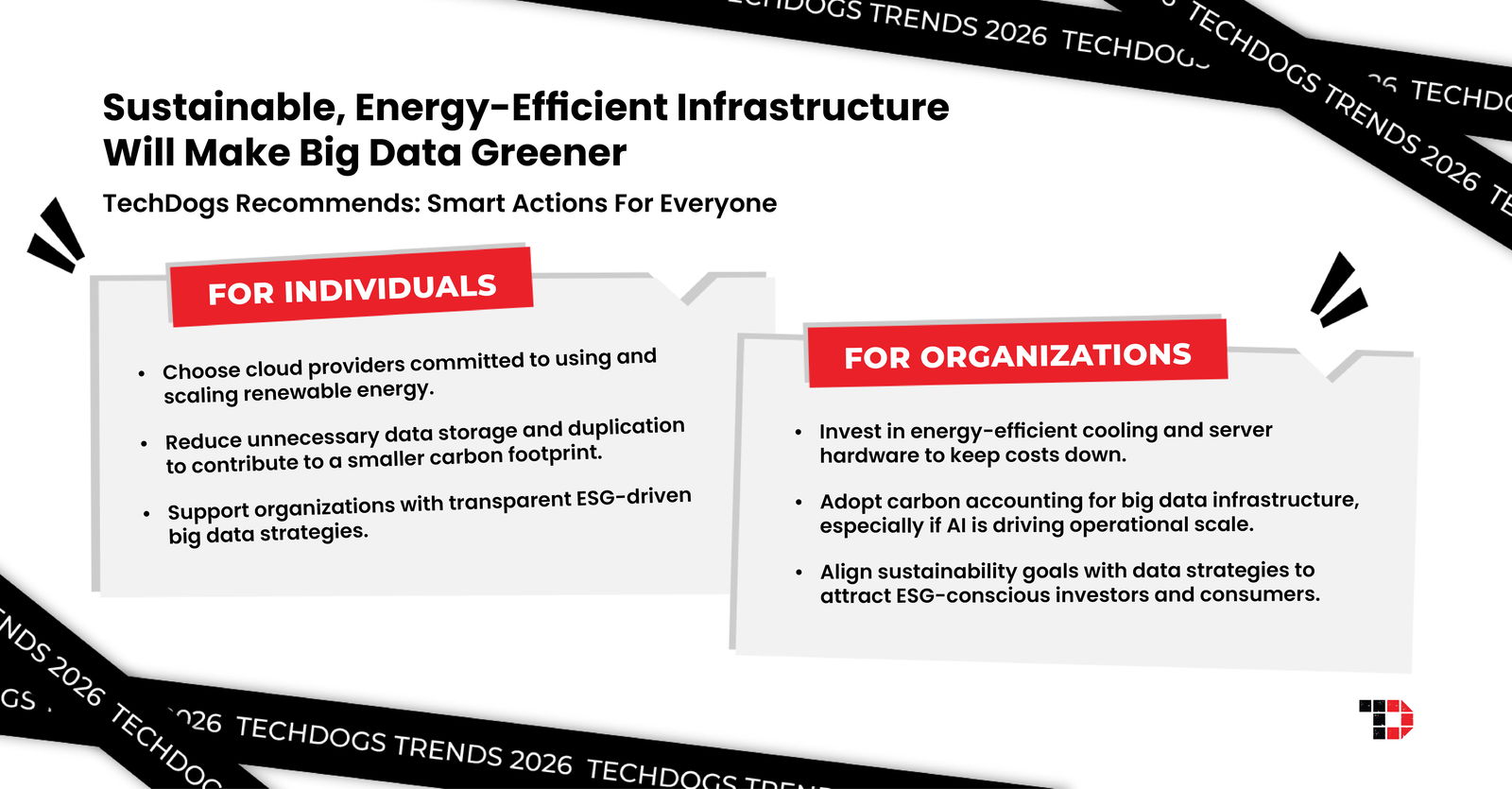
TechDogs Recommends: Smart Actions For Everyone
Conclusion
Sherlock Holmes never waited for more clues. He worked with what was in front of him and drew better conclusions than anyone else. Big data in 2026 is the same challenge at enterprise scale.
Generative AI with RAG is making analytics smarter. Unified data fabrics are breaking down silos. Edge analytics is processing data where decisions are made. Ethical data practices are building the trust that makes AI-driven decisions actionable. And sustainable infrastructure is ensuring this expansion does not outrun the planet's resources.
The businesses that will lead are not those with the most data. They will be those that connect their data fastest, most responsibly, and most efficiently.
Frequently Asked Questions
What Are The Top Big Data Trends To Watch In 2026?
The biggest big data trends in 2026 include generative AI with retrieval-augmented generation (RAG), unified and composable data fabrics, rapid growth of edge analytics powered by 5G/6G, a stronger focus on ethical data practices around privacy and explainability, and the shift toward greener, energy-efficient infrastructure.
How Will Big Data Impact Businesses In 2026?
Big data in 2026 is less about volume and more about real-time, responsible intelligence. According to IDC, global spending on big data and analytics will reach $420 billion in 2026. Businesses will leverage AI-powered analytics to make faster decisions, integrate data across platforms through data fabrics, and process information at the edge for real-time efficiency.
Why Should Organizations Focus On Ethical And Sustainable Big Data Practices In 2026?
As AI-driven systems play an increasingly critical role in decision-making, organizations face growing pressure to ensure data practices are transparent, fair, and compliant with global regulations. According to PwC's 2025 Global Compliance Survey, 89% of respondents are concerned about data privacy and security.
Customers, regulators, and investors alike are demanding higher standards around data privacy, explainability, and environmental impact. Businesses that build trust through ethical frameworks and sustainable infrastructure will avoid compliance risks and gain a reputational advantage.
Fri, Oct 17, 2025

Enjoyed what you read? Great news – there’s a lot more to explore!
Dive into our content repository of the latest tech news, a diverse range of articles spanning introductory guides, product reviews, trends and more, along with engaging interviews, up-to-date AI blogs and hilarious tech memes!
Also explore our collection of branded insights via informative white papers, enlightening case studies, in-depth reports, educational videos and exciting events and webinars from leading global brands.
Head to the TechDogs homepage to Know Your World of technology today!
Disclaimer - Reference to any specific product, software or entity does not constitute an endorsement or recommendation by TechDogs nor should any data or content published be relied upon. The views expressed by TechDogs' members and guests are their own and their appearance on our site does not imply an endorsement of them or any entity they represent. Views and opinions expressed by TechDogs' Authors are those of the Authors and do not necessarily reflect the view of TechDogs or any of its officials. While we aim to provide valuable and helpful information, some content on TechDogs' site may not have been thoroughly reviewed for every detail or aspect. We encourage users to verify any information independently where necessary.
Loading comments...