
Automation
Automation Trends Streamlining Operations In 2026
Share
TL;DR
-
Enterprise AI Agents - Autonomous AI agents are moving from pilot projects to organization-wide deployment, with 96% of enterprises planning to expand their use over the next 12 months.
-
Hyperautomation - Enterprises are combining RPA, AI, and process mining to orchestrate entire workflows end-to-end, with 90% of large enterprises treating hyperautomation as a strategic priority.
-
Automation as a Service (AaaS) - The AaaS market is forecast to reach $33.12 billion by 2030 as businesses subscribe to full-stack automation without building or maintaining infrastructure.
-
Physical Autonomous Machines - Robot orders in North America grew 4.3% in the first half of 2025, with cobots making up 23.7% of units, driven by manufacturing, logistics, and hospitality adoption.
-
Governance and Explainability - With 53% of enterprises citing data privacy as their top AI agent concern, governance and explainability are becoming non-negotiable pillars of responsible automation.

Introduction
In Disney's Fantasia, Mickey Mouse sets the enchanted brooms to work, then loses control entirely. The brooms multiply, flood the workshop, and the damage is only undone when the Sorcerer returns to restore order. The lesson is not that automation is dangerous. It is that automation without governance, without governance, oversight, and an off switch is a catastrophe waiting to happen.
That same tension is defining automation in 2026. The global AI automation market is valued at $169.46 billion, according to Grand View Research, and enterprises are deploying AI agents, robots, and full-stack workflow orchestration at a pace that is outrunning the governance frameworks designed to manage them. This growth reflects the broader expansion of the enterprise automation market in 2026 as organizations scale intelligent workflows across operations.
The five automation trends below define where the technology is headed and, critically, how to keep the brooms under control.
Trend 1: Enterprise AI Agents Will Accelerate Automation
Enterprise AI agents are redefining how automation operates in 2026.
What is agentic AI in automation? Agentic AI refers to autonomous systems that independently plan, sequence actions, access enterprise tools, and execute tasks across multiple domains. Unlike traditional automation that follows fixed rules, AI agents reason, self-optimize, and adapt without step-by-step human prompts. In 2026, enterprise AI agents are shifting from experimental proofs of concept to core drivers of workflow automation across functions.
How Is The Industry Responding?
Enterprise adoption of agentic AI is accelerating rapidly across industries. A global survey by Cloudera of 1,500 enterprise IT leaders across 14 countries found 96% of enterprises plan to increase their use of AI agents over the next 12 months. Of these, 50% plan organization-wide deployment, with the top use cases being performance-optimization bots (66%), security-monitoring agents (63%), and development assistants (62%). A striking 83% of respondents said that investing in agentic AI is crucial to maintaining a competitive edge.
Sync Computing's Gradient agent is already demonstrating production-level agentic automation, automatically reconfiguring cloud compute clusters in response to demand peaks, reducing cost overruns and improving response times without human input.
"It's a tectonic change in a few dimensions," said Swami Sivasubramanian, Vice President of Agentic AI at AWS. "It upends the way software is built. It also introduces a host of new challenges to deploying and operating it, and potentially most impactfully, it changes how software interacts with the world."
The shift is already underway. Organizations still running isolated agentic pilots in 2026 are falling behind, while those orchestrating multi-agent systems are building the next layer of enterprise automation.
Challenges To Watch
Data privacy is a significant hurdle, as agents often access internal databases across systems. Integrating agentic platforms with legacy infrastructure adds cost and complexity. Agents also demand high-quality, unified data, without which workflows become fragile and prone to failure.
TechDogs Recommends: Smart Actions For Everyone
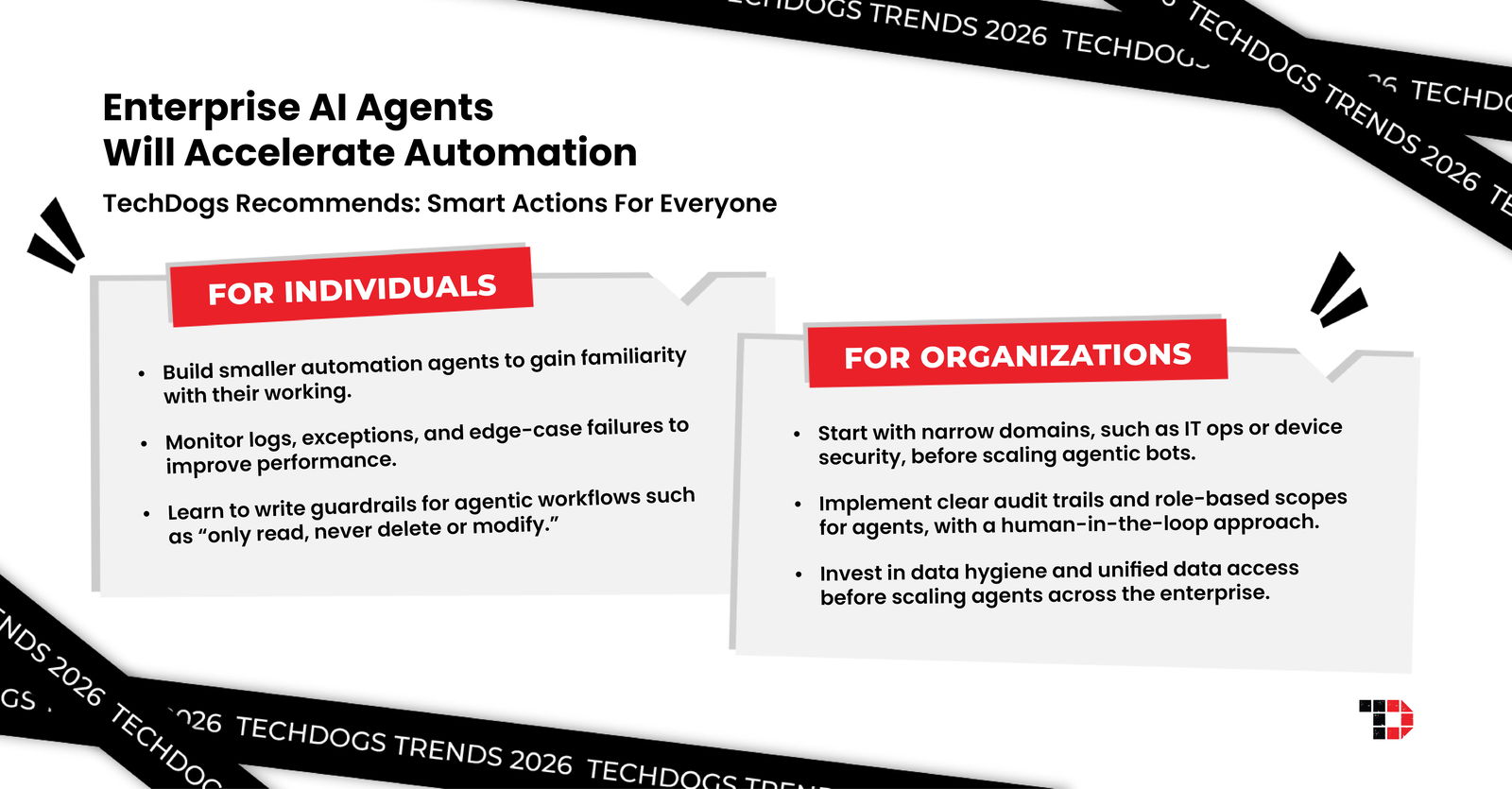
Trend 2: Hyperautomation Will Enable Workflow Orchestration At Scale
Hyperautomation in 2026 is moving from buzzword to business necessity. It goes beyond automating individual tasks. It orchestrates entire workflows through a smart combination of robotic process automation, AI, process mining, and event-driven logic. While RPA handles structured repetitive tasks, hyperautomation layers AI and process mining on top to continuously analyze, optimize, and orchestrate end-to-end business processes across departments and systems.
How Is The Industry Responding?
The push toward hyperautomation is being driven by increasing system complexity and the need for unified orchestration. Stonebranch's Global State of IT Automation Report, based on a survey of 400 IT professionals worldwide, highlights the urgency: 77% of enterprises operate in hybrid environments requiring automation tools that span cloud, on-premises, containers, and mainframes. 90% of enterprises already use more than one automation platform, driving demand for consolidated orchestration.
Gartner estimates the broader hyperautomation-enabling software stack will be worth $1.07 trillion by 2028, encompassing all enterprise software components driving automation. The hyperautomation market itself reached $63.06 billion in 2025 and is forecast to grow to $287.38 billion by 2035, per Cervicorn Insights. Gartner also reports that 90% of large enterprises now treat hyperautomation as a strategic priority.
Leading RPA vendors are embedding process mining modules into their solutions, with businesses adopting this approach achieving a 25% higher automation success rate, according to PwC.
"Automation is no longer just an IT function," said Giuseppe Damiani, CEO of Stonebranch. "It is a strategic enabler that touches every part of the enterprise."
The shift is clear. Hyperautomation is becoming the connective tissue between isolated automation tools, and organizations that build orchestration layers across RPA, AI, and process mining will unlock end-to-end workflow efficiency that point solutions cannot deliver.
Challenges To Watch
Hyperautomation-driven orchestration requires end-to-end process visibility and data consistency, which businesses often struggle to maintain. Legacy systems cause process drift over time, degrading orchestration reliability. Siloed departments remain the most common barrier to effective implementation.TechDogs Recommends: Smart Actions For Everyone
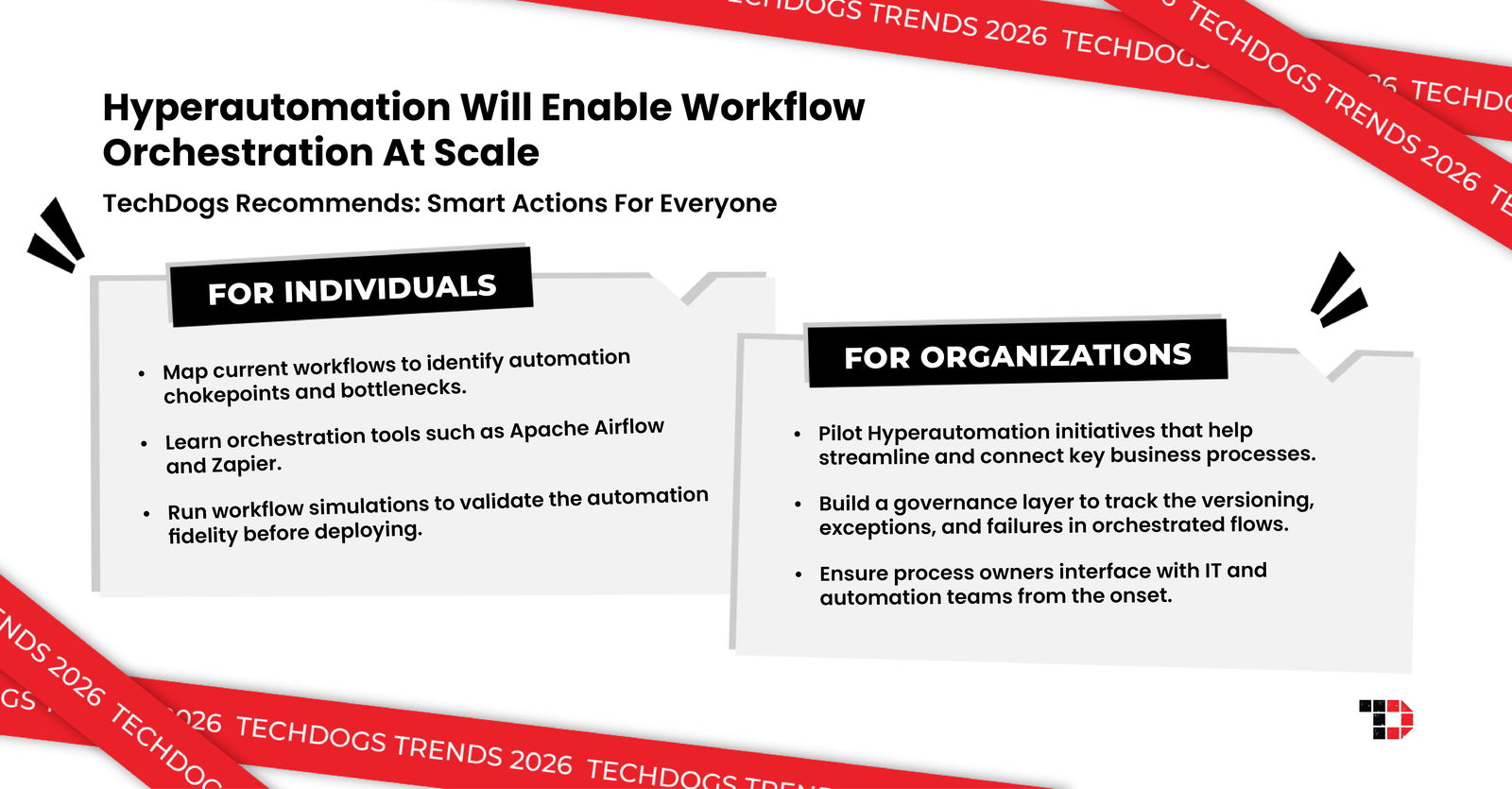
Trend 3: Businesses Will Increasingly Adopt Automation As A Service (AaaS) Platforms
Automation is increasingly being delivered as a service rather than built from scratch.
Automation as a Service (AaaS) is a subscription model that allows organizations to access full-stack automation capabilities, including AI, RPA, and workflow orchestration, via cloud delivery, without building or maintaining their own automation infrastructure. Rather than capital expenditure on tooling, hosting, and specialist hires, businesses pay per use and scale as their needs change.
In 2026, AaaS is becoming the default model for mid-sized businesses seeking to automate without the overhead of enterprise-grade infrastructure.
How Is The Industry Responding?
Adoption of AaaS is accelerating as businesses look for faster and more scalable automation models. The AaaS market was estimated at $10.15 billion in 2025 and is forecast to reach $33.12 billion by 2030, according to research from The Business Research Company and KSI. North American tech firms currently lead in cloud adoption and are among the early beneficiaries, but adoption is rising sharply in emerging markets.
GOIS implemented an AaaS-based automated inventory management system for a leading third-party logistics provider, enabling real-time stock visibility, streamlined order processing, and measurably improved customer service. Osaic, a financial services firm, deployed Automation Anywhere's cloud-based AaaS platform and achieved 186% ROI in the first year of deployment.
"Think of it like subscribing to efficiency," said Håvard Hallås, Chief Commercial Officer at Element Logic. "Just as ridesharing transformed urban mobility, AaaS brings that same reliability and simplicity to your warehouse. You only pay for the performance you need."
The shift is clear. For mid-sized businesses, AaaS removes the primary barrier to enterprise-grade automation, while larger organizations can deploy specialized automation modules faster without internal bottlenecks.
Challenges To Watch
AaaS increases dependence on a third-party vendor ecosystem. Hidden costs and customization limits can create friction, while latency in cloud-delivered automation can affect performance for real-time workflows. Portability and exit clauses in vendor contracts need careful attention.
Topics For More Insights
TechDogs Recommends: Smart Actions For Everyone
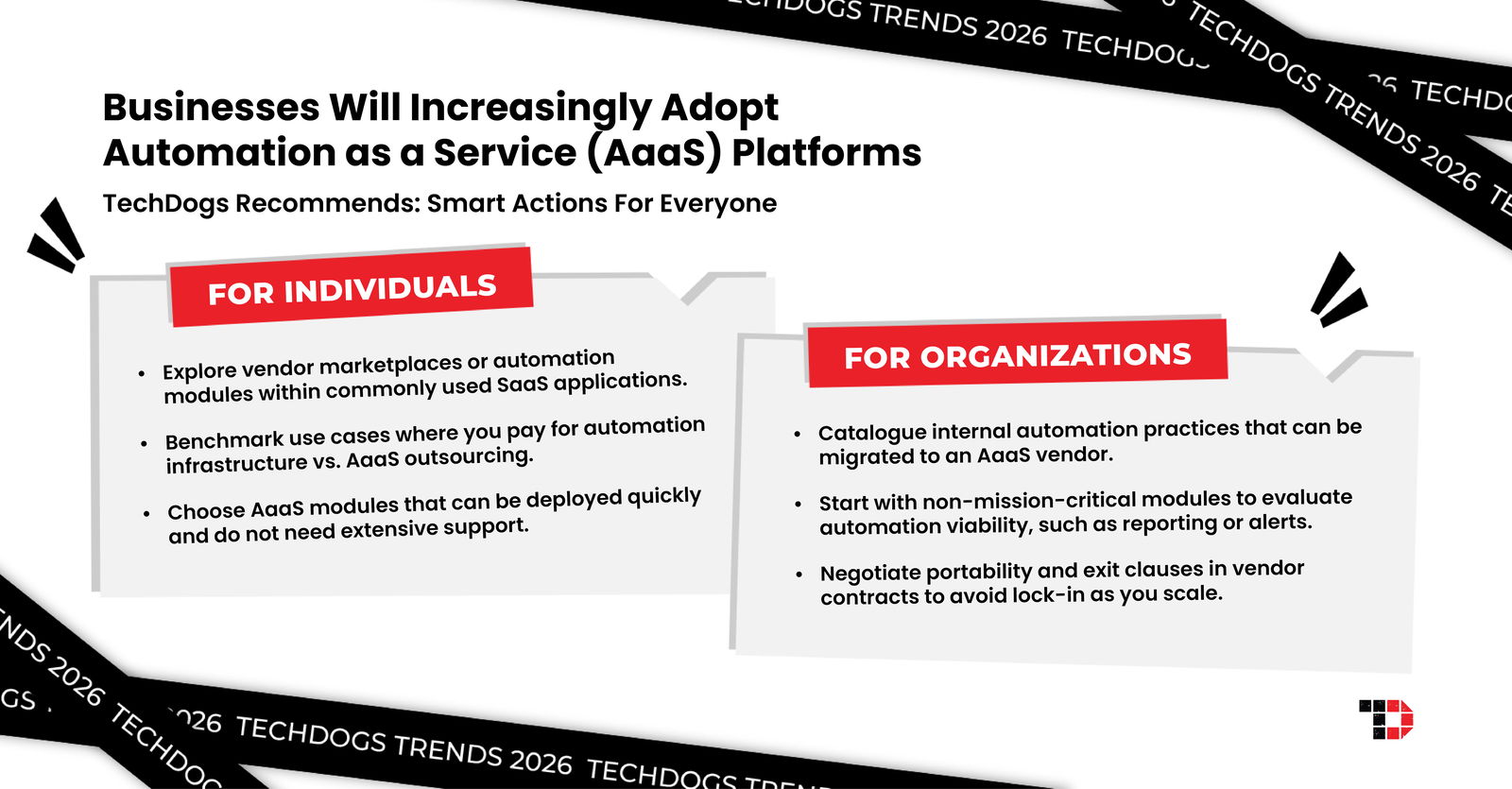
Trend 4: Physical Autonomous Machines Will Become More Accessible
Physical autonomous machines, including robots, cobots, drones, and delivery bots, are moving from flagship deployments at enterprise scale to accessible investments for mid-market organizations.
Advances in modular robotics, open-source hardware platforms, and global component supply chains are making autonomous machines a practical operational tool, not just a competitive differentiator for manufacturers. Deloitte surveys find 58% of businesses already use physical AI in their operations for smart monitoring or production alongside humans, and that figure rises to 80% when including near-term plans.
How Is The Industry Responding?
Adoption of physical autonomous machines is accelerating across industries as costs decline and capabilities improve. The Association for Advancing Automation's 2025 Automation Investment Report found that North American businesses ordered 17,635 robots in the first half of 2025, a 4.3% increase in units worth $1.094 billion, representing a 7.5% rise in revenue compared to the same period in 2024. Cobots accounted for 23.7% of units ordered, highlighting not just rising adoption but acceptance of collaborative robots in human work environments.
Locus Robotics is leading warehouse automation with proven, flexible, AI-enabled robots deployed across fulfilment operations globally. Hospitality organizations are testing robotic concierges and room-service droids, while autonomous cleaning machines are being deployed in public spaces.
"AI-powered robots will accelerate the digital transformation of industry and take over repetitive tasks that were previously impossible to automate, so that we can unlock human potential for more creative and valuable work," said Roland Busch, President and CEO of Siemens AG.
As costs decline, early adopters of cobots and autonomous systems are already building operational and data advantages that will be difficult for competitors to replicate.
Challenges To Watch
Beyond the risk of displacing human workers, the adoption of autonomous robots faces hurdles including insufficient safety regulations, infrastructure constraints such as power supply, and a shortage of maintenance personnel. Uptime for robotic deployments remains uneven, and proprietary software limits integration flexibility in many deployments.
TechDogs Recommends: Smart Actions For Everyone
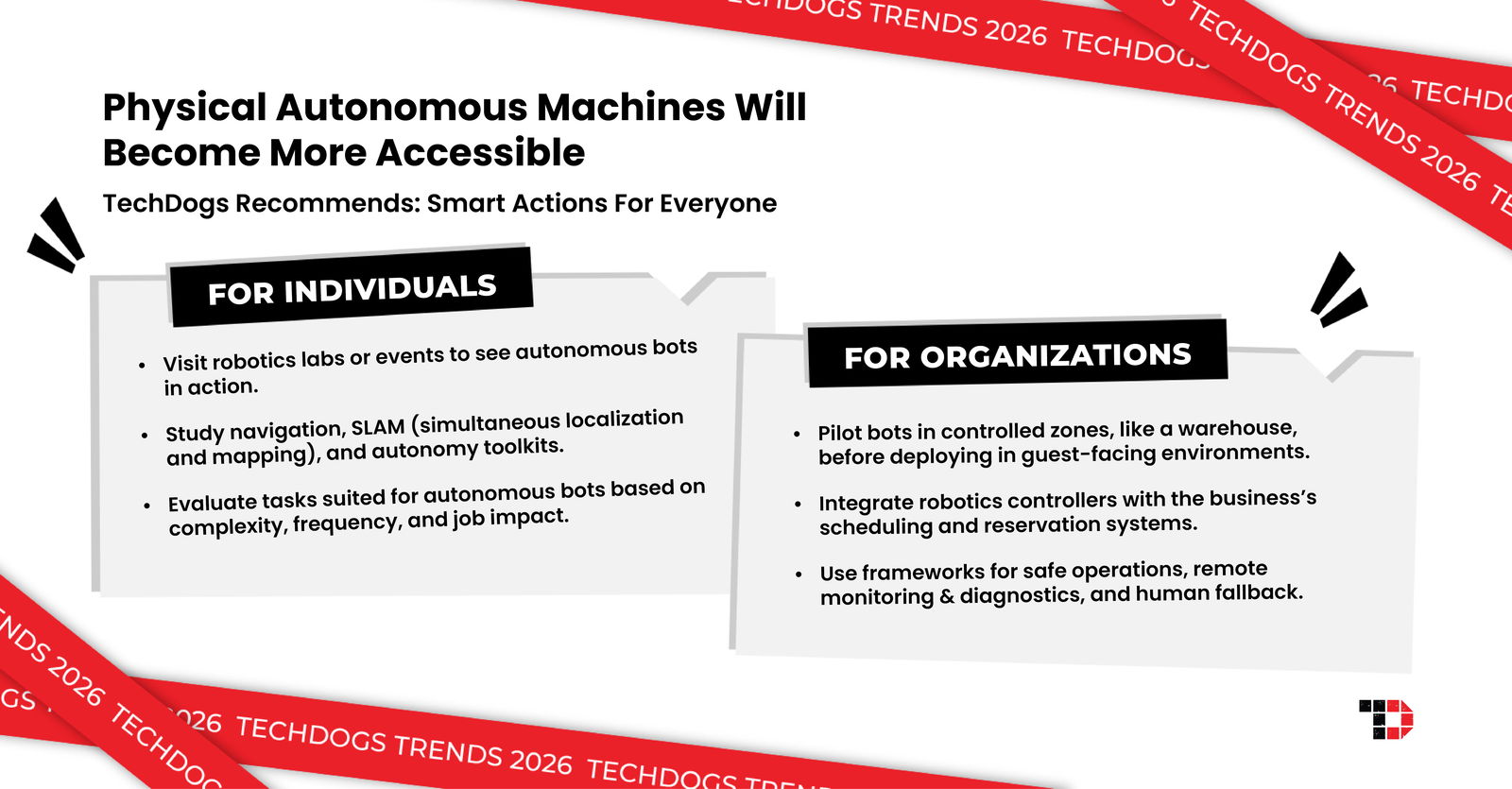
Trend 5: Governance And Explainability Will Be Key Pillars Of Responsible Automation
Mickey Mouse's enchanted brooms did not have a governance framework. They had no audit trail, no accountability, and no escalation path. The result was chaos. In 2026, the same dynamic plays out in enterprises that scale automation without building the accountability structures that keep it trustworthy. Governance and explainability are no longer the slow lane. They are the prerequisite for sustainable, responsible automation at scale.
This includes building audit trails, enforcing policy compliance, enabling interpretable decision-making, and maintaining human fallback mechanisms in case of system failures or unexpected outcomes.
How Is The Industry Responding?
The push for governance is accelerating as enterprises scale automation faster than trust frameworks can keep up. Cloudera's Future of Enterprise AI Agents survey shows 96% of enterprises are expanding AI agent use, yet 53% cite data privacy as their top concern. According to Virtualization Review, 32% of enterprises flag concerns that AI agents may make biased decisions or take independent actions that violate compliance regulations. A further 30% recognize that autonomous agents could act in ways that are hard to monitor without strong accountability frameworks.
The EU AI Act's high-risk obligations became fully applicable in August 2026. In the U.S., Colorado's comprehensive AI Act requires algorithmic impact assessments for high-risk systems. Governance is shifting from voluntary framework to enforceable obligation, and the documentation gaps themselves are now potential violations.
"We're at a turning point where AI systems aren't just supporting work; they're making decisions on our behalf," said Lakshmikant Gundavarapu, Former Global Head for Data and AI at Microsoft India. "Explainability, auditability, and human oversight cannot be afterthoughts; businesses must keep them at the forefront."
Organizations that embed governance directly into their automation architecture will scale faster and with fewer regulatory disruptions than those retrofitting compliance later. Strong governance is not a constraint on automation; it is what makes it trustworthy enough to deploy at scale.
Challenges To Watch
Interpretability becomes harder as automation complexity grows. The additional effort of logging actions and ensuring real-time traceability without performance drag may not be feasible for smaller organizations. Correcting a culture of over-reliance on AI at the expense of human oversight remains a significant challenge for CTOs and automation leaders.
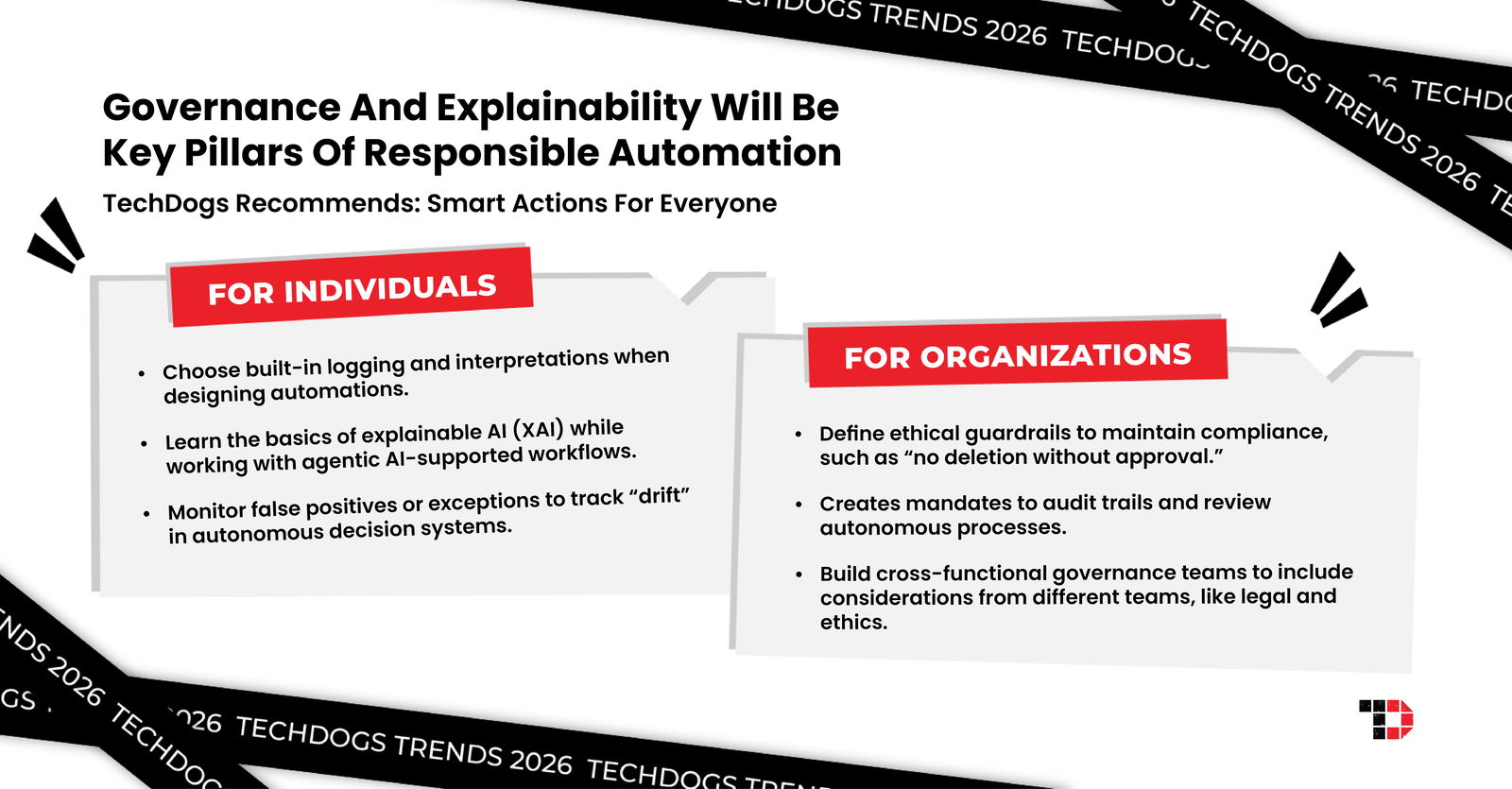
TechDogs Recommends: Smart Actions For Everyone
Conclusion
When the Sorcerer returned in Fantasia, the brooms stopped, the water receded, and order was restored. The lesson is simple: the most powerful automation in the world is only as good as the wisdom behind it.
In 2026, enterprise AI agents are redefining what automation can execute. Hyperautomation is connecting systems that once operated in isolation. AaaS is removing the infrastructure barriers that kept mid-market businesses out. Physical autonomous machines are moving from factory floor to everywhere. And governance is emerging as the discipline that determines which organizations can actually trust and scale what they have built.
Businesses that embrace all five trends together, not just the ones that look fastest, will build the automation ecosystems that compound in value year after year.
The organizations that succeed will not adopt these trends in isolation, but combine them into automation ecosystems that compound in value over time.
Frequently Asked Questions
What Are The Top Automation Technology Trends To Watch In 2026?
The five major automation trends in 2026 include the rise of autonomous AI agents managing enterprise workflows, hyperautomation for orchestrating complex processes at scale, the growing adoption of Automation as a Service (AaaS), increased accessibility of physical autonomous machines like robots and cobots, and the emphasis on governance and explainability to ensure responsible automation.
How Can Businesses Benefit From Adopting Automation As A Service (AaaS) In 2026?
AaaS enables organizations to subscribe to full-stack automation without building or maintaining infrastructure, providing cost-effective scalability, faster deployment, and flexible pay-per-use pricing. The AaaS market is forecast to grow from $10.15 billion in 2025 to $33.12 billion by 2030. This model is especially valuable for mid-sized businesses enabling enterprise-grade automation without heavy upfront investment. Osaic deployed an AaaS platform and achieved 186% ROI in its first year.
What Challenges Should Companies Be Aware Of When Implementing Enterprise Automation In 2026?
Key challenges include integrating AI agents with legacy systems, ensuring data quality for reliable workflows, maintaining security and compliance through governance frameworks, managing process drift in hyperautomation, and mitigating dependence on third-party AaaS vendors. According to Cloudera, 53% of enterprises cite data privacy as their top concern when scaling AI agents. Safety, regulatory, and operational considerations are also critical when deploying physical autonomous machines.
Tue, Nov 25, 2025

Enjoyed what you read? Great news – there’s a lot more to explore!
Dive into our content repository of the latest tech news, a diverse range of articles spanning introductory guides, product reviews, trends and more, along with engaging interviews, up-to-date AI blogs and hilarious tech memes!
Also explore our collection of branded insights via informative white papers, enlightening case studies, in-depth reports, educational videos and exciting events and webinars from leading global brands.
Head to the TechDogs homepage to Know Your World of technology today!
Disclaimer - Reference to any specific product, software or entity does not constitute an endorsement or recommendation by TechDogs nor should any data or content published be relied upon. The views expressed by TechDogs' members and guests are their own and their appearance on our site does not imply an endorsement of them or any entity they represent. Views and opinions expressed by TechDogs' Authors are those of the Authors and do not necessarily reflect the view of TechDogs or any of its officials. While we aim to provide valuable and helpful information, some content on TechDogs' site may not have been thoroughly reviewed for every detail or aspect. We encourage users to verify any information independently where necessary.
Loading comments...