Artificial Intelligence
Artificial Intelligence Trends Shaping Business In 2026
Share
TL;DR
-
Agentic AI - Autonomous AI agents are moving from pilots into production, with 40% of enterprise applications embedding task-specific agents by end of 2026.
-
Multimodal Generative AI - GenAI now creates video, 3D assets, music, and code from a single prompt, reshaping creative workflows across every industry.
-
Physical AI - AI is leaving the screen and entering the physical world through warehouse robots, delivery drones, surgical assistants, and smart infrastructure.
-
AI in Healthcare - From ECG interpretation to polyp detection, AI is shifting medicine from reactive treatment to predictive, personalised care.
-
Synthetic Data - Algorithm-generated datasets are replacing scarce real-world data, enabling faster AI training while meeting privacy and compliance requirements.
Introduction
In Stanley Kubrick's 2001: A Space Odyssey, HAL 9000 could see every room on the ship, read lips, manage life support, and make decisions without being asked. In 1968, that was science fiction. In 2026, five AI trends are turning that vision into operational reality, minus the homicidal tendencies.
Technology has reshaped enterprises faster in the last two years than in the entire previous decade. Gartner predicted that by 2026, over 80% of enterprises would have used Generative AI APIs or deployed AI-enabled applications. That moment has now arrived. Morgan Stanley estimates nearly $3 trillion of AI-related infrastructure investment will flow through the global economy by 2028, with more than 80% of that spending still ahead.
From autonomous agents rewriting business workflows to physical robots operating in warehouses, AI trends in 2026 are not incremental. Here are the five that matter most.
Trend 1: Agentic AI Will Transform Business Operations
Agentic AI is changing how we think about automation. What once felt like rigid, rule-based bots is now evolving into systems that can act with context and intent. With the debut of ChatGPT’s Agent Mode and tools like Gemini and Claude integrating third-party communication, automation is becoming more autonomous than ever before.
What is agentic AI? Agentic AI refers to intelligent systems that independently set goals, make decisions, and complete complex workflows with minimal human input. Unlike traditional AI that responds to prompts, agentic AI takes initiative. It does not wait for instructions. It anticipates, plans, and executes. In 2026, these systems are moving from demo stage to production infrastructure.
How Is the Industry Riding The Wave?
Agentic AI is already moving from theory to real-world deployment. Darktrace, the global cybersecurity leader, offers a clear example. Its autonomous AI platform continuously monitors enterprise network traffic across 9,400+ organizations worldwide, detecting and neutralizing complex threats in real time without waiting for human instruction.
Gartner predicts that 40% of enterprise applications will embed task-specific AI agents by the end of 2026, up from less than 5% in 2025. In a best-case scenario, agentic AI could drive nearly 30% of enterprise software revenue, roughly $450 billion, by 2035. The global agentic AI market is projected to reach $10.8 billion in 2026, according to Fortune Business Insights.
"As Indian organizations explore Agentic and GenAI, the key to unlocking their potential lies in moving from experimentation to large-scale deployment," said Moumita Sarker, Partner at Deloitte India. "Businesses must build trust in AI systems by addressing concerns about errors, bias, and data quality through strong governance."
The shift is already underway. Organizations still running isolated agentic AI pilots are falling behind, while those orchestrating multiple agents across functions are building a scalable competitive advantage.
Challenges To Watch
Agentic AI still faces hurdles including maintaining transparency, avoiding bias, and ensuring system reliability. As organizations hand over more decision-making to machines, governance frameworks and human oversight will determine how smoothly this collaboration unfolds.
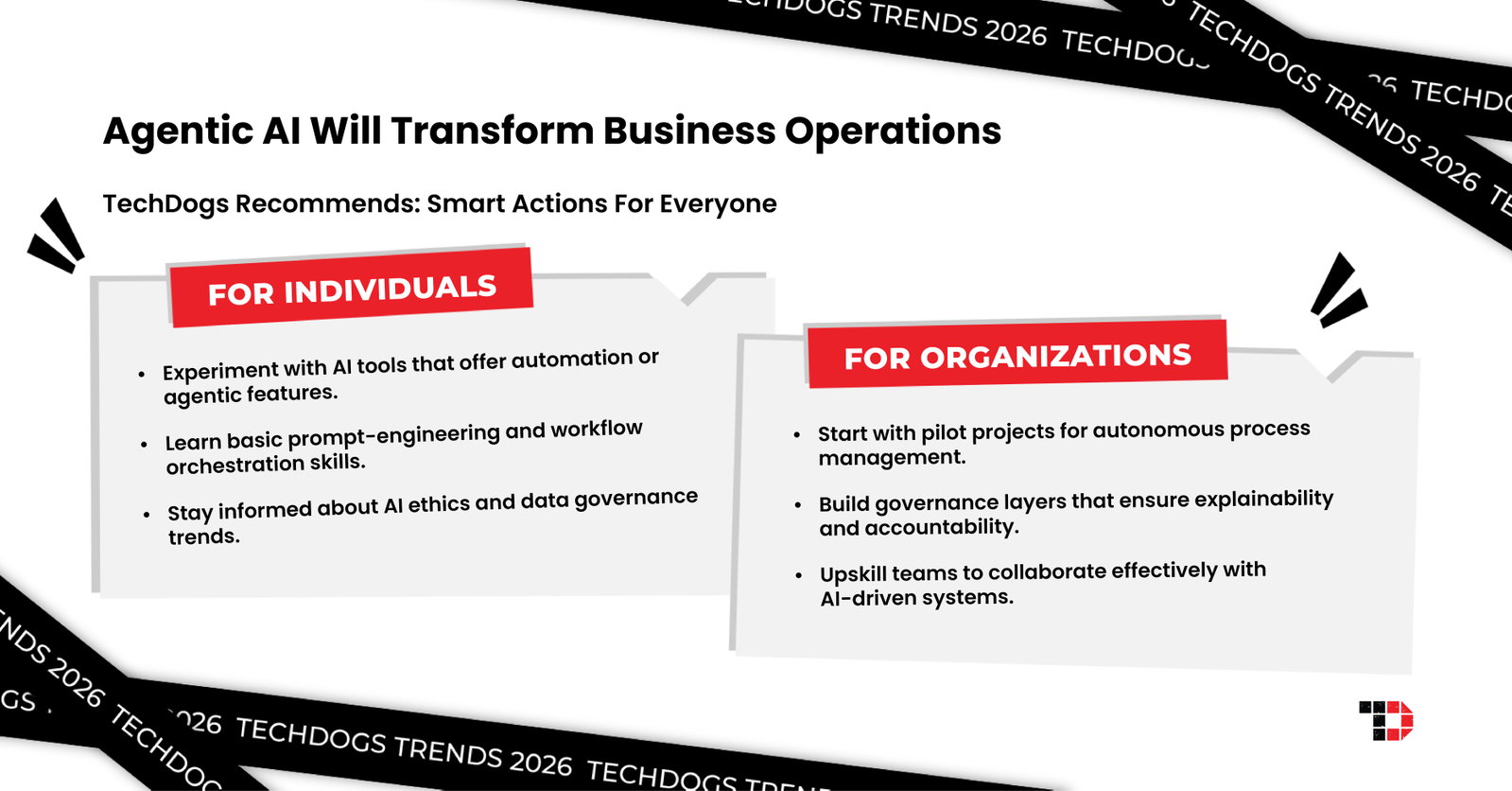
TechDogs Recommends: Smart Actions For Everyone
Trend 2: Generative AI Will Continue Generating Content Beyond Text And Images
If 2023 was the year GenAI learned to write and draw, 2026 is the year it creates everything else. Among the leading generative AI trends in 2026, multimodal capabilities are the most transformative. With AI now used by billions of people globally, it is no longer a niche tool. It is becoming part of everyday workflows across generations.
Multimodal AI enables systems to interpret and generate multiple media types, including text, audio, video, 3D assets, and code, from a single unified prompt. These models are breaking down silos between creative formats, allowing users to co-create fully formed digital outputs without switching tools. In 2026, multimodal GenAI is not experimental. It is becoming the default creative infrastructure for enterprise teams.
How Is The Industry Riding The Wave?
Multimodal AI is already reshaping how content is created and delivered at scale. Monday.com, trusted by over 245,000 customers globally, now uses Veo, an AI-powered video generation tool, to produce training clips, social content, and internal communications in minutes rather than days. What once required a full production team now happens with a single prompt.
According to BCG's AI at Work 2025 Report, 72% of workers globally now use AI regularly. Half of companies are moving beyond tool deployment to redesign workflows entirely, and 22% are building new business models around AI.
"These models will be able to perceive and act in a world much more like a human," said Aaron Baughman, Distinguished Engineer at IBM. "They'll be able to bridge language, vision, and action, all together. In the near future, we're going to start seeing these multimodal digital workers that can autonomously complete different tasks, interpret complex scenarios, and assist in healthcare cases."
The shift is becoming clear. The competitive gap in 2026 is no longer between companies that use AI and those that do not. It is between those that have rebuilt their creative and production workflows around multimodal AI and those still treating it as a single-task productivity tool.
Challenges To Watch
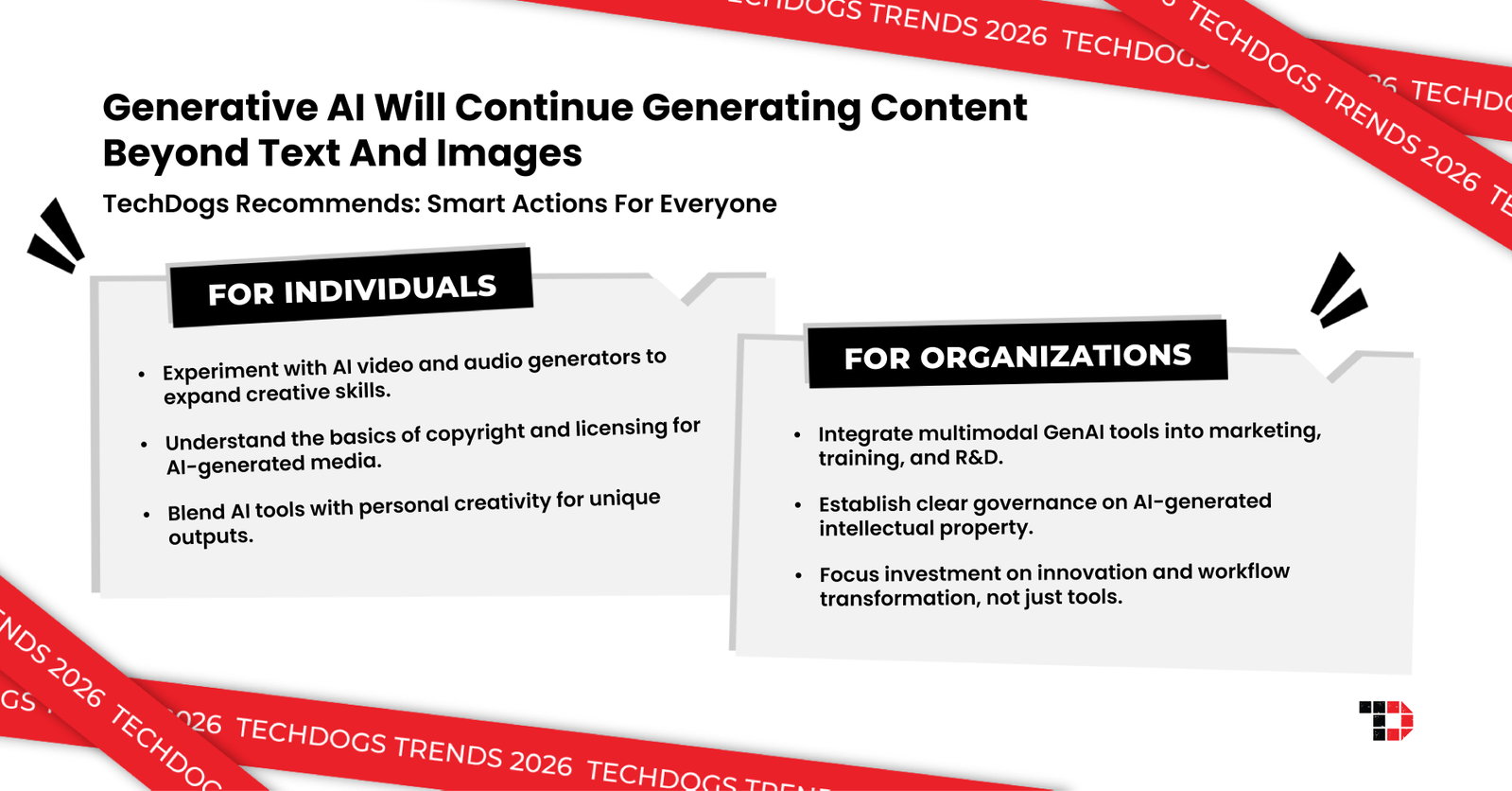
As GenAI expands its creative canvas, ethical challenges arise around copyright ambiguity, creative ownership, and quality control. The line between human originality and machine creativity is blurring, demanding clear governance and attribution frameworks.TechDogs Recommends: Smart Actions For Everyone
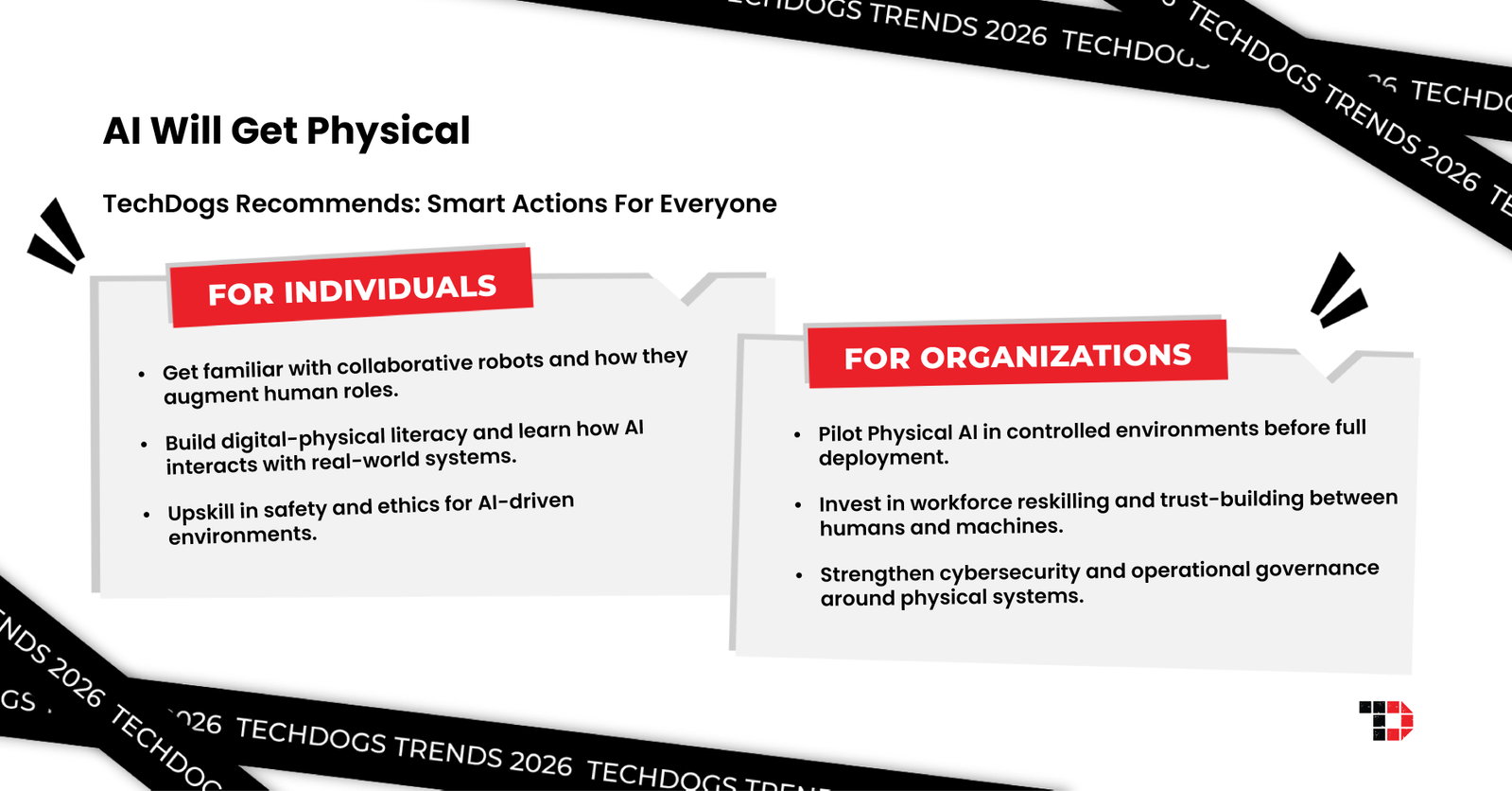
Trend 3: Physical AI Will Bring Intelligence Into The Real World
Think of HAL 9000 managing the ship's environment autonomously. Physical AI in 2026 is that convergence of cognition and action, brought out of the screen and into warehouses, hospitals, and roads. By merging AI with sensors, actuators, and edge devices, these systems can perceive, decide, and act within physical environments in real time.
If 2025 was the year AI learned to think, 2026 is the year it learns to move. From warehouse robots and delivery drones to surgical assistants and smart infrastructure, physical AI robotics is becoming part of the everyday workforce. It is enabling safer work environments, faster operations, and more resilient supply chains while continuously learning from real-world interactions.
How Is The Industry Riding The Wave?
Physical AI is already moving from controlled environments into real-world operations across industries. Amazon now operates over 1 million robots across its global fulfilment network for stowing, picking, sorting, and intra-facility transport. This year, it also acquired RIVR, a physical AI startup developing quadruped wheeled robots for last-mile doorstep delivery, signaling a push beyond warehouses into outdoor environments.
In healthcare, Medtronic's GI Genius endoscopy platform uses computer vision to identify colorectal polyps with precision levels previously unseen in clinical settings. Deloitte reports that over 44% of AI leaders expect extensive Physical AI adoption within two years, with logistics, agriculture, and healthcare leading the charge.
Dr. Anirudh Devgan, CEO of Cadence, also predicts that in the second phase of physical AI, new applications will need to yield economic impacts measured in trillions of dollars since technology companies are already investing hundreds of billions. He also believes that Physical AI could scale substantially.
The shift is becoming clear. Physical AI is not just a manufacturing story. It is a competitive operations story. Companies that integrate intelligent physical systems into their supply chains, healthcare delivery, and infrastructure in 2026 will build operational advantages that purely software-based competitors cannot replicate.
Challenges To Watch
High infrastructure costs, complex integrations, and the need for skilled operators remain major hurdles. Safety and cybersecurity top the list as organizations work to protect both humans and machines. Physical AI failures carry real-world consequences, making governance and testing more critical than in software-only deployments.
TechDogs Recommends: Smart Actions For Everyone
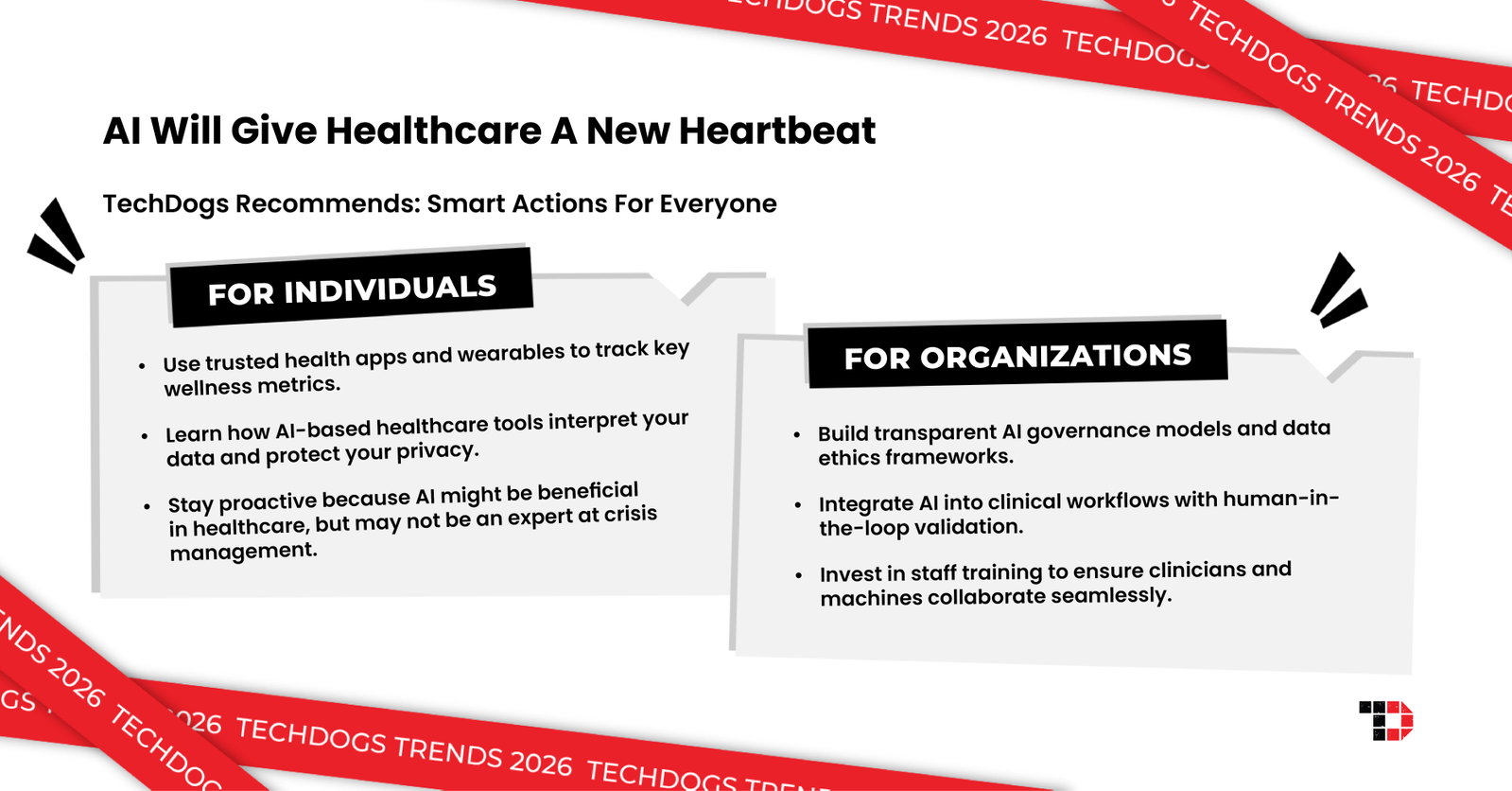
Trend 4: AI Will Give Healthcare A New Heartbeat
The debate around whether AI will help or harm humans often continues, but in healthcare, the impact is already clear. From analyzing X-rays to predicting patient admissions and tailoring treatments based on genetic data, AI is transforming healthcare into a faster, safer, and more proactive service.
Behind this shift lies a convergence of computer vision, generative AI, and predictive analytics. Hospitals are moving from a “wait and treat” model to a “predict and prevent” approach. Wearables, biosensors, and edge AI enable continuous patient monitoring, while virtual assistants help patients stay on track with medications and follow-up care. AI healthcare diagnostics are reducing the time it takes to identify conditions from days to minutes. According to Accenture, AI applications in healthcare can generate up to $150 billion in annual savings for the industry by 2026.
How Is the Industry Riding the Wave?
Healthcare leaders are already proving the real-world impact of AI. Mayo Clinic uses deep-learning models to interpret ECGs and detect early signs of heart disease, achieving close to 89% diagnostic accuracy on complex cases and reducing diagnostic time by up to 60% when AI assists with triage. Medtronic's GI Genius endoscopy platform, powered by computer vision, identifies colorectal polyps with precision levels previously unseen in clinical settings.
Adoption is accelerating across the industry. AMA surveys show that 66% of U.S. doctors now use AI tools in clinical practice, while KPMG reports that 68% of healthcare organizations have already deployed an AI strategy, with a growing focus on AI-driven clinical decision-making.
"AI must not become a new frontier for exploitation," said Dr. Yukiko Nakatani, WHO Assistant Director-General for Health Systems. "We must ensure that Indigenous Peoples and local communities are not only protected but are active partners in shaping the future of AI in traditional medicine."
The shift is clear. AI in healthcare in 2026 is not about replacing clinicians, but augmenting them with systems that can process vast amounts of data, identify patterns faster, and support better clinical decisions. Organizations that integrate AI into workflows today will deliver measurably better patient outcomes.
Challenges To Watch
Clinical validation, algorithmic bias, cybersecurity, and regulatory compliance remain pressing issues. Integrating AI into legacy EHR systems is complex, and workforce readiness is uneven. The stakes are higher than in any other sector: errors in AI healthcare diagnostics have direct patient consequences.
TechDogs Recommends: Smart Actions for Everyone
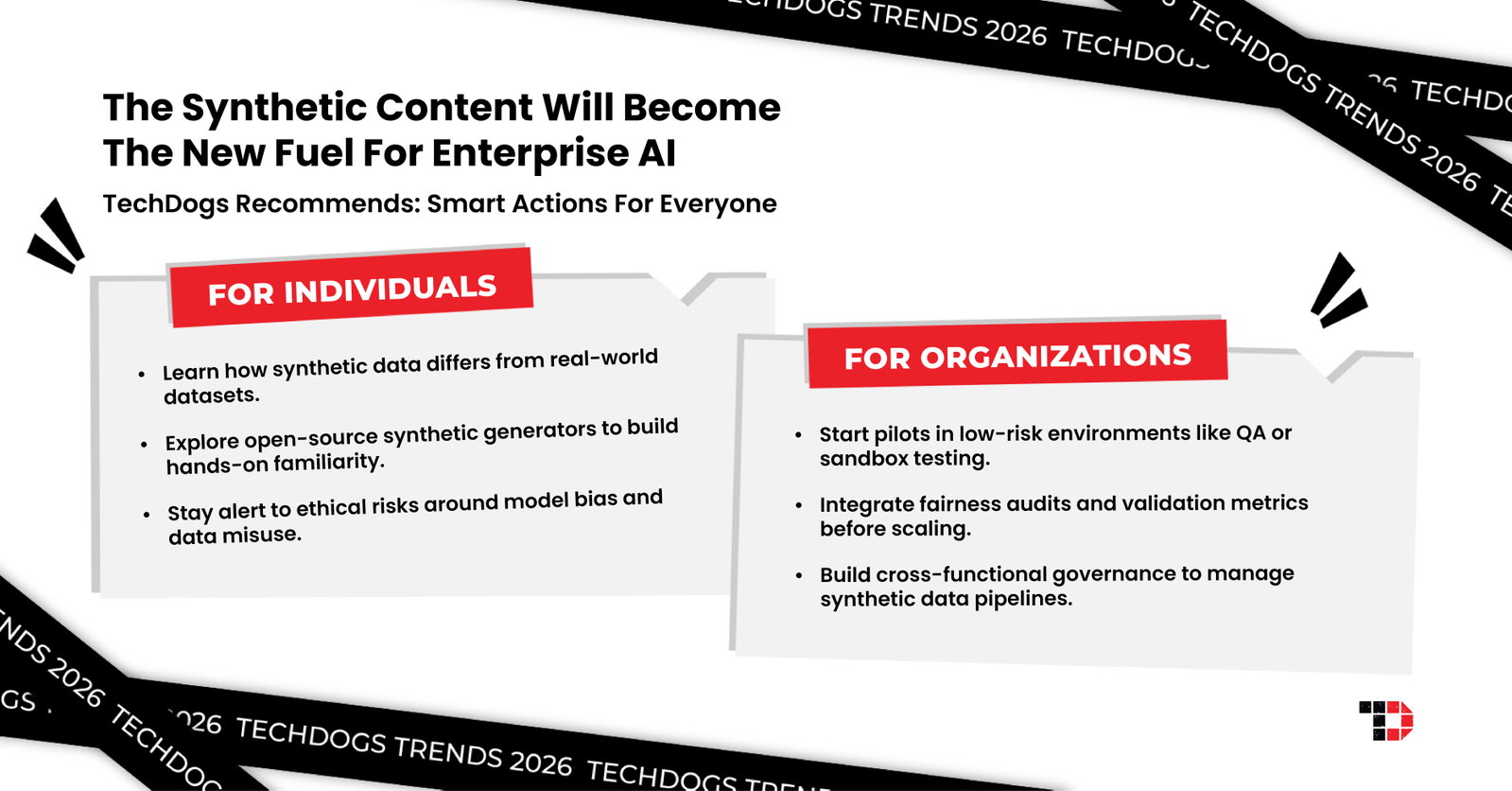
Trend 5: Synthetic Data Will Become The New Fuel For Enterprise AI
Synthetic data is quickly moving from a niche concept to a critical enterprise capability in 2026.
What is synthetic data? It is algorithm-created information in the form of tabular records, images, videos, time-series streams, or text, designed to mimic real-world patterns without exposing actual users. Once considered a research tool, it is now becoming the mainstream solution to the enterprise data shortage limiting modern AI.
Teams across FinTech and HealthTech are increasingly unable to find the edge cases they need in real-world datasets. Strict data regulations, rising annotation costs, and inconsistent data sources are pushing enterprises toward synthetic datasets as the preferred solution for privacy, scalability, and faster testing cycles.
How Is The Industry Responding?
Synthetic data is already being deployed across industries to solve real-world data challenges. In FinTech, organizations are using it to simulate fraud scenarios, AML cases, and rare transactional patterns that are difficult to capture in real datasets. Companies like Gretel.ai are partnering with digital banks to generate controlled, fully labeled datasets for A/B testing and model refinement. According to McKinsey's AI Adoption Report, data quality issues stall nearly 65% of enterprise AI projects, which is why leaders are doubling down on synthetic alternatives.
In healthcare, adoption is accelerating as well. A 2024 MIT CSAIL study found that synthetic medical datasets can match real-world data in predictive performance while meeting HIPAA standards with 98% accuracy. Gartner's Emerging Technologies Report forecasts that synthetic data will surpass real data in AI training by 2030. The synthetic data generation market is already expected to reach $9 billion in 2026, according to SQ Magazine.
"True value will come from feeding models high-quality, permission-aware structured data to generate intelligent, relevant, and trustworthy answers," said David Lanstein, Co-founder and CEO of Atolio. "Data sovereignty and first-class permissioning are non-negotiable requirements for AI in production."
The shift is becoming clear. Synthetic data is not a workaround but a competitive advantage. Organizations that build controlled synthetic data pipelines today will train faster, test more edge cases, and meet compliance requirements that competitors without clean data pipelines cannot, making synthetic data a foundational layer for enterprise AI systems.
Challenges To Watch
Despite its rise, synthetic data faces challenges with realism, regulatory ambiguity, and fairness concerns. If generative models embed subtle biases or drift from real distributions, enterprises risk training AI systems that misfire in production. Integrating synthetic pipelines across engineering, compliance, and security teams remains a significant operational lift.
TechDogs Recommends: Smart Actions for Everyone
Conclusion
HAL 9000 was terrifying because it acted with complete autonomy and no accountability. The five AI trends shaping 2026 are the same technology deployed with human oversight, governance, and purpose.
Agentic AI is automating what used to require constant human direction. Multimodal GenAI is creating content at a scale and speed no team could match alone. Physical AI is bringing intelligence off the screen and into the supply chain. AI in healthcare is giving clinicians a diagnostic partner that never sleeps. And synthetic data is removing the last bottleneck from enterprise AI at scale.
The future HAL imagined has arrived. The difference is that this time, we built the off switch first.
Frequently Asked Questions
What Are The Top Artificial Intelligence Trends Shaping Business And Technology In 2026?
The top AI trends for 2026 include Agentic AI, multimodal Generative AI, Physical AI, AI-powered healthcare systems, and synthetic data for enterprise innovation. These trends are redefining automation, creativity, robotics, clinical decision-making, and enterprise data strategies across global industries.
How Will Agentic AI Transform Enterprise Operations And Decision-Making In 2026?
Agentic AI will automate complex workflows, independently make decisions, and proactively execute tasks with minimal human input. According to Gartner, 40% of enterprise applications will feature task-specific agents by end of 2026. The global agentic AI market will reach $10.8 billion in 2026, with a 43.8% CAGR through 2034.
What Is Synthetic Data?
Synthetic data is algorithm-generated information crafted to mimic real-world patterns without exposing actual users. It enables scalable, privacy-safe AI training, accelerates testing, and reduces regulatory risks. Gartner forecasts synthetic data will surpass real data in AI model training by 2030. The market is expected to reach $9 billion in 2026.
Thu, Nov 27, 2025

Enjoyed what you read? Great news – there’s a lot more to explore!
Dive into our content repository of the latest tech news, a diverse range of articles spanning introductory guides, product reviews, trends and more, along with engaging interviews, up-to-date AI blogs and hilarious tech memes!
Also explore our collection of branded insights via informative white papers, enlightening case studies, in-depth reports, educational videos and exciting events and webinars from leading global brands.
Head to the TechDogs homepage to Know Your World of technology today!
Disclaimer - Reference to any specific product, software or entity does not constitute an endorsement or recommendation by TechDogs nor should any data or content published be relied upon. The views expressed by TechDogs' members and guests are their own and their appearance on our site does not imply an endorsement of them or any entity they represent. Views and opinions expressed by TechDogs' Authors are those of the Authors and do not necessarily reflect the view of TechDogs or any of its officials. While we aim to provide valuable and helpful information, some content on TechDogs' site may not have been thoroughly reviewed for every detail or aspect. We encourage users to verify any information independently where necessary.
Loading comments...