
Business Intelligence
Top 5 Marketing Intelligence Software In 2026
Share
TL;DR
That’s where Marketing Intelligence Software earns its keep.
-
ZoomInfo: Connects real-time account signals with extensive B2B sales intelligence data.
-
Semrush: Provides deep competitor traffic insights and tracking for AI-driven search.
-
Similarweb: Offers comprehensive market benchmarking across organic, paid, and generative AI channels.
-
Klue: Delivers automated competitive research and structured battlecards for revenue teams.
-
Demandbase One: Features a Pipeline Engine for account-based marketing orchestration.
Introduction
You probably remember Coca-Cola’s “Share a Coke” campaign. Suddenly, people were scanning store shelves looking for bottles with their own names on them, posting photos online, and buying extras for friends and family.
On paper, it sounded like a tiny branding tweak. In reality, it became one of Coca-Cola’s most successful personalization campaigns, helping the company increase engagement and revive sales momentum in key markets.
What made it work was not luck. It was insight.
The campaign tapped into something marketers are still chasing in 2026: understanding what people actually respond to.
Today, that challenge has become far more complicated. Customers jump between TikTok, Google, Reddit, newsletters, YouTube, AI search tools, and online communities before making decisions. Competitors react faster than ever, trends disappear overnight, and marketing teams are expected to make smarter decisions with less time and even less patience from audiences.
This is why marketing intelligence has become such an important part of modern business strategy.
Companies no longer rely only on instincts or broad campaign reports. They want real-time visibility into customer behavior, competitor activity, buying signals, audience trends, and market movement so they can react before opportunities disappear.
Before we dive into the list, it helps to understand what Marketing Intelligence Software actually does and why businesses are investing heavily in it heading into 2026.
What Is Marketing Intelligence Software?
Marketing Intelligence Software is a digital tool that helps businesses understand what is happening in their market before everyone else does. It pulls together data from customers, competitors, campaigns, search trends, websites, social platforms, ad performance, and buying signals, then turns all that noise into insights teams can actually use.
You know how streaming platforms seem to know exactly what people want to watch next? Marketing teams now operate with a similar mindset. They constantly look for patterns in audience behavior, competitor activity, and market trends to figure out what people care about, where demand is shifting, and which opportunities are worth chasing.
Without the right tools, doing this manually becomes exhausting very quickly. Teams end up buried in spreadsheets, dashboards, screenshots, Slack messages, and endless reporting tabs trying to piece together what changed and why.
Marketing Intelligence Software simplifies that process.
Some platforms focus heavily on competitor tracking and market research. Others specialize in buyer intent, account-based marketing, SEO visibility, audience analytics, or sales intelligence. The goal stays the same: helping businesses make faster, smarter marketing decisions using real-time insights instead of assumptions.
Now that we understand what Marketing Intelligence Software actually does, let’s look at the top 5 Marketing Intelligence platforms of 2026.
Top 5 Marketing Intelligence Software Of 2026
Here are some of the best Marketing Intelligence Software solutions of 2026. There is no ranking here. Just the top 5 without any order.
 |
 |
 |
 |
 |
ZoomInfo: Best Overall
Founded in 2007, ZoomInfo built its reputation around a fairly simple idea: better data leads to better business decisions. Over the years, it has grown into one of the biggest names in B2B intelligence, supporting more than 35,000 customers worldwide, including Adobe, Google, Microsoft, AWS, Canva, Airbnb, and Figma. The company now operates across multiple global offices with a workforce of roughly 3,500 employees. Its continued presence in G2 Leader reports and Easiest To Use rankings also shows how deeply embedded ZoomInfo has become in modern B2B sales and marketing workflows.
Why We Chose ZoomInfo In 2026
ZoomInfo stands out in 2026 because it connects marketing intelligence directly with revenue generation instead of treating them as separate workflows. The platform combines two major solutions, ZoomInfo Marketing and ZoomInfo Sales, allowing marketing and sales teams to work from the same buyer signals, account activity, and contact intelligence without constantly switching systems or losing context along the way.
Its ABM-focused platform, ZoomInfo Marketing, helps teams capture real-time accounts, market, and contact-level intent signals and turn them into orchestrated campaigns across channels like display ads, email, LinkedIn, Meta, SDR routing, and even Connected TV.
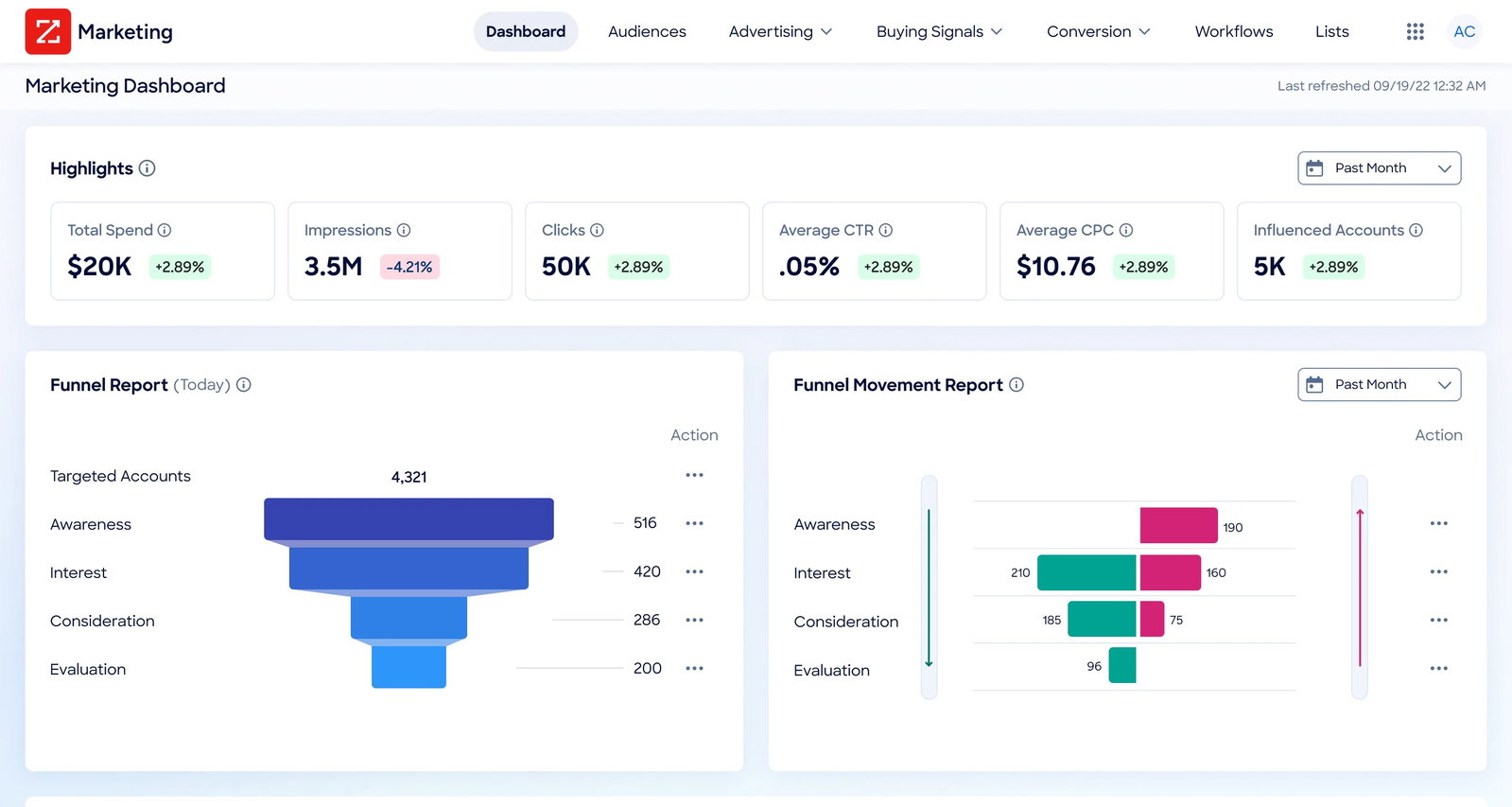
What makes ZoomInfo especially powerful, though, is how tightly that marketing intelligence connects with its sales database. ZoomInfo Sales gives teams access to more than 420 million global contacts, 120 million direct dials, and 145 million company profiles alongside 300+ filtering attributes, including funding data, hiring signals, and technology stack insights. That combination makes it easier for teams to define ICPs, prioritize accounts showing active buying intent, and move prospects directly into CRM workflows while preserving valuable signal context.
Pricing
ZoomInfo follows a customized pricing structure across both ZoomInfo Marketing and ZoomInfo Sales. Pricing depends on the solutions, user seats, data access, and workflow capabilities selected by each business. The company also offers demo access and trial options for organizations evaluating the platform.
What Works & What Doesn't
| Pros | Cons |
| Intuitive platform experience | High pricing structure |
| Strong contact and company data accuracy | Steeper learning curve for advanced workflows |
| Powerful ABM and campaign orchestration capabilities | Feature depth can feel overwhelming initially |
Our Final Take
ZoomInfo is best suited for B2B marketing, sales, and revenue operations teams that rely heavily on buyer intent data, account-based marketing, and sales-ready intelligence. Smaller teams or businesses looking for lightweight prospecting tools, however, may find the platform more complex and expensive than they actually need.
Semrush By Adobe: Best AI Features
Founded in 2008, Semrush built its reputation as one of the most widely used digital marketing and SEO intelligence platforms in the industry. Over the years, it evolved far beyond keyword tracking, expanding into competitor research, audience intelligence, content optimization, traffic analytics, and market benchmarking. In April 2026, the company was acquired by Adobe following acquisition discussions that reportedly began in late 2025. Adobe itself, founded in 1982, already operates one of the strongest ecosystems across digital creativity, marketing, analytics, and customer experience platforms, making the acquisition feel like a fairly natural fit.
Why We Chose Semrush In 2026
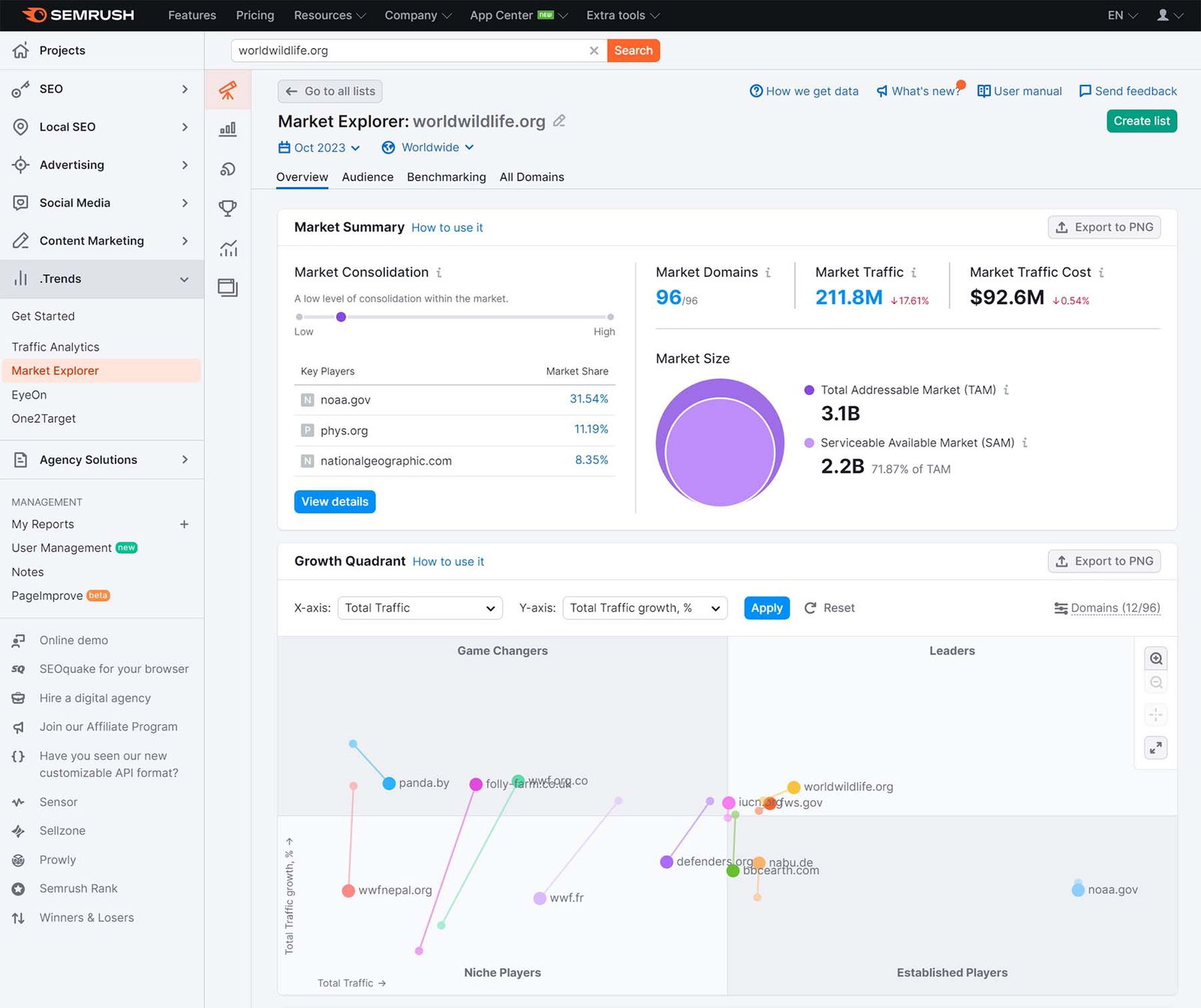
Semrush stands out in 2026 because it helps marketing teams understand not just where traffic comes from, but how audiences, competitors, and search behavior are changing in real time. Its Traffic & Market Intelligence tools provide visibility into competitor traffic sources, engagement patterns, regional demand shifts, audience demographics, and industry benchmarks across more than 190 countries and regions. That level of insight helps teams spot opportunities earlier, adjust campaigns faster, and understand where competitors may be quietly gaining momentum.
The platform also makes competitor monitoring feel far more actionable instead of purely observational. Teams can analyze up to 100 competitors simultaneously, monitor daily market changes, receive automated alerts, and generate reporting insights that support faster campaign decisions without constantly digging through disconnected analytics tools.
What really pushes Semrush ahead in 2026, though, is Semrush One. The platform combines traditional SEO intelligence with AI-driven search visibility tracking inside one environment. Teams can now monitor brand presence not only across Google search results but also inside AI Overviews and LLM-generated responses.
With access to keyword intelligence, backlink data, AI prompt tracking, weekly updates, and more than 239 million AI-relevant prompts globally, Semrush gives marketers a much clearer picture of how search itself is evolving in the AI era.
Pricing
Semrush Traffic & Market offers a Pro plan priced at $289/month across both monthly and annual billing cycles. Add-ons include Lead Generation ($90/month), Base Report ($10/month), and Pro Report ($20/month). Meanwhile, Semrush One pricing starts at $165/month for Starter, $248/month for Pro+, and $455/month for Advanced plans. Free trial access is also available for interested users.
What Works & What Doesn't
| Pros | Cons |
| Extensive SEO and competitor intelligence capabilities | Pricing can become expensive for smaller teams |
| Strong AI-driven search visibility tracking | Learning curve for advanced analytics workflows |
| Flexible and customizable marketing tools | Data limits may feel restrictive at scale |
Our Final Take
Semrush is best suited for marketing teams that rely heavily on SEO, competitor monitoring, audience intelligence, and content performance tracking to drive growth. Smaller businesses with simpler marketing needs, however, may find the platform’s depth, pricing, and analytics complexity more extensive than necessary.
Similarweb: Best For Scalability
Similarweb was founded in 2007 in Tel Aviv. The company houses over 1,000 employees across 11 global offices, with its headquarters in New York. It boasts a customer base of over 3,500 companies spanning names such as Adidas, Virgin Atlantic, Walmart, eBay, DHL, Panasonic, Samsonite, Ogilvy, Google, and more. Backing this stellar list is the company’s widespread recognition, including being named a Leader in G2’s Spring 2026 report.
Why We Chose Similarweb In 2026
Similarweb stands out in 2026 because it helps businesses understand not just what competitors are doing, but how entire markets are shifting around them. The platform combines competitor intelligence, audience analytics, traffic insights, search trends, advertising visibility, and market benchmarking inside one connected environment.
Its intelligence capabilities stretch across SEO, PPC, GenAI visibility, affiliate activity, keywords, ads, referrals, and traffic sources, helping marketers identify where competitors are gaining momentum and where opportunities may still exist. Teams can monitor channel shifts, uncover emerging keyword trends, analyze ad creatives, and evaluate affiliate strategies without constantly jumping between disconnected research tools.
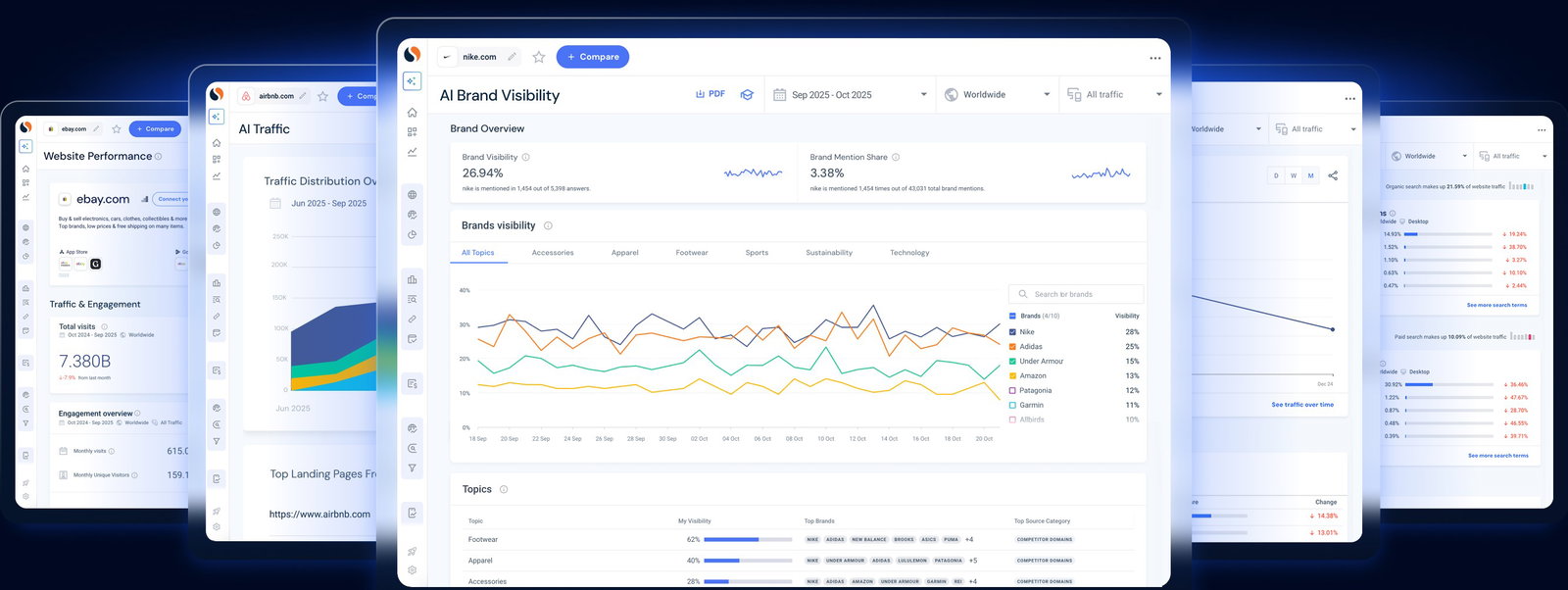
What really separates Similarweb, though, is the depth of its market intelligence layer. Beyond traffic analytics, the platform helps organizations evaluate market size, competitiveness, audience loyalty, geographic demand, demographic trends, and consumer behavior changes from a strategic growth perspective. Its customizable market views also allow teams to define their own competitors, industries, regions, or audience segments, making it easier to spot hidden opportunities, emerging players, and underserved markets before competitors do.
Pricing
Similarweb offers multiple pricing tiers for individuals and teams, while Business and Enterprise plans follow customized pricing structures. Competitive Intelligence starts at $125/month, billed annually, or $199/month with one user and three months of historical data. Competitive Intel, SEO & AEO starts at $333/month annually or $399/month, while Competitive Intel, SEO & AEO & Ads begins at $542/month annually or $649/month with six months of historical data included.
What Works & What Doesn't
| Pros | Cons |
| Easy-to-use interface and reporting experience | Limited visibility into smaller websites |
| Strong competitor and traffic intelligence capabilities | Some traffic estimates may vary in accuracy |
| Broad channel-level visibility across SEO, ads, and referrals | Advanced features often require higher-tier plans |
Our Final Take
Similarweb is best suited for marketing, SEO, and strategy teams that need competitive intelligence, market benchmarking, and channel-level visibility. Its vast coverage across search, ads, affiliates, Gen AI, and audience behavior makes it valuable for data-backed growth planning.
Klue: Best Customer Support
Founded in 2015 and headquartered in Vancouver, Canada, Klue has quickly built a strong reputation in the competitive intelligence space. The company operates with a team of more than 200 employees and supports customers including SurveyMonkey, 6Sense, ClickUp, Glean, Zendesk, and Gainsight. Klue’s growing influence has also earned multiple industry recognitions, including Leader placements in G2’s Fall 2025 and Spring 2025 reports.
Why We Chose Klue In 2026
Klue stands out in 2026 because it focuses heavily on helping teams operationalize competitive intelligence instead of simply collecting competitor data. Many platforms stop at tracking websites, pricing changes, or product updates, but Klue pushes further by helping marketing, product marketing, and sales enablement teams actually turn that information into positioning strategies, battlecards, executive reporting, and revenue-facing insights.
The platform continuously monitors competitor websites, pricing updates, reviews, product launches, news coverage, and field intelligence. Its workflows support the full intelligence cycle, from data collection and analysis to content distribution and sales enablement, which becomes especially valuable for teams operating in highly competitive SaaS and B2B markets.
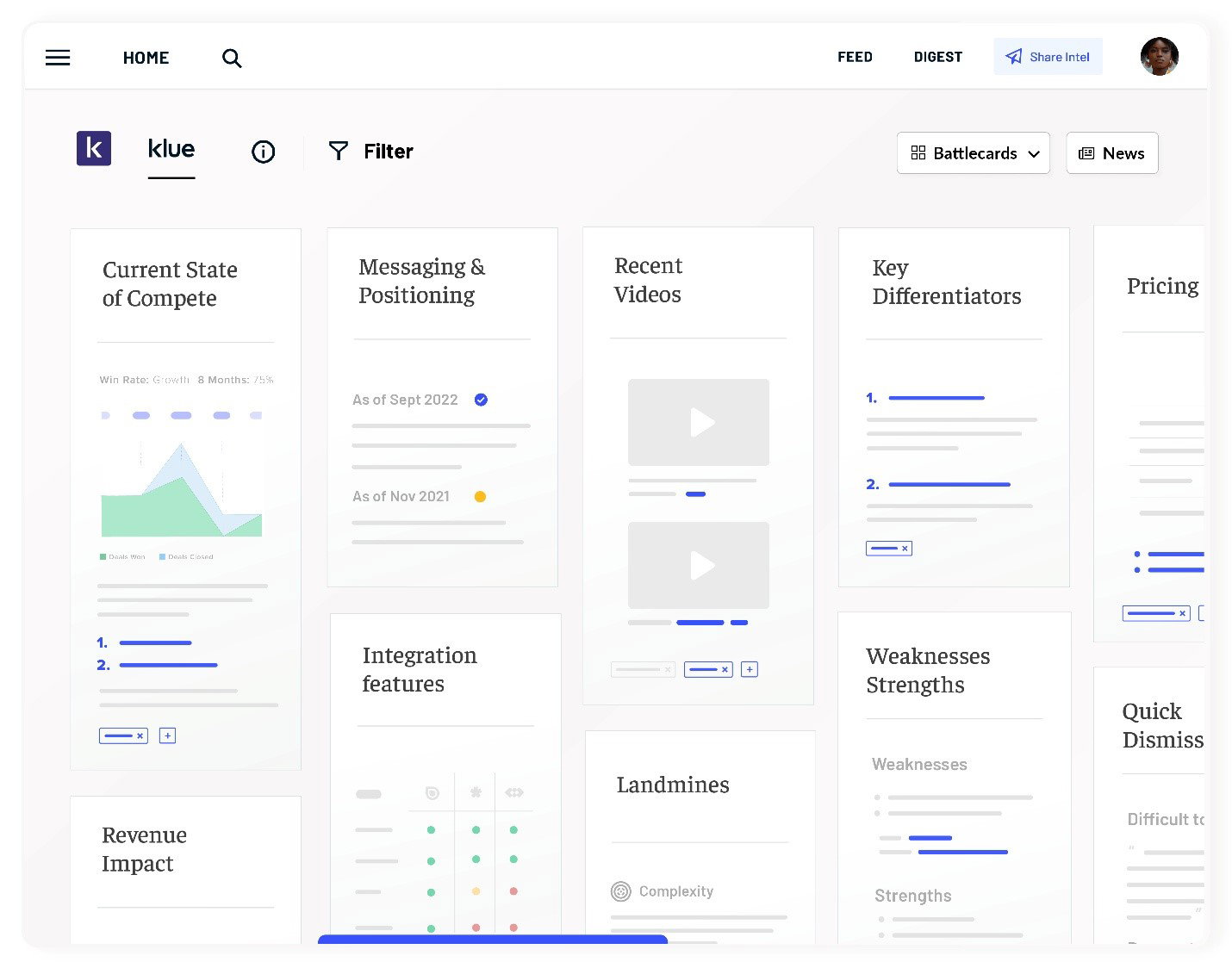
One of Klue’s biggest differentiators in 2026 is Compete Agent, its AI-powered intelligence engine designed to automate research, trend analysis, and deal intelligence generation. Features like Auto Insights, Knowledge Hub, Ask Klue, Deal Tips, and Klue Insights help teams surface competitive trends faster, answer positioning questions more consistently, and understand how competitive intelligence programs directly influence pipeline and revenue outcomes.
Pricing
Klue follows a customized pricing model based on organizational requirements, team size, and intelligence workflows. Businesses interested in the platform can contact Klue directly to request tailored pricing and schedule a demo experience.
What Works & What Doesn't
| Pros | Cons |
| Strong competitive intelligence and battlecard workflows | Initial setup can feel time-intensive |
| Excellent customer support and onboarding experience | Collaboration features may feel limited for larger cross-functional teams |
| Seamless integrations with marketing and sales ecosystems | Customization options are not as extensive as some enterprise platforms |
Our Final Take
Klue is best suited for marketing and revenue teams that need structured competitor tracking, messaging alignment, and actionable market insights. Its AI-assisted research, battlecards, and intel distribution tools make it useful for turning competitive intelligence into stronger marketing strategies.
Demandbase One: Best For Enterprise
Founded in 2006, Demandbase has evolved into one of the most recognized names in account-based marketing and go-to-market intelligence. The company now operates with more than 750 employees across six global offices and serves over 1,000 customers, including IBM, SAP Concur, DocuSign, Hexagon, BlackBerry, Salesforce, and Visa. Demandbase’s continued recognition in G2 reports, including Leader placements and Users Most Likely To Recommend awards, further reinforces its strong position in enterprise B2B marketing.
Why We Chose Demandbase One In 2026
Demandbase One stands out in 2026 because it approaches marketing intelligence from a full go-to-market perspective instead of limiting itself to campaign analytics or account tracking alone. The platform is built around helping B2B teams identify, engage, convert, and expand high-value accounts across the entire customer journey using unified account intelligence and AI-driven orchestration.
Its capabilities stretch across buying group identification, intent signal tracking, CRM syncing, website personalization, account scoring, sales guidance, and journey monitoring. That shared visibility becomes especially valuable for enterprise organizations managing long buying cycles, multiple stakeholders, and complex revenue workflows.
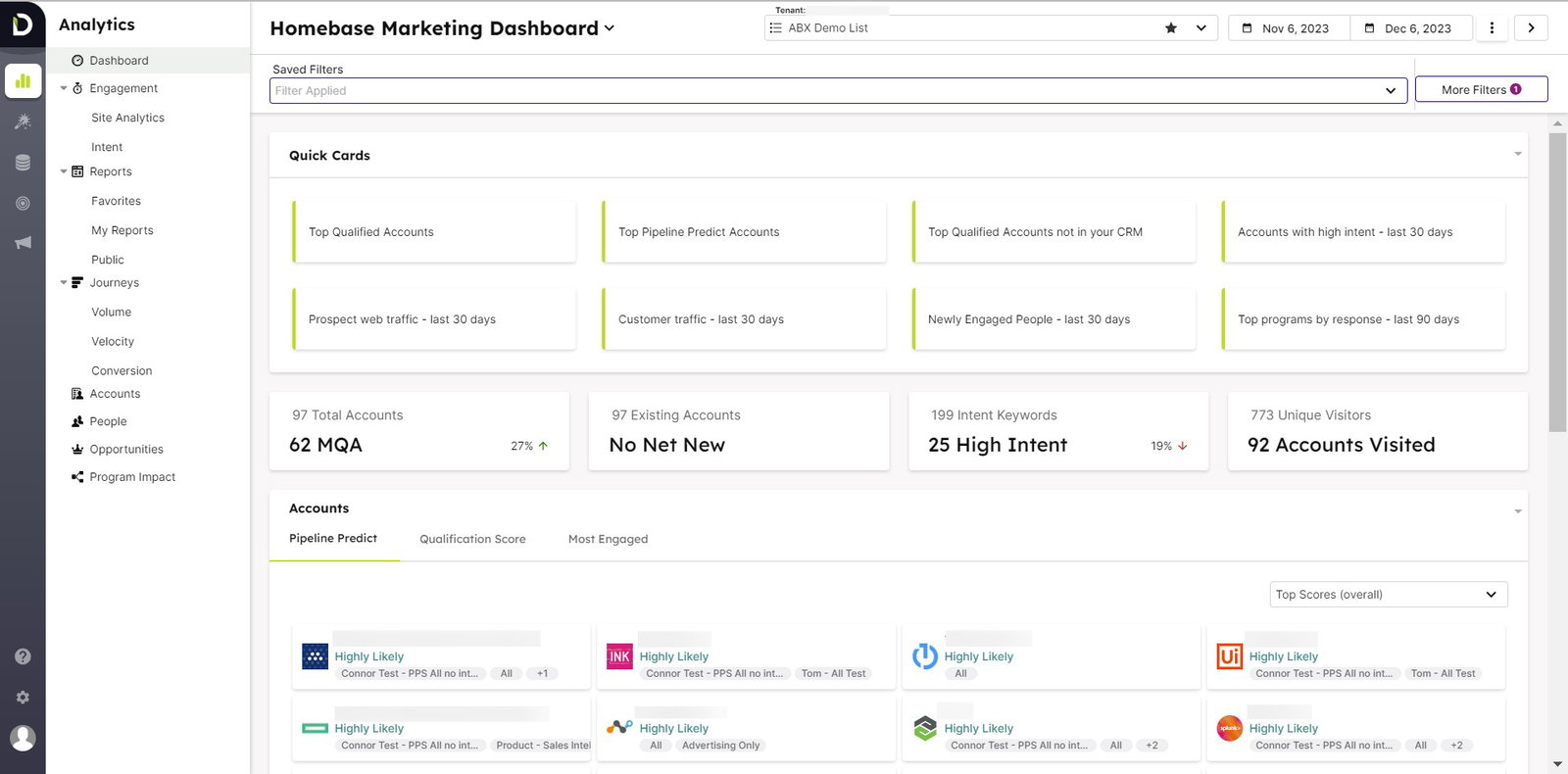
One of Demandbase One’s biggest differentiators is its Pipeline Engine for AI GTM. The platform combines first-, second-, and third-party data sources to surface in-market opportunities, rank accounts by buying readiness, and coordinate next-best actions across marketing and sales workflows.
Pricing
Demandbase One follows a customized pricing structure tailored around organizational requirements, platform usage, and team size. The company uses a platform-based pricing model that includes core software and services, along with flat per-user scaling fees. Demandbase does not separate the platform into standalone product modules.
What Works & What Doesn't
| Pros | Cons |
| Strong account intelligence and buying group insights | The learning curve can feel steep initially |
| Comprehensive datasets and AI-driven orchestration | Some advanced workflows may require technical expertise |
| Excellent customer support and enterprise scalability | Feature depth may feel overwhelming for smaller teams |
Our Final Take
Demandbase is ideal for B2B marketing and GTM teams that need account intelligence, buying group insights, and AI-driven orchestration. Its unified data, intent signals, and pipeline-focused automation make it especially useful for turning high-fit accounts into measurable revenue opportunities.
Top 5 Marketing Intelligence Software Comparison
| Criteria |  |
 |
 |
 |
 |
| Starting Price | Custom | $289/month | $125/month | Custom | Custom |
| Avg. User Rating | 4.5 | 4.5 | 4.4 | 4.7 | 4.4 |
| Trial Period/Demo | Free Trial | Demo | Free Trial | Demo | Demo |
| Key Features | Real-time signals, AI orchestration, and sales intelligence | Competitor tracking, AI search insights, and traffic analysis | Market benchmarking, channel insights, and audience analysis | Competitor profiles, battlecard creation, and AI deal tips | Account intelligence, buying groups, and pipeline orchestration |
| Integrations | HubSpot, Zoho, LinkedIn Sales Navigator, and more | Wix, Surfer, Monday.com, and more | Claude, Google Analytics, Microsoft Power BI, and more | Agentforce Sales, Okta, Slack, and more | HubSpot, Claude, Google Analytics, LinkedIn, and more |
Conclusion
Marketing in 2026 is no longer just about launching campaigns and hoping they work. It is about understanding signals before competitors do, spotting shifts in buyer behavior early, and turning massive amounts of market data into smarter decisions that actually drive revenue. That is exactly where Marketing Intelligence Software has become incredibly valuable.
The right choice ultimately depends on what your team needs most. Some organizations may prioritize competitive tracking and audience intelligence, while others may need pipeline-focused orchestration, AI search visibility, or large-scale account-based marketing support.
One thing, however, is becoming increasingly obvious: in a market where buyer behavior changes quickly, and competition reacts even faster, businesses that can turn intelligence into action will almost always move ahead of those still relying purely on assumptions.
Frequently Asked Questions
What Are The Top 5 Marketing Intelligence Software In 2026?
The Top 5 Marketing Intelligence Software In 2026 are ZoomInfo, Semrush, Similarweb, Klue, and Demandbase One. ZoomInfo is ideal for B2B sales and marketing intelligence; Semrush supports SEO, competitor, and AI search insights; Similarweb helps with market benchmarking and traffic analysis; Klue focuses on competitive intelligence and battlecards, while Demandbase One is built for account-based marketing and pipeline orchestration.
What Is Marketing Intelligence Software Used For?
Marketing intelligence software is used to collect, analyze, and interpret market, customer, competitor, and campaign data. Businesses use these tools to understand buyer behavior, track industry trends, monitor competitors, improve targeting, personalize campaigns, and make data-driven marketing decisions that support revenue growth.
How Do I Choose The Best Marketing Intelligence Software For My Business?
To choose the best marketing intelligence software, businesses should look at their main goals, such as competitor tracking, account-based marketing, SEO intelligence, audience research, or sales pipeline growth. They should also compare pricing, integrations, ease of use, data accuracy, reporting features, and whether the platform fits their team size, industry, and marketing strategy.
Wed, May 20, 2026

Liked what you read? That’s only the tip of the tech iceberg!
Explore our vast collection of tech articles including introductory guides, product reviews, trends and more, stay up to date with the latest news, relish thought-provoking interviews and the hottest AI blogs, and tickle your funny bone with hilarious tech memes!
Plus, get access to branded insights from industry-leading global brands through informative white papers, engaging case studies, in-depth reports, enlightening videos and exciting events and webinars.
Dive into TechDogs' treasure trove today and Know Your World of technology like never before!
Disclaimer - Reference to any specific product, software or entity does not constitute an endorsement or recommendation by TechDogs nor should any data or content published be relied upon. The views expressed by TechDogs' members and guests are their own and their appearance on our site does not imply an endorsement of them or any entity they represent. Views and opinions expressed by TechDogs' Authors are those of the Authors and do not necessarily reflect the view of TechDogs or any of its officials. While we aim to provide valuable and helpful information, some content on TechDogs' site may not have been thoroughly reviewed for every detail or aspect. We encourage users to verify any information independently where necessary.
Loading comments...