 Featured
Data Management
What Is MongoDB? Understanding The Popular NoSQL Database
Share
TL;DR
-
MongoDB offers powerful querying and aggregation capabilities for analyzing complex data.
-
It’s designed for scalability, making it ideal for handling large and growing datasets.
-
Developers prefer MongoDB for its schema flexibility and ease of use with modern apps.
-
It supports high performance with features like indexing and in-memory processing.
-
MongoDB works well in distributed systems, enabling high availability and fault tolerance.

Introduction
Have you watched The Matrix?
There’s that iconic opening sequence where endless streams of green code are flying across the screen, systems are evolving in real time, and everything feels one step away from complete collapse if something goes wrong.
Modern applications are no different in today’s time.
Data today moves fast, changes constantly, and rarely arrives in neat little rows the way traditional databases prefer. One minute, an app is serving a few thousand users, and the next, it is processing millions of interactions, recommendations, messages, transactions, and behavioral signals all at once. Things scale quickly, structures evolve constantly, and flexibility suddenly matters a lot more than people expect.
That is exactly where MongoDB comes in. Instead of forcing everything into rigid tables and fixed schemas, MongoDB was built as a document-based database designed to handle modern applications where data is messy, unpredictable, and constantly changing.
That flexibility is a huge part of why MongoDB became one of the most talked-about databases in modern development.
What Is MongoDB?
MongoDB is an open-source NoSQL database designed to store and manage large amounts of flexible, fast-changing data. Unlike traditional relational databases that organize everything into fixed tables and rows, MongoDB uses a document-based model that adapts much more naturally to modern applications.
That flexibility is a huge reason why developers like working with it. Modern applications rarely deal with perfectly structured data anymore. User activity, product catalogs, messages, media files, recommendations, and real-time interactions all evolve constantly, and MongoDB is built to handle that kind of unpredictability much more naturally.
MongoDB also follows the familiar CRUD model: Create, Read, Update, and Delete. In simple terms, developers can quickly add, retrieve, modify, and remove data without dealing with overly rigid database structures.
Another major advantage is speed and accessibility. MongoDB supports indexing for faster queries, replication for better availability and reliability, and driver support across programming languages like Java, PHP, Python, Node.js, and .NET. This makes it relatively easy to integrate into modern development stacks.
Originally created in 2007 to support large-scale advertising and web applications, MongoDB eventually grew into one of the most widely used NoSQL databases in modern software development. Today, it powers everything from mobile apps and content platforms to AI workloads and real-time analytics systems.
Now that we understand what MongoDB is, let’s understand MongoDB working and its features.
How Does MongoDB Work?
To understand how MongoDB works, let’s take Netflix as an example.
Netflix handles a huge amount of constantly changing information: user profiles, watch history, recommendations, genres, subscriptions, ratings, search activity, and viewing preferences.
MongoDB is built for handling that kind of flexible, unpredictable data.
As shown below, MongoDB stores information inside collections, and each collection contains multiple documents. In our case, one collection may store user profiles while another stores movie data. Each document can contain different fields depending on the information attached to that specific user or movie.
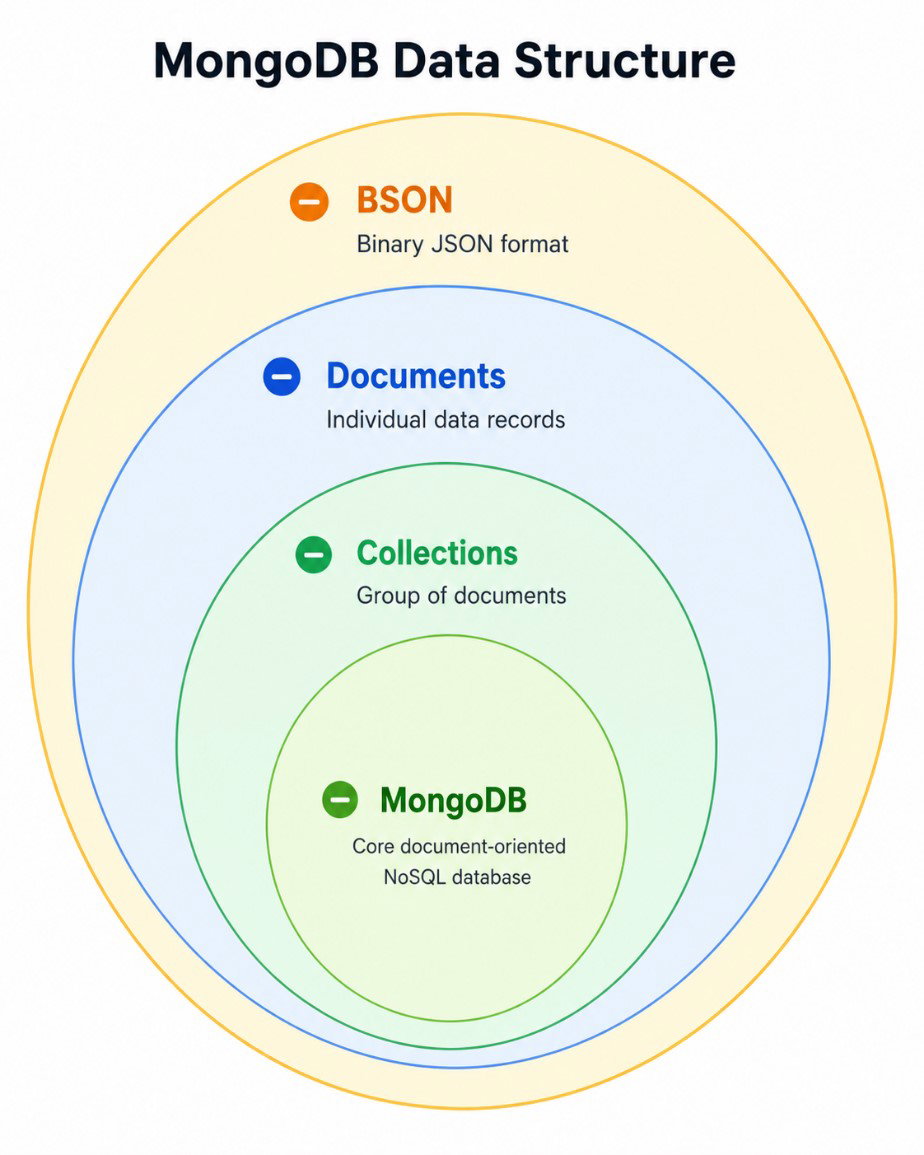
MongoDB also supports indexing, which helps platforms quickly retrieve information. So when someone searches for “crime documentaries” or “Christopher Nolan movies,” MongoDB does not scan the entire database manually every time. Indexes help surface results much faster, especially when millions of users are searching simultaneously.
Another important feature is replication. Platforms like Netflix cannot afford downtime every time a server fails or undergoes maintenance. As shown below, MongoDB uses replica sets to store multiple copies of data across different servers. If the primary server goes offline, another replica automatically takes over to keep the platform running smoothly.
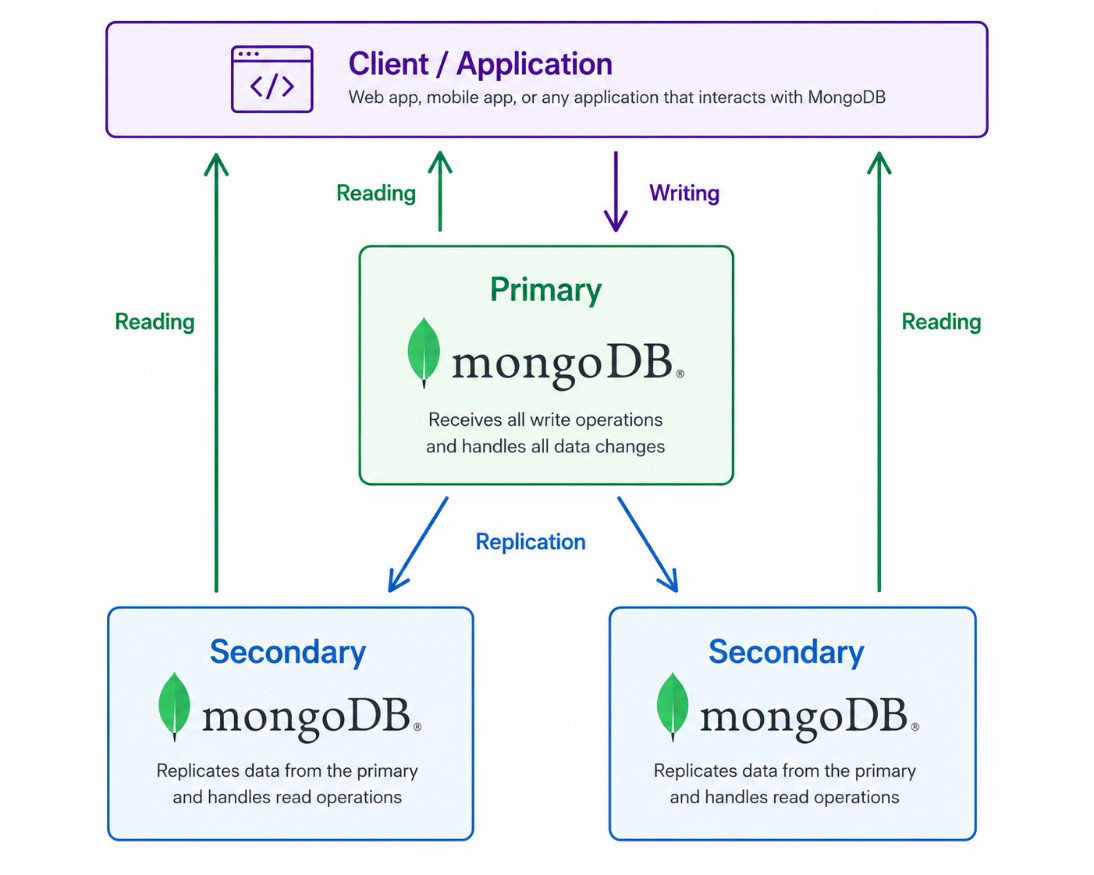
Put together, this flexibility, scalability, speed, and reliability are a huge reason why MongoDB is a popular database choice for modern applications handling constantly evolving data at massive scale.
Now that we have understood MongoDB, one might get confused with the Relational Database Management System (RDBMS). It’s important to understand the difference before we get into its benefits and use cases. Read on.
MongoDB Vs. RDBMS
Traditional relational databases (RDBMS) and MongoDB solve the same problem, storing and managing data, but they approach it very differently.
RDBMS platforms like MySQL, PostgreSQL, or Oracle organize data into strict tables with fixed rows and columns. MongoDB, on the other hand, stores information in flexible JSON-like documents that can evolve more naturally as applications grow.
A simple way to look at it is this:
-
RDBMS works best when data is highly structured, and consistency is critical, such as banking systems or financial transactions.
-
MongoDB works best when applications deal with fast-changing, flexible, or large-scale data, such as streaming platforms, social media apps, real-time analytics, or content-heavy applications.
Here’s a simplified comparison:
| MongoDB | RDBMS |
| Stores data in flexible documents | Stores data in fixed tables |
| The schema can change easily | Requires predefined schemas |
| Better for rapidly evolving apps | Better for highly structured systems |
| Scales horizontally across servers | Commonly scales vertically |
| Uses MongoDB Query Language (MQL) | Uses SQL |
| Handles unstructured data naturally | Best for structured data |
| Popular for modern web/mobile apps | Popular for banking and ERP systems |
MongoDB focuses more on flexibility and scalability, while traditional relational databases focus heavily on structure and consistency. Neither approach is universally “better.” The right choice usually depends on the kind of application being built and how the data behaves over time.

Now that we understand how MongoDB differs from traditional databases, let’s look at some of its biggest advantages.
Benefits Of MongoDB
MongoDB offers outstanding benefits that make it ideal for scalable and high-performance modern applications.
-
Load Balancing
When enterprises’ resource demands increase and cloud applications scale, issues arise with the availability and reliability of services. MongoDB’s load balancing distributes large data sets across several Virtual Machines (VMs) at once while still managing considerable read and write outputs.
This horizontal scaling that MongoDB facilitates is called sharding, which helps businesses avoid the cost of vertical scaling of hardware while still enhancing the capacity of cloud-based deployments. -
Ad hoc Database Queries
One of the biggest merits of MongoDB over other databases is its ability to manage ad hoc queries that don’t demand predefined schemas.
MongoDB database uses a query language similar to SQL databases and is seamlessly accessible to beginners and advanced developers. This accessibility makes it simpler to push, sort, query, update, and export your data with common assistance methods and simple shell commands. -
Multiple Programming Language Support
Several versions of MongoDB have been released and are in continuous development with driver support for popular programming languages, including PHP, Python, Ruby, Node.js, Scala, C++, JavaScript, and more.
These benefits, put together, make some really interesting and useful applications. Let’s look at some of the use cases of MongoDB.
Use Cases Of MongoDB
MongoDB has become a powerful choice across diverse industries and modern use cases. Let’s explore some key applications in real-world scenarios.
-
Real-Time Analytics
When companies scale their operations, it becomes critical to gain access to business insights and key metrics from large data pools. MongoDB converts JSON-like documents, such as BSON, into Java objects effortlessly, making the reading and writing of data incredibly effective while analyzing real-time data across several development environments. This has proved fruitful to many business sectors, including financial services, retail, and government.
-
Content Management System (CMS)
CMS is a robust platform that plays a vital role in providing positive user experiences while handling e-commerce sites, online publications, document management tools, and other applications and services.
By using MongoDB, you can simply integrate new attributes and features into your websites and applications with a single database and higher availability. -
Mobile Applications
MongoDB’s JSON document model allows you to store back-end application data wherever you need it, including in Android devices, Apple iOS, as well as cloud-based storage applications. This flexibility enables you to aggregate data across several environments with geospatial and secondary indexing, giving developers the ability to scale mobile applications effortlessly.
On that note, let’s wrap this article.
Conclusion
MongoDB has emerged as one of the most popular NoSQL databases due to its scalability, flexibility, and high performance. Unlike traditional relational databases, MongoDB stores data in document-oriented collections, making it ideal for handling large volumes of unstructured or rapidly changing data.
Its powerful features, such as aggregation, indexing, automatic failover, and replication, make it well-suited for modern applications ranging from web development to real-time analytics. As businesses continue to generate massive amounts of data, MongoDB provides a reliable and efficient solution for building scalable, quick, and data-driven applications.
Frequently Asked Questions
Is MongoDB Better Than SQL Databases?
It depends on the application. MongoDB is generally better for applications that handle flexible, fast-changing, or unstructured data, such as social media platforms, streaming services, and real-time analytics systems. Traditional SQL databases are often preferred for highly structured applications that require strict transactional consistency, such as banking or financial systems.
Why Do Developers Use MongoDB?
Developers use MongoDB because of its flexibility, scalability, and ease of use. Its document-based structure allows applications to evolve without constantly redesigning database schemas, making it especially useful for modern web, mobile, AI, and cloud-native applications that process large volumes of dynamic data.
What Is The Difference Between MongoDB And Relational Databases?
The biggest difference is how data is stored. MongoDB stores information in flexible JSON-like documents, while relational databases store data in fixed tables with predefined schemas. MongoDB is designed for scalability and rapidly evolving applications, whereas relational databases focus more on structured data and transactional reliability.
Thu, May 14, 2026

Enjoyed what you've read so far? Great news - there's more to explore!
Stay up to date with the latest news, a vast collection of tech articles including introductory guides, product reviews, trends and more, thought-provoking interviews, hottest AI blogs and entertaining tech memes.
Plus, get access to branded insights such as informative white papers, intriguing case studies, in-depth reports, enlightening videos and exciting events and webinars from industry-leading global brands.
Dive into TechDogs' treasure trove today and Know Your World of technology!
Disclaimer - Reference to any specific product, software or entity does not constitute an endorsement or recommendation by TechDogs nor should any data or content published be relied upon. The views expressed by TechDogs' members and guests are their own and their appearance on our site does not imply an endorsement of them or any entity they represent. Views and opinions expressed by TechDogs' Authors are those of the Authors and do not necessarily reflect the view of TechDogs or any of its officials. While we aim to provide valuable and helpful information, some content on TechDogs' site may not have been thoroughly reviewed for every detail or aspect. We encourage users to verify any information independently where necessary.
Loading comments...