Blockchain
The Force Behind Blockchain: Distributed Ledger Technology
Share
Overview
This time, assume every player has a "ledger" that records the results of their throws (aka your choice among rock, paper or scissors). If you throw a “rock” to win the round, the outcome is recorded on your ledger. Similarly, the hands thrown by other players (say, paper or rock) are recorded on their ledgers. When the hands for the round are tallied, everyone can agree that you’re that "annoyingly successful friend" as rock beats every other hand.
We’ve just seen how a decision is made with a consensus of votes in a transparent and decentralized manner. This is similar to Distributed Ledger Technology (DLT); a technology that records transactions into a ledger that can be accessed by every user on the network. This way, only if the majority of the users unanimously agree on the data is it permanently recorded. Yet, there’s a lot more DLT can do other than ensuring there’s no cheating when you play rock, paper and scissors with your friends!
Read on!
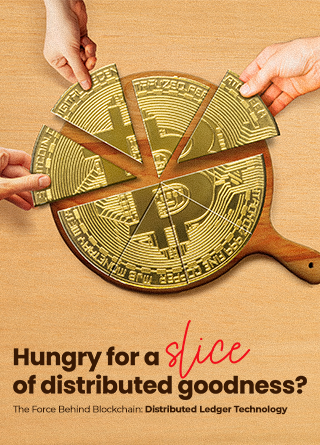
.png.aspx "TechDogs-\"The Force Behind Blockchain: Distributed Ledger Technology\" Hungry For A Slice Of Distributed Goodness?")
The concept of Distributed Ledger Technology is simple: it creates a common record or “ledger” of activity that is shared across every computer in a network. When every user has the same information, it is impossible for one user (or a group) to game the system – we mean, it can be done if more than half the total users of the network unite, yet it is highly unlikely on large networks!
This technology eliminates the need for centralized authority and instead places trust in the users of the network. For example, DLT can be applied to financial use cases to record transactions, which users can verify through various consensus mechanisms, such as proof-of-work (PoW) and proof-of-stake (PoS). No third-party authorities needed to verify the price of a large commission!
Distributed Ledger Technology essentially leverages a network of nodes, so the user at each node has the exact same copy of the ledger. When each user can review the data, the recorded data is tamper-proof, transparent and decentralized. Sounds interesting, right?
Here’s a deeper dive into Distributed Ledger Technology, or DLT.
What Is Distributed Ledger Technology?
The primary distinction between DLT and a conventional, centralized ledger is that a copy of the ledger is distributed to every node (or user) on the network. Since everyone can view and validate the ledger, trust and transparency are vastly improved.
Moreover, as DLT is essentially an immutable database, information that is stored cannot be updated or deleted without the consent of 51% or more users. For business ecosystems, this can be a boon! DLT is also advantageous for military and financial activities as the record of data is permanent. Once a transaction or activity is validated by a majority of users, DLT uses cryptography to safely store the data.
No more arguing about who won which round at the annual TechDogs Rock-Paper-Scissors tournament! #YesThatsAThing
While hand games have been around for centuries, DLT is a recent concept – here’s a brief look!
Evolution And Origins Of Distributed Ledger Technology
You may have come across the term “distributed computing” recently. Although businesses and governments have been experimenting with the concept for decades, today we have achieved a deployable use case for it through Distributed Ledger Technology. Here’s how we achieved that:
The concept of a distributed ledger can be traced back to the Roman Empire through a thought experiment called the Byzantine Generals' Problem. The issue describes a situation in which a general prepares to attack but lacks centralized command as the Byzantine army is widely dispersed. The General can only prevail if he plans an organized attack where every soldier has access to the same information.
Then, in the 1990s, it became possible for computers at various locations to work together to solve complex problems and send the solutions back to a central location. This led to the birth of distributed computing solutions. If only the Byzantine General had heard of this technology! #JustKidding
In 2017, the FCA (Financial Conduct Authority, UK) released an academic paper that led to the HM Treasury’s demand “call for evidence” (CfE) on the public uses of Distributed Ledger Technology. The FAC responded and the CfE described how equities, bonds and other structured products were successfully and legally issued by businesses via the Ethereum blockchain.
Later, in 2020, the American company Axoni launched Veris, a distributed ledger platform to manage equity swap transactions. The platform securely matched and reconciled post-trade data, which led to adoption by major players such as BlackRock Inc., Goldman Sachs Group Inc., and Citigroup, Inc.
The Monetary Authority of Singapore started a pilot program, allowing banks to trade tokenized Singapore government bonds, Japanese government bonds, Singapore dollars and yen using smart contracts. DBS and JP Morgan were the first to use this Distributed Ledger Technology in 2022.
Although the journey has been slow, the steady adoption of DLT leads many to ask: how does it even work? Well, read on!
How Does Distributed Ledger Technology Work?
You know by now that DLTs allow data to be stored securely using cryptographic techniques. The data can still be viewed by users through "cryptographic keys" but once the information is stored, it turns into an immutable database – no modifications or changes allowed.
Moreover, every node on the distributed ledger network receives an updated copy of the ledger. When changes happen in the ledger, such as a new transaction, it is recorded across ledgers on all nodes. #EqualRightsForAllUsers
Yet, the real fun is what happens before the data is etched permanently. When a transaction or activity occurs, voting is carried out where all the nodes must participate. If at least 51% of them agree on the data, the transaction is accepted and the ledger is updated so each node has an updated version.

Think of blockchain networks: when the users reach a consensus about the validity of the latest transaction, the information is finalized, encrypted and stored in the ledger. DLT is what makes blockchain so successful; it is decentralized, transparent and immutable.
Much like blockchain, DLT also has different types and each one has a specific utility. Here’s all you need to know!
Types Of Distributed Ledger Technology
Distributed Ledger Technology has three main flavors:
-
Permissioned DLTs
To access or modify any part of the data, nodes (users) must first obtain permission from a centralized authority. These permissions typically require identity verification.
-
Permissionless DLTs
There is no central authority to validate transactions. Instead, the nodes (users) work together to establish the accuracy of the data. This is done using a variety of consensus mechanisms; for instance, Bitcoin uses a proof-of-work consensus mechanism.
-
Hybrid DLTs
Permissionless and permissioned DLTs can be combined to create a hybrid DLT that can reap the benefits of both types. Certain actions need permission from the centralized authority, while others are accessible to all users.
Now that you know about the types of DLTs, let’s explore where they are used. Let’s go!
Applications Of Distributed Ledger Technology
.jpg.aspx "TechDogs-\"Applications Of Distributed Ledger Technology \"- A Meme Showing Blockchain Uses DLT")
That’s our way of saying that blockchain is probably the most widespread use of DLT. While such solutions have proven to add value in specific industries, we are seeing new applications with each passing day! Some common applications of DLT include:
-
Record Transactions With Accuracy
DLT enables secure, transparent and decentralized processing and recording of transactions without the need for a central authority. As a digital ledger, it can register transactions, activities, events and other records of immutable nature.
-
Tamper-Proof Voting Through Consensus Mechanisms
DLT can be used to create a secure and transparent voting system that prevents double voting and identity scams to ensure the integrity of the voting process. For instance, voting to approve network updates can be recorded in a transparent, immutable ledger along with user interactions.
-
Developing Smart Contracts
DLTs allow users to create smart contracts, that is, agreements that can automatically be executed based on preset conditions. For example, insurance funds may be automatically released once a claim has been processed.
-
Tracking Ownership
DLT can be used to record property transactions and ownership, creating a tamper-proof and transparent record of ownership. Even if there is a transfer of property, the ledger can be updated and used as immutable source ownership.
You bet there are more uses to Distributed Ledger Technology, as there are benefits!
Benefits Of Distributed Ledger Technology
Using a DLT provides several unique advantages, including:
-
High Transparency Of Data
As the records are open to public view, distributed ledgers offer a high level of transparency. If anyone attempts to change or alter data in the ledger, it is immediately reflected across all nodes, preventing any invalid or fake transactions. Any addition to the existing records must be validated by a majority of the nodes (51% or more) using consensus mechanisms.
-
Decentralization
In a centralized network, a single point of failure could happen and bring the entire network to a halt. However, this risk is eliminated in distributed networks as the decentralized architecture of DLT depends on multiple participating nodes.
-
Lower Validation Time
A central authority is not required to consistently validate transactions as users of the network validate transactions using a variety of consensus mechanisms. Hence, the time required for validating each transaction is dramatically reduced.
-
Scalable Nature
Given its quick, reliable and scalable mechanism, Distributed Ledger Technology is adaptable as the number of nodes grows. When we say blockchain projects are sophisticated and secure, it is actually DLT that supports millions of daily transactions!
So, what happens when the transactions go from millions to billions in a few years? To find the answer, read on!
What’s The Future Of Distributed Ledger Technology?
You may have realized that Distributed Ledger Technology has potentially impacted several sectors already. Distributed ledgers are being used across industries such as finance and banking, cybersecurity, healthcare, data security, etc. However, we will see more effective DLT solutions replace outdated ones in the near future.
Most enterprises and visionary tech experts are trying to solve the challenge of quickly and sustainably establishing new networks to leverage DLT solutions. Businesses will try to integrate DLT into existing networks which may radically change how they share data, store sensitive records, vote during meetings, etc. One thing is certain: DLT will enable entirely innovative processes and business models soon! So, are you ready for the DLT Revolution?
Conclusion
.gif.aspx "TechDogs-\"Conclusion\"- A Funny Meme Showing DLT Is Secure From Scammers")

To ensure accuracy, transparency and security, Distributed Ledger Technology creates ledgers stored on separate but linked devices in a network. The famous "blockchain" was developed from DLT to address growing concerns about central third-party entities in transactions. Every modern business that invests in Distributed Ledger Technology can guarantee accuracy in financial reporting, supply chain planning, data security, identity authorization and lots more!
Frequently Asked Questions
What Is Distributed Ledger Technology?
Distributed Ledger Technology (DLT) fundamentally alters how data is managed and shared. Unlike conventional centralized ledgers, DLT distributes a copy of the ledger to each node on the network, ensuring transparency and trust among users. This technology utilizes cryptographic techniques to secure data, making it immutable and tamper-proof unless a majority (51% or more) of users consent to changes. Essentially, DLT empowers users to collectively maintain a shared record without relying on centralized authority.
How Does Distributed Ledger Technology Work?
DLT operates by securely storing data through cryptographic methods, rendering it immutable once recorded. Each node in the network maintains an updated copy of the ledger, ensuring consistency and transparency across the system. Transactions undergo a consensus process where a majority of nodes must agree on the validity of the data before it is permanently etched into the ledger. This consensus mechanism, akin to the process in blockchain networks, guarantees decentralization, transparency, and immutability, which are the core tenets of DLT.
What’s The Future Of Distributed Ledger Technology?
As Distributed Ledger Technology continues to permeate various sectors, its future appears promising. Industries such as finance, cybersecurity, healthcare, and data security are already leveraging DLT to enhance processes and security measures. Looking ahead, we anticipate more robust DLT solutions replacing outdated systems, revolutionizing how businesses handle data sharing, storage, and decision-making processes. Enterprises and tech innovators are actively exploring ways to integrate DLT into existing networks, paving the way for innovative business models and processes. The DLT revolution is on the horizon, promising enhanced accuracy, transparency, and security across diverse domains.
Wed, Jun 14, 2023

Enjoyed what you read? Great news – there’s a lot more to explore!
Dive into our content repository of the latest tech news, a diverse range of articles spanning introductory guides, product reviews, trends and more, along with engaging interviews, up-to-date AI blogs and hilarious tech memes!
Also explore our collection of branded insights via informative white papers, enlightening case studies, in-depth reports, educational videos and exciting events and webinars from leading global brands.
Head to the TechDogs homepage to Know Your World of technology today!
Disclaimer - Reference to any specific product, software or entity does not constitute an endorsement or recommendation by TechDogs nor should any data or content published be relied upon. The views expressed by TechDogs' members and guests are their own and their appearance on our site does not imply an endorsement of them or any entity they represent. Views and opinions expressed by TechDogs' Authors are those of the Authors and do not necessarily reflect the view of TechDogs or any of its officials. While we aim to provide valuable and helpful information, some content on TechDogs' site may not have been thoroughly reviewed for every detail or aspect. We encourage users to verify any information independently where necessary.
Loading comments...