Software Development
Get To The Meat Of Your Business With Agile Development
Share
Overview
Rest assured, they completed the sprint successfully and as they sailed from Portsmouth, Jackson became a fan of Agile. Today, Agile process is the go-to method for many businesses that aim to pace with the ever-changing trends and market demand. Many industries and projects use Agile methodologies to get things done and trust us; it can work for you as well. Read this article to know all about what is Agile Development, its history, benefits and future.

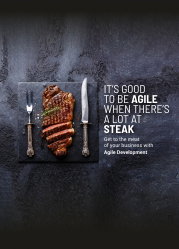
"The Caprese Steak is not on our menu but I will inquire with the chef if we can make some special arrangement," said Oliver, your server for the evening at Barney's Open-Kitchen Steakhouse. In this imaginary steakhouse, you see Oliver whisper your special order to the chef. You are waiting in anticipation, your mouth watering with the thought of biting into the juicy, meaty steak. To your delight, you see the chef smile and nod in acceptance. As he decides to prepare your steak, he calls out your order to the sous chef and gives specific instructions to prepare a delicious steak, just for you . A little later, you decide to ask them for your favorite sides as well. You call Oliver again and request green beans with pickled shallots on the side. He once again repeats the charade and the head chef relays the instruction to his team accordingly.
You overhear the sous chef calling out the head chef that he needs some more balsamic vinegar. The head chef immediately sends in kitchen staff to fetch it from the pantry. While you enjoy the spectacle of their seamless functioning, Oliver sets up your table and serves you a glass of red wine; that could mean only one thing - your steak is almost done. Oliver jets to the kitchen and brings you " The Caprese Steak." He lays it out on the table and with your eyes gleaming in happiness you inhale the aroma and happily take your first bite and horror strikes! You have been served a medium-rare steak while you like it well-done. You raise your hand in the air and Oliver rushes to take your steak back to the kitchen in and within minutes, you have a well-done Caprese Steak. With a full belly, you happily ask for your bill; Oliver hands it over to you, you make the payment (don't forget about a fat tip) and leave the restaurant.
What you just witnessed was a flawless execution of Agile methodology. Eliminating the buzzwords, Agile is not a tool or a software but is a mindset/ methodology to adapt and deliver continuously and iteratively based on customer expectations. When you adopt this mindset to software development, you get Agile Development.
What is Agile Development? How did it become the most effective way of managing a software development teams project? What are its values and benefits. Read on to learn all that and more in this intro guide to Agile Software Development.
What Is Agile Development?

Agile is a term used to describe a development approach that concentrates on learning and improving planning, execution and delivery of project, product or software in small increments by taking continual customer feedback throughout the process of development, so rather than trying to deliver the entire product at once, product is delivered in incremental parts.
Coming back to our earlier example, Taking our imaginary Barney's Open-Kitchen Steakhouse and comparing it to a software development environment: our favorite, Oliver (server) will be the product manager that communicates your requirements and feedback to the team. The head chef here will be the lead developer instructing the team on how to execute your requirements and the rest of the staff is the development team. One step ahead, the menu will be the basic product demo that the team will show you, based on which you order a specific order or customize a new one.
While the development is in progress, you modify your order or add some more specifications to be incorporated. Once you get the first version, you give your feedback, based on which the product is further worked upon (medium-rare to well done!). This iterative approach that involves you - the customer, in the development process and is known as Agile Software Development.
In short - Agile Software Development is a project management and development process that is customer focused and promotes frequent feedback, evaluation of development and software testing throughout the development cycle. In it, instead of risking everything on a "final" launch, an Agile team produces work in small batches and keeps improving on it based on evaluation and customer feedback.
The next big question is, where did it all start?
A Little Background Of Agile Development
Before Agile, the waterfall methodology was the golden benchmark in software development. It was introduced in 1970 and was considered revolutionary because it provided software development a discipline that guaranteed a follow-up specification. Waterfall technique demanded a lot of documentation before writing any codes and were super detailed with plans about the strategy, complete technical specifications and UI designs. Each phase in the production process offered certainty to ensure that the finished product was adapted to what was expected. However, the waterfall process's rigidity became an Achilles heel in the fast times of the Internet, which requires pace and flexibility.
In 2001, a seasoned software developer group gathered and discovered that they collectively approached software development differently from conventional waterfall methodology. This group included technical stalwarts such as Kent Beck, Martin Fowler, Ron Jeffries, Ken Schwaber and Jeff Sutherland, who came up with the Agile Manifesto. It detailed how a modern software development team and the process should work. They also emphasized on teamwork over documentation, self-organization rather than hierarchical management and the desire to continually adapt rather than trap yourself in a rigid production framework. These principles along with agile framework gave birth to the modern Agile Software Development Methodology we know and love today.
Don't you worry, we won't skimp out on the details, here are the famous principles of the Agile Manifesto for your pleasure.

The 12 Principles Of Agile Stated In The Agile Manifesto
-
Our highest priority is to satisfy the customer through early and continuous delivery of valuable software.
-
Welcome changing requirements, even late in development. Agile processes harness change for the customer's competitive advantage.
-
Deliver working software frequently, from a couple of weeks to a couple of months, with a preference to the shorter timescale.
-
Business people and developers must work together daily throughout the project.
-
Build projects around motivated individuals. Give them the environment and support they need and trust them to get the job done.
-
The most efficient and effective method of conveying information to and within a development team is face-to-face conversation.
-
Working software is the primary measure of progress. Agile processes promote sustainable development.
-
The sponsors, developers and users should be able to maintain a constant pace indefinitely.
-
Continuous attention to technical excellence and good design enhances agility.
-
Simplicity - the art of maximizing the amount of work not done - is essential.
-
The best architectures, requirements and designs emerge from self-organizing teams.
-
At regular intervals, the team reflects on how to become more effective, then tunes and adjusts its behavior accordingly.
Makes you wonder, what are the values that brought about the principles of Agile?
Topics For More Insights
The Four Values Of Agile Development
This brings us to the four key values that drive Agile Development:
-
Individuals And Interactions Over Processes And Tools
For a agile, the team working on the project is more important than the tool or the process followed to make it.
-
Working Software Over Comprehensive Documentation
Agile focuses on action over words. Agile wants a working software, not a sob story around why it did not work.
-
Customer Collaboration Over Contract Negotiation
You cannot keep developing and changing your code if you have one binding contract with a set of requirements established in the beginning. So, Agile tells you to involve customers continuously in the process and decide on changes on the go.
-
Responding To Change Over Following A Plan
Earlier, you'd make a road map or a plan and follow it to the top. With Agile, you even need to set a full-fledged plan. You just take one step and a time and decide along the process.
Why Businesses Need Agile Software Development?
The fast-pacing, competitive market in today's world demands businesses to respond to the changes around them quickly. This means that they can't spend months designing software only to realize that the trend has changed and they'd have to do it all over again. Agile method allows businesses to continually adapt and change their product development process to match industry standards and customer demand. Other benefits include:
-
Emphasizes on needs of real users
-
Opportunities for stakeholder and team collaboration pre, during, after every sprint.
-
Realistic expenditure and planning
-
Transparency for clients
-
Maximum focus on business value
-
Improved product quality
What's Next: Future Of Agile
The industry has come a long way from the Waterfall method to continuous delivery and continuous integration with Agile principle. Does that end here? Not even close. Agile practices hold enormous potential and we are likely to witness a convergence of agile and waterfall, giving birth to a hybrid approach. The real future of Agile lies in adopting an Agile mindset.
Agile needs to be looked at not just with software development methodologies but as a business value. Imagine if every business function, from product management to sales, takes the agile approach of continuously improvising to deliver a better customer experience. So, the ultimate goal for agile developers is business agility with Agile Development method. As Bill Gates rightly said, "Success today requires the agility and drive to constantly rethink, reinvigorate, react and reinvent."
Frequently Asked Questions
What is Agile Development and how does it work?
Agile Development is a methodology that focuses on iterative and incremental development, where software is built in small increments and continually adapted based on customer feedback. Unlike traditional approaches that aim to deliver the entire product at once, Agile emphasizes delivering value to customers in small, frequent releases. It involves close collaboration between cross-functional teams, continuous customer involvement, and the flexibility to adapt to changing requirements throughout the development process. This approach allows for quicker delivery of working software and ensures that the final product meets customer needs effectively.
How did Agile Development become the preferred method for managing software development projects?
Agile Development emerged as a response to the limitations of traditional waterfall methodologies, which often resulted in lengthy development cycles and rigid processes. In 2001, a group of software developers came together to formulate the Agile Manifesto, which outlined principles for a more adaptive and customer-centric approach to software development. Agile methodologies prioritize customer satisfaction, welcome changing requirements, and promote collaboration among team members. These principles, along with iterative development practices, have made Agile the preferred method for managing software development projects, allowing teams to deliver high-quality software more efficiently and responsively.
What are the values and benefits of Agile Development?
Agile Development is driven by four key values: prioritizing individuals and interactions over processes and tools, focusing on working software over comprehensive documentation, emphasizing customer collaboration over contract negotiation, and prioritizing responding to change over following a plan. These values promote flexibility, adaptability, and customer-centricity throughout the development process. The benefits of Agile Development include improved responsiveness to changing market conditions, enhanced collaboration between stakeholders and development teams, increased transparency, and higher quality software. By embracing Agile principles, businesses can deliver value to customers more effectively and stay competitive in today's fast-paced market.
Mon, Mar 1, 2021

Enjoyed what you've read so far? Great news - there's more to explore!
Stay up to date with the latest news, a vast collection of tech articles including introductory guides, product reviews, trends and more, thought-provoking interviews, hottest AI blogs and entertaining tech memes.
Plus, get access to branded insights such as informative white papers, intriguing case studies, in-depth reports, enlightening videos and exciting events and webinars from industry-leading global brands.
Dive into TechDogs' treasure trove today and Know Your World of technology!
Disclaimer - Reference to any specific product, software or entity does not constitute an endorsement or recommendation by TechDogs nor should any data or content published be relied upon. The views expressed by TechDogs' members and guests are their own and their appearance on our site does not imply an endorsement of them or any entity they represent. Views and opinions expressed by TechDogs' Authors are those of the Authors and do not necessarily reflect the view of TechDogs or any of its officials. While we aim to provide valuable and helpful information, some content on TechDogs' site may not have been thoroughly reviewed for every detail or aspect. We encourage users to verify any information independently where necessary.
Loading comments...