Storage
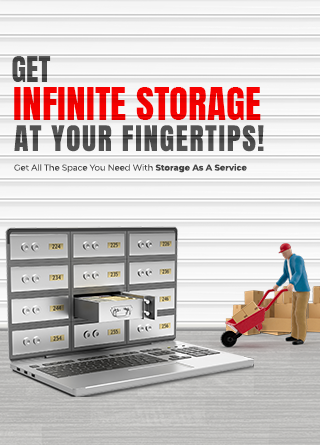
Get All The Space You Need With Storage As A Service
Share
Overview
Would it not be wonderful to have something that never gets over?
However, we live in a world of data where every day brings something unique and new - from videos to images and whatnot! Innumerable bytes of data are consumed and created each day. #DataOcean
We also store our personal data in various formats, from contacts to photos and apps. However, storing evermore larger sizes of data is becoming a challenge to deal with.
That is where a unique concept emerges – providing data storage as a service. Do you remember how Doctor Who had TARDIS, a time-traveling phone booth he used to travel across time and space? While it seemed small (the size of a phone booth from the outside), opening the door revealed a place larger than you can imagine. With Storage As A Service, you can open a door for unlimited storage - as much as you wish to store for anything you wish to store!
It is Storage but as a service - it may look smaller on the outside but can do wonders with its limitless potential!
-01.png.aspx "TechDogs-\"Get All The Space You Need With Storage As A Service\"-\"Get Infinite Storage At Your Fingertips!\"")
Businesses are processing more than USD 2 billion in transactions daily. This shows only one thing: how digital transformation is shaping modern businesses. This kind of revolutionary digital transformation would require modern solutions to fulfill their requirements of storage – a platform to store millions of data points.
Storage As a Service, also known as StaaS is a modern service to empower modern businesses. The concept emerged in the boundless expanse of data storage where information traverses time and dimensions – just like Doctor Who!
Think of the TARDIS, the time-traveling booth from Doctor Who, that knew no physical limitations. Similarly, StaaS has an infinite storage capacity with no physical limitations. TARDIS looked generic with its exterior and outlook; however, it held the entire universe’s secrets; not just the universe but beyond!
StaaS provides individuals and organizations with a virtually limitless repository for their data, accessible from anywhere in the cosmos.
Don’t worry, guys! It is not rocket science. It is just cloud computing, providing storage whenever and wherever you require it.
As we explore the cosmos trying to learn more about StaaS, let’s learn about its basics first.
What Is Storage As A Service (StaaS)?
StaaS is a service provided by cloud service providers for third-party storage. Individuals, small or medium businesses, home offices or big enterprises can use these cloud facilities for various purposes such as multimedia storage, data repositories, data backup or even disaster recovery. It is like entering into the TARDIS – anyone can time travel anywhere and look up any data!
Individuals can access the storage using a standard interface or application program interface (API). Besides the data storage capacity, cloud service providers also offer storage services such as raw storage volumes, network file systems, storage objects and managing backup lifecycles.
The concept of Storage as a Service is quite effective for small and mid-sized businesses as they do not need to invest in implementing storage capacity or maintaining storage infrastructure at the beginning of operations.
Speaking of the beginning, wouldn’t you wish to time travel in TARDIS? Well, we do not have a time travel machine yet - but we can go back into the history of storage!
The Brief History Of Storage

We all store our data in the cloud in one way or another. However, cloud technology hasn’t always been a way to keep our data safe. While cloud technology has transformed the way we store our data, let’s talk about how it all began in the first place.
The 1700s: The Early Punch Cards
Punched cards are the oldest form of data storage, introduced in the early eighteenth century. However, they were not used as storage devices as they were used to control automated textile looms during the onset of the industrial revolution.
Over the years, they became a form of computer data storage for basic computer programs, financial records and various other use cases.
The 1900s: The Local Storage
Throughout the 20th century, various devices were introduced to store data more efficiently than before. Magnetic tapes were the first development to store analog data. They could store audio and video recordings as well.
Later, different gadgets were invented, such as hard disks, floppy disks, compact disks and USB flash drives in the end. The latest were superior to the previous ones, more handy and easily accessible with larger storage capacities.
The 1990s: The Cloud Storage
The year was 1994 and the world was ready to introduce one of the revolutionized technologies that changed the way we store our data. AT&T launched a service called PersonaLink services that facilitated both personal and business communications to store files online, the first of its kind web-based storage service – cloud storage.
Later, in 2006, Amazon came up with its limitless potential and amazing cloud services. It made it possible to store unlimited data online in data centers connected to the internet. Amazon introduced a storage service called Amazon Simple Storage Service, widely known as Amazon S3, which currently has over 100 trillion objects of up to five terabytes each.
Now that we know how storage became a service from gadgets, let’s talk about how this service works. Don’t fret, it’s not as complex as time-traveling!
How Does StaaS Work?
Storage as a Service (StaaS) operates on a subscription-based model, like other managed service models on the Software as a Service (SaaS) model. Businesses subscribe to a storage space package with a Service Level Agreement (SLA) and charges are incurred monthly, quarterly or yearly.
An alternative option is the pay-as-you-go system, where businesses are charged predetermined rates for the storage they use, resulting in a more cost-effective model for many companies. Now, let's explore how managed service providers store data for StaaS setups.
-
File Storage
The file system storage model enables users to organize their files in a hierarchical directory structure, resembling the data management approach found on personal computers or public cloud infrastructures such as Amazon AWS, Microsoft OneDrive or Google Cloud.
-
Block Storage
Block storage management entails dividing data into smaller blocks and distributing them efficiently across the system to facilitate easy retrieval by devices. It operates like how a computer's hard drive or solid-state drive (SSD) functions, enabling quick access to files.
-
Object-based Storage
Object storage proves ideal for various applications, including APIs and Internet of Things (IoT) data. It organizes data by incorporating metadata, enabling users to locate information swiftly.
That wasn’t that techy to understand, was it? Businesses have been adopting these services for different storage types based on their business type and requirements.
Let’s explore!

What Are The Applications Of StaaS?
StaaS finds applications in various real-time scenarios, offering flexibility, scalability and accessibility to meet dynamic data storage needs. Here are some real-time applications of StaaS:
-
Backup Data & Disaster Recovery
By leveraging cloud storage, data is continuously replicated and stored off-site, providing a reliable backup solution. In the event of data loss or a disaster, organizations can quickly restore their data from the cloud, ensuring business continuity.
-
Big Data Analytics
The large volumes of data stored in the cloud let you analyze and process the data in real time, resulting in actionable, powerful insights that help make confident decisions.
-
Content Distribution
Your favorite shows on Netflix and Amazon Prime rely on StaaS to store and deliver real-time media content! With scalable storage infrastructure, they seamlessly handle high volumes of data and ensure that we can binge-watch all the seasons of Doctor Who.
Apart from the above-mentioned applications, StaaS is helpful in Ecommerce, virtual reality, collaborative workspaces, IoT and many others. StaaS is popular because of its three primary reasons, which make StaaS so important. Let’s see what they are!
Why Is StaaS So Important?
StaaS serves solutions to three fundamental problems. Let’s have a look at them:
-
Volume Of Data
A large amount of data has always been challenging to store and manage. Enterprises deal with large volumes of data daily, as StaaS helps manage and access the stored data easily.
-
Variety Of Data
Traditional storage can no longer manage the unstructured variety of data. Multiple data types can be handled with StaaS, especially when the majority of the data is unstructured.
-
Velocity Of Data
The amount and rate of generating unstructured data is rapid on Ecommerce and social media platforms. StaaS solves the problem of velocity and growth of data as well.
Apart from solving problems, StaaS offers significant benefits as well. Let's see!
What Are The Benefits Of StaaS?
Here are the benefits of StaaS you need to know about:
-
Scalability
It lets businesses expand or reduce their storage resources based on their current needs. The seamless scalability eliminates the need for upfront investments and ensures optimal resource utilization and cost-effectiveness.
-
Security
Cloud service providers are known for their reputation and security due to their offerings, such as encryption and access controls. Regular backups and disaster recovery mechanisms help safeguard your data against loss or unexpected events. Now you have a plan B in case things go wrong!
-
Accessibility
Access the data from anywhere and any device with an internet connection. This flexibility promotes remote work and collaboration and enables seamless data sharing and synchronization across teams and locations.
It’s time to visit the TARDIS one more time as we dive into the future of StaaS. We do not know the future. However, being fans of Doctor Who, we are optimistic and sure that the future of StaaS is promising!
.gif.aspx "TechDogs-\"What Are The Benefits Of StaaS?\"-\"A GIF From A TV Show Doctor Who - Cool, Right?\"")

The Future Of StaaS
The future of Storage as a Service (StaaS) holds immense potential with the convergence of various technologies. As technologies evolve, the way we store our data will also change over time:
- Flashed Memory's fast read/ write capabilities will enable even more efficient data storage and retrieval.
- Edge computing will bring storage closer to the data source, reducing latency and enabling real-time processing at the edge devices.
- Artificial Intelligence/ Machine Learning algorithms will enhance data management, enabling intelligent data categorization, predictive analytics and automated storage optimization.
StaaS will get more advanced to handle the massive influx of data, provide faster and more responsive storage services and unlock valuable insights from the stored data. #BrightFuture
Last Stop
As data continues to grow exponentially, Storage as a Service presents a compelling option for businesses looking to optimize their storage strategies, improve data security and stay competitive in the ever-evolving technological landscape. Just as the Doctor's time-traveling vessel opens doors to infinite possibilities, StaaS unlocks new dimensions of storage efficiency, accessibility and innovation for businesses.
Let’s not forget what Doctor Who said, “There’s always something to look at if you open your eyes!”
Frequently Asked Questions
What Is Storage As A Service (Staas) And How Does It Work?
Storage As a Service (StaaS) is a cloud service provided by third-party cloud service providers for storing data. It allows individuals and businesses to access storage space on a subscription basis, eliminating the need for investing in and maintaining physical storage infrastructure. Users can store various types of data, including multimedia, backups and disaster recovery data, and access it from anywhere using standard interfaces or APIs. StaaS operates on a subscription-based or pay-as-you-go model, providing flexibility and cost-effectiveness.
What Are The Applications Of Storage As A Service (Staas)?
Storage As A Service (StaaS) finds applications in backup data and disaster recovery, big data analytics, content distribution, ecommerce, virtual reality, collaborative workspaces and IoT. It offers flexibility, scalability and accessibility to meet dynamic data storage needs.
Why Is Storage As A Service (Staas) Important?
StaaS addresses three fundamental challenges in data storage: volume, variety and velocity. It helps manage large volumes of data easily, handles multiple data types and accommodates the rapid growth of unstructured data. Additionally, StaaS offers benefits such as scalability, security and accessibility, making it crucial for modern businesses.
Fri, Aug 25, 2023

Enjoyed what you read? Great news – there’s a lot more to explore!
Dive into our content repository of the latest tech news, a diverse range of articles spanning introductory guides, product reviews, trends and more, along with engaging interviews, up-to-date AI blogs and hilarious tech memes!
Also explore our collection of branded insights via informative white papers, enlightening case studies, in-depth reports, educational videos and exciting events and webinars from leading global brands.
Head to the TechDogs homepage to Know Your World of technology today!
Disclaimer - Reference to any specific product, software or entity does not constitute an endorsement or recommendation by TechDogs nor should any data or content published be relied upon. The views expressed by TechDogs' members and guests are their own and their appearance on our site does not imply an endorsement of them or any entity they represent. Views and opinions expressed by TechDogs' Authors are those of the Authors and do not necessarily reflect the view of TechDogs or any of its officials. While we aim to provide valuable and helpful information, some content on TechDogs' site may not have been thoroughly reviewed for every detail or aspect. We encourage users to verify any information independently where necessary.
Loading comments...