Data Management
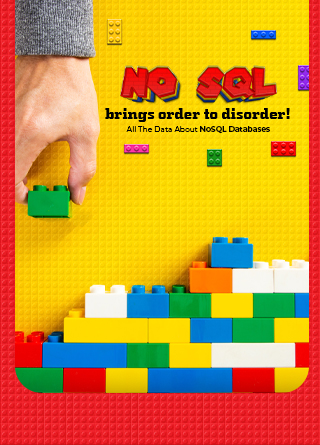
All The Data About NoSQL Databases
Share
Overview
With this method, you may need several drawers, not to mention countless hours to categorize every block. You’re essentially creating a structured database, where you define a strict location for storing each block. When you’re building something, you would need to rummage through multiple drawers, searching for the right piece. Talk about slowing down your creative process!
The second approach is much more fun as it entails creating a gigantic, colorful pile of LEGO blocks! You can throw them together with total disregard for any organizational approach. Sounds chaotic, right? Yet, when you’re building something and need a specific brick, you could simply reach into the pile and grab it. No need to identify a logic to locate and search a specific drawer. That’s the NoSQL way!
Unlike traditional databases, NoSQL Databases embrace a non-relational approach, where data is stored in a flexible, unstructured manner. It's like having a giant pile of LEGO blocks (data), so you can add, modify and retrieve them quickly. Ready to learn more about NoSQL Databases?
LEGO!
.jpg.aspx "TechDogs-\"All The Data About NoSQL Databases\" NoSQL Brings Order To Disorder!")
We bet every business owns at least one database – whether it’s an industrial equipment manufacturer or baby clothes retailer. Irrespective of the industry, most databases follow a typical tabular structure, AKA, a relational database. Think of an Excel sheet – we bet every business uses that too!
However, NoSQL Databases store data in a flexible, non-tabular format. Thanks to this non-relational design, the database does not require a schema (a blueprint or structure of the database). This leads to high scalability and flexibility when it comes to managing large unstructured data sets. The database knows where every piece of data is stored, just not as a row-column matrix.
NoSQL is also a distributed database, that is, information can be stored on various servers. This ensures always-on availability and reliability of data whether the servers are on-premises or remote. Want to understand how this chaotic approach to storing data can actually benefit businesses?
Hop on as we explore all about NoSQL Databases; its evolution, how it works, types, benefits, future and more!
What Are NoSQL Databases?
Let’s start by breaking down the term “NoSQL” – it stands for "not only SQL" where SQL (Structured Query Language) refers to a programming language used to manage data held in a relational database. Hence, NoSQL Databases can handle “not only” relational but also non-relational data.
This is achieved by storing data in a non-tabular format. Hmm, still sounds complex, right? So, let’s understand what the terms “relational” and “tabular” mean. Yeah, at TechDogs we want you to get the clearest picture possible! #TechForAll
A relational database refers to a database that stores data and provides access to information about how it is linked to one another.
A tabular database, as the name implies, stores data in a structured tabular format.
Bringing it all together, NoSQL Databases allow data to be stored in formats other than SQL databases (that is, other than rows and columns). This flexibility allows users to create formats that are ideal for large datasets.
Wondering who thought of it first? Read on!
Evolution And Origins Of NoSQL Databases
In 1998, Carlo Strozzi coined the term "NoSQL" to describe his open-source, lightweight relational database called Strozzi NoSQL. While it did not leverage the standard Structured Query Language (SQL) interface, it remained relational.
In the late 2000s, the cost of data storage dramatically decreased. (Spoiler Alert: this is when NoSQL Databases first emerged!)
This graph shows the cost of storing 1 MB of data in US dollars:
.png.aspx "TechDogs-\"Evolution And Origins Of NoSQL Databases\"-\"A Graph Showin How Data Storage Became Cheaper\"")
The amount of data generated by businesses and individuals increased as storage costs rapidly declined. The problem was that this data came in all shapes and sizes — structured, semi-structured, polymorphic, etc., — making it impossible to define a database schema ahead of time.
In February 2001, the Agile Manifesto was signed to emphasize the need for an alternative to the documentation-driven software development process. At the same time, software engineers were rethinking the development of databases for software development.
In the early 2000s, cloud computing also became more popular. Developers quickly realized the need to distribute data across multiple servers and regions. This could help deploy applications that were resilient, always accessible and location agnostic.
NoSQL Databases came into existence to answer these questions and give developers the flexibility they needed to store and access data flexibly.
Today, NoSQL Databases have unique features such as flexible schemas, horizontal scaling and fast queries to enable ease of use for developers. Yet, how does it all work?
How Do NoSQL Databases Work?

NoSQL Databases can be purpose-specific given their flexibility and scalability. However, at their core, they have five main features that help them function the way they do:
-
Flexible API Integration
SQL Databases use SQL programming language as the primary, or only, interface to the data. With NoSQL Databases, that exclusivity is eliminated and non-SQL interfaces can also be used.
-
Unique Data Model
NoSQL Databases allow for better adaptability of data as it is not modeled as tables with fixed rows and columns. The information can be represented as key-value pairs, JSON documents, graphs with nodes and edges, etc.
-
Schemaless Design
There is no set structure to the data, data types, or lengths for data elements in a NoSQL Database, so its schema is flexible. Programmers can work with more freedom and flexibility when storing data in a free-form or "schemaless" manner.
-
Horizontal Scalability
Typically, NoSQL Databases use horizontal scaling, which involves "sharding" to divide large databases into smaller ones distributed across multiple servers.
-
BASE Approach
NoSQL databases manage data integrity using the BASE (Basically Available, Soft State with Eventual Consistency) approach, which updates all copies of the data to be consistent to maintain data integrity.
Through a combination of these five features, NoSQL Databases offer various advantages over traditional relational databases.
Here’s a question for you: is a red round brick LEGO more useful than a yellow knob LEGO?
Well, it depends on the usage. Similarly, various types of NoSQL Databases are useful in differing use cases. Read on!
Types Of NoSQL Databases
Unlike LEGO bricks, NoSQL Databases can be classified into four main categories:
-
Document Databases
These NoSQL Databases can store data in semi-structured documents and formats such as JSON or XML. They are preferred with document-oriented query languages.
-
Key-value Stores
These NoSQL Databases can store information as key-value pairs and are preferred for quick read/write operations in the database.
-
Column-family Stores
These NoSQL Databases can store data as column families, that is, sets of columns that can be treated as a single entity. They are preferred for quick and efficient querying of large datasets.
-
Graph Databases
These NoSQL Databases can store data as nodes and edges and are generally preferred while handling large datasets with complex relationships.
Naturally, no matter which type of NoSQL Database you choose, there are plenty of benefits.
.gif.aspx "TechDogs-\"Types Of NoSQL Databases\"-\"A GIF Of Legos\"")
Although not nearly as many as the LEGO pieces we own! #LegoFanatics
Benefits Of NoSQL Databases
Many developers ask why they should opt for NoSQL Databases or non-relational databases. Well, here are some of the key reasons:
-
Enhanced Flexibility
Data in SQL databases is kept in a rigid, predetermined structure. NoSQL Databases allow data to be stored in a free-form manner without the use of rigid schemas, enabling quick innovation and application development. Developers don't have to worry about schemas when developing systems, as NoSQL Databases can easily handle a variety of data formats in a single data store.
-
High Scalability
NoSQL Databases can scale by using “sharding” rather than by adding more servers or hardware. This easily accommodates increased database traffic and satisfies the requirement for zero downtime. Hence, scaling of NoSQL Databases allows your evolving data sets to grow larger and more powerful, leading to better insights.
-
Improved Database Performance
When data volume or database traffic increases, the scale-out architecture of NoSQL Databases can be especially useful in ensuring quick and reliable response times. NoSQL Databases can ingest data and deliver it swiftly and consistently, which is particularly in applications that gather large amounts of data and necessitate a highly interactive response from the database.
-
Highly Functional Storage
NoSQL Databases are designed for distributed data storage, especially for systems that require vast amounts of data. Due to its flexible nature of data storage, NoSQL Databases are the ideal choice for big data, real-time applications, online gaming, the Internet of Things and interactive web applications.
Well, now you know how NoSQL Databases can help your business improve data management. Yet, it has long-term benefits as well – you’ll understand once you read about the future of NoSQL Databases.
Scroll on!
What’s The Future Of NoSQL Databases?
Databases are a major expense for businesses. Thus, nobody wants to migrate or modify the data once it has been entered into the database. This decides choosing a database crucial and many emerging businesses will choose NoSQL Databases in the near future.
The "shared-nothing" architecture will be prevalent in NoSQL Databases soon. Each server node in a shared-nothing architecture cluster functions independently of the others. As a result, the system does not need to obtain consensus for a request. This means that queries will execute more quickly as they will be directed only to the nearest node. A shared-nothing architecture also has the benefit of being highly resilient. Even if one NoSQL node fails, the other servers in the cluster will continue to operate and provide access to the database.
Just like LEGOs, NoSQL Databases aren’t going anywhere anytime soon!
Conclusion
Every business relies on data and their choice of database directly affects business decisions and insights. Hence, when it comes to databases, a NoSQL Database is an ideal choice. Its non-relational, schemeless and distributed nature enables businesses to extract the full potential from their data. After all, who wants to categorize every single data point like it’s a LEGO brick? It’s time to have fun building with data, so LEGO of traditional databases and invest in NoSQL Databases!
Frequently Asked Questions
What are NoSQL Databases?
NoSQL Databases, short for "not only SQL," diverge from traditional relational databases by storing data in a non-tabular format. Unlike relational databases, they don't require a predefined schema, offering high scalability and flexibility for managing large unstructured datasets. This non-relational design allows for various storage formats beyond the typical row-column matrix, such as key-value pairs, JSON documents, or graphs.
How do NoSQL Databases work?
NoSQL Databases operate on five key features: flexible API integration, unique data models, schemaless design, horizontal scalability through sharding, and the BASE approach for data consistency. These features collectively offer advantages like adaptability, fast queries, and distributed data management. Unlike SQL databases, NoSQL systems don't rely exclusively on SQL interfaces, enabling developers to work with diverse data structures and access patterns efficiently.
What are the types of NoSQL Databases?
NoSQL Databases come in four main types: document databases, key-value stores, column-family stores, and graph databases. Each type caters to specific data storage and querying needs. Document databases excel at storing semi-structured data like JSON or XML, while key-value stores optimize quick read/write operations. Column-family stores are efficient for querying large datasets, and graph databases specialize in managing complex relationships. Choosing the right type depends on the nature of the data and the application's requirements.
Thu, Aug 31, 2023

Enjoyed what you read? Great news – there’s a lot more to explore!
Dive into our content repository of the latest tech news, a diverse range of articles spanning introductory guides, product reviews, trends and more, along with engaging interviews, up-to-date AI blogs and hilarious tech memes!
Also explore our collection of branded insights via informative white papers, enlightening case studies, in-depth reports, educational videos and exciting events and webinars from leading global brands.
Head to the TechDogs homepage to Know Your World of technology today!
Disclaimer - Reference to any specific product, software or entity does not constitute an endorsement or recommendation by TechDogs nor should any data or content published be relied upon. The views expressed by TechDogs' members and guests are their own and their appearance on our site does not imply an endorsement of them or any entity they represent. Views and opinions expressed by TechDogs' Authors are those of the Authors and do not necessarily reflect the view of TechDogs or any of its officials. While we aim to provide valuable and helpful information, some content on TechDogs' site may not have been thoroughly reviewed for every detail or aspect. We encourage users to verify any information independently where necessary.
Loading comments...