IT Infrastructure
A Comprehensive Guide To IT Infrastructure
Share
Overview
From the various software you are running on your corporate laptop to the hardware it’s connected to, such as LAN cables, routers and access points to the CRM your organization uses - every business in the world relies on components of IT infrastructure to operate and achieve business goals.
Naturally, the IT Infrastructure needs to be flexible, dependable and secure for a business to achieve its goals and gain a competitive edge in the market. We mean, can a manufacturing business that still uses blueprints and pen-paper sketches survive, let alone dominate the market? Every organization needs IT Infrastructure, be it a semi-virtual system that uses virtual machines or a physical system with hardware devices.
Think of IT infrastructure as the highway and the roads that connect your hardware and software. Moreover, it brings together the users from various verticals, domains and regions to work together!
Join us as we explore the what, why and how of IT Infrastructure!
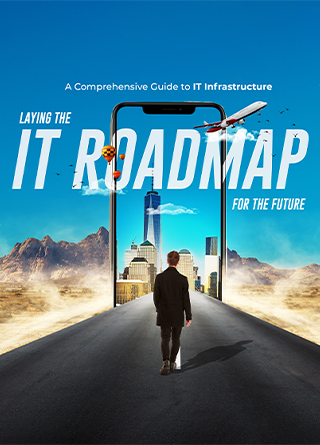
.png.aspx "TechDogs-\"A Comprehensive Guide To IT Infrastructure\"-Laying The It Roadmap For The Future")
Imagine if your local road administration decided to build an eight-lane highway right in front of your house located in a serene rural area, or a dirt road instead of a freeway to connect busy cities. Would people ever get to their intended destinations? We’re sure chaos and congestion would ensure!
The same is true for your organization’s IT Infrastructure. A poorly designed infrastructure will restrict how well your employees can communicate and collaborate, make access to critical resources challenging and reduce technology’s aid in the workplace. Just like designing the roads so that it takes 20 miles to get to a gas station but the airport is within walking distance!
Hence, businesses need to design their IT Infrastructure beforehand and implement it correctly. So that when your employees need that Word file, they can get it as quickly as possible. Or when you need that sales report from the business server, the application does not crash. Or when your remote co-worker has a Linux Operating System and you have Windows, you don’t have to ask for a new laptop! Yes, that's how much we depend on IT Infrastructure today!
In literal terms, IT Infrastructure entails all components and tools that are installed or implemented by a business to ensure IT services such as software applications, hardware devices, networks, servers, etc. function smoothly and efficiently.
Let’s dive in!
Understanding IT Infrastructure
The best way to understand IT Infrastructure in in layers, starting from the basics and gradually adding components that will form the entire IT Infrastructure in a typical work environment. Let’s go!

In most companies, employees have their designated workstations, which consist of a laptop or a desktop. These systems (hardware) are used by the employees to access business applications (software) which they need to conduct business-related activities – and sometimes watching cat GIFS on Reddit. (can’t just be us!)
Apart from these systems, a typical company also has a server room, where enterprise servers are running on a software that enables secure and reliable Internet access to employees through browsers. Other servers may be used for various data-related activities such as batch-processing and database handling.
Going one level higher, these servers, hardware systems and databases come together through networks, which contain IT components such as switches, routers, hubs, etc. We're sure you have a better understanding of what a generic IT Infrastructure looks like in any organization.
Before we dive into the technicalities and cool stuff, let us take a quick look at the evolution of IT Infrastructure - from its humble beginnings to the complex but super-efficient infrastructure that we rely on today.
The Evolution Of IT Infrastructure
So what was there before computers? Well, throughout the late 1800s and early 1900s, the full extent of most businesses’ IT Infrastructure was based on a tabulating machine. These machines were typically quite large and clunky, some literally looked like a weird piano! Take a look for yourself...

It combined the functionality a calculator with a printer and was mostly used to complete tasks such as filing payroll information and tracking bills. This may not sound as impressive as sending your cat’s photo to a friend halfway across the world but it was the highest form of automation you could get at that time.
Then, in the 1930s, the term ‘super-computing’ was used for the first time. The tabulating machines had a long life span but as technology improved, it was overshadowed by a new player in business - the ‘mainframe.’ These were powerful servers that could be used for bulk data processing. The most famous mainframe - IBM 360 – could execute over 16 million instructions in a second! While mainframes were great, they were replaced in the early 80s – by the personal computer.
One of the biggest differences between a mainframe and a PC was that multiple individual PC users could connect to a central server, thanks to client-server architecture. This type of IT Infrastructure was developed in the early 80s and its applications can be seen today in emails, the world-wide-web and wireless printing. By the early 2000s, PCs had become a staple piece of equipment in almost every workplace.
IT Infrastructure really boomed after this point. The introduction of networks and servers helped increase the productivity and efficacy of workplaces. The most recent addition to the IT Infrastructure is cloud computing. In the early 2000s, with the rise of laptops and other portable devices, the need to access data on the go emerged. Cloud computing uses a network of remote servers that are hosted on the internet to store, process, access and manage data (think OneDrive, Dropbox or Google Drive).
That has been the journey of IT Infrastructure so far. Now, as promised, let’s get into the cool stuff!
Topics For More Insights
What Are The Building Blocks Of IT Infrastructure?
To understand IT Infrastructure, let’s break it down into the 4 vital components and understand why each of these components is essential to the creation and deployment of an efficient IT Infrastructure:
-
Hardware
This component forms the very core of IT Infrastructure. The physical machines and devices that help in establishing a robust system, including PCs, switches, Wi-Fi routers, network cables, servers and data centers, etc. are the hardware components of an IT Infrastructure.
-
Software
Hardware gains vitality due to the software, or metaphorically speaking, the software is what gives consciousness to the hardware. We have all used software at work for file-sharing (Google Drive or MS Teams), communication (Slack), video conferencing (Skype) or document processing (MS Word or Excel), etc. Other aspects of the software are the operating systems such as Linux and Windows and enterprise management systems such as Customer Relationship Management or Enterprise Resource Management software, etc., that are crucial to running a business.
-
Networking
The need for businesses to be connected cannot be overlooked in today’s day and age. Being in touch with executives, decision-makers and stakeholders at all times is as crucial as conducting business activities themselves. Networking components include firewalls, load balancers, local area networks, routers, switches, etc. In the age of cloud computing, it is even more important to focus on creating a robust network of interconnected enterprise systems as part of your IT Infrastructure.
-
People
Although the ITIL (Information Technology Infrastructure Library) does not include this component while defining IT Infrastructure, people are the most crucial element. The onus falls on the people (employees) to make good use of the other components to achieve the desired results for the organization. From conglomerates to start-ups, everyone employs IT system administrators who are in charge of handling the IT Infrastructure. A skilled and qualified talent pool is crucial to the effective implementation, maintenance and improvement of IT Infrastructure.
Understanding these 4 blocks of IT Infrastructure can help your business set up a robust yet flexible IT Infrastructure to assist employees and stakeholders in achieving the business goals! #ITsThatCritical
However, these components can be structured in various ways, leading to three different types of IT Infrastructure – let's explore.
The Types Of IT Infrastructure
The following are the three types of IT Infrastructure:
-
Traditional Infrastructure
In this type, all the hardware components of the IT Infrastructure such as data centers, storage devices, laptops and PCs are actually owned and managed by the business within their own premises. This type of IT Infrastructure is often considered expensive as it requires a lot of hardware, power supply, in-house IT teams and physical space too.
-
Cloud Infrastructure
As the name suggests, this type of IT Infrastructure resides mostly on the cloud. This enables businesses to create either a private cloud using internal resources or use a public cloud from cloud providers such as Alibaba, Google, IBM, Amazon or Microsoft. This type has proven to be a boon for companies experimenting with a remote work model or employing remote workers.
-
Hyper-Converged Infrastructure
Imagine how cool it would be to manage your laptop (hardware), business applications (software) and network service (network) from a single interface! Hyper-Converged infrastructure allows you to do just that (and more!) by bundling storage, compute, networking and management requirements in a unified platform.
Depending on the peak traffic and the number of registered vehicles, city planners are able to come up with a suitable plan to build highways and roads. Similarly, depending on your workforce and their hardware and software requirements, you can choose the most apt IT Infrastructure of the three mentioned above.
Well, let’s check the future of IT Infrastructure before rush-hour traffic!
What’s Trending In IT Infrastructure?

IT Infrastructure will have a crucial role to play in the digital transformation of business processes. It will go beyond laptops and PCs as wearables and IoT devices will arrive in workplaces. Automation will be the need of the hour as IT environments will grow more complex every day and humans won’t be able to keep up with their demands. Looking into our crystal ball, we can foresee that the cloud execution model or serverless computing will make it possible to use servers on a pay-per-use basis, without the need to maintain physical storage space.
Moreover, Artificial Intelligence (AI) will help in automating a large portion of the IT Infrastructure activities, as AI-based tools will become more capable and advanced with time. This will lead to higher network agility and digitally transformed workplaces. So, is your IT Infrastructure taking your business to its right destination?
To digitally transform, you need to know about the latest developments in the world of technology. Head on to the TechDogs homepage to find the latest tech content, including Articles, White Papers, Case Studies, Reports, Videos and Events the complete lot to help you Know Your World of Technology.
Thu, Jun 30, 2022

Liked what you read? That’s only the tip of the tech iceberg!
Explore our vast collection of tech articles including introductory guides, product reviews, trends and more, stay up to date with the latest news, relish thought-provoking interviews and the hottest AI blogs, and tickle your funny bone with hilarious tech memes!
Plus, get access to branded insights from industry-leading global brands through informative white papers, engaging case studies, in-depth reports, enlightening videos and exciting events and webinars.
Dive into TechDogs' treasure trove today and Know Your World of technology like never before!
Disclaimer - Reference to any specific product, software or entity does not constitute an endorsement or recommendation by TechDogs nor should any data or content published be relied upon. The views expressed by TechDogs' members and guests are their own and their appearance on our site does not imply an endorsement of them or any entity they represent. Views and opinions expressed by TechDogs' Authors are those of the Authors and do not necessarily reflect the view of TechDogs or any of its officials. While we aim to provide valuable and helpful information, some content on TechDogs' site may not have been thoroughly reviewed for every detail or aspect. We encourage users to verify any information independently where necessary.
Loading comments...