Cloud
Why Cloud Infrastructure Is Becoming A Business Growth Lever
Share
Overview
Here is a brief introduction to Bijo:
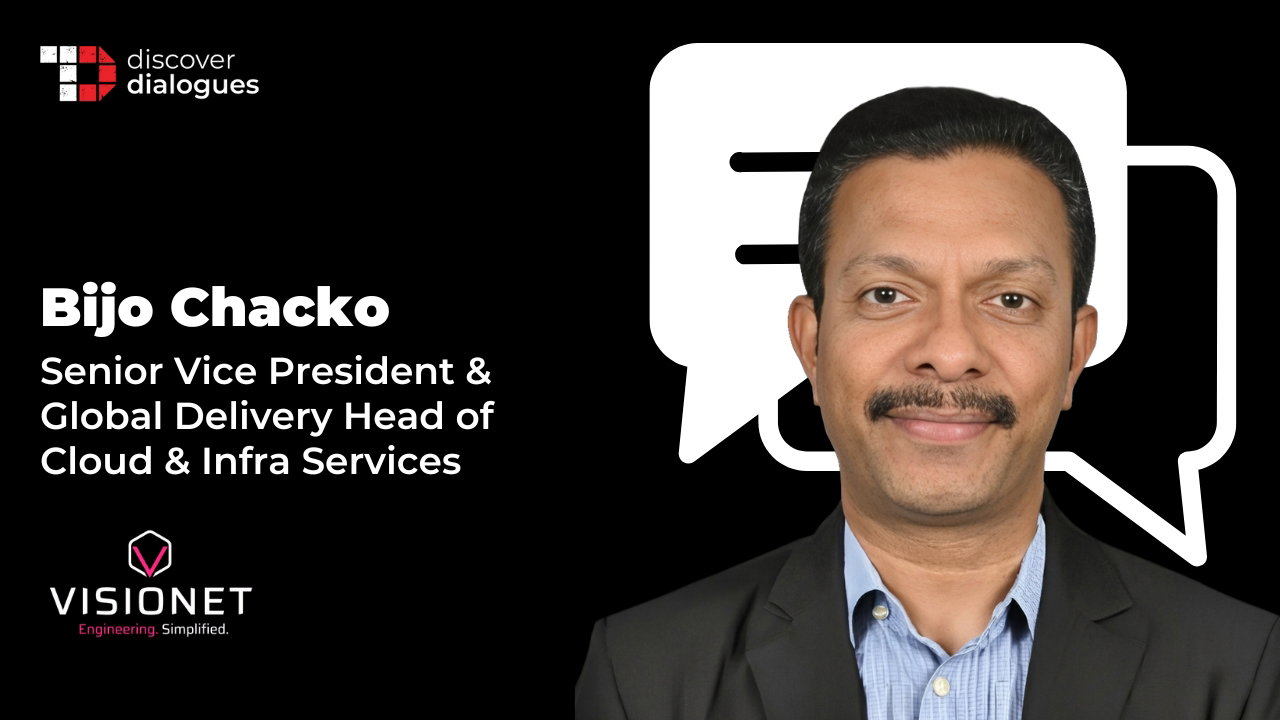
Bijo Chacko is the Senior Vice President and Global Delivery Head of Cloud & Infrastructure Services at Visionet Systems. With extensive experience across cloud, infrastructure managed services, AWS, Microsoft Azure, Kubernetes, and global IT delivery, he works with enterprises to modernize cloud operations, strengthen resilience, improve cost governance, and build scalable digital infrastructure. His expertise spans cloud-native transformation, hybrid and multi-cloud environments, FinOps, AI-led observability, automation, and infrastructure services across sectors such as BFSI, retail, travel, transportation, hospitality, and shared services.
With deep experience across cloud and infrastructure services, how do you see enterprise infrastructure priorities changing as organizations move toward more cloud-native operating models?
The conversation has really shifted. Three years ago, everyone was debating where to run their systems - on-prem, data center, or cloud. That debate is mostly over now. The real question today is how you operate, and that's a much tougher problem to solve.
A few things stand out to me. Infrastructure teams are no longer just keeping the lights on - they're now expected to build platforms developers can self-serve from, with guardrails baked in. That shift from infrastructure management to platform engineering is a real cultural change for traditional IT teams.
Security is the other big one. In a cloud environment, one misconfiguration can cascade fast. It can't be something you check at the end - it has to be built into how you design and deploy from day one.
And honestly, AI is starting to reshape infrastructure economics in ways a lot of teams aren't ready for. GPU infrastructure, model serving, data pipelines - these are now real production problems, not just R&D experiments.
The organizations getting this right have accepted one thing: infrastructure is never finished. It keeps evolving, and our teams have to evolve with it.
As businesses adopt platforms such as AWS, Microsoft Azure, and Kubernetes, what are the most common challenges they face in building scalable, resilient, and cost-efficient cloud environments?
The most common thing I see is that organizations migrate to the cloud but carry their old habits with them. They lift and shift workloads without really redesigning for cloud - and then wonder why the bills are high and the reliability isn't where they expected.
Cost is probably the number one shock. Cloud gives you incredible flexibility, but that same flexibility means you can overspend at remarkable speed. Most organizations don't build cost discipline (FinOps) early enough, and by the time they notice, there's significant waste already baked in.
Kubernetes is a great example of the complexity trap. It's powerful, but it has a steep learning curve. Teams adopt it because it's the industry standard, then find themselves managing more complexity than they bargained for- without the skills internally to run it well.
Resilience is another consistent gap. Everyone assumes cloud means high availability automatically. It doesn't. You still have to design for failure - and most organizations only discover these gaps during an actual outage, which is never a good time to learn.
You need to land your cost governance model early, before the spend grows. Invest in upskilling your teams - don't just buy the technology. Design for failure from day one, not as an afterthought. And don't let multi-cloud sprawl happen without a clear governance layer sitting across all of it.
The technology is mature. The discipline around it is where most organizations fall short.
You have led global infrastructure managed services across sectors such as BFSI, RCM, TTH, and shared services. How do infrastructure needs differ across industries, and what remains common across all of them?
Most Indian enterprises are running a mix of everything: legacy data centres, multiple public clouds, SaaS apps, UPI and payments systems, remote work, and in some cases OT or branch environments. Each of these brings its own tools and logs. When that information sits in separate places, you inevitably end up with blind spots.
Unified visibility is really about answering a simple question: “Do we know what’s happening across our entire technology estate, quickly enough to act?” If you can’t see devices, users, cloud workloads, and critical applications together, you’re always one step behind the attacker. That’s why more leaders are trying to get security‑relevant data into a common layer and using AI to highlight what matters most. It’s less about a single dashboard and more about having one trusted view of risk that security, IT, and business teams can act on together.
Cyber threats in India are evolving rapidly, especially with the rise of AI-driven attacks and identity-focused breaches. Which emerging threat patterns concern you the most right now?
Two shifts worry me the most. First, attacks are now happening at “machine speed.” AI lets attackers scan, learn, and exploit weaknesses much faster than before, so the time between a small mistake and a major breach is shrinking. Traditional, manual defences struggle when the other side is using automation and AI by default.
Second, attacks are increasingly targeting people and trust, not just systems. We’ve seen deepfake‑based scams where fraudsters use AI‑generated video to bypass identity checks, including Aadhaar verification. Digital payments are being hit by highly convincing phishing, fake QR codes, and “digital arrest” scams, where people are coerced over video calls by attackers impersonating officials. For India’s critical sectors like banks, telecom, government, and energy, which mix of AI‑driven speed and identity‑based attacks is especially dangerous. It means we must invest more in protecting identities, monitoring behaviour, and verifying that the person or system on the other side is genuine before we trust them.
Despite growing interest in AI-led cybersecurity, many organizations still struggle with implementation. Where do you think the biggest readiness gaps exist today across technology, processes, or talent?
The first gap is technology debt. Many SOCs are still built on older tools and fragmented stacks that were never designed with AI in mind. They produce a lot of alerts but not enough insight, which makes it hard to plug in AI and get meaningful outcomes. Without better‑integrated platforms and cleaner data, AI risks becoming a side project.
The second gap is process and governance. In many AI projects, security comes in at the end rather than being part of the design. Basic questions are still unclear in a lot of organisations: which AI tools are allowed, what data can they see, how long is it kept, and who owns the risk? The third gap is skills. Teams increasingly need people who understand both security and data/AI, how models work, where they can fail, and how to keep them aligned with business and regulatory expectations. India has strong cyber talent, but we need structured upskilling to prepare teams for this new blend of responsibilities.
For organizations looking to move beyond reactive defense models, what foundational changes are necessary to build a more predictive and prevention-first security posture?
Every industry thinks their problems are unique- and to a degree, they're right.
In BFSI, everything revolves around compliance. The regulatory bar is high, the audit requirements are relentless, and security isn't negotiable. Whereas in RCM, the focus shifts to scale and integration. You're dealing with e-commerce platforms, ERP and POS integrations, and increasingly, real-time data pipelines feeding personalization and demand forecasting. And in TTH, where auto-scaling gets genuinely stress-tested. Booking platforms, reservation engines, loyalty systems - these can go from baseline to peak traffic in hours. The cloud infrastructure has to be designed for that elasticity by default, not as an afterthought. Cost governance is equally critical because idle infrastructure between peaks is pure waste.
What's universal across all of them;
-
Observability is non-negotiable. Every client needs end-to-end visibility across their cloud environment - infrastructure metrics, application performance, security events - unified into a single monitoring layer.
-
Identity and access governance is the second constant. Who has access to what, with what level of privilege, and is it being reviewed regularly? In cloud environments, over-privileged identities are one of the biggest risk vectors we see across every sector.
-
Resilience by design — not resilience by assumption. High availability, tested DR runbooks, defined RTO and RPO targets that are actually validated. Most organizations have these on paper. Fewer have actually tested them under realistic conditions.
-
Infrastructure as Code and automation maturity. Whether it's BFSI or retail, the organizations that manage cloud well are the ones that have removed manual processes from provisioning, patching, and configuration. Human intervention at scale is where drift and risk creep in.
-
And finally, FinOps discipline. Tagging hygiene, rightsizing, reserved capacity planning, showback to business units - this is now a core infrastructure function, not a finance team problem. Every CFO across every vertical is asking the same question: what are we getting for our cloud spend?
These fundamentals are the baseline expectation everywhere.
What role does a strong global delivery model play in ensuring service reliability, operational consistency, and customer confidence across large enterprise technology environments?
The honest answer is that global delivery models are going through a fundamental reset right now - and what worked two years ago is already becoming outdated.
Traditionally, global delivery was built around people and shifts. You'd have L1 engineers monitoring dashboards, triaging alerts, running first-level diagnostics, and escalating when needed. Follow-the-sun meant hiring across time zones to keep human eyes on customer environments around the clock. It worked, but it was expensive, it was reactive, and it was only as good as the engineer who picked up the alert.
What's changing dramatically in the last six to twelve months is that AI-based observability is taking over that entire first layer. Platforms are now correlating signals across infrastructure, applications, and security in real time - identifying anomalies, predicting failures, and in many cases auto-remediating issues before a human even knows there was a problem. What used to take an L1 engineer twenty minutes to triage is now being resolved in seconds.
This is genuinely shifting the delivery model from reactive to predictive. We're moving from "customer calls because something broke" to "we're already fixing something the customer hasn't noticed yet." That's a completely different conversation to have with an enterprise client - and it builds a very different level of confidence.
The role of the human engineer is evolving too. L1 as a function is shrinking. The value is moving up the stack - to engineers who can interpret what the AI is surfacing, make judgment calls on complex situations, and drive continuous improvement.
For a global delivery leader, this changes the economics significantly. You can cover more customers, at higher quality, with leaner teams - but only if your tooling, your processes, and your people are genuinely ready for that shift. The organizations that embrace this transition are going to pull ahead.
As infrastructure teams manage increasingly complex hybrid and multi-cloud ecosystems, what capabilities should they build to improve governance, performance, and long-term service quality?
Hybrid and multi-cloud sound sophisticated, but the problems it creates are very practical. Workloads spread across AWS, Azure, and on-prem, each with different tooling and billing - without the right capabilities, you end up with a visibility gap, a governance gap, and a cost gap all at once.
The first capability is unified observability - a single plane of glass across the entire estate, rather than siloed tools stitched together manually. AI now does much of the heavy lifting on correlation and anomaly detection, but only if your data is unified to begin with.
The second is policy-as-code. Manual compliance checks don't scale across multiple clouds. Security baselines, tagging standards, and access policies need to be codified and enforced automatically, not checked after the fact.
Third is FinOps as a continuous discipline - rightsizing, commitment planning, chargeback to business units - not a dashboard someone glances at monthly.
Infrastructure as Code matters just as much. Provisioning and configuration should be version-controlled and automated, because in complex hybrid environments, manual changes are where drift - and eventually incidents - creep in.
And the most underrated capability is skills investment. The tooling exists. The patterns are well understood. The real gap is teams that haven't kept pace with the environments they're managing.
Long-term service quality comes from building these capabilities deliberately - not bolting them on after something breaks.
In your current role at Visionet, how are cloud and infrastructure services evolving from backend operational support to a strategic enabler of business agility and digital transformation?
This shift is something I see play out daily in my own role. Cloud and infrastructure used to sit firmly in the "keep the lights on" category - necessary, but invisible to the business. That's no longer true. Infrastructure decisions now directly shape how fast a business can launch a product, enter a new market, or respond to a demand spike. It's moved from a cost center conversation to a business agility conversation.
At Visionet, this is exactly the thinking behind OpenDesk, our AI-powered MSP platform. OpenDesk was built to unify visibility, control, and automation across a customer's entire cloud environment - instead of operations teams toggling between disconnected tools, everything sits on a single platform with AI and GenAI-powered support baked in.
What that translates to practically is fewer manual interventions and faster response times. OpenDesk drives self-healing capabilities into the environment - issues are being detected and resolved automatically, often before a customer even notices an impact. That's a very different value proposition than traditional managed services, where you're paying for headcount to watch dashboards.
The strategic shift is this: when infrastructure operations become largely autonomous, our delivery teams stop spending their time on routine triage and start spending it on what actually moves the business forward - cost optimization, architecture decisions, security posture, and scaling for the next phase of growth. That's where the real conversation with our customers' leadership teams happens now.
So, the way I'd frame it - cloud and infrastructure haven't just become more reliable; they've become a lever. Platforms like OpenDesk are what let us shift our customers' infrastructure spend from "running things" to "enabling growth."
Tue, Jul 21, 2026

Enjoyed what you read? Great news – there’s a lot more to explore!
Dive into our content repository of the latest tech news, a diverse range of articles spanning introductory guides, product reviews, trends and more, along with engaging interviews, up-to-date AI blogs and hilarious tech memes!
Also explore our collection of branded insights via informative white papers, enlightening case studies, in-depth reports, educational videos and exciting events and webinars from leading global brands.
Head to the TechDogs homepage to Know Your World of technology today!
Disclaimer - Reference to any specific product, software or entity does not constitute an endorsement or recommendation by TechDogs nor should any data or content published be relied upon. The views expressed by TechDogs' members and guests are their own and their appearance on our site does not imply an endorsement of them or any entity they represent. Views and opinions expressed by TechDogs' Authors are those of the Authors and do not necessarily reflect the view of TechDogs or any of its officials. While we aim to provide valuable and helpful information, some content on TechDogs' site may not have been thoroughly reviewed for every detail or aspect. We encourage users to verify any information independently where necessary.
Loading comments...