Financial Management Solutions
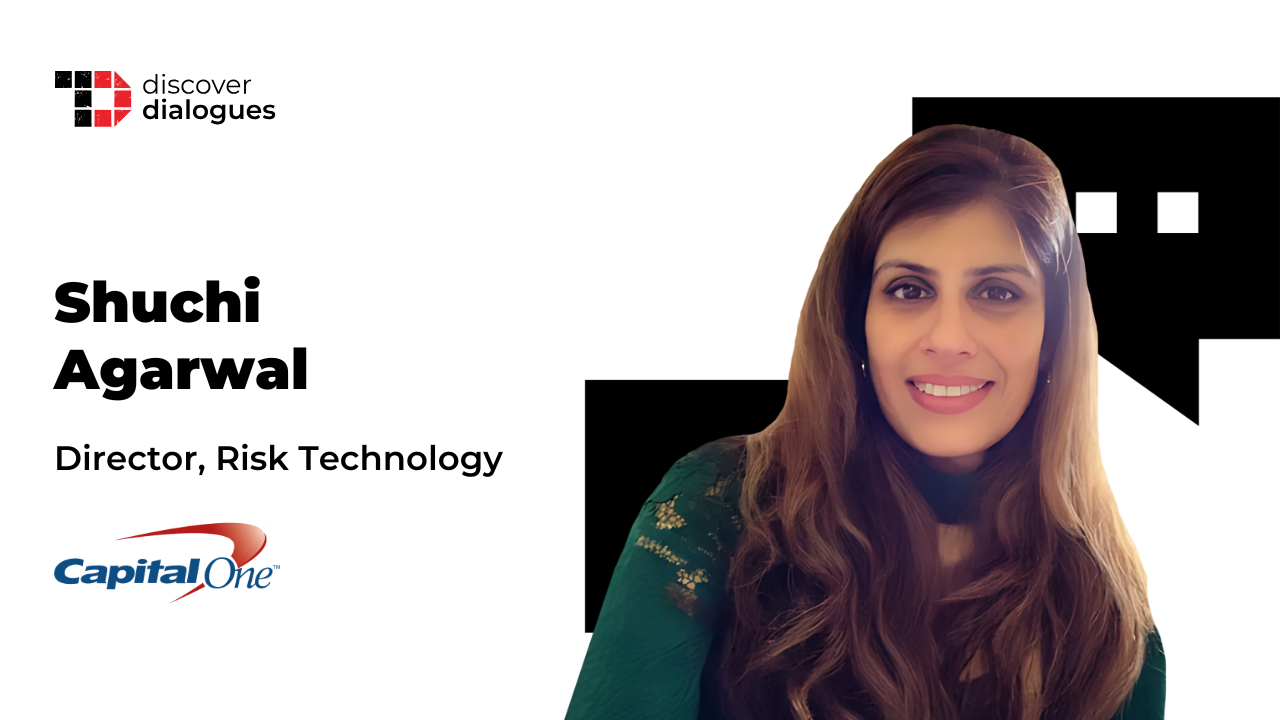
Shuchi Agarwal, Director At Capital One On Engineering Excellence In The Age Of AI
Share
Overview
Here is a small introduction to Shuchi Agarwal:
Shuchi Agarwal is Director of Risk Technology at Capital One and a seasoned technology leader with over 25 years of experience across financial services and healthcare. She has led global engineering teams in modernizing legacy systems, driving AI adoption, and embedding resilience into enterprise platforms. Known for championing human-centric design and inclusive leadership, she combines deep technical expertise with strategic foresight, helping organizations align innovation with business outcomes while ensuring systems remain robust, fair, and future-ready.
TD Editor: In an era where AI models increasingly influence financial risk decisions, how do you ensure the human lens — especially inclusive thinking — remains central in building those systems?
Shuchi Agarwal: That's the fundamental question in risk technology today. The goal of AI should never be to replace human judgment, but to augment and empower it. My own career journey has taught me the critical importance of human-centric design, and that principle is the bedrock of our approach. We should be building intelligent systems,to act as a partner to our users, not a replacement. The system should be designed to handle the exhaustive, time-consuming tasks—sifting through decades of unstructured data, identifying potential patterns, and reviewing documentation for quality.
This will free up our users to focus on what humans do best: applying critical thinking, understanding nuanced context, and making complex judgment calls. We ensure the human lens remains central in two key ways. First, through a "human-in-the-loop" design. The AI provides insights, flags anomalies, and suggests lines of inquiry, but the final decision and the ultimate assurance rest with a person. Second, we build our systems through inclusive co-creation. The development of our technology shouldn't be done in a tech silo; it should be a deep partnership between engineers, product managers, designers, and the users themselves. By having diverse voices at the table from the very beginning, we ensure the system is built to solve real-world problems and reflects the varied perspectives of the people who will use it.
TD Editor: Risk technology is evolving rapidly, especially with AI in the mix. What are the nuanced ethical or operational blind spots you think only leadership can spot—and how do you build teams to catch them early?
Shuchi Agarwal: Leadership's unique vantage point is the ability to see beyond the code and connect it to the broader landscape of business strategy, reputational risk, and customer trust. One of the most nuanced blind spots we must guard against is automation bias—the subtle but powerful tendency for people to over-trust the output of an automated system. A leader's role is to relentlessly champion a culture of healthy skepticism. We have to constantly ask, "What if the model is wrong?" and empower our teams to challenge the machine. Another critical blind spot is data integrity. An AI model is a mirror reflecting the data it was trained on. Leadership must push the teams to question the data itself: Whose history does it represent? What biases might be embedded in it? What context are we missing? Building teams to catch these issues early requires intentional design.
1. We build for cognitive diversity. This isn't just about demographics; it's about bringing together people with different professional backgrounds—business, design, product, data science, and engineering—to analyze a problem from all angles.
2. We foster psychological safety. It is essential that the most junior engineer on the team feels safe enough to question an assumption or flag a potential bias they see in a dataset, even to senior leadership.
3. We implement rigorous governance. This includes formal risk management frameworks and ethical review boards that act as independent challengers, ensuring our technology is not only effective but also fair and responsible before it ever impacts a decision.
TD Editor: How do you personally define 'engineering excellence' in an era where velocity can often come at the cost of resilience?
Shuchi Agarwal: I define engineering excellence as sustainable velocity, achieved through resilience. The idea that speed and stability are opposing forces is a false dichotomy. True, sustainable speed is only possible when you build on a foundation of well-managed, resilient systems. Rushing to deliver a feature that is brittle or incurs significant tech debt is not velocity; it's just borrowing time from the future with high interest. My experience, from launching new services in the fast-paced environment of AWS to leading teams in a well-managed, regulated company like Capital One, has shown me that excellence rests on three pillars:
• Customer Obsession: Excellence begins with deeply understanding the problem you're solving. Velocity is useless if you're quickly building the wrong thing.
• Operational Rigor: A system is not "done" when the code is deployed. It's done when it's observable, reliable, and secure in production. Building in resilience from the start is what allows teams to move faster later, as they aren't constantly fighting fires.
• Technical Craftsmanship: This is about taking pride in building systems that are not just functional, but also clean, maintainable, and scalable. It's this craftsmanship that prevents the accumulation of tech debt and enables future teams to build upon your work with confidence and speed.
TD Editor: What shifts have you seen in how CTOs or engineering leaders are expected to show up in boardrooms?
Shuchi Agarwal: The expectation has fundamentally shifted from the engineering leader as a service provider to a strategic partner. A decade ago, the conversation might have been limited to reporting on budgets, project timelines, and system uptime. Today, a technology leader is expected to be a business strategist who speaks the language of technology. We are now required to be compelling storytellers, capable of translating highly complex topics—like the business implications of a multi-year cloud transformation or the competitive advantage offered by a proprietary GenAI model—into the language of business outcomes, risk appetite, and market opportunity. The focus is no longer just on what we are building, but on why it matters. We must be able to clearly articulate how our technology strategy directly enables the company's strategic objectives and strengthens its risk management posture.
TD Editor: When you're modernizing legacy systems, how do you create space for young engineers, especially women, to contribute meaningfully rather than just follow orders?
Shuchi Agarwal: Modernizing legacy systems is one of the most critical challenges in enterprise tech, and it's a fantastic opportunity for growth if framed correctly. The key is to transform it from a "cleanup job" into a mission-driven innovation opportunity. First, we connect the work to the vision. We show how replacing a fragmented, manual process is the essential first step to enabling our future vision of a fully integrated, intelligent ecosystem. This gives the work a powerful sense of purpose. Second, we create autonomous ownership. We break down the monolith into smaller, well-defined domains and give teams, including junior engineers, true ownership. They aren't just given a ticket to fix a bug; they are tasked with reimagining and rebuilding a specific capability. This is their space to research new technologies, propose architectural patterns, and implement a modern solution. Finally, we foster a culture of two-way learning. We create an environment where a junior engineer, who might be an expert on the latest containerization technology, can be a teacher to a senior engineer who holds decades of invaluable domain knowledge. This mutual respect ensures everyone contributes meaningfully and grows in the process.
TD Editor: You've led globally distributed teams — how do you intentionally design inclusive practices that ensure women engineers across regions thrive equally?
Shuchi Agarwal: Inclusivity in a globally distributed team has to be intentional and architected into your operating model. The default settings often favor the location with the most people or where leadership is centered. A core practice is to default to asynchronous communication. We make detailed documentation, thoughtful code reviews, and recorded demos the primary way information is shared. Live meetings are for discussion and collaboration, not for the initial transfer of knowledge. This levels the playing field across time zones and ensures that someone in a different hemisphere has the same opportunity to absorb information and formulate their thoughts as someone at headquarters. We also rotate meeting times so that the burden of early-morning or late-night calls is shared equitably across the globe. For women engineers specifically, we focus on creating global mentorship networks and clear sponsorship paths. It's vital that a talented woman engineer in any of our locations has visibility with senior leadership across the organization and has access to sponsors who can advocate for her, regardless of geography. It's about creating a single, unified team culture where opportunities and support are independent of location.
Mon, Sep 22, 2025

Liked what you read? That’s only the tip of the tech iceberg!
Explore our vast collection of tech articles including introductory guides, product reviews, trends and more, stay up to date with the latest news, relish thought-provoking interviews and the hottest AI blogs, and tickle your funny bone with hilarious tech memes!
Plus, get access to branded insights from industry-leading global brands through informative white papers, engaging case studies, in-depth reports, enlightening videos and exciting events and webinars.
Dive into TechDogs' treasure trove today and Know Your World of technology like never before!
Disclaimer - Reference to any specific product, software or entity does not constitute an endorsement or recommendation by TechDogs nor should any data or content published be relied upon. The views expressed by TechDogs' members and guests are their own and their appearance on our site does not imply an endorsement of them or any entity they represent. Views and opinions expressed by TechDogs' Authors are those of the Authors and do not necessarily reflect the view of TechDogs or any of its officials. While we aim to provide valuable and helpful information, some content on TechDogs' site may not have been thoroughly reviewed for every detail or aspect. We encourage users to verify any information independently where necessary.
Loading comments...